DST fundamentals
What is a Delaware statutory trust?
Understand DST ownership, potential 1031 exchange eligibility and the practical trade-offs of passive real estate investing.
Read guide →
Home / Learning center / 1031 exchange planning
1031 exchange planning
Winthco Wealth Management · Updated October 2, 2026
DST debt replacement requires reviewing the liabilities relieved on your sale, the debt attributable to replacement property and any additional cash you contribute. A new mortgage is not always required. Added cash may offset debt relief, but your CPA must calculate potential taxable boot using the complete exchange facts.
Selling a rental with a loan creates two separate questions: what happens to the sale proceeds, and what happens to the liability you no longer owe? IRS Publication 544 explains that liabilities assumed by the other party can be treated as money received when determining recognized gain. Reinvesting the cash left after a mortgage payoff does not, by itself, resolve that calculation.
Start with Winthco’s overview of a 1031 exchange involving a mortgage, then ask your CPA to reconcile the sale statement with the replacement acquisition. Keep the gross sale price, loan payoff, allowable exchange expenses and funds held by the qualified intermediary in separate columns. These are planning inputs, not interchangeable definitions of your taxable gain.
Share your timeline and investment range. A Winthco team member will follow up with you.
Not necessarily. IRS Form 8824 instructions describe net liabilities by comparing liabilities relieved with liabilities assumed, cash paid and qualifying other property given up. IRS Publication 544 likewise explains that cash paid can reduce the liability amount treated as money received. The common instruction to replace every dollar of debt leaves out the possibility of contributing additional cash.
That does not mean any movement of cash fixes an exchange. Timing, who receives the money, transaction structure and expense classification matter. Have the CPA and qualified intermediary agree on the treatment before funds move. New borrowing also does not automatically erase cash you take out of an exchange. Review cash boot separately instead of treating a larger loan as a universal cure.
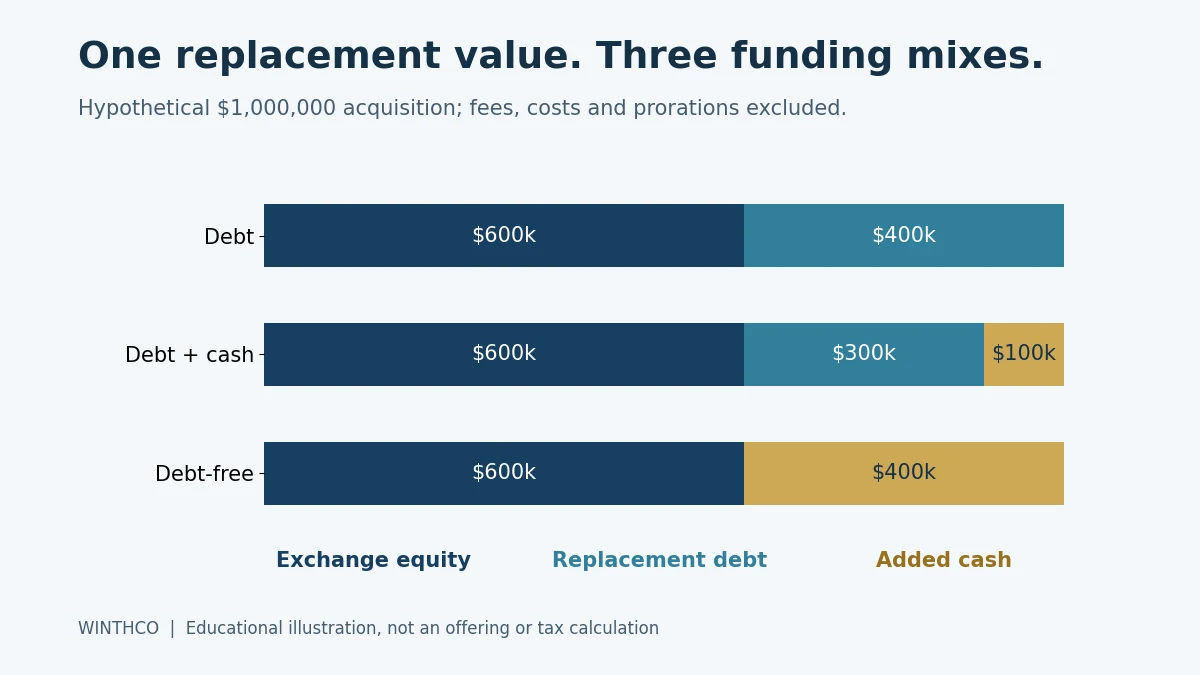
Assume an investment property sells for $1,000,000, its mortgage payoff is $400,000 and $600,000 of equity is available for the exchange. This hypothetical excludes selling costs, prorations, fees, tax basis issues and other property. It illustrates funding choices only. It is not an actual offering, client result or complete Form 8824 computation.
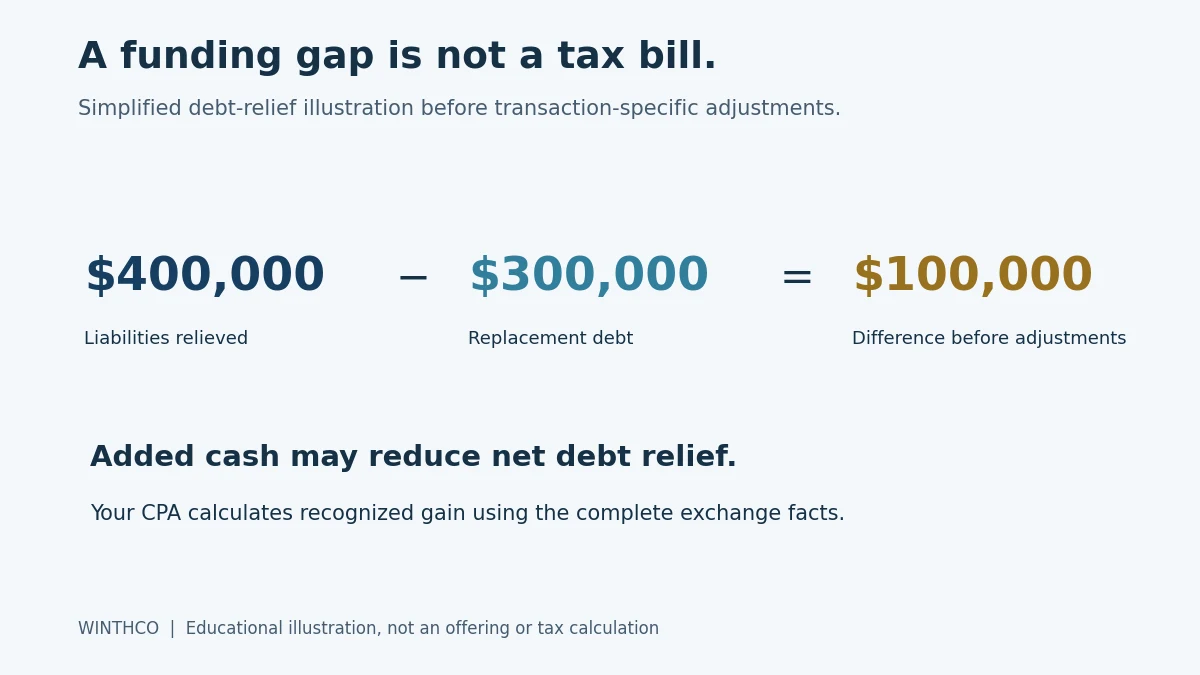
One replacement uses the $600,000 exchange equity plus $400,000 of properly attributable debt to acquire $1,000,000 of qualifying property. Another uses that equity, $300,000 of debt and $100,000 of additional cash for the same replacement value. The second approach changes the funding mix without leaving the simplified $100,000 debt gap uncovered. A debt-free acquisition would require $400,000 of added cash under these assumptions.
If the investor instead acquires only $900,000 of replacement property with $600,000 of exchange equity and $300,000 of debt, there is a $100,000 reduction before adjustments. The amount of recognized gain is generally limited by the realized gain and applicable boot calculation; the $100,000 is not automatically a tax bill. Have the CPA model the actual numbers and any recapture rules.
Discuss your DST questions with Winthco →
For a DST interest that receives the relevant tax treatment, the investor’s economic interest can include a proportionate share of underlying real estate and debt. Revenue Ruling 2004-86 describes a specific qualifying trust structure with nonrecourse financing. It does not approve every trust carrying the DST label. Review the trust agreement, tax analysis, loan documents and acquisition statement for the interest being considered.
Winthco’s explanation of a leveraged Delaware statutory trust provides background for this discussion. Request written figures showing your equity contribution, total replacement value, debt allocation and how fees are treated. A headline loan-to-value percentage alone is insufficient. Verify its denominator and do not assume multiplying an equity check by the stated percentage produces the debt amount.
For illustration, $600,000 of equity in a simplified 40% loan-to-value structure corresponds to $1,000,000 of total value and $400,000 of debt, because equity represents the other 60%. Actual offering calculations can differ once reserves, acquisition costs and other components enter the picture. Reconcile the offering’s figures to the CPA’s exchange schedule rather than substituting this illustration.
Also ask when the debt figure becomes final, whether amortization changes it before your acquisition and which document records your allocated amount. An initial illustration can become stale while the transaction is pending. If your plan combines several replacement interests, reconcile the total across them rather than treating each one as a separate exchange. Confirm that every acquisition fits the identification and exchange rules with your advisers.
A debt-free Delaware statutory trust can be relevant to investors who want to avoid property-level borrowing, but it does not remove the exchange consequences of a loan paid off on the relinquished property. Using only the net sale equity may leave a replacement-value shortfall. The additional cash required, if any, depends on the full transaction and tax calculation.
Decide whether contributing that cash would leave enough accessible money outside the investment. A choice that reduces borrowing can still increase household liquidity risk if it consumes emergency reserves. Compare the capital commitment, investment restrictions and any taxable alternative with your advisers. Do not select an investment solely because a simplified worksheet produces a zero in one column.
WATCH & LEARN
David Moore of Equity Advantage explains debt relief in a 1031 exchange. This third-party clip appears in the creator’s March 21, 2023 resource. Its market commentary is historical, not a description of 2026 conditions. No Winthco affiliation or endorsement is implied. Original resource · Watch on YouTube ↗
Educational context only. The discussion does not establish the suitability, returns or tax treatment of an investment.
Treasury Regulation 1.1031(k)-1 generally requires identification within 45 days of transferring the relinquished property and completion by the earlier of 180 days or the applicable federal return due date, including extensions. Your qualified intermediary should confirm compliant identification and delivery. Identify the actual replacement interest with the required specificity; an informal discussion about a sponsor or property category is insufficient.
Arrange the exchange before receiving or controlling sale proceeds, and confirm how additional cash will reach closing. Keep the signed identification, proof of delivery, final allocations and closing records together. Ask the CPA about the applicable return date and reporting. Deadline pressure is a reason to prepare earlier, not a reason to skip the investment review or assume an interest remains available.
Debt can increase losses and create exposure to interest costs, covenants, maturity and an unfavorable sale. Review the actual loan terms and any structural limitations on refinancing or changes to the property. Nonrecourse borrowing does not protect the equity invested in the real estate from loss. Distributions can fall or stop, and principal can be lost.
DST investors generally have limited control and may be unable to sell when they need cash. A projected holding period is not an assured exit date. Sponsor execution, tenant performance, property condition, fees and conflicts affect outcomes. Tax rules can change, and a planned exchange treatment can fail if its requirements are not met.
The SEC’s private-placement bulletin highlights limited disclosure, illiquidity and possible total loss. FINRA explains that several holdings may still share concentration in an asset class, geography or illiquid investment category. Compare those exposures with the rest of your finances. Private DST offerings are generally intended for accredited investors and offered through a private placement memorandum; eligibility alone does not establish suitability.
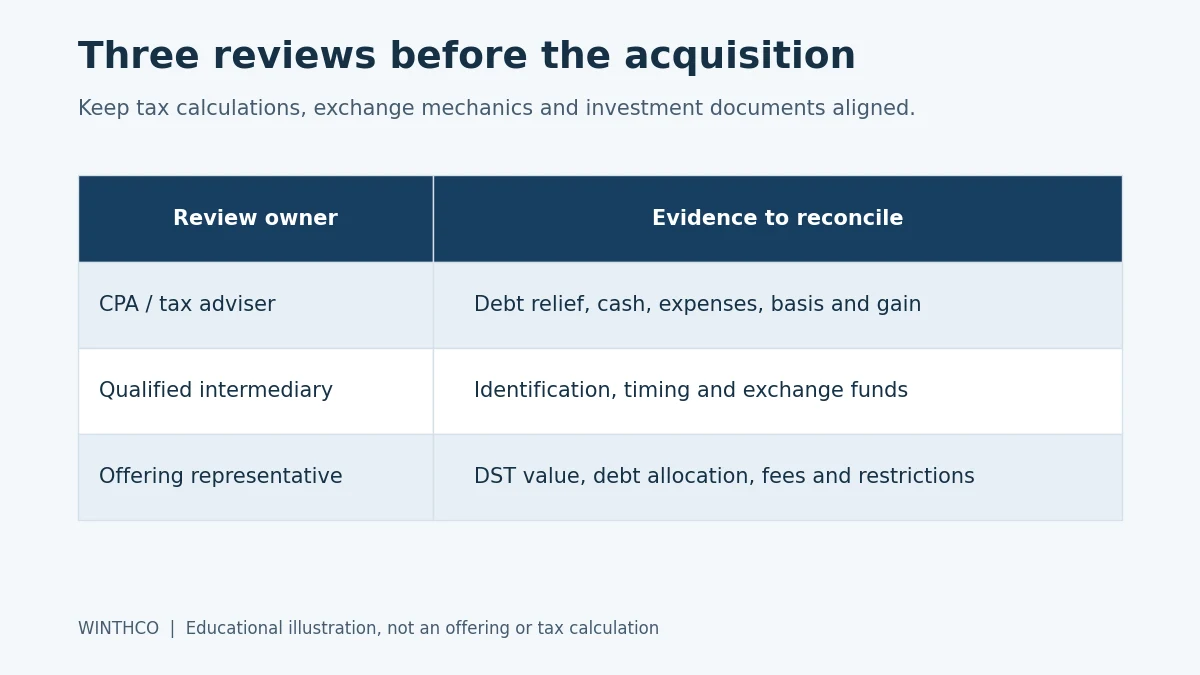
Ask the CPA for a written reconciliation of liabilities relieved, replacement debt, added cash, allowable expenses, realized gain and potential recognized gain. Ask the intermediary to confirm the exchange mechanics. Ask the offering representative to substantiate the DST allocation and restrictions. Each professional addresses a different part of the decision; no single sales illustration settles them all.
Keep unresolved assumptions visible until the supporting documents arrive. If the final acquisition figures change, rerun the calculation before closing. To prepare for an introductory conversation, use the prospect contact form on this page or the dedicated contact page. Share your transaction stage and estimated investment range, without sending account numbers or other sensitive documents.
| Decision | Evidence to request | What to avoid assuming |
|---|---|---|
| Replace with debt | $600,000 exchange equity + $400,000 debt = $1,000,000 value | No added cash in this simplified example; verify debt allocation |
| Use less debt and add cash | $600,000 equity + $300,000 debt + $100,000 cash = $1,000,000 | Added cash may offset the debt reduction; obtain CPA review |
| Acquire debt-free | $600,000 equity + $400,000 added cash = $1,000,000 | Consider liquidity outside the DST |
| Leave a funding gap | $600,000 equity + $300,000 debt = $900,000 | Potential $100,000 boot before adjustments, not a calculated tax bill |
Additional cash paid can reduce the net liability amount treated as money received under the IRS rules. Your CPA must apply those rules to the actual transaction, including cash received and exchange expenses.
No. The result depends on the relinquished property’s liabilities, the replacement acquisition and other transaction details. Additional cash may be relevant when the sold property had a mortgage.
Do not assume that. The IRS ruling describes nonrecourse financing, but the actual loan and offering documents govern the proposed interest. Nonrecourse terms do not eliminate investment losses.
No. Boot is part of the gain-recognition calculation, not a tax rate or final tax amount. Realized gain, basis, recapture and applicable federal and state rules affect the result.
No. Cash received and net debt relief require separate review under the exchange rules. Ask the CPA to complete the calculation rather than netting all cash and borrowing informally.
No. It requests a conversation with Winthco and creates no investment commitment. Any potential investment requires separate documentation and review.
Sources checked October 2, 2026. This article explains general concepts; your facts and the applicable documents control.
Winthco DST services · Winthco evaluation overview · Editorial standards
DST fundamentals
Understand DST ownership, potential 1031 exchange eligibility and the practical trade-offs of passive real estate investing.
Read guide →1031 exchange planning
Plan the identification and completion periods for a deferred 1031 exchange, including the earlier tax-return deadline.
Read guide →Risks and due diligence
Review DST liquidity, leverage, sponsor conflicts, fees and distribution assumptions before making an investment decision.
Read guide →Explore Winthco’s main DST article collection
Share your timeline and investment range. A Winthco team member will follow up with you.