DST fundamentals
What is a Delaware statutory trust?
Understand DST ownership, potential 1031 exchange eligibility and the practical trade-offs of passive real estate investing.
Read guide →
Home / Learning center / Investor decision-making
Investor decision-making
Winthco Wealth Management · Updated October 2, 2026
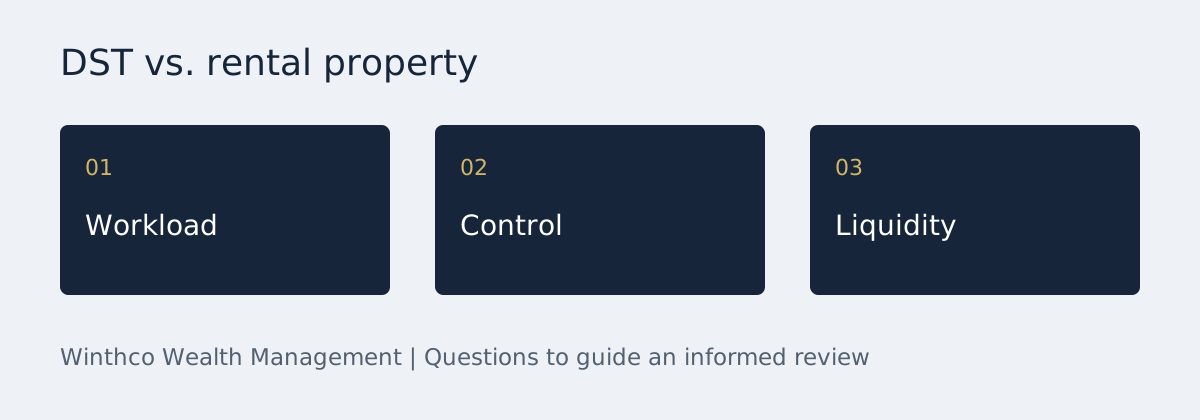
A DST can reduce an investor's direct landlord responsibilities, while a directly owned rental property generally offers more control over management and major decisions. Neither choice removes real estate risk. Compare workload, liquidity, fees, leverage, concentration and tax treatment using your circumstances and the actual ownership and offering documents.

Direct rental ownership can involve choosing tenants, supervising repairs, reviewing insurance, negotiating leases and arranging financing. Even with a property manager, the owner often retains responsibility for selecting and overseeing that manager. A DST investor generally relies on the parties named in the offering and governing documents for property operations and investment decisions.
That reduction in hands-on involvement can be meaningful for an owner who wants fewer daily responsibilities. It is a change in the nature of the work, not an absence of work or risk. The investor should still read reports, monitor changes and understand tax information. Ask what reporting will be provided, how questions are handled and what information may be less accessible than it was when you directly owned the building.
Share your timeline and investment range. A Winthco team member will follow up with you.
A direct owner may have considerable discretion over property decisions, subject to lender requirements, leases, ownership agreements and law. In a DST, authority is allocated by the trust and offering documents. Investors should not assume they can demand a sale, change management, select a new loan or approve a renovation simply because they own a beneficial interest.
Review the specific limits on the trust's activities and the circumstances in which special provisions become relevant. IRS Revenue Ruling 2004-86 concerns a particular arrangement and should not be treated as a universal description of every trust. If retaining a strong voice in major decisions is important to you, make that preference explicit before reviewing potential replacement properties. A lower workload can come with a substantial reduction in personal control.

Neither form should be treated like cash. Selling a rental property can take time, involve transaction costs and depend on market demand, financing and the property's condition. A direct owner nevertheless may be able to initiate a sale process, subject to contractual limits and the interests of other owners.
A DST investor may not have the same ability to initiate an exit. There may be transfer restrictions and no active secondary market. A proposed holding period is not a guaranteed cash-return date. Compare not only how long an exit might take, but who can initiate it and what approvals are required. Money needed for near-term household expenses should not depend on the assumption that either form can be sold quickly at an attractive price.
For context on planning around an uncertain exit, explore the DST holding period and discuss how long you can commit capital.
Discuss your DST questions with Winthco →
For a rental, distinguish gross rent from cash available after operating expenses, capital needs and debt service. Account for the cost of your time and any property manager you would hire. For a DST, investigate the projected distribution's assumptions, the source of payments and the fees and reserves described in the offering materials.
Do not compare a rental's gross income with a DST's projected cash distribution or compare different time periods. Neither a projection nor a recent payment guarantees future results. A full evaluation considers initial costs, ongoing cash flow, potential additional costs, debt, timing and eventual net proceeds. Tax reporting can differ from the cash received, so ask your CPA to explain the distinction rather than treating cash flow as a complete measure of investment return.

No. A DST may hold one property or a portfolio, and your interest may be concentrated in a particular sponsor, region, property type or tenant. Owning several interests can still leave common exposures if their underlying assumptions and financing are closely related. Direct ownership of several rentals can also contain meaningful concentration.
Map the exposures you actually have. List geography, major tenants, lease expirations, property use, financing and sponsor relationships. Then compare the proposed investment with the rest of your assets. Diversification may reduce some concentration risks but cannot assure a profit or prevent loss. A larger-looking property portfolio does not by itself establish that your household's overall risks are better balanced.
WATCH & LEARN
“1031 DST Welcome Video From Winthco Wealth Management” by Winthco Wealth Management. A 42-second introduction to the team’s DST resources. Original resource · Watch on YouTube ↗
Educational context only. The discussion does not establish the suitability, returns or tax treatment of an investment.
Certain properly structured DST interests can qualify as replacement real property under the applicable rules. That possibility is not blanket approval of every DST or every sale. The nature and use of the relinquished and replacement properties, the transaction structure and the timing all matter. Your tax adviser and qualified intermediary should confirm how those requirements apply.
A direct replacement rental may also be part of a qualifying exchange if the facts satisfy the rules. Compare the actual alternatives before the sale closes, rather than treating the DST structure as an automatic solution to a looming deadline. Tax deferral does not eliminate investment risk or necessarily eliminate future tax. Review debt, cash needs and potential taxable amounts with your CPA before deciding how to allocate proceeds.
Consider a hypothetical owner who wants less involvement but expects a significant family expense in the next several years. The owner should first determine how much accessible cash is needed, then examine the portion of the portfolio that could tolerate a longer and uncertain holding period. Starting with a specific product before answering that question reverses the useful order of decisions.
Another owner may value control enough to retain direct ownership while improving management arrangements. A third may decide that a passive structure deserves review. These examples illustrate questions, not recommendations or actual client outcomes. Document the workload you want to reduce, the control you want to keep and the risks you can accept. Discuss that summary with your advisers before choosing a structure.
For your existing rental, gather operating statements, lease summaries, loan terms, expected selling costs and information about planned repairs. For a proposed DST, obtain the offering memorandum, supplements, trust information and the financial assumptions available to prospective investors. Compare current facts separately from future projections.
Use the Winthco contact form to introduce your timeline and priorities. An initial conversation can help identify missing information and the roles of your adviser, CPA and qualified intermediary. Do not enter Social Security numbers or banking credentials in the public form. Call Kelly Clark for the appropriate process for sensitive information. No contact request commits you to an investment or completes an exchange. Keep that written summary with the documents used in your comparison.
Winthco’s explanation of how to evaluate a DST can help organize the offering documents for that comparison.
| Decision | Evidence to request | What to avoid assuming |
|---|---|---|
| Direct rental | Owner generally directs decisions within contractual limits | Hiring a manager transfers all responsibility |
| DST interest | Sponsor and governing documents define decision authority | Beneficial ownership gives direct operational control |
| Both structures | Property and financing details determine risks | Real estate always provides stable cash flow |
That may be an alternative to discuss. A manager can reduce operational work while the owner retains responsibilities and risks.
No. The property, financing, sponsor and market can still produce losses.
Authority depends on the governing documents. Do not assume an individual investor can require a sale.
No. The trust structure and the transaction must satisfy applicable requirements.
There is no universal answer. Liquidity, control, workload, concentration and financial circumstances all matter.
Sources checked October 2, 2026. This article explains general concepts; your facts and the applicable documents control.
Winthco DST services · Winthco evaluation overview · Editorial standards
DST fundamentals
Understand DST ownership, potential 1031 exchange eligibility and the practical trade-offs of passive real estate investing.
Read guide →1031 exchange planning
Plan the identification and completion periods for a deferred 1031 exchange, including the earlier tax-return deadline.
Read guide →Risks and due diligence
Review DST liquidity, leverage, sponsor conflicts, fees and distribution assumptions before making an investment decision.
Read guide →Share your timeline and investment range. A Winthco team member will follow up with you.