DST fundamentals
What is a Delaware statutory trust?
Understand DST ownership, potential 1031 exchange eligibility and the practical trade-offs of passive real estate investing.
Read guide →
Home / Learning center / Investor decision-making
Investor decision-making
Winthco Wealth Management · Updated October 2, 2026
Choose a DST advisor by examining the professional's registration, role, compensation, due-diligence process and ability to coordinate with your tax adviser and qualified intermediary. Ask how alternatives, liquidity needs and risks are evaluated. A title, accreditation claim or projected distribution alone does not establish that the professional or investment fits your circumstances.
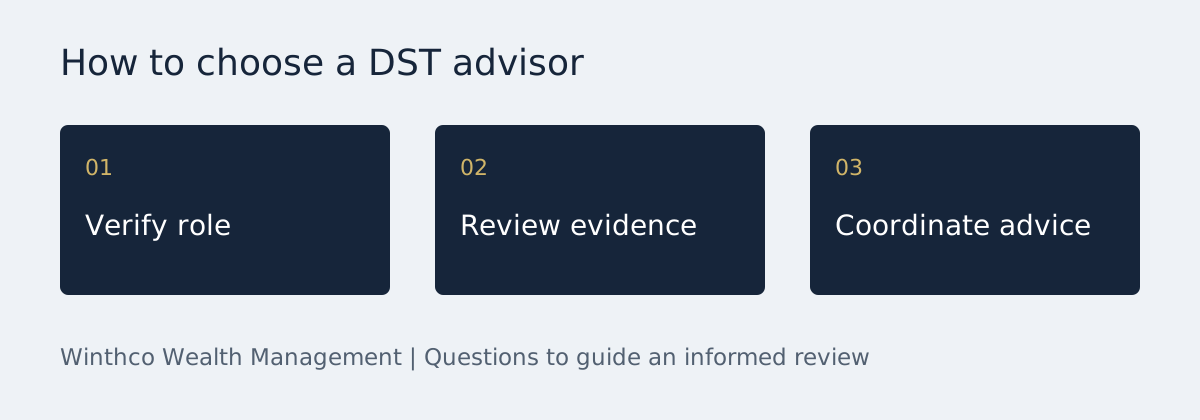

Begin with the professional's exact legal name, firm affiliation and the capacity in which they would work with you. A person may act through different firms or under different arrangements for different services. Ask which entity is responsible for the proposed relationship and which documents explain its scope. Registration is a starting point for verification, not proof that any particular investment is appropriate.
Check the relevant public registration resources, including FINRA BrokerCheck and the SEC's Investment Adviser Public Disclosure system where applicable. Read the information rather than relying on a logo or a claim on a marketing page. If a disclosure or employment history raises questions, ask for an explanation and consider the information in context. Do not interpret a database listing as a regulator's endorsement of performance or suitability.
Share your timeline and investment range. A Winthco team member will follow up with you.
Winthco’s overview of the Delaware statutory trust advisor role is a useful starting point for questions about the relationship.
Question 1: In what capacity would you be working with me for this transaction? Question 2: Which firm supervises that work and what disclosures describe the relationship? Question 3: How are you and your firm paid, and does compensation differ among the alternatives under consideration? These questions help separate an educational conversation from the actual terms of a professional relationship.
Question 4: Which costs belong to your services and which belong to the offering or property? Ask for written references in the relevant documents. A single quoted percentage may not capture ongoing property costs, sponsor compensation or exit-related charges. If a fee reduction is discussed, ask how it would be approved and documented. Do not assume a verbal estimate is a final transaction term or that the same arrangement applies to every investor.

Question 5: What information do you review about the property, sponsor, financing and conflicts? Question 6: What could make you decide that this investment should not be recommended or pursued? A useful explanation describes specific evidence and limitations, rather than relying solely on a sponsor's reputation or a projected distribution.
Question 7: How would you compare this investment with alternatives? Ask whether the comparison addresses liquidity, costs, concentration, investment horizon and your ability to tolerate loss. The number of available offerings is not itself a measure of advice quality. Ask what information is unavailable and how that uncertainty affects the evaluation. A clear statement of limitations can be more useful than an unsupported assurance that an investment has been thoroughly checked.
Discuss your DST questions with Winthco →
Question 8: How do my household cash requirements affect the amount I could consider investing in an illiquid structure? Explain expected expenses and the assets you would retain outside the investment. An anticipated holding period is not a guaranteed exit date, and a projected distribution should not be treated as an assured source of money for essential obligations.
Consider a hypothetical owner facing both a property sale and an upcoming family expense. An appropriate review would need to address accessible reserves before focusing on an offering's income target. This is an illustration of the decision process, not a recommendation or a description of an actual client. Ask how the adviser would evaluate a delayed exit, reduced distributions or a loss of principal in the context of your plan.

Question 9: How will you coordinate with my qualified intermediary and CPA, and what remains each professional's responsibility? A securities professional does not automatically serve as a qualified intermediary or provide individualized tax or legal advice. Obtain clear contact details and agree who will confirm deadlines, identification requirements, funding steps and reporting information.
Question 10: What happens if the proposed replacement investment becomes unavailable? An exchange deadline can create pressure, but it does not remove the need for due diligence. Ask what alternatives might be considered and how their risks differ. Do not accept a promise that every exchange can be completed or that a particular DST will remain available. Any investment decision should account for both the transaction rules and your financial circumstances.
WATCH & LEARN
“1031 DST Welcome Video From Winthco Wealth Management” by Winthco Wealth Management. A 42-second introduction to the team’s DST resources. Original resource · Watch on YouTube ↗
Educational context only. The discussion does not establish the suitability, returns or tax treatment of an investment.
Question 11: What reports will I receive, how often, and who answers questions about changes? Ask how you will be informed about operating results, distributions, material events and tax documents. Understand which information comes from the sponsor and which communications are part of the adviser's services. A promised communication process should be clear enough that you know whom to contact.
Question 12: How will we revisit the investment's place in my broader plan? An illiquid investment may not be easy to change, but your cash needs, estate objectives and other holdings can still evolve. Clarify whether ongoing planning is included, separately contracted or outside the relationship. Keep copies of the applicable agreements and avoid assuming that an initial transaction automatically includes unlimited future services.
Ask who will coordinate DST tax reporting and how you will receive the information your tax preparer needs.
Be cautious about guaranteed-return language, urgency that discourages reading documents, vague explanations of fees, unverified credentials or suggestions that tax qualification makes an investment safe. A private placement can involve limited disclosure and significant loss risk. An assertion that an offering is registered, exempt or intended for accredited investors does not establish that regulators approved its merits.
You can slow down a discussion and ask for written explanations. Compare statements against the offering memorandum and the professional's disclosures. If answers conflict, ask the appropriate firm to resolve the issue before signing or sending money. Use independently verified contact information for important instructions, and confirm the authorized process for transmitting sensitive information. An educational website cannot verify a wire instruction or approve a transaction on your behalf.
Bring a concise summary of your property, anticipated closing date, ownership structure, estimated proceeds and current debt. List your objectives in order: for example, reducing management work, retaining accessible cash or evaluating a possible exchange. Explain uncertainties rather than guessing at numbers that could materially affect the discussion.
Winthco's public contact form helps organize those details and route them to the team. It is not an investment recommendation, account approval, subscription agreement or exchange identification notice. Kelly Clark handles the paperwork process and can explain how to provide sensitive information. Call 805-583-2720 ext. 106 for information such as Social Security numbers instead of entering it in the public contact form. The goal of preparation is a clearer, better-informed conversation.
| Decision | Evidence to request | What to avoid assuming |
|---|---|---|
| Professional role | Firm disclosures and registration records | A marketing title defines the legal relationship |
| Compensation | Written fee and conflict disclosures | One quoted fee captures every cost |
| Exchange coordination | Named responsibilities and documented deadlines | Every advisor also acts as a qualified intermediary |
No. Registration information helps verification but does not establish suitability, service quality or investment performance.
Do not assume those roles are interchangeable. Clarify the professionals involved and confirm the exchange structure with qualified advisers.
Projected distributions should not be presented as guaranteed. Review the actual offering risks and payment assumptions.
Explain the timeline immediately. Time pressure does not remove the need for appropriate advice, documentation or due diligence.
Yes. The prospect contact form requests background information. Call Kelly for the process for sensitive information.
Sources checked October 2, 2026. This article explains general concepts; your facts and the applicable documents control.
Winthco DST services · Winthco evaluation overview · Editorial standards
DST fundamentals
Understand DST ownership, potential 1031 exchange eligibility and the practical trade-offs of passive real estate investing.
Read guide →1031 exchange planning
Plan the identification and completion periods for a deferred 1031 exchange, including the earlier tax-return deadline.
Read guide →Risks and due diligence
Review DST liquidity, leverage, sponsor conflicts, fees and distribution assumptions before making an investment decision.
Read guide →Share your timeline and investment range. A Winthco team member will follow up with you.