1031 exchange planning
1031 exchange deadlines: the 45-day and 180-day rules
Plan the identification and completion periods for a deferred 1031 exchange, including the earlier tax-return deadline.
Read guide →
Home / Learning center / 1031 exchange planning
1031 exchange planning
Winthco Wealth Management · Updated October 3, 2026
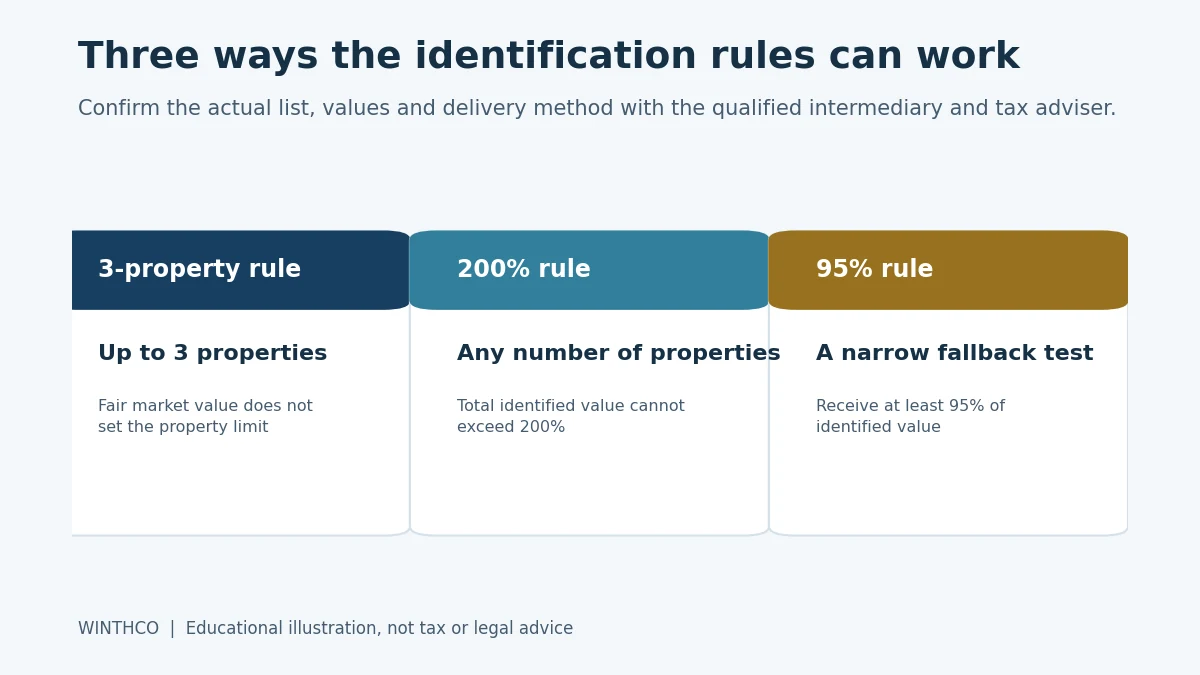
The 1031 exchange identification rules generally allow a taxpayer to name up to three replacement properties regardless of value, or any number whose combined fair market value does not exceed 200 percent of the relinquished property's value. A 95 percent receipt test can apply when those limits are exceeded, but it is demanding and should not be a planning default.
Treasury Regulation 1.1031(k)-1 requires more than choosing a property before day 45. The replacement property must be designated in a written document signed by the taxpayer and sent before the identification period ends. The recipient must be the person obligated to transfer the replacement property or another permitted participant in the exchange, such as the qualified intermediary, escrow agent or title company. A private note kept in the taxpayer's own file does not satisfy that delivery rule.
The identification must also describe real property unambiguously. The regulation says a legal description, street address or distinguishable name will generally work. A DST investor should request the exact legal wording for the interest being considered and ask the qualified intermediary how it should appear on the identification form. Do not shorten the sponsor's description or substitute a marketing nickname without written confirmation that the property remains clearly identified.
Share your timeline and investment range. A Winthco team member will follow up with you.
Winthco's overview of the 1031 exchange rules can help organize the broader process, but the qualified intermediary and tax adviser should review the actual identification before it is delivered. Keep the signed document, delivery confirmation, valuation support and any timely written revocation in the exchange file. These records matter because a correct idea that was described vaguely or delivered late may not count as a valid identification.
The three-property rule permits identification of three replacement properties without regard to their fair market values. It does not mean that the taxpayer must buy all three. The exchange still must close on qualifying identified property within the exchange period, and the property received must be substantially the same as the property identified. The rule provides room for alternatives, not permission to replace a failed choice after day 45.
Counting can become more complicated when a candidate involves multiple legal parcels, a portfolio or fractional interests. The regulation has no general rule saying that every item sold under one label automatically counts as one property. For a DST that owns more than one real estate asset, obtain the exact identification package and ask the qualified intermediary and tax counsel how the interest and underlying real estate should be described and counted. Avoid assuming that one offering booklet always uses only one slot.
The three-property rule can be practical when each candidate is already well understood and the taxpayer wants a short backup list. It can be restrictive when the plan combines direct property with several DST interests or a DST holding multiple assets. The decision should be made from a written inventory before the deadline, not from a late verbal estimate of how many properties may be involved.
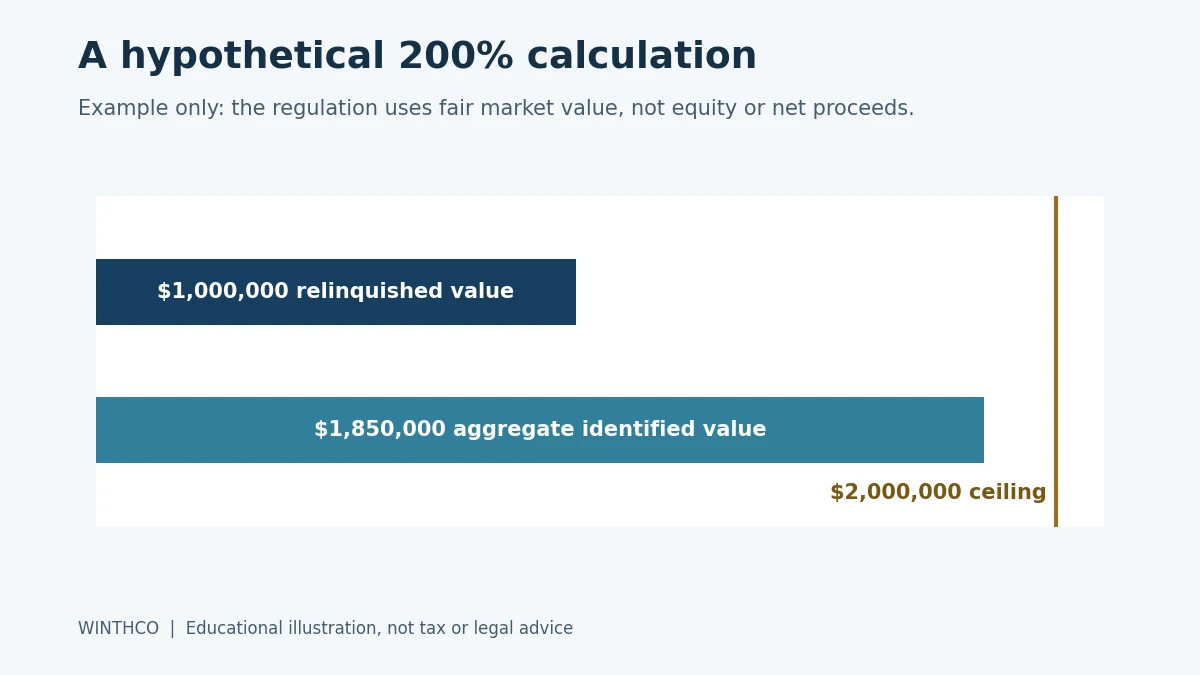
The 200 percent rule permits identification of any number of replacement properties if their aggregate fair market value at the end of the identification period does not exceed 200 percent of the aggregate fair market value of all relinquished properties when transferred. The test uses property value. It is not based only on net sale proceeds, the taxpayer's equity, the cash subscription amount or the mortgage payoff.
Consider a simplified example. If the aggregate fair market value of relinquished property is $1,000,000, the 200 percent ceiling is $2,000,000. A list containing identified replacement properties valued at $1,850,000 is below that ceiling. A list totaling $2,050,000 exceeds it. Real transactions require supportable fair market values and may involve multiple relinquished properties, fractional interests or changes before day 45, so the qualified intermediary and tax adviser should check the calculation.
The rule can provide more flexibility when evaluating several interests, but a longer list is not automatically a better plan. Each named property should still receive investment review. Read the private placement memorandum, evaluate liquidity, leverage, fees and sponsor conflicts, and confirm how much cash remains available outside the investment. Winthco's discussion of Delaware statutory trust requirements provides additional context for issues that must be coordinated separately from the identification count.
Discuss your DST questions with Winthco →
If the taxpayer identifies more properties than allowed under both the three-property and 200 percent rules, the regulation generally treats the taxpayer as if no replacement property was identified. A limited exception can apply to property received before day 45 and to identified property received by the end of the exchange period when the value received is at least 95 percent of the aggregate fair market value of all identified properties.
That threshold makes the 95 percent rule a difficult fallback. If a taxpayer identifies $2,000,000 of property under this exception, receiving property worth only $1,800,000 would equal 90 percent, not 95 percent. A failed acquisition, changed allocation or unavailable DST interest could prevent the threshold from being met. The exchange team should not treat this rule as casual permission to identify an unlimited list.
The regulation also specifies when fair market value is measured for this purpose. Because values, closings and allocations can change, the taxpayer should obtain transaction-specific advice before relying on the exception. A plan built around the three-property or 200 percent rule is generally easier to document, but even those tests require precise descriptions, timely delivery and eligible property.
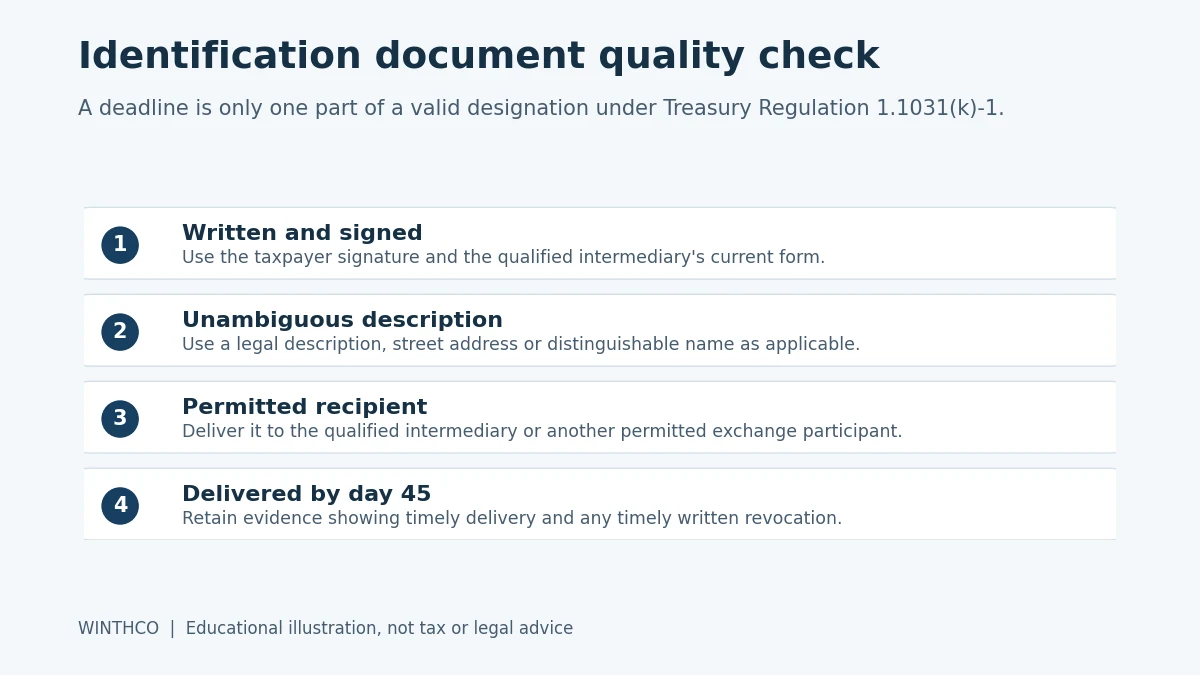
An identification may be revoked before the end of the identification period, but the revocation must be written, signed by the taxpayer and sent before the deadline to the person who received the original identification. An oral instruction is not enough. If the identification appeared in an exchange agreement signed by all parties, the regulation has additional written revocation requirements.
When replacing one candidate with another, state clearly whether the new document revokes and replaces the prior list. Otherwise, both versions could create uncertainty about which properties remain identified, and all nonrevoked identifications are counted when applying the three-property, 200 percent and 95 percent rules. Ask the qualified intermediary to acknowledge the final list and retain evidence of delivery.
After the 45-day identification period ends, a preferred new candidate ordinarily cannot simply be substituted for a failed property. That is why due diligence should begin before the relinquished-property closing whenever possible. Confirm the offering is open, documents are available for review and the proposed interest can be acquired on the expected timeline, while remembering that availability and closing are never guaranteed.
WATCH & LEARN
Jeff Peterson of CPEC1031 explains DSTs and replacement-property identification in an April 24, 2025 third-party video. No Winthco affiliation or endorsement is implied. Original resource · Watch on YouTube ↗
Educational context only. The discussion does not establish the suitability, returns or tax treatment of an investment.
A valid identification does not make a DST suitable, liquid or profitable. A DST interest offered through a private placement may have transfer restrictions and no active resale market. The SEC warns that exempt offerings can provide fewer prescribed disclosures than registered offerings and may involve the loss of the entire investment. Accreditation establishes eligibility for certain offerings, not government approval or suitability.
Review tenant concentration, lease terms, financing, reserves, conflicts, fees and the sponsor's authority under the trust documents. Consider the planned hold, possible early sale, refinance limitations and circumstances in which distributions could be reduced or suspended. Concentrating exchange proceeds in one property type, market, tenant or sponsor may increase portfolio risk even when the identification list contains several line items.
Keep tax mechanics and investment analysis as separate workstreams. The qualified intermediary administers exchange steps but does not replace tax, legal or securities advice. The CPA or tax attorney analyzes the taxpayer's consequences. The investment professional explains the DST documents and suitability review. Winthco's DST investment opportunities overview can be used as general background, but only the current offering memorandum describes a specific security.
| Decision | Evidence to request | What to avoid assuming |
|---|---|---|
| Three-property rule | Final list showing no more than three replacement properties | One DST label always counts as one property |
| 200 percent rule | Fair market value support for every identified property and all relinquished property | The ceiling is based on equity or net proceeds |
| 95 percent rule | Closing evidence showing receipt of at least 95 percent of identified value | It safely permits an unlimited backup list |
| DST investment review | Offering memorandum, risks, fees, liquidity and portfolio analysis | Valid identification means the investment is suitable |
Yes, if the aggregate fair market value of all identified properties does not exceed 200 percent of the aggregate fair market value of the relinquished property or properties. A narrow 95 percent receipt test can apply when both limits are exceeded.
No. Treasury Regulation 1.1031(k)-1 bases the test on aggregate fair market value. Equity, proceeds and debt are different figures.
Do not assume that. A DST can hold one or multiple real estate assets, and the identification should follow the actual legal structure and advice from the qualified intermediary and tax counsel.
A timely written, signed revocation and replacement may be possible before the end of day 45. Follow the regulation and the qualified intermediary's documented procedure, and retain delivery evidence.
Ordinarily, no. Property generally must be properly identified by the end of the identification period, subject to specific relief that may apply in limited circumstances.
No. Identification does not reserve an offering, confirm availability, complete a purchase or establish suitability.
No. Identification is only one requirement. The transaction, taxpayer, property, timing, receipt and reporting must satisfy the applicable rules.
Sources checked October 3, 2026. This article explains general concepts; your facts and the applicable documents control.
Winthco DST services · Winthco evaluation overview · Editorial standards
1031 exchange planning
Plan the identification and completion periods for a deferred 1031 exchange, including the earlier tax-return deadline.
Read guide →Risks and due diligence
Review DST liquidity, leverage, sponsor conflicts, fees and distribution assumptions before making an investment decision.
Read guide →1031 exchange planning
Understand DST debt replacement, added cash and mortgage boot with a worked example and questions for your CPA and qualified intermediary.
Read guide →Explore Winthco’s main DST article collection
Share your timeline and investment range. A Winthco team member will follow up with you.