1031 exchange planning
1031 exchange deadlines: the 45-day and 180-day rules
Plan the identification and completion periods for a deferred 1031 exchange, including the earlier tax-return deadline.
Read guide →
Home / Learning center / California 1031 planning
California 1031 planning
Winthco Wealth Management · Updated October 7, 2026
A California investment-property owner may use a qualifying DST interest as Section 1031 replacement property when the federal exchange and trust requirements are satisfied. If California property is exchanged for out-of-state property, California may require annual Form FTB 3840 reporting, so coordinate the qualified intermediary, CPA and DST review before closing.
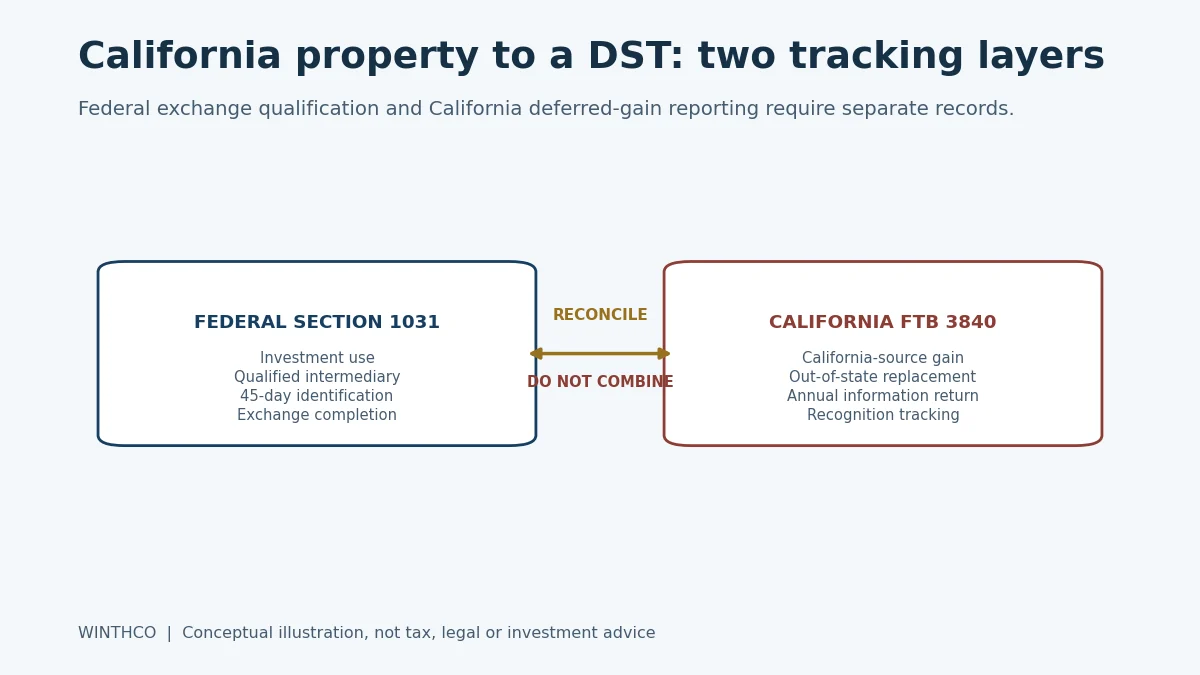
California location does not prevent a federal Section 1031 exchange. The relinquished real estate and replacement real estate must be held for productive use in a trade or business or for investment, and the transaction must satisfy the federal exchange rules. IRS Revenue Ruling 2004-86 concludes that beneficial interests in the specifically described, restricted Delaware statutory trust are treated as direct interests in real property for Section 1031 purposes. It does not approve every trust or every transaction. Winthco's California DST planning overview introduces the structure for California property owners.
The taxpayer must review the actual DST documents, not rely on the label. The trust agreement, master lease, financing and sponsor powers must be consistent with the tax analysis. A DST interest commonly is also a private-placement security, so tax eligibility and investment suitability are separate questions. Accreditation, offering availability and a timely identification do not establish that the property, debt, fees or holding period fit the investor.
Share your timeline and investment range. A Winthco team member will follow up with you.
California owners should begin with the existing property and ownership record. Confirm that the property is held for business or investment, identify the tax owner, calculate federal and California basis, document liabilities and estimate sale proceeds. Personal use, a dealer or development purpose, co-owner changes, entity distributions and a sale contract already near closing can change the analysis. A California CPA and tax attorney should review state and federal consequences before the owner commits to a replacement strategy.
The California Franchise Tax Board states that Form FTB 3840 applies when one or more California properties are exchanged for one or more properties outside California and some California-source realized gain or loss remains unrecognized. The 2025 instructions require the form for the exchange year and generally each later taxable year until the California-source deferred gain or loss is recognized. This reporting follows the deferred California source amount rather than treating a move or out-of-state replacement as an automatic end to California's claim.
The filing obligation can continue even when an out-of-state replacement is later exchanged again. The FTB's page updated January 28, 2026 says the taxpayer should remove an exchanged property from the earlier form, file a new FTB 3840 for the later exchange and carry the applicable California-source deferred gain forward. A taxable sale can require recognition and a final form. The CPA should maintain a schedule connecting the original California property, every later replacement and each allocation of deferred gain.
DST reporting needs careful document work. The 2025 FTB 3840 instructions specifically tell a filer to enter the DST name when a property given up or received is a Delaware statutory trust. A DST can hold one property or multiple properties in different states, and the offering structure controls what the investor acquires. Ask the CPA how to complete the location, allocation and annual reporting for the actual trust. Do not infer the filing answer from the sponsor's mailing address or the word Delaware.
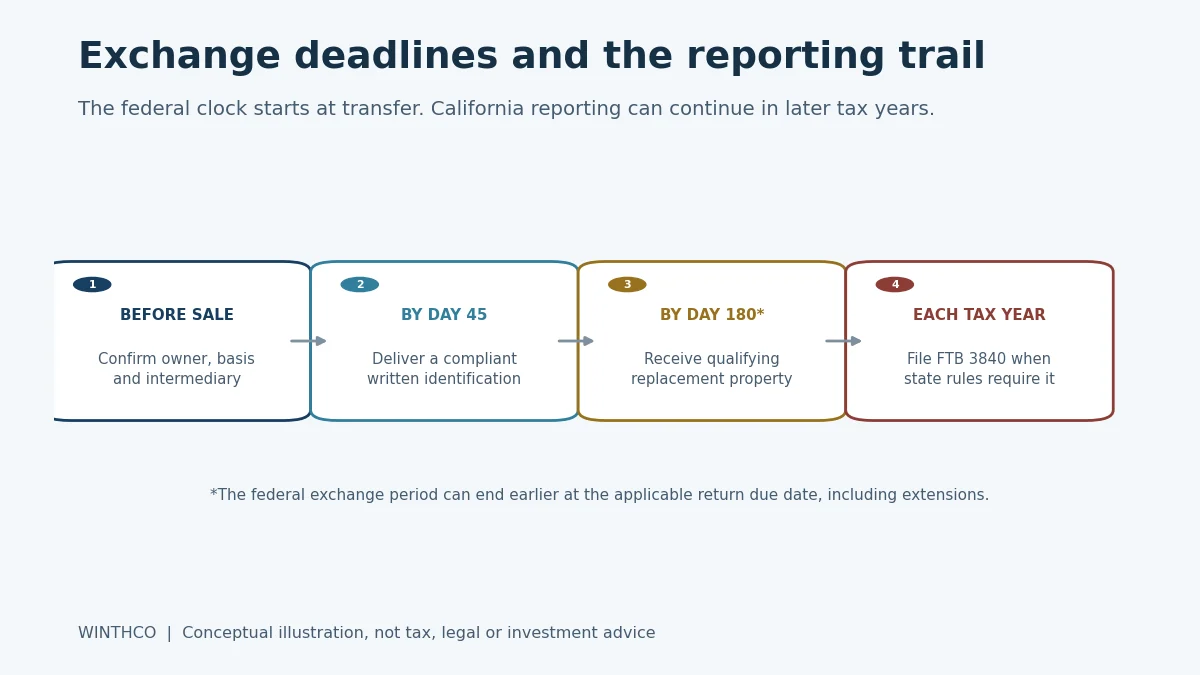
A deferred exchange must be organized before the seller receives or controls the proceeds. The qualified intermediary normally enters into a written exchange agreement and holds the funds subject to the required restrictions. The sale contract, vesting, intermediary documents and replacement subscription must use the correct taxpayer. Engage the intermediary and advisers before transfer of the California property. Winthco's 1031 exchange rules and deadlines page offers procedural background, but the transaction documents determine the result.
The identification period generally ends 45 days after the relinquished property transfers. The exchange period generally ends on the earlier of 180 days after that transfer or the due date, including extensions, for the applicable federal return. Identification must be written, signed and delivered to a permitted party under the Treasury regulations. Weekends and holidays do not ordinarily extend the federal periods. Confirm the dates in writing and do not wait until day 45 to begin reviewing an offering.
Have the CPA model adjusted basis, sale value, cash, debt, exchange expenses and every replacement property. Receiving cash or other non-like-kind property can cause recognized gain, and a lower replacement value or liability change can affect the result. California basis can differ from federal basis because of state adjustments. Federal Form 8824 and California Form FTB 3840 serve different reporting functions, so both sets of records should reconcile to the closing statements.
Discuss your DST questions with Winthco →
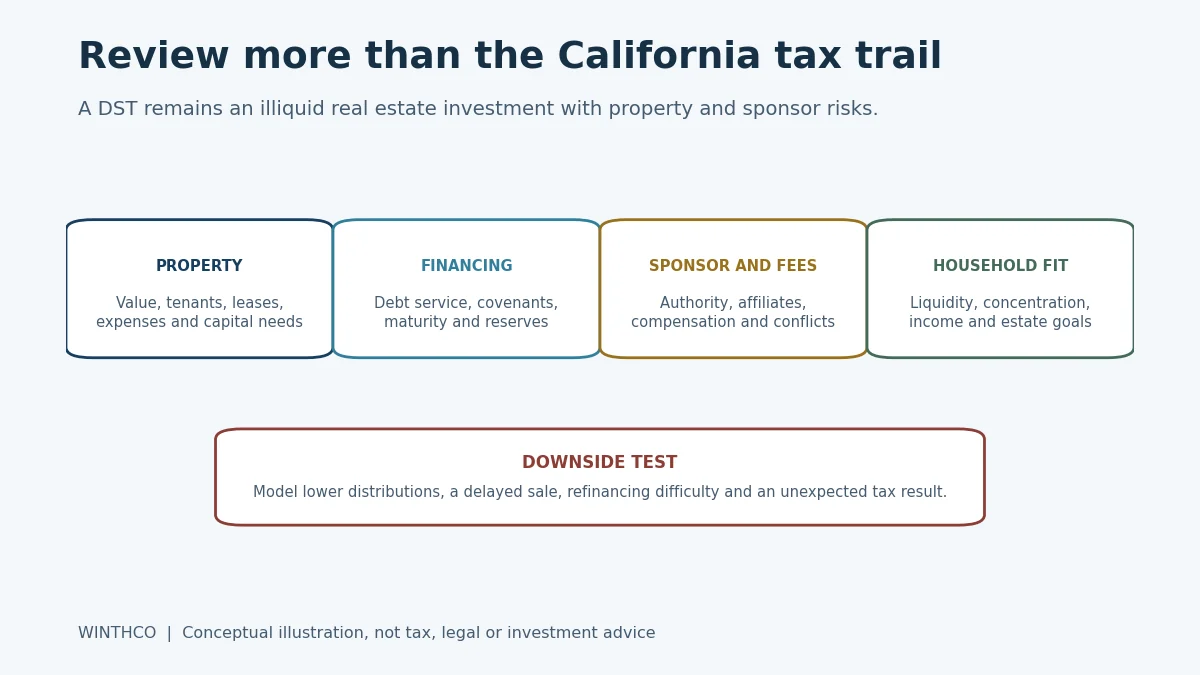
Start with the real estate. Review purchase price, independent market evidence, leases, tenant credit, occupancy, local supply, operating costs, insurance, taxes, capital needs and reserves. A California seller may be tempted to focus on geographic diversification or a projected distribution after years of owning one local rental. Neither geography nor projected income substitutes for property underwriting. Distributions can decline or stop.
Next review financing and ownership limits. Record the loan balance, rate, amortization, maturity, extensions, covenants and lender remedies. Compare allocated DST debt with the relinquished-property liabilities as part of the complete tax model, not as a stand-alone matching rule. Understand that beneficial owners generally cannot direct leasing, refinancing, property improvements or sale timing. Reduced landlord duties come with reduced control.
Then map state filing exposure. A multi-state or multi-property DST may create income-tax returns or information filings in more than one jurisdiction, depending on the structure and the investor's facts. Ask the CPA to estimate compliance work and after-tax cash flow before identification. Winthco's 1031 exchange investment options page can help organize the alternatives, but only the current private placement memorandum and tax documents describe the actual investment.
Most DST interests used in exchanges are private placements. The SEC warns that private placements can be highly illiquid, may provide less information than registered offerings and can expose an investor to total loss. Transfers may be restricted, and there may be no dependable public market. A California owner should be prepared to hold until the sponsor arranges a property sale, with no assurance about timing or price.
Fees and conflicts affect both cash flow and exit value. Trace acquisition, selling, financing, organization, asset-management, property-management, servicing and disposition compensation. Identify affiliates and any sponsor markup. Rebuild the projected cash flow after realistic vacancy, expense growth, capital work, reserves and debt service. A projected distribution rate is not a guaranteed payment and is not the same as total return.
Concentration should be measured across the household. Several DST interests may still share a sponsor, tenant, property type, lender, geography or economic driver. FINRA cautions that correlated and illiquid holdings can make cash difficult to access. Keep adequate liquid assets outside the DST and stress-test lower distributions, a delayed sale, refinancing difficulty, property loss and an unexpected tax bill.
WATCH & LEARN
The Keith Walker Team discusses California 1031 exchange rules and state tax considerations. This third-party video is educational background, not a Winthco endorsement; current FTB instructions and the investor's advisers control. Original resource · Watch on YouTube ↗
Educational context only. The discussion does not establish the suitability, returns or tax treatment of an investment.
Use one worksheet for a DST, another directly owned property, professional management, a net-lease property, a mixed replacement plan and a taxable sale. Record management duties, control, liquidity, debt, tax reporting, fees, projected cash flow, downside exposure and estate considerations. A taxable sale may create a current tax cost but more flexibility. A direct replacement may preserve control while continuing landlord work.
Coordinate decisions in the correct order. Before the sale, confirm the taxpayer, title, basis, qualified intermediary and closing path. Before identification, complete offering and property due diligence. Before funding, reconcile the subscription, debt, cash and state reporting schedule. Keep copies of the sale closing statement, exchange agreement, identification, DST documents, federal Form 8824 and every FTB 3840. Assign responsibility for each annual filing.
Finish with independent tax, legal and securities advice. Ask the California CPA to explain when Form FTB 3840 begins, how deferred gain is allocated, what happens after another exchange and what event would make a filing final. Ask securities professionals to explain property risk, sponsor authority, fees and liquidity. A DST may address management and replacement-property needs, but it cannot promise tax deferral, distributions, liquidity or return of principal.
| Decision | Evidence to request | What to avoid assuming |
|---|---|---|
| Federal exchange | Taxpayer, investment use, qualified intermediary, identification and receipt | A DST label automatically establishes Section 1031 treatment |
| California reporting | California-source deferred gain, replacement location and annual FTB 3840 | Buying outside California ends every California filing obligation |
| Property review | Value, leases, tenants, expenses, debt, reserves and market data | Geographic diversification guarantees a better result |
| Cash flow | Revenue after expenses, fees, reserves and debt service | Projected distributions are fixed retirement income |
| Exit | Sponsor authority, transfer limits, expected hold and taxable disposition | The investor can choose the sale date or access principal on demand |
Potentially. The property must be held for business or investment, the DST interest must represent qualifying replacement real property, and the taxpayer must satisfy the federal exchange rules.
It reports a qualifying exchange of California property for out-of-state replacement property and tracks the California-source deferred gain or loss. It is generally filed for the exchange year and later years until recognition.
Not by itself. The FTB states that the requirement applies regardless of residence status when California property is exchanged for out-of-state property and deferred California-source gain remains.
The FTB says the reporting obligation can continue. The taxpayer may need to update the earlier form, file a new FTB 3840 for the later exchange and carry the applicable deferred gain forward.
No. Revenue Ruling 2004-86 addresses a specific trust with restricted powers. Tax counsel should review the current trust and transaction documents.
No tax outcome is guaranteed. A qualifying exchange may defer eligible gain, while California can continue tracking California-source deferred gain until it is recognized.
Do not assume that a ready market exists. DST interests are generally illiquid private placements with transfer restrictions, so investors should be prepared for an extended hold.
Sources checked October 7, 2026. This article explains general concepts; your facts and the applicable documents control.
Winthco DST services · Winthco evaluation overview · Editorial standards
1031 exchange planning
Plan the identification and completion periods for a deferred 1031 exchange, including the earlier tax-return deadline.
Read guide →Risks and due diligence
Review DST liquidity, leverage, sponsor conflicts, fees and distribution assumptions before making an investment decision.
Read guide →1031 exchange planning
Learn when inherited investment property may enter a 1031 exchange, how basis and ownership matter, and how to evaluate a DST replacement.
Read guide →Explore Winthco’s main DST article collection
Share your timeline and investment range. A Winthco team member will follow up with you.