Risks and due diligence
DST investment risks: a practical due-diligence checklist
Review DST liquidity, leverage, sponsor conflicts, fees and distribution assumptions before making an investment decision.
Read guide →
Home / Learning center / 1031 exchange planning
1031 exchange planning
Winthco Wealth Management · Updated October 7, 2026
Inherited real estate may be exchanged into a qualifying DST when the property is held for investment or business use, the same taxpayer completes the exchange, and Section 1031 procedures are followed. First confirm inherited basis, title, ownership authority, qualified-intermediary timing and whether the DST fits the investor's risks and liquidity needs.
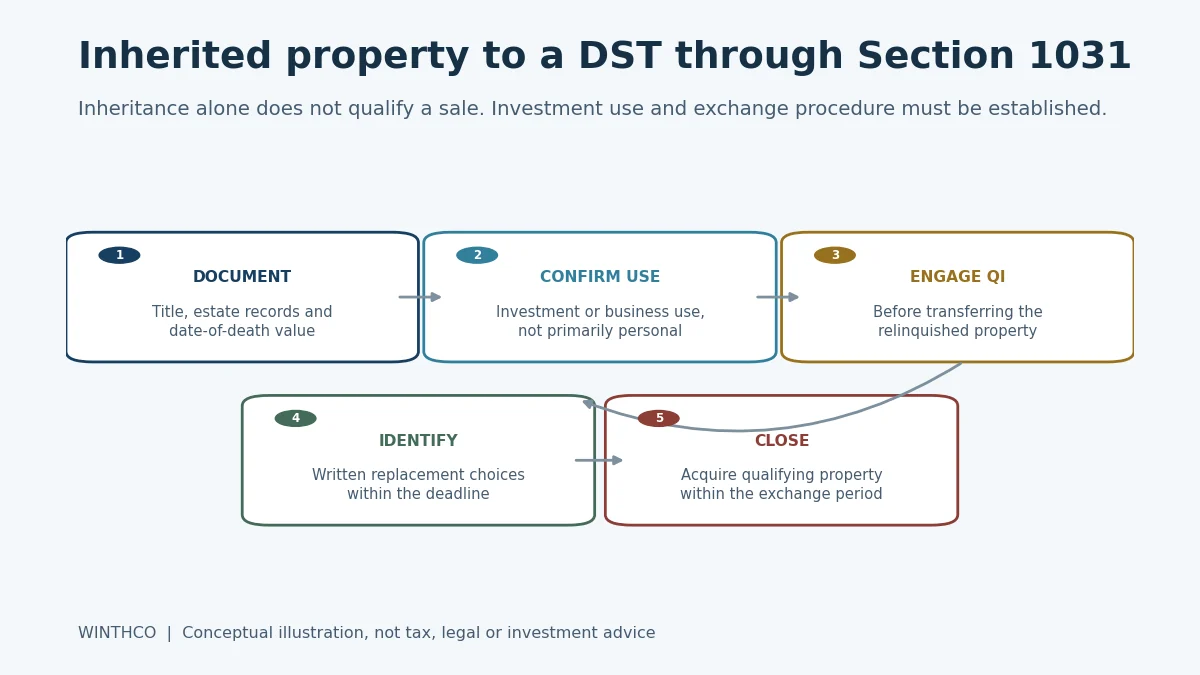
Inheritance does not prevent real estate from qualifying for Section 1031, but it does not create automatic eligibility. Treasury Regulation 1.1031(a)-1 requires both the relinquished real property and the replacement real property to be held for productive use in a trade or business or for investment. Property held primarily for sale does not qualify, and personal use can complicate the analysis. Winthco's 1031 exchange rules for investment property page provides additional procedural context.
An inherited rental, farm, commercial building or land held for appreciation may fit the investment-use requirement when the facts support that purpose. A recently inherited residence immediately listed for sale presents a different record. There is no universal holding period in the regulation that makes intent automatic. Tax counsel should examine use, leases, management, marketing, improvements, personal occupancy and the timing of the sale.
Share your timeline and investment range. A Winthco team member will follow up with you.
The replacement also requires qualifying intent. An heir cannot complete an exchange into a DST and treat it as a short-term cash substitute. The interest must represent qualifying replacement real property under the actual trust structure, and the investor should intend to hold it for investment. Document the decision, advisers, offering review and investment purpose rather than relying only on the word DST.
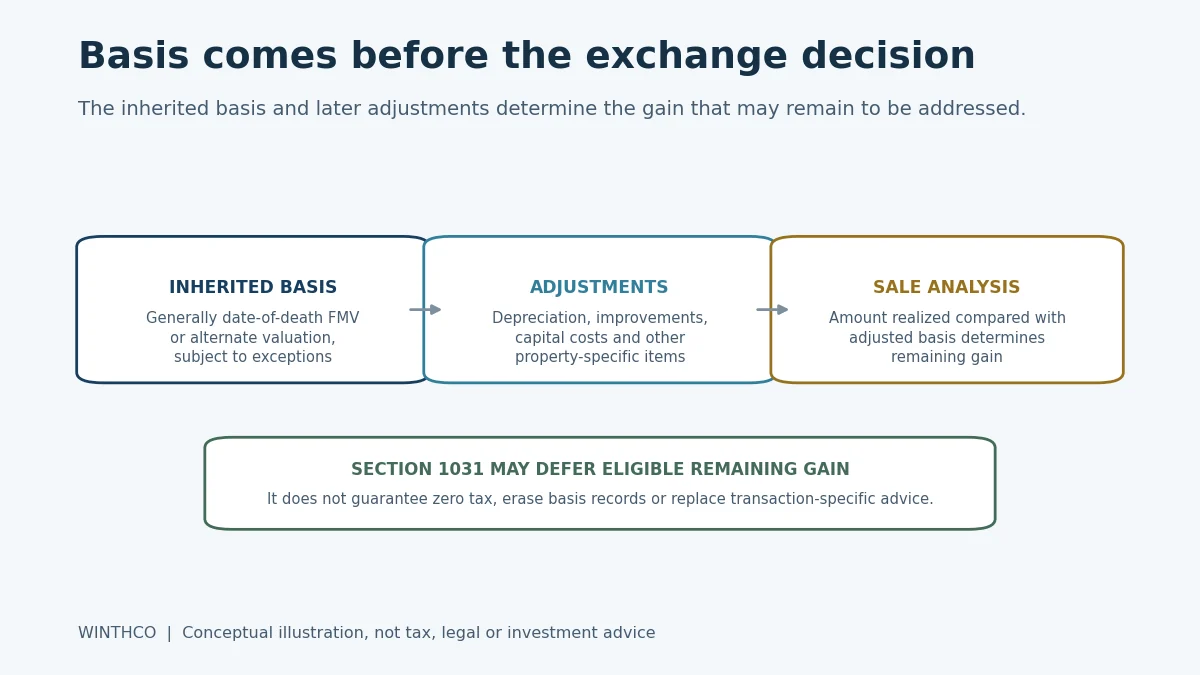
IRS Publication 551 states that inherited property basis is generally fair market value at the date of death, or fair market value on an alternate valuation date when the personal representative properly elects it. Exceptions and consistency rules can apply. The beneficiary may receive Schedule A of Form 8971 when an estate tax return is required, and records supporting the valuation should be retained.
A date-of-death value can materially change the gain compared with the decedent's former adjusted basis, but it does not guarantee that a sale is tax free. Property may appreciate after death, depreciation and other adjustments may apply, and selling costs affect the calculation. Community property, joint ownership, special-use valuation, property returned to a donor within one year and trust distributions can require different analysis.
Before opening an exchange, ask a CPA to establish the inherited basis and all later adjustments. Compare that amount with the expected amount realized and calculate depreciation recapture, federal gain, state tax and any non-like-kind consideration. A Section 1031 exchange generally carries basis into replacement property and defers eligible gain; it does not erase basis records or make an exchange necessary when little taxable gain remains.
The owner transferring the relinquished property must be coordinated with the owner receiving replacement property. Inherited real estate may still be titled to an estate or trust, may have been distributed to one beneficiary, or may be owned by several heirs. Determine who has authority to sell, who will sign the exchange agreement and which tax identification number applies before the contract and closing documents are finalized.
Co-heirs may want different outcomes. One may prefer cash, another direct real estate and another a DST. Do not assume sale proceeds can be distributed first and then placed into separate exchanges. A partition, distribution, redemption or ownership change near the sale can affect taxpayer identity and investment intent. Estate counsel, tax counsel and the qualified intermediary should design the sequence before anyone becomes entitled to cash.
Trust terms and probate orders can also limit action or require approvals. Confirm whether the fiduciary can sell, exchange, borrow, distribute property or acquire a private-placement security. Review beneficiary rights, creditor issues, state law and the estate's administration schedule. The Winthco overview of DST estate-planning considerations can help organize questions, but the governing documents and professional advice control.
Discuss your DST questions with Winthco →
IRS Revenue Ruling 2004-86 addresses a specific Delaware statutory trust whose beneficial owners were treated as owning interests in the underlying real property for federal tax purposes. The ruling depends on detailed restrictions on trustee powers and the trust's activities. It is not blanket approval of every trust or every security carrying a DST label. Tax counsel should review the current trust agreement and offering documents.
A properly structured DST may help an heir acquire professionally managed replacement property without taking sole responsibility for leasing, repairs and financing. It may also offer fractional access to a property or portfolio and accommodate a particular equity amount. Those features are not promised benefits. The investor gives up substantial control and depends on the sponsor, property manager, tenants, loan terms and exit decisions.
The exchange still follows the deferred-exchange rules. Engage a qualified intermediary before transferring the inherited property, identify replacement property in a signed writing within the applicable identification period and complete acquisition within the exchange period. A DST with multiple assets can complicate identification counting, so review its legal description with the qualified intermediary. Winthco's guide to buying a DST describes the offering-review process.
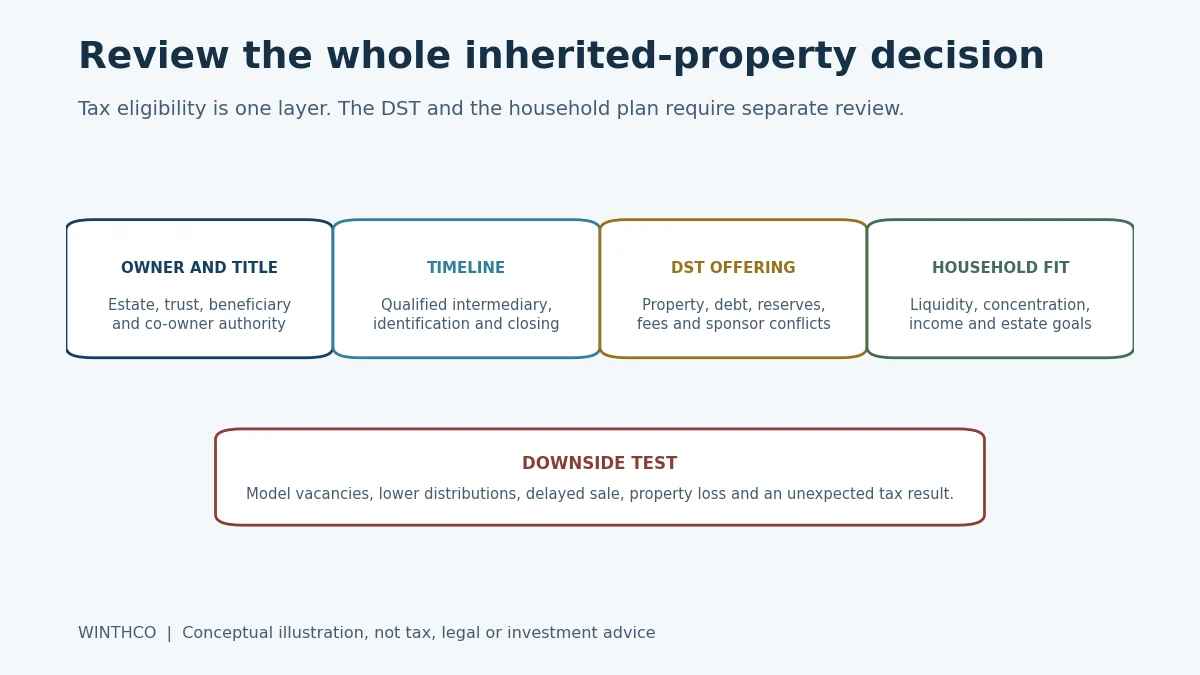
A DST interest is generally offered through a private placement memorandum and is commonly limited to accredited investors under the offering exemption. Accreditation is an access standard, not proof that the investment is appropriate. The SEC warns that private placements can be highly illiquid, provide less disclosure than registered offerings and expose investors to a total loss. Review the complete memorandum and incorporated exhibits.
Property risk remains central. Examine tenant credit, lease expirations, market supply, property condition, environmental reports, insurance, taxes, operating history and capital reserves. For a leveraged DST, review interest rate, amortization, covenants, maturity, extension rights and foreclosure remedies. For a debt-free DST, remember that the absence of a mortgage does not remove vacancy, expense, sponsor, valuation or liquidity risks.
An inheritance can create concentration that already dominates a household balance sheet. Replacing one property with one DST may preserve real-estate concentration rather than diversify it. FINRA cautions that concentrated and illiquid investments can make timely, cost-efficient access to cash difficult. Compare the proposed allocation with other real estate, securities, retirement income, estate obligations and near-term liquidity needs. Distributions and return of principal are not guaranteed.
WATCH & LEARN
Jeff Peterson of CPEC1031 explains how DST portfolios can affect replacement-property identification counting. This third-party video is educational background, not a Winthco endorsement; review the actual identification with your qualified intermediary. Original resource · Watch on YouTube ↗
Educational context only. The discussion does not establish the suitability, returns or tax treatment of an investment.
Start with an ownership and tax file. Collect the death certificate, will or trust, probate or trustee documents, deed, appraisal, Form 8971 information if applicable, depreciation schedules, leases, mortgage statement, improvements and carrying costs. Confirm the property's current owner, each beneficiary's rights and the expected sale date. Missing basis or authority documents should pause the transaction.
Next, model choices before signing away flexibility. Compare a taxable sale, a direct replacement property, one or more DSTs and a mixed replacement plan. For each exchange scenario, calculate value, equity, debt, cash retained, exchange expenses and possible recognized gain. Keep the inheritance decision separate from grief, family pressure and a compressed identification deadline. No investment should be selected solely because it can close quickly.
Finally, perform parallel tax, legal and investment reviews. The CPA should verify basis and tax projections; estate counsel should confirm authority and beneficiary consequences; the qualified intermediary should manage exchange procedure; and a licensed securities professional should evaluate the DST offering and investor fit. Stress-test lower income, higher costs, distribution suspension, delayed sale, loss of principal and unexpected tax. Record why the selected path fits the investor's objectives and what facts would cause rejection.
| Decision | Evidence to request | What to avoid assuming |
|---|---|---|
| Inherited basis | Date-of-death or alternate valuation records, plus later adjustments and applicable exceptions | Every inherited property has zero taxable gain |
| Qualifying use | Evidence that relinquished and replacement real property are held for investment or business use | Inheritance automatically proves investment intent |
| Taxpayer and title | Estate, trust, beneficiary and co-owner authority coordinated before closing | Cash can be distributed first and exchanged later |
| DST qualification | Current trust agreement and offering documents compared with Revenue Ruling 2004-86 | Every investment called a DST qualifies |
| Investor fit | Liquidity, concentration, property, debt, fees, sponsor and downside scenarios | Accredited status establishes suitability or safety |
There is no universal waiting period in Section 1031, but the property must be held for investment or business use. A rapid sale can make intent and taxpayer-identity facts especially important, so obtain tax and legal advice before contracting to sell.
Inherited basis is generally fair market value at the date of death or an elected alternate valuation date, subject to exceptions and consistency rules. A CPA should verify the valuation and all later adjustments rather than assuming the gain is zero.
An estate may own investment real property, but fiduciary authority, administration needs, beneficiary rights and taxpayer continuity must be reviewed. Coordinate estate counsel, the CPA and qualified intermediary before the sale.
Possibly, but the ownership and transaction sequence matter. Do not distribute sale proceeds or change title near closing without advisers analyzing taxpayer identity, investment intent and the rights of each heir.
No. Revenue Ruling 2004-86 addresses a specific, restricted trust structure. The current trust and exchange must satisfy applicable law, and tax counsel should review the actual documents.
No tax result is guaranteed. A qualifying exchange may defer eligible gain, but basis, depreciation, debt, cash received, state law and later disposition can affect the result.
Do not assume that you can. DST interests are generally private placements with transfer restrictions and no dependable public market, so investors should be prepared for an extended hold.
Sources checked October 7, 2026. This article explains general concepts; your facts and the applicable documents control.
Winthco DST services · Winthco evaluation overview · Editorial standards
Risks and due diligence
Review DST liquidity, leverage, sponsor conflicts, fees and distribution assumptions before making an investment decision.
Read guide →1031 exchange planning
Understand the three-property, 200 percent and 95 percent identification rules before naming DST replacement property.
Read guide →DST eligibility and risk
Learn the DST accredited investor income, net worth, credential and entity tests before planning a 1031 exchange.
Read guide →Explore Winthco’s main DST article collection
Share your timeline and investment range. A Winthco team member will follow up with you.