DST fundamentals
What is a Delaware statutory trust?
Understand DST ownership, potential 1031 exchange eligibility and the practical trade-offs of passive real estate investing.
Read guide →
Home / Learning center / DST eligibility and risk
DST eligibility and risk
Winthco Wealth Management · Updated October 3, 2026
Most DST interests used in 1031 exchanges are private placements limited to accredited investors. An individual may qualify through income, net worth or specified professional credentials, while entities have separate tests. Accreditation concerns securities eligibility. It does not confirm 1031 qualification, investment suitability, liquidity or an acceptable level of risk.
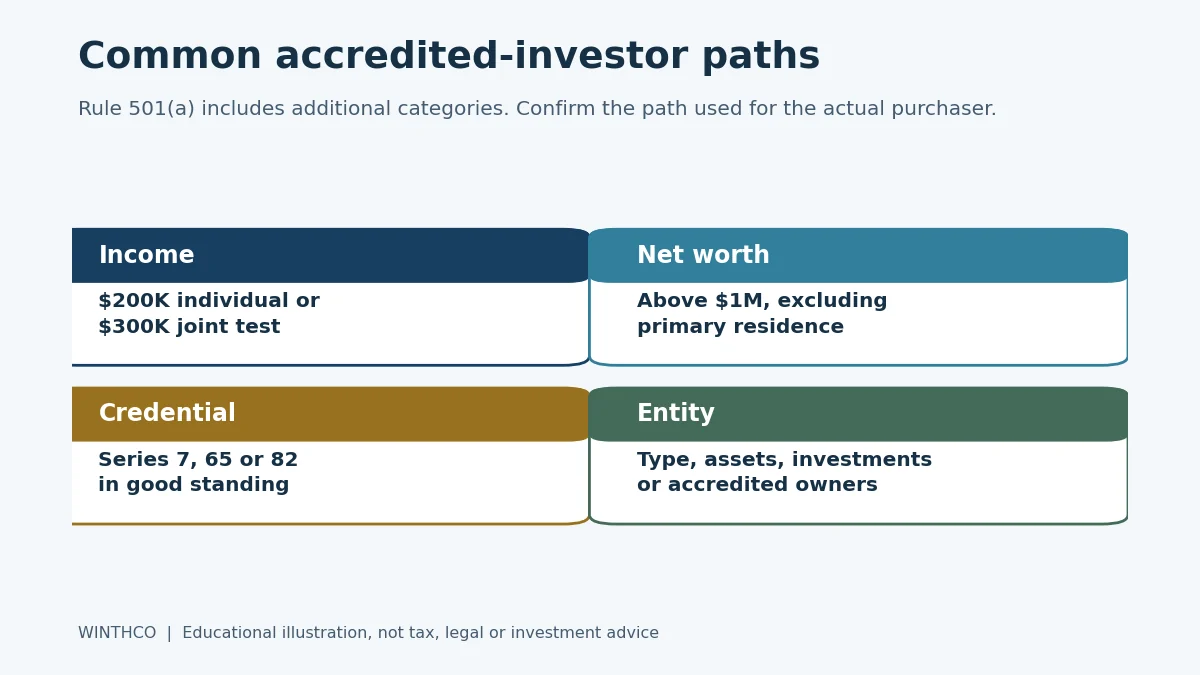
Rule 501(a) of Regulation D defines several accredited-investor categories. For individuals, the most common paths are qualifying income, net worth above the regulatory threshold or a qualifying professional credential held in good standing. Entities can qualify under separate categories based on their type, assets, investments or accredited owners. The status is evaluated at the time of the securities sale.
Under the income test, an individual must have income above $200,000 in each of the two most recent years and reasonably expect the same level in the current year. Joint income with a spouse or spousal equivalent must exceed $300,000 for those years, with the same current-year expectation. A single strong year does not satisfy this two-year test.
Share your timeline and investment range. A Winthco team member will follow up with you.
Winthco's DST accredited investor overview introduces the qualification issue, but the current federal rule and the actual offering documents control. Most DST private placements used in exchanges limit purchasers to accredited investors, although Regulation D includes offering structures with different conditions. Never assume that a DST interest is available merely because it is being considered as replacement property. Confirm eligibility early enough to evaluate other identified property if the proposed DST is unavailable or the purchaser does not qualify.
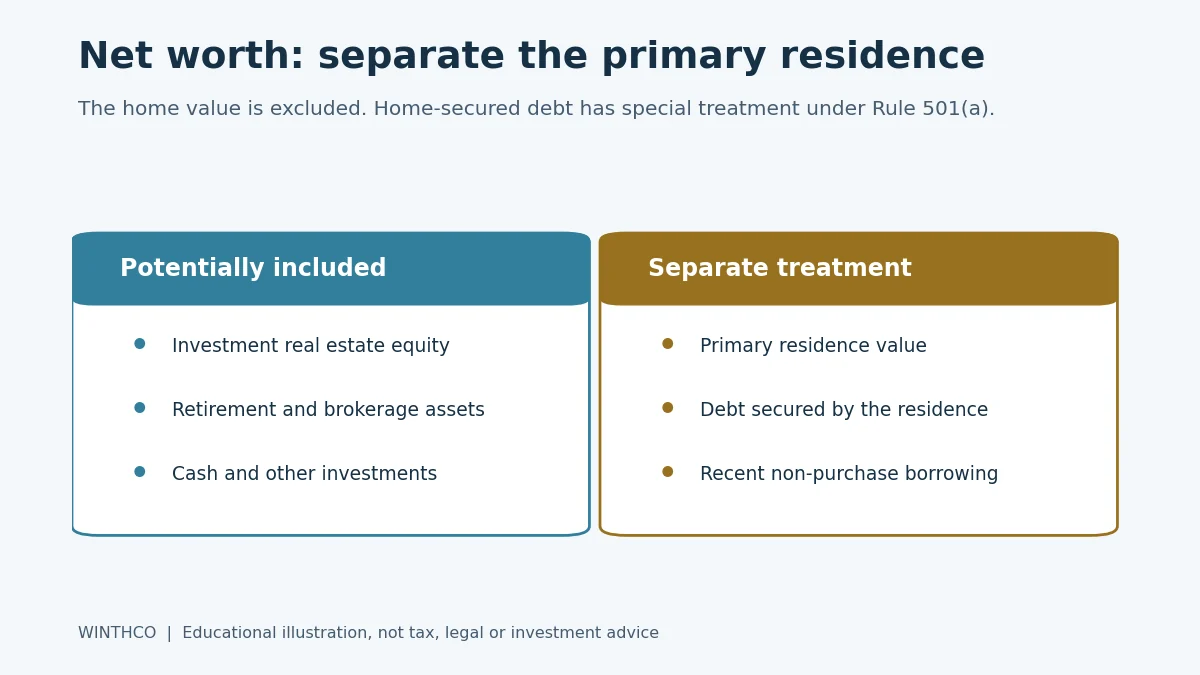
The net worth path requires net worth above $1 million, individually or jointly with a spouse or spousal equivalent. The value of the primary residence is excluded as an asset. Assets such as investment real estate equity, eligible retirement accounts, cash and other investments may be relevant, while debts and other liabilities reduce the calculation. Valuation and ownership records should be supportable.
Primary-residence debt receives special treatment. Debt secured by the home generally is excluded as a liability up to the home's estimated fair market value. Any secured debt above that value is included. A non-purchase increase in home-secured debt during the 60 days before the securities purchase also may count as a liability, even when total debt remains below the home's value.
Joint net worth can aggregate the investor's and spouse's or spousal equivalent's assets even when assets are not jointly titled, and the security does not have to be purchased jointly. That rule does not make a spouse a party to the 1031 exchange. Securities qualification, exchange ownership and the taxpayer named in the transaction are separate questions that require separate documentation.
An individual holding a Series 7, Series 65 or Series 82 license in good standing can qualify under the professional-credential path. Passing an exam years ago is not enough if the credential is not currently in good standing. The offering team should verify the applicable record and should not treat unrelated education, work history or real estate ownership as a substitute.
Entity qualification depends on the entity and facts. Rule 501(a) includes specified institutions, certain organizations with more than $5 million in assets, qualifying trusts, entities owning more than $5 million in investments, and entities whose equity owners are all accredited investors. Some categories include conditions such as not being formed for the specific purpose of purchasing the offered security.
The subscribing party matters. If an LLC, trust or partnership will acquire the DST interest, do not assume the owner's personal accreditation automatically transfers to the entity. Likewise, changing the purchaser to solve a securities-eligibility issue may create 1031 continuity, title or tax concerns. Coordinate the subscription name with the qualified intermediary, tax counsel and securities professional before identification and closing.
Discuss your DST questions with Winthco →
The verification process depends partly on the offering exemption and the issuer's procedures. Rule 506(b) permits an issuer to sell to accredited investors and a limited number of sophisticated non-accredited investors under specified conditions, while Rule 506(c) permits general solicitation only when all purchasers are accredited and the issuer takes reasonable steps to verify that status. A DST's private placement memorandum should identify the exemption and eligibility conditions.
Possible support can include tax forms for income, financial statements and third-party documentation for net worth, or public licensing records for a qualifying credential. A written confirmation from an attorney, CPA, registered broker-dealer or SEC-registered investment adviser may be used in some Rule 506(c) verification circumstances. The requested evidence and its acceptable date range depend on the rule and offering procedure. Ask who will review the information, how long it will be retained and whether a recent verification may be reused under the applicable procedure.
Provide sensitive documents only through the approved secure process. The public prospect contact form is for an initial conversation, not for Social Security numbers, account statements, tax returns or subscription documents. Winthco's guide on how to invest in a Delaware statutory trust explains the broader sequence, but an investor should wait for secure instructions before sending qualification evidence. Redact information that is not requested, verify the recipient independently and keep a record of what was provided.
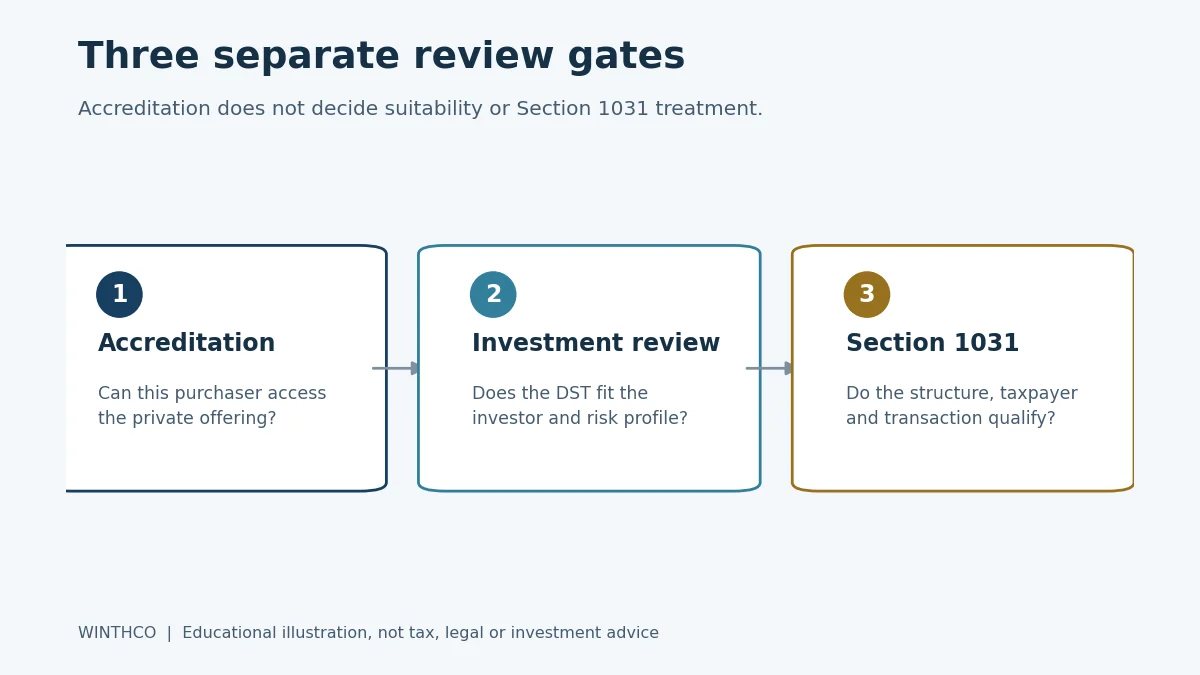
No. Accreditation is an eligibility threshold for certain private securities offerings. It is not a recommendation, a government approval or evidence that a particular DST fits an investor's objectives. Suitability and best-interest review considers liquidity, time horizon, concentration, tax status, risk tolerance, other holdings and the ability to withstand reduced distributions or loss of principal.
Section 1031 treatment is a separate tax analysis. IRS Revenue Ruling 2004-86 concluded that interests in the specific DST described there were treated as interests in underlying real property, provided the other Section 1031 requirements were met. The ruling does not convert every trust interest into replacement real estate, and accreditation does not cure identification, timing, taxpayer or property defects.
A taxpayer can therefore clear one gate and fail another. The investor may be accredited but unable to complete the intended exchange, or the proposed interest may fit the exchange structure but be unsuitable for the household. Winthco's DST review approach can provide planning context, while the offering memorandum, exchange documents and the investor's actual circumstances remain controlling.
WATCH & LEARN
The Winthco Wealth Management team introduces its 1031 DST educational resources in this 42-second video. Accreditation does not establish suitability or tax treatment. Original resource · Watch on YouTube ↗
Educational context only. The discussion does not establish the suitability, returns or tax treatment of an investment.
The SEC cautions that exempt offerings do not provide all the prescribed disclosures required in registered offerings and can involve loss of the entire investment. Accreditation does not create a resale market or reduce property risk. A DST interest may be difficult or impossible to sell when cash is needed, and any secondary transfer can require approvals or a substantial discount.
Read the private placement memorandum for property condition, tenants, lease expirations, financing, reserves, fees, conflicts and sponsor authority. Consider what happens if occupancy falls, a major tenant defaults, debt cannot be refinanced or a sale occurs earlier or later than projected. Distributions can decline or stop, and neither principal value nor a future tax result is assured. Stress-test household liquidity without relying on projected distributions or a sale on the expected date.
FINRA notes that private placements can have fewer disclosures and limited liquidity, and that concentration can amplify losses. Compare the proposed DST with existing real estate, geography, property types, tenants, sponsor exposure and household cash reserves. Meeting an income or net worth threshold does not mean the investor can comfortably hold an illiquid asset through an adverse period. A decision file should show why the investment size, risks and holding uncertainty fit the investor, not merely that the threshold was met.
| Decision | Evidence to request | What to avoid assuming |
|---|---|---|
| Individual income | Prior two years of income and reasonable current-year expectation | One high-income year is sufficient |
| Individual net worth | Assets, liabilities and primary-residence treatment | Home equity counts toward the $1 million threshold |
| Professional credential | Current good-standing record for Series 7, 65 or 82 | Any financial or real estate license qualifies |
| Entity purchaser | Entity type, formation purpose, assets, investments and owners | An owner's status automatically qualifies every entity |
Income must exceed $200,000 individually or $300,000 jointly with a spouse or spousal equivalent in each of the two most recent years, with a reasonable expectation of reaching the same level in the current year.
No. The primary residence is excluded as an asset, and the rule has specific treatment for debt secured by the residence.
Yes, if the Series 7 license is held in good standing. Series 65 and Series 82 licenses in good standing are also designated qualifying credentials.
Potentially. Rule 501(a) contains several entity categories, but the applicable test depends on the entity's type, assets, investments, owners and formation purpose.
No. The offering's eligibility rules, availability, subscription review, pre-existing relationship requirements and the firm's investment review still apply.
No. Accreditation is a securities-law concept. Section 1031 treatment depends on the taxpayer, property, structure, identification, timing and other transaction facts.
Use only the secure process supplied by the authorized firm. Do not place tax returns, account numbers or identity documents in the public prospect contact form or ordinary email.
Sources checked October 3, 2026. This article explains general concepts; your facts and the applicable documents control.
Winthco DST services · Winthco evaluation overview · Editorial standards
DST fundamentals
Understand DST ownership, potential 1031 exchange eligibility and the practical trade-offs of passive real estate investing.
Read guide →Risks and due diligence
Review DST liquidity, leverage, sponsor conflicts, fees and distribution assumptions before making an investment decision.
Read guide →Investor decision-making
Use practical questions about registration, compensation, due diligence, coordination and follow-up when evaluating a DST advisor.
Read guide →Explore Winthco’s main DST article collection
Share your timeline and investment range. A Winthco team member will follow up with you.