DST fundamentals
What is a Delaware statutory trust?
Understand DST ownership, potential 1031 exchange eligibility and the practical trade-offs of passive real estate investing.
Read guide →
Home / Learning center / 1031 exchange planning
1031 exchange planning
Winthco Wealth Management · Updated October 10, 2026
For a typical deferred 1031 exchange into a Delaware statutory trust, arrange a qualified intermediary before the relinquished property closes. The intermediary enters a written exchange agreement, coordinates assignments, restricts the taxpayer's access to sale proceeds and transfers exchange funds for eligible replacement property. A QI does not replace tax, legal or investment advice.
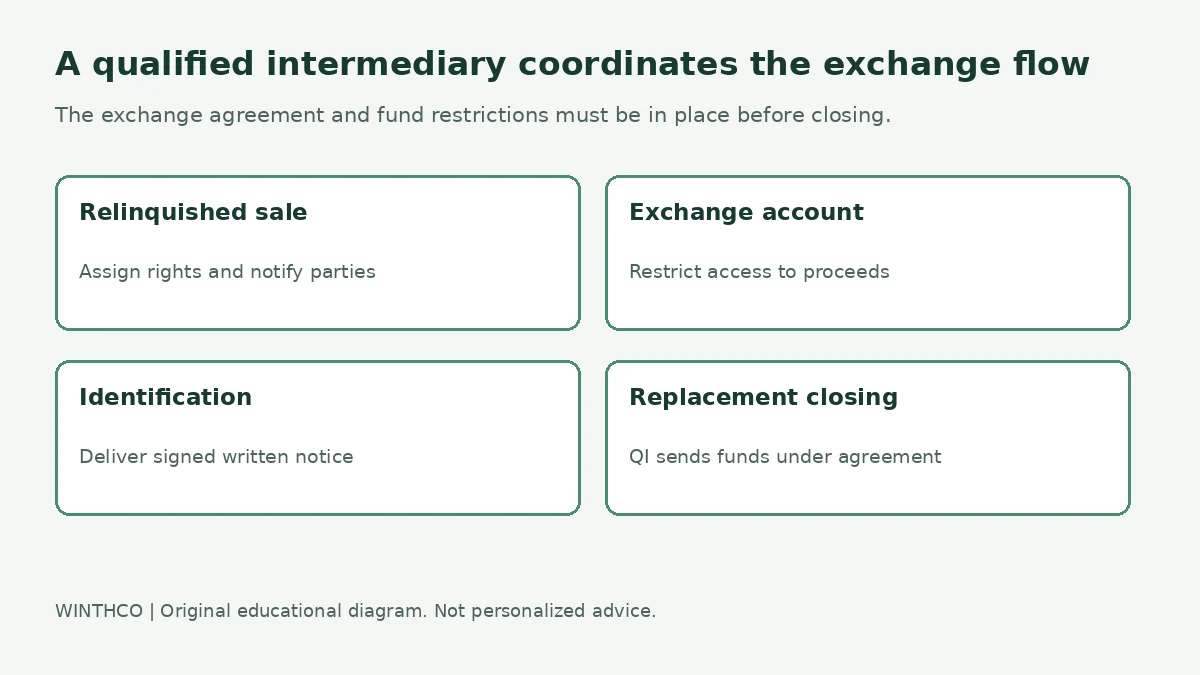
Treasury Regulation 1.1031(k)-1 provides a qualified-intermediary safe harbor for deferred exchanges. Under the regulation, the intermediary is not treated as the taxpayer's agent for Section 1031 purposes when the requirements are met. The transaction is treated as an exchange rather than a sale followed by an unrelated purchase, and the taxpayer's rights to the funds must be expressly limited. Winthco's qualified intermediary near me guide provides related planning context.
The QI enters a written exchange agreement with the taxpayer and is treated as acquiring and transferring the relinquished and replacement properties through title or assigned contract rights. Written notice of an assignment must reach the relevant parties by the applicable transfer date. The closing documents, agreement and actual flow of funds should tell the same story.
Share your timeline and investment range. A Winthco team member will follow up with you.
For a DST purchase, the intermediary does not select the security or decide whether it is suitable. The QI follows the exchange agreement, receives the signed identification and sends authorized exchange funds to the replacement closing. The investor, tax adviser and securities professional separately evaluate whether the DST structure and transaction fit the rules and the investor's circumstances.
A deferred exchange can be jeopardized if the seller actually or constructively receives the relinquished-property proceeds before receiving qualifying replacement property. Sending the money to the seller's personal account, allowing unrestricted access or attempting to add the exchange structure after closing can undermine the intended safe harbor. Do not assume escrow alone fixes the problem.
Before closing, execute the exchange agreement, confirm assignment language, notify the buyer and closing agent as required, and independently verify the QI's wiring instructions. Ask the intermediary to confirm in writing that the exchange account and restrictions are ready. The settlement statement should direct exchange proceeds according to the agreement.
Timing pressure is not a substitute for review. If the sale is close, assemble the QI, CPA, attorney, broker and closing agent immediately, but do not accept promises that a transaction can always be repaired later. A contact with Winthco can help identify the roles to coordinate, but it does not itself establish the exchange or appoint an intermediary.
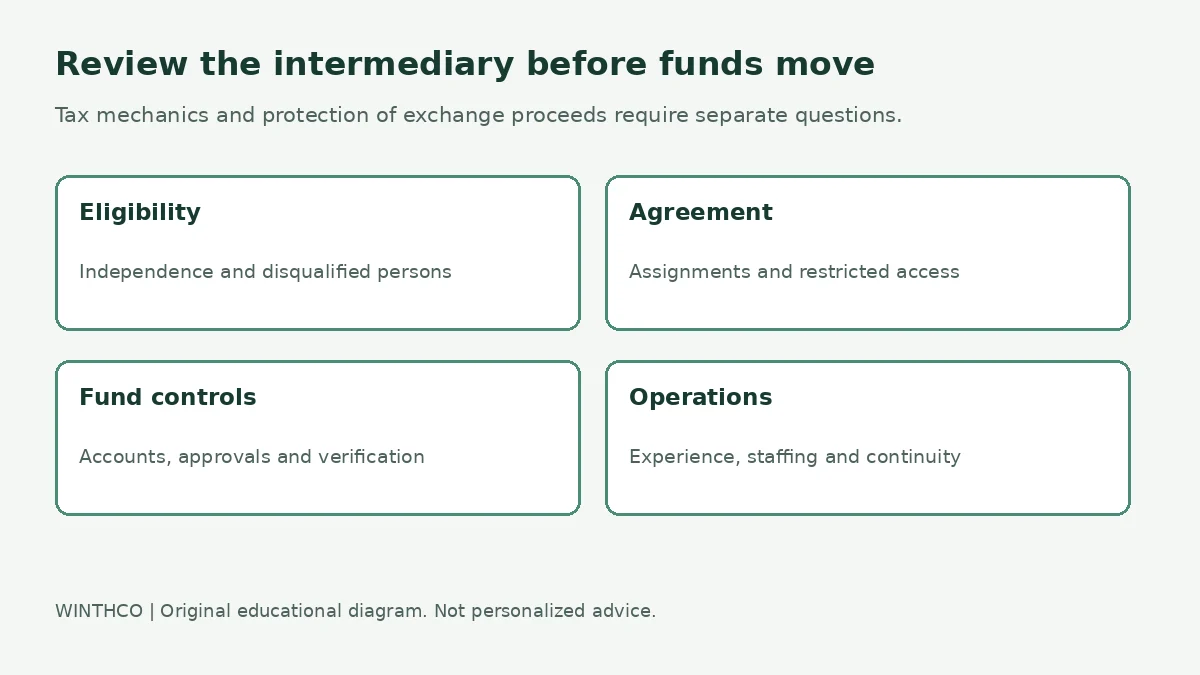
The federal regulation says a qualified intermediary cannot be the taxpayer or a disqualified person. Disqualified-person rules can include certain agents and related persons. The regulation's examples identify an accountant who provided nonexchange accounting services during the applicable two-year period as disqualified, while prior exchange-only services can be treated differently under the stated facts.
Do not assume that a current attorney, accountant, real estate broker, investment banker or employee can hold exchange funds merely because the person is trusted. Ask tax counsel to apply the detailed rules to existing relationships and ownership connections. Independence for the QI safe harbor is a legal test, not a marketing description.
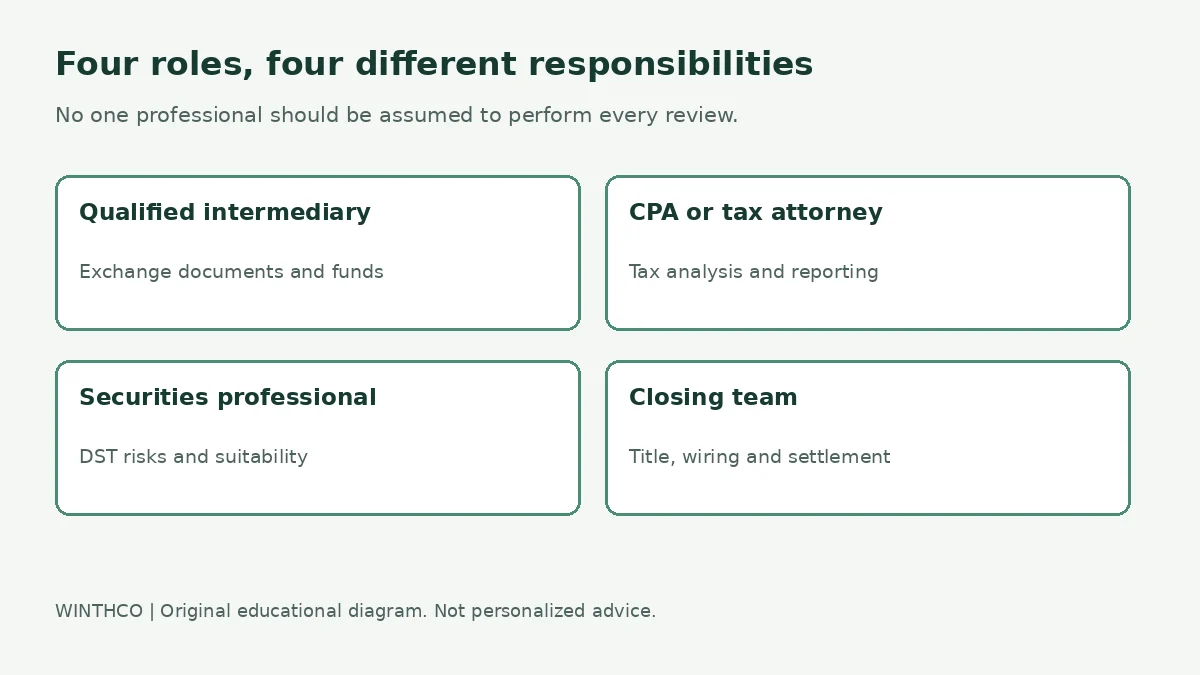
A DST sponsor, securities representative and QI also have different roles. The investment professional explains offering documents, fees, conflicts, risks and suitability. The QI administers exchange mechanics. The CPA or tax attorney analyzes the taxpayer's treatment and reporting. Winthco's Delaware statutory trust advisor page can help frame the investment professional's role without confusing it with the intermediary's work.
Discuss your DST questions with Winthco →
Start with the legal entity, ownership, experience and people responsible for the file. Ask how proceeds are titled, whether each client receives a segregated account, which financial institution holds the funds and what contractual rights apply if the intermediary or bank has financial trouble. Obtain current written answers rather than relying on a logo or referral.
Review control procedures. Ask who can authorize a wire, whether the taxpayer's approval is required, how callback verification works and how changes to instructions are authenticated. Confirm insurance and bonding representations through supporting documents and understand their limits, exclusions and claim procedures. No control eliminates every risk.
Read the exchange agreement for fees, interest treatment, permitted investments, release conditions, dispute terms, indemnities, successor arrangements and restrictions on access. IRS Publication 544 warns that if a QI causes timing requirements to be missed, the transaction may fail and gain may become taxable in the transfer year. It describes limited relief for certain bankruptcy or receivership defaults, not a general cure.
The identification period generally ends at midnight on day 45 after the relinquished-property transfer. A replacement must be unambiguously described in a signed writing delivered to a permitted recipient. The QI commonly receives that notice, acknowledges delivery and retains it in the exchange file. Winthco's 1031 exchange rules page offers general background, while the current regulation and intermediary instructions govern.
Ask for the precise legal description of the DST interest and underlying real estate that the tax and exchange team expects to use. Do not substitute a marketing nickname. Confirm how a multi-property DST is counted under the three-property, 200 percent or 95 percent identification rules. Identification does not reserve capacity, approve a security or ensure a closing.
For funding, the securities professional and sponsor handle subscription and investor-eligibility documents, while the QI handles exchange cash under the agreement. Coordinate the subscription amount, financing allocation, closing date and wire destination. The taxpayer may add outside cash when appropriate, but should not instruct the QI or sponsor in a way that creates unrestricted access to exchange proceeds.
WATCH & LEARN
Accruit discusses why choosing a qualified intermediary is an important step in a 1031 exchange. This third-party video is general education, not a Winthco endorsement; the current regulation, exchange agreement and the investor's advisers control. Original resource · Watch on YouTube ↗
Educational context only. The discussion does not establish the suitability, returns or tax treatment of an investment.
A properly structured exchange does not make the DST a suitable or successful investment. Private DST interests can be illiquid, difficult to value and subject to property, tenant, financing, sponsor and market risks. Distributions can change or stop, a sale may occur earlier or later than expected, and investors can lose principal.
The SEC states that private placements may provide less information than registered offerings, can impose transfer restrictions and may involve total loss. A Form D notice is not SEC approval. Read the private placement memorandum, trust agreement, subscription package, property reports and fee disclosures before funding.
FINRA explains that apparently different investments can remain concentrated when they share an asset class, market segment, region or other economic driver. A QI can administer funds for several DST interests, but that does not determine diversification. Measure the combined exposure against the household's liquid reserves, other real estate and ability to withstand a delayed exit.
Consider a hypothetical owner whose rental is expected to close on November 20. Two weeks before closing, the owner engages a proposed QI, sends the purchase contract and title information, and asks the CPA and attorney to review taxpayer identity and the exchange agreement. This example is educational and does not describe a client or promised outcome.
Before the sale, the QI prepares the exchange documents, the parties receive assignment notice and the closing agent verifies the exchange-account wire instructions. After closing, the owner reviews direct property and DST candidates. The signed identification is delivered before the applicable day-45 deadline using the QI's documented procedure.
The owner later chooses a DST only after reviewing the offering, fees, debt, liquidity and downside cases. The securities professional completes the suitability process, the CPA reviews allocation and possible recognized gain, and the QI sends the authorized exchange amount to closing within the exchange period. If a candidate becomes unavailable, the team relies only on property that was properly identified and remains eligible.
Keep the executed exchange agreement, assignments, notices, relinquished closing statement, signed identification, delivery evidence, replacement documents, wire confirmations and final settlement statement. Preserve correspondence explaining any amendment, revocation, rejected wire or change in property description.
Give the CPA the records needed for Form 8824 and basis calculations. Reconcile every dollar among the relinquished closing, exchange account, outside cash and replacement closing. Record debt relief, replacement liabilities and any cash or unlike property received without assuming that reinvesting net equity alone establishes full deferral.
Maintain the DST investment file separately but cross-reference the closing. It should include the current offering memorandum and supplements, trust and subscription documents, accreditation records, fee and compensation disclosures, property materials and signed approvals. A prospect contact form begins a conversation with Winthco; it does not appoint a QI, reserve an offering, establish suitability or complete an exchange.
| Decision | Evidence to request | What to avoid assuming |
|---|---|---|
| Exchange structure | Written agreement, assignments and restricted access to proceeds | The exchange can be added after the sale closes |
| QI eligibility | Independence and disqualified-person review | Any trusted adviser can automatically hold funds |
| Fund protection | Account title, controls, approvals and verified instructions | The QI label guarantees the proceeds |
| DST review | Offering documents, suitability, risks, fees and liquidity | The QI approves the investment |
| Tax reporting | CPA review, Form 8824 and reconciled closing records | The QI determines every tax consequence |
Do not assume so. For a typical deferred exchange using the QI safe harbor, arrange the exchange agreement and fund handling before the relinquished property transfers.
A person who provided certain nonexchange services during the applicable two-year period can be disqualified. Tax counsel should review the detailed regulation and the existing relationship.
No. The QI administers exchange mechanics. The securities professional handles offering and suitability questions, while the CPA or attorney handles tax and legal analysis.
Review the account title, bank, segregation, permitted investments, withdrawal controls and contract terms. Do not infer fund protection from the QI label alone.
No. Identification is an exchange step. It does not reserve capacity, approve the offering or guarantee that a subscription will close.
IRS guidance warns that the exchange may fail and gain may be taxable in the transfer year. Limited relief can apply in specified bankruptcy or receivership circumstances, so obtain immediate tax and legal advice.
Sources checked October 10, 2026. This article explains general concepts; your facts and the applicable documents control.
Winthco DST services · Winthco evaluation overview · Editorial standards
DST fundamentals
Understand DST ownership, potential 1031 exchange eligibility and the practical trade-offs of passive real estate investing.
Read guide →1031 exchange planning
Plan the identification and completion periods for a deferred 1031 exchange, including the earlier tax-return deadline.
Read guide →1031 exchange planning
Understand the three-property, 200 percent and 95 percent identification rules before naming DST replacement property.
Read guide →Explore Winthco’s main DST article collection
Share your timeline and investment range. A Winthco team member will follow up with you.