1031 exchange planning
1031 exchange deadlines: the 45-day and 180-day rules
Plan the identification and completion periods for a deferred 1031 exchange, including the earlier tax-return deadline.
Read guide →
Home / Learning center / Exchange Planning
Exchange Planning
Winthco Wealth Management · Updated November 13, 2026
A disaster can postpone certain 1031 exchange deadlines, but a closing delay or disaster declaration alone does not establish relief. Find the applicable IRS announcement, confirm which taxpayer and exchange acts it covers, and have your tax adviser and qualified intermediary document the dates. Evaluate any replacement DST separately from the deadline question.
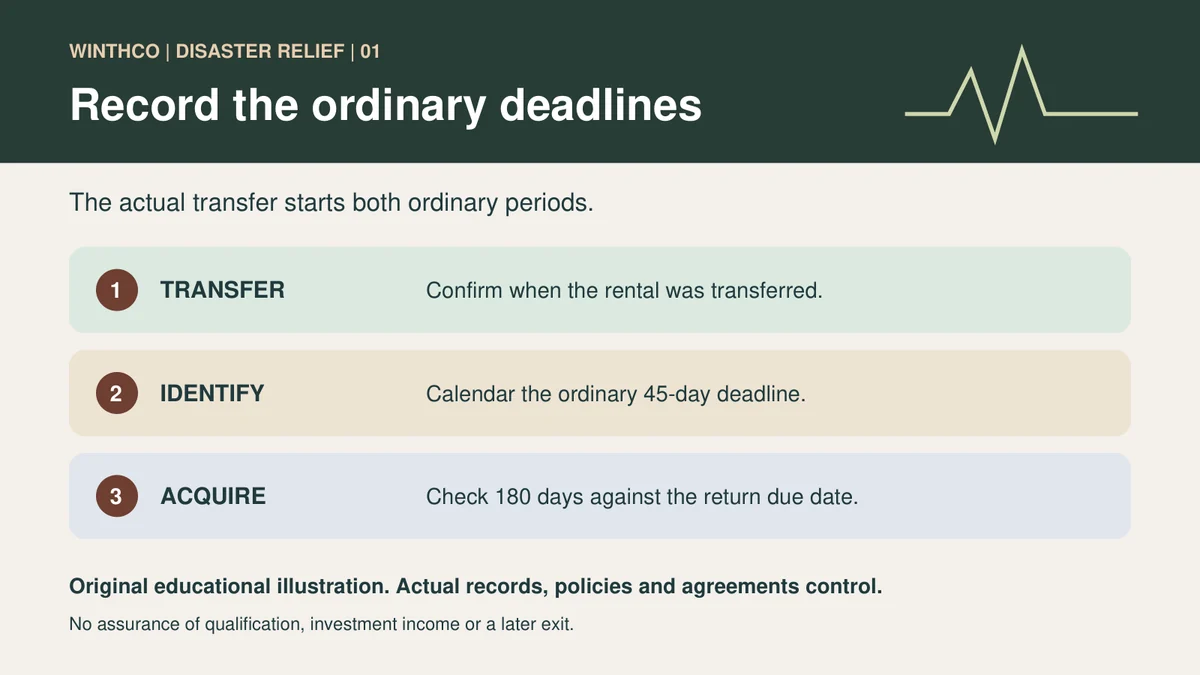
Start with the sale file. Ask your licensed broker for an updated closing calendar, the property conditions that might affect marketing or price, and a revised estimate of net proceeds after repair credits and selling costs. Ask escrow to distinguish the scheduled signing, funding and actual transfer. If the property has not transferred, a moving closing date may change when the normal deferred exchange periods begin. That is different from postponement after a transfer.
The broker can explain how the transaction has changed; your CPA and attorney should assess the tax and legal implications. Arrange the qualified intermediary before the sale transfers or you receive proceeds. Ask for written confirmation of the transfer date, copies of the exchange agreement and proof of any identification you already delivered. Winthco's overview of 1031 exchange deadline relief provides additional background; the IRS guidance for the particular disaster controls.
Share your timeline and investment range. A Winthco team member will follow up with you.
For a deferred exchange of eligible investment or business real property, the ordinary identification period ends 45 days after transfer. The acquisition deadline is generally the earlier of 180 days after transfer or the federal return due date, including extensions. The clocks run from the same transfer, not one after the other. A routine return extension may affect the earlier-of calculation, but by itself does not extend the 45-day identification period.
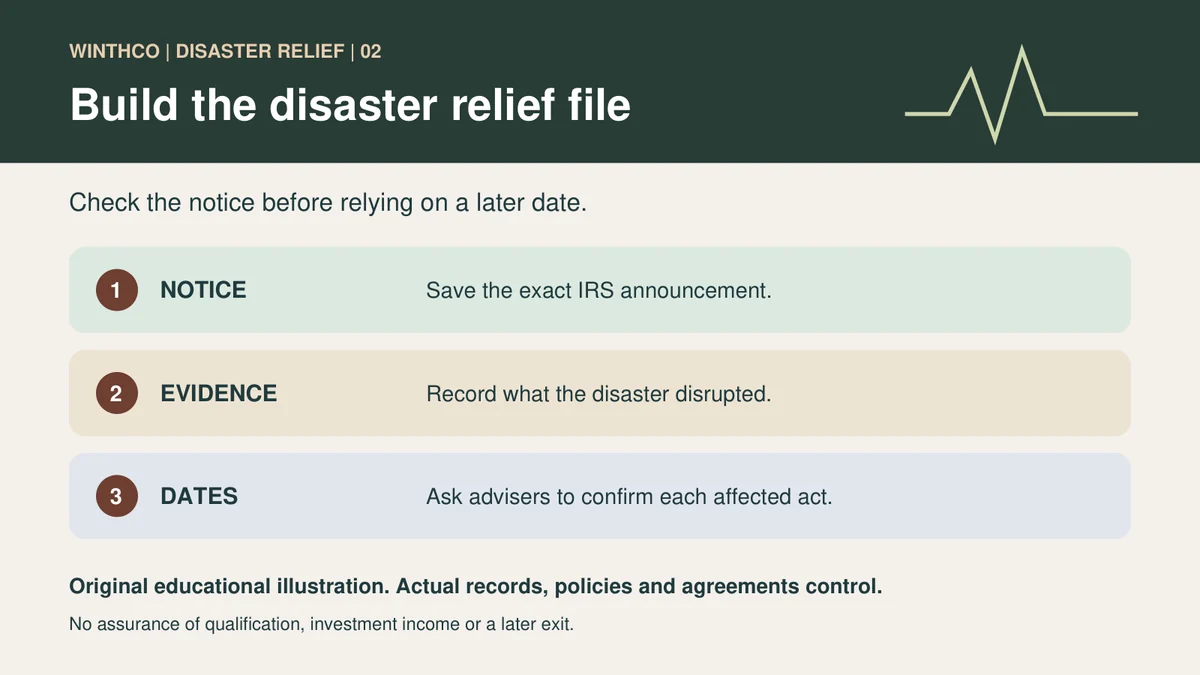
Find the exact announcement in the IRS disaster relief directory. Record the covered areas, incident and relief dates, who qualifies, which time-sensitive acts are postponed and any express limits. Match these items to your own timeline rather than borrowing a date from someone in the same county. Keep the original calendar in place while the CPA and intermediary review the notice, and preserve both versions of the dates if they confirm relief.
Section 17 of Revenue Procedure 2018-58 describes special postponement rules when applicable IRS guidance authorizes them. In general, its provisions look at whether the relinquished property was transferred by the disaster date and whether the transferor is an affected taxpayer or has qualifying disaster-related difficulty meeting the exchange deadline. Examples in the procedure include property or certain transaction parties in a covered area, lost transaction records, and certain lender or title insurance problems attributable to the disaster. Those examples are not a general exception for ordinary scheduling or financing problems.
For specified deadlines falling on or after the disaster date, Section 17 describes a 120-day postponement or the end of the general disaster relief period, whichever is later, subject to its limits. The procedure includes caps tied to the return due date, including extensions, and one year. It also separately addresses certain previously identified property that is substantially damaged. Do not add 120 days to every date or assume you get a new identification list. Ask your advisers to state which provision applies to each act, which date anchors the calculation, and what evidence supports it.
Hypothetical: A seller transferred a rental before a federally declared storm, and the replacement lender temporarily stops funding because of that storm. The seller keeps the lender's written notice and gives the QI the exchange calendar and prior identification. The CPA checks the applicable IRS announcement and the Section 17 conditions. Meanwhile, the seller keeps pursuing closing within the ordinary deadlines and does not assume that a different replacement can be added. The lender's note is supporting evidence, not an IRS determination.
Discuss your DST questions with Winthco →
Potentially. IRS Revenue Ruling 2004-86 analyzed a specific trust arrangement in which beneficial interests could be treated as interests in the trust's real property. It does not establish that all Delaware statutory trusts qualify. Ask the QI how a particular interest would be identified, the attorney to review the actual documents, and the CPA how the structure, cash retained, closing costs and any debt relief would affect reporting. Winthco's explanation of DST replacement property gives an overview of the structure.
If you already identified a replacement and now want to change course, give the QI the signed identification, any revocations and the dates they were delivered. A later acquisition deadline does not by itself show that a new property can be identified. A DST that is available today may also stop accepting subscriptions, fail to close in time or not fit the exchange amounts. Get a written schedule for document review, subscription acceptance and funding; ask what happens if an offering fills or its terms change.
A DST can reduce day-to-day property work but shifts decisions to others. Review the private placement memorandum for fees and affiliated compensation, tenant concentration, loan maturity, insurance exclusions, reserves and transfer restrictions. Ask how cash is allocated if occupancy falls or repairs exceed reserves. Investors may receive less than expected, receive nothing for a period or lose principal. Many offerings are limited to accredited investors, and qualifying for an offering does not make it suitable. A Section 721 contribution, if offered later, is a separate decision and cannot be assumed as a source of liquidity.
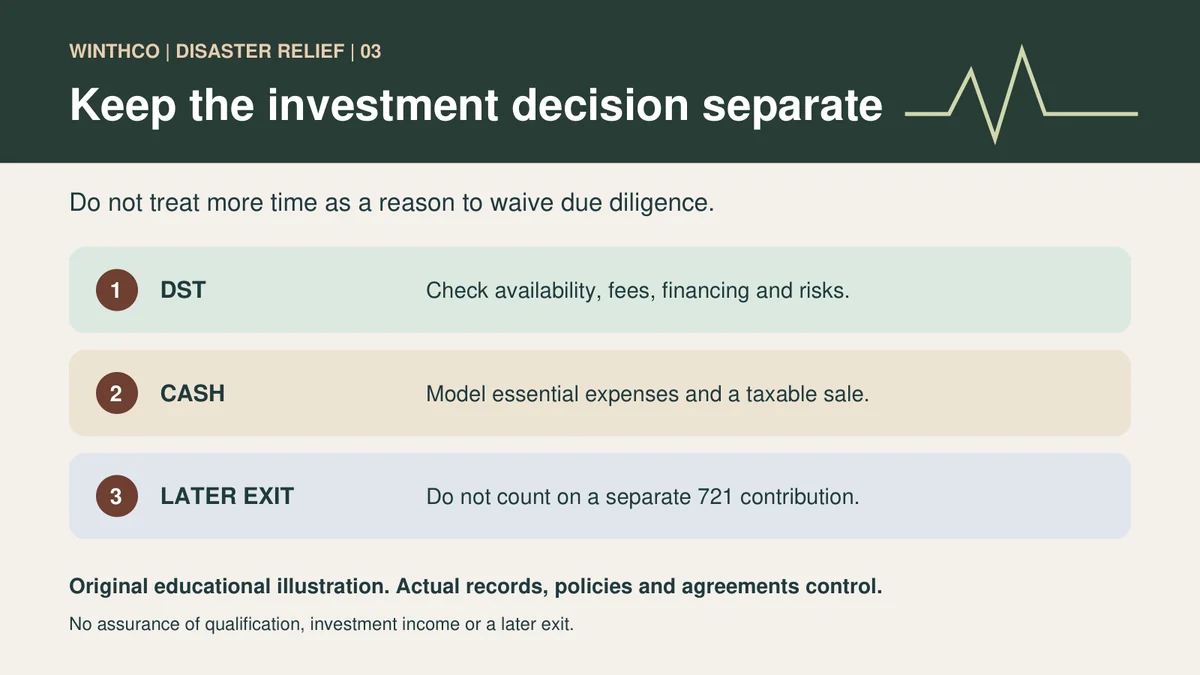
Compare the outcome if the exchange closes as planned, if an identified alternative closes, and if the sale remains taxable. Ask for a range of net proceeds and taxes under each rather than treating the exchange as all or nothing. Build a separate cash reserve for housing, tax payments, repair obligations or essential retirement spending. Do not rely on a DST distribution or later sale to cover an expense you cannot postpone.
Ask your advisers to review investment concentration, access to taxable savings, retirement-account expenses and beneficiary arrangements. An IRA or 401(k) is a separate planning question, not an exchange-proceeds account, and no rollover should be presumed. The priority is to understand what you can afford to keep illiquid even if the deal or an IRS deadline decision goes differently than expected.
WATCH & LEARN
Accruit explains ordinary identification rules. This third-party video does not determine disaster relief or whether a particular property can be substituted. Original resource · Watch on YouTube ↗
Educational context only. The discussion does not establish the suitability, returns or tax treatment of an investment.
Keep a copy of the IRS release with the affected area and relief language highlighted, evidence of transfer and written identification, and any lender, title or property records that explain the delay. Record each ordinary deadline next to the corresponding confirmed deadline and assign responsibility for the remaining steps. If your advisers cannot verify relief, do not present the later date to escrow as settled. Use the prospect form or dedicated contact page to discuss how the sale and possible replacements fit your broader plan; share tax records only through a secure channel approved by your advisers. The file should also distinguish the tax notice from any private contract extension. A seller and buyer may agree to move a closing under their contract, while the federal exchange deadline stays the same. Conversely, an IRS postponement does not require a seller, lender, sponsor or escrow agent to hold a transaction open. Ask each party what expires and when: the purchase contract, rate lock, subscription reservation or insurance binder. Write down which approvals are outstanding and who will communicate changes. If the proposed replacement depends on an unconfirmed extension from either the IRS or a transaction party, show that dependency explicitly when comparing it with other options.
| Decision | Evidence to request | What to avoid assuming |
|---|---|---|
| Ordinary exchange | Actual transfer date and return due date | Counting from the original closing estimate |
| Disaster review | Applicable IRS announcement and transaction evidence | Applying another taxpayer's postponed date |
| DST decision | Identification, available allocation and offering documents | Treating availability as suitability |
| Household plan | Liquid cash and potential taxable-sale budget | Depending on an uncertain exit |
No. Check the applicable IRS guidance and the facts of the taxpayer and transaction. A declaration alone is not a personalized deadline calculation.
Not by itself. A routine filing extension can affect the acquisition deadline's return-due-date limit, but is different from a postponement of the identification period.
Section 17 lists certain disaster-caused financing problems. Document the cause and have your tax advisers confirm whether the notice and conditions cover it.
Do not assume that. Ask the QI to review your identification record and the exact deadlines that apply before trying to change the list.
No. Review the offering's costs, debt, transfer restrictions and downside separately from the calendar. Keep cash for obligations that cannot wait.
Sources checked November 13, 2026. This article explains general concepts; your facts and the applicable documents control.
Winthco DST services · Winthco evaluation overview · Editorial standards
1031 exchange planning
Plan the identification and completion periods for a deferred 1031 exchange, including the earlier tax-return deadline.
Read guide →1031 exchange planning
Planning a late-year property sale? Review how a return extension, DST closing requirements and household liquidity affect your exchange plan.
Read guide →1031 exchange planning
If your 1031 replacement falls through, compare options before and after day 45, check whether a DST backup still fits, and plan for a taxable sale.
Read guide →Explore Winthco’s main DST article collection
Share your timeline and investment range. A Winthco team member will follow up with you.