1031 exchange planning
1031 exchange deadlines: the 45-day and 180-day rules
Plan the identification and completion periods for a deferred 1031 exchange, including the earlier tax-return deadline.
Read guide →
Home / Learning center / 1031 exchange planning
1031 exchange planning
Winthco Wealth Management · Updated October 19, 2026
A year-end 1031 exchange can have a completion deadline before day 180 because the taxpayer's return due date also matters. A valid filing extension may prevent that earlier cutoff, but it does not create extra identification time or automatically postpone tax payments. Coordinate the CPA, qualified intermediary and DST closing team before committing.
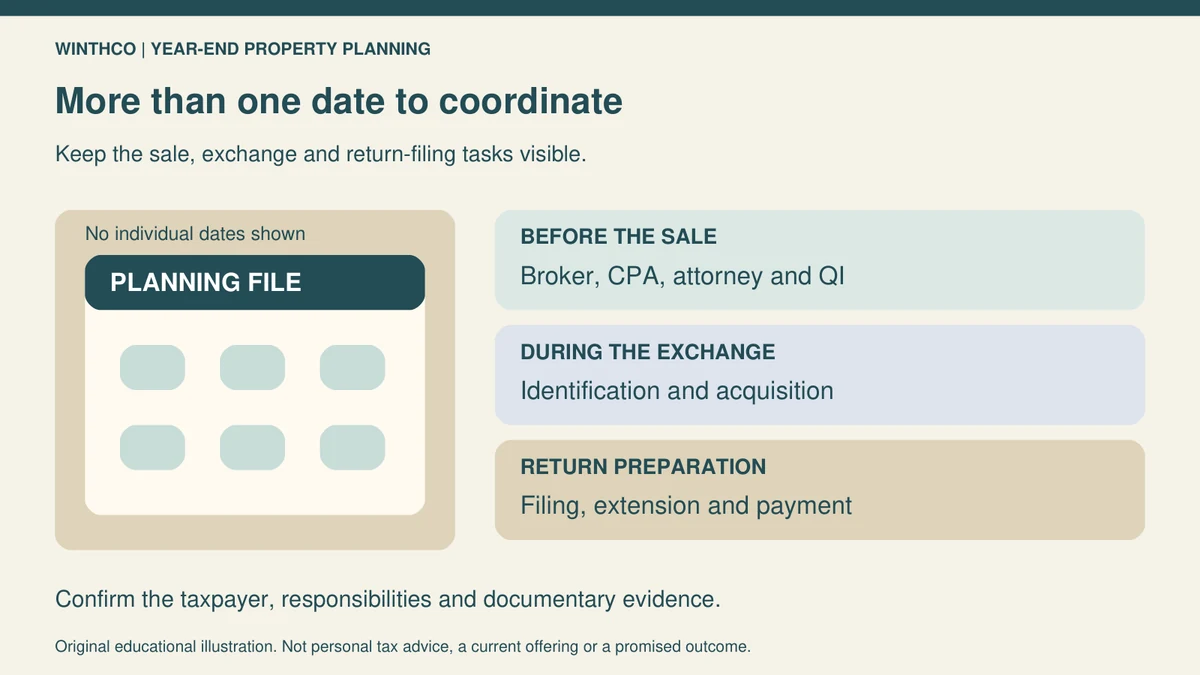
Begin with the property sale and the household's reason for selling. Interview appropriately licensed realtors or commercial brokers about property-type experience, valuation evidence, marketing, compensation and a realistic closing process. Gather leases, repair records, loan information and ownership documents. A desired closing date should be discussed alongside replacement planning, rather than chosen solely to fit a buyer's calendar or an investment presentation.
Engage the CPA, attorney and qualified intermediary before closing or receiving proceeds if a deferred exchange is contemplated. Ask them to identify the actual taxpayer and coordinate the exchange with that taxpayer's filing obligations. Compare retaining the property with management help, a taxable sale and partial or full exchange alternatives. Winthco's exchange timeline planning overview provides context, but your professionals must confirm the dates and structure for your own transaction.
Share your timeline and investment range. A Winthco team member will follow up with you.
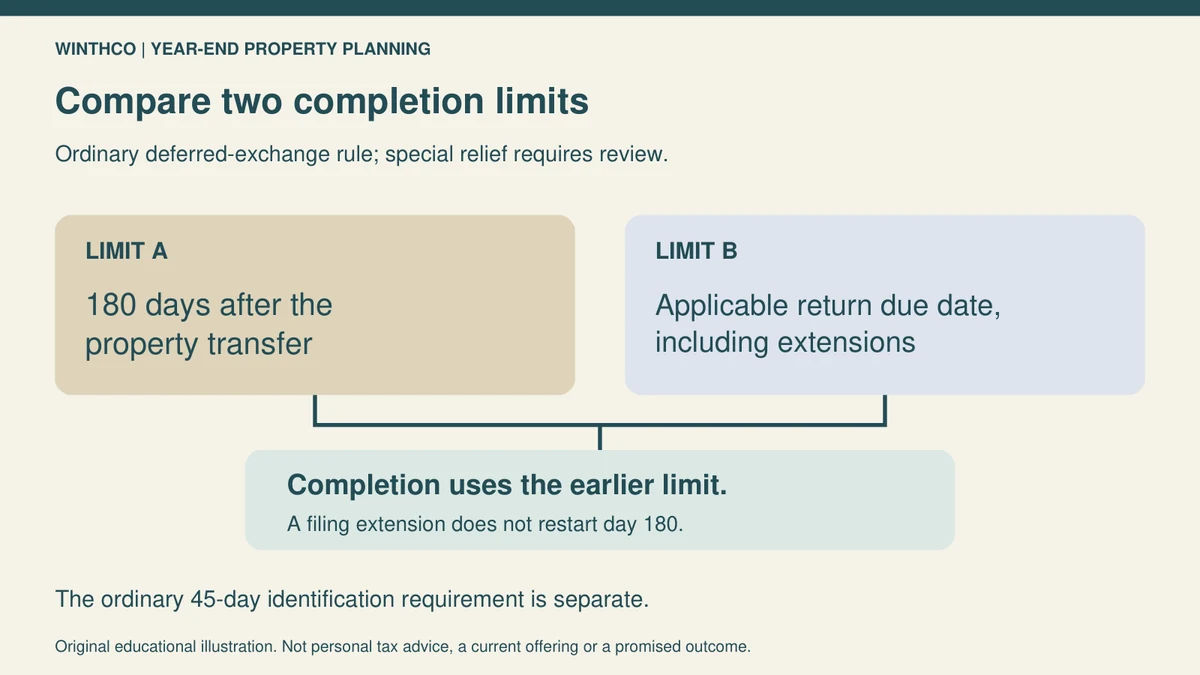
The IRS Form 8824 instructions state that replacement property must be identified within 45 days and received by the earlier of 180 days or the tax-return due date, including extensions. Those are separate tests. Completing a return-extension request does not replace the written identification, and identifying a DST interest does not establish that its acquisition has been completed.
Treasury Regulation 1.1031(k)-1 ties the exchange period to the taxpayer's return for the year of the relinquished-property transfer. A sale near year-end can therefore create work spanning two calendar years while still belonging to the transfer year's exchange reporting. Have the CPA identify the relevant return and the QI confirm the controlling transfer date. Do not assume every seller is an individual with the same filing deadline.
Consider a simplified hypothetical: the regular return due date falls before day 180, and the proposed replacement closing falls between those two dates. Without an applicable extension or relief, that proposed closing would be too late under the ordinary earlier-of rule. If a valid return extension moves the filing deadline beyond day 180, day 180 still remains the ordinary exchange limit. This example illustrates the comparison, not a personalized deadline calculation.
The IRS describes several ways individuals can request additional filing time, including an appropriate electronic payment designated for an extension or Form 4868. Business and other return types have different procedures. Ask the tax preparer which method applies, who will submit it and how completion will be documented. A calendar reminder or an intention to extend is not evidence that the required action occurred.
Form 4868 requires an estimate of tax liability and a timely request. Its instructions distinguish filing time from payment time: an extension does not generally extend the deadline to pay, and interest or penalties may apply to unpaid amounts. Do not assume all possible tax disappears because an exchange is planned. Ask the CPA about estimated payments and potential recognized gain, including a partial exchange or unsuccessful acquisition.
Maintain separate entries for the identification deadline, the exchange completion deadline, the return-extension task and tax-payment obligations. Assign a responsible professional to each entry and retain confirmations. This practical coordination sheet is more useful than writing only one date in a calendar. It also helps the family understand which questions belong to the CPA, which belong to the QI and which still require investment review.
Discuss your DST questions with Winthco →
An ordinary filing extension and disaster-related postponement are not interchangeable. The IRS disaster-relief page directs taxpayers to current notices with eligible locations and other details. If relief might apply, ask the CPA and QI to identify the specific provision covering the taxpayer, transaction and time-sensitive act. Do not assume a filing announcement automatically gives every exchange participant more time to identify or acquire property.
Winthco's historical IRS exchange-extension discussion includes 2020 emergency-relief material. That historical example is not a current authorization to postpone a 2026 exchange. Use the current IRS notice and professional advice for a live deadline, including any conditions or exclusions. This guide does not determine eligibility for a particular disaster, and a personal scheduling problem is not itself evidence that IRS relief applies.
A DST is an investment structure, not an automatic deadline solution. Revenue Ruling 2004-86 addresses the specific trust arrangement described in that ruling; other exchange requirements still matter. Review the actual structure with tax and legal professionals. Winthco's discussion of DST investment requirements can introduce questions, but it cannot replace the offering documents or determine whether a particular taxpayer's exchange qualifies.
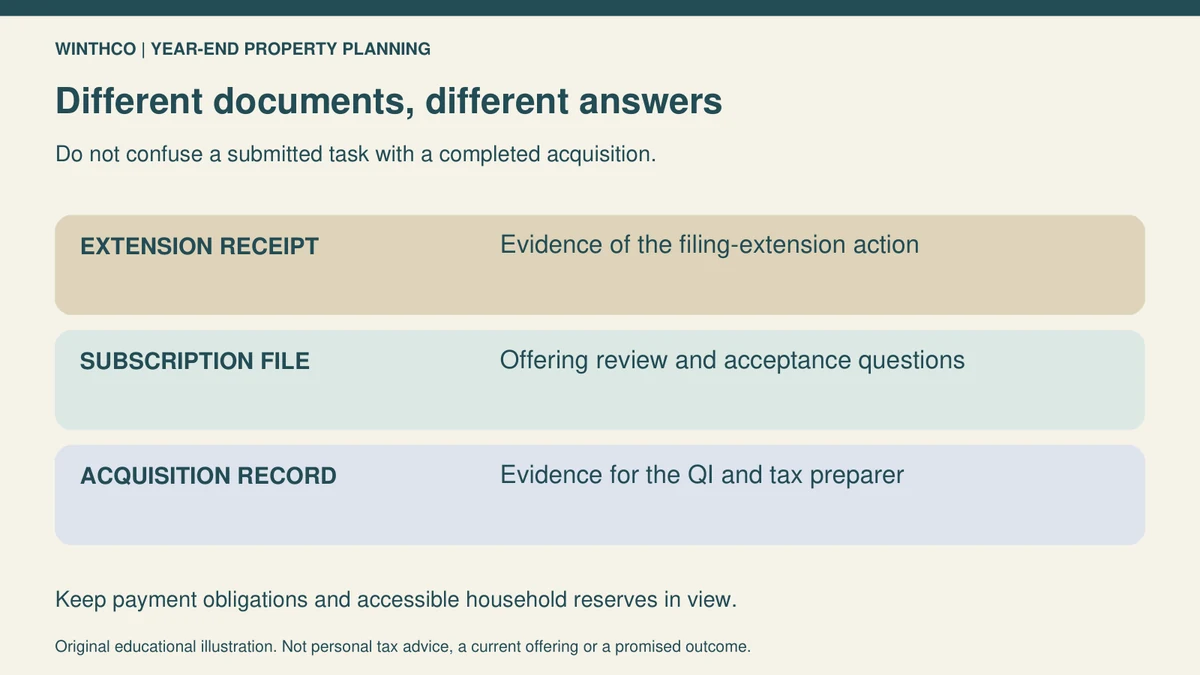
Ask the offering representative what documents, investor qualifications, signatures, acceptance steps and funding procedures are required. Confirm who can state that the interest is available and when acquisition would be complete. A subscription submitted for review is not necessarily an accepted purchase. The QI and closing team should coordinate the required transfer evidence, not rely on a verbal statement that everything should fit before the deadline.
Create an operational buffer around document review and funding. Ask about processing times, incomplete paperwork, wire-verification procedures and the consequences if an allocation changes. These are offering-specific questions, not promises about how fast a DST can close. For identification questions and potential alternatives, work with the QI before the identification period ends; a late substitution cannot simply be assumed acceptable because the original choice became unavailable.
Do not let a completed extension task shorten the investment review. Read the private placement memorandum, fees, debt terms, reserves, lease information and sponsor responsibilities. Compare the proposed interest with the management duties you want to leave behind. Reduced daily property work usually means less direct control, not the disappearance of operating decisions or the right to withdraw principal on demand.
WATCH & LEARN
Winthco Wealth Management introduces its DST resources. This general welcome video is not an explanation of filing extensions, current disaster relief or a particular offering. Use the cited IRS guidance and your tax and exchange professionals for deadline decisions. Original resource · Watch on YouTube ↗
Educational context only. The discussion does not establish the suitability, returns or tax treatment of an investment.
Treat a proposed future Section 721 contribution as a separate decision, not a substitute for completing a qualifying replacement acquisition now. Publication 541 describes the general partnership-contribution framework and its exceptions. Ordinary REIT shares and operating-partnership units generally are not direct Section 1031 replacement real property. An investment diagram that places several steps in a row does not establish that each step qualifies for your circumstances.
For a DST program contemplating a later operating-partnership transaction, ask whether participation is optional, who controls timing, what conditions apply and how value and unit rights would be determined. The transaction might not occur. Review restrictions, potential later redemption taxes and liabilities with the CPA and attorney. FIFO selection does not itself guarantee tax-free basis withdrawals. Evaluate the initial DST even if the anticipated later step never happens.
Create a shared document checklist before the year changes. It can include the relinquished-property closing statement, QI agreement, signed identification and delivery evidence, replacement acquisition documents, extension confirmation and tax-payment records. Ask the CPA which basis and liability information is still missing. The IRS instructs taxpayers to file Form 8824 with the return for the year in which the relinquished property was transferred in the exchange.
Keep operational and tax confirmations distinct. A funding receipt, an accepted subscription and a tax-extension acknowledgment answer different questions. Our DST tax-reporting preparation guide explains the broader records discussion after acquisition. Request a secure channel for sensitive documents rather than putting account numbers, tax returns or private statements into an ordinary prospect message. Retain the final transaction documents, not just screenshots of a projected schedule.
Private DST offerings are generally limited to accredited investors and offered through a private placement memorandum. The SEC warns that private placements can involve limited information, severe illiquidity and total loss. Sponsor, property, tenant, debt, fee and tax-law risks remain even when exchange timing is handled correctly. Distributions can decline or stop. Tax deferral is not tax elimination, and a timely closing does not prove an investment is suitable.
Review accessible cash, near-term spending and contingencies alongside the property decision. FINRA's concentration guidance highlights exposure to correlated assets and illiquid holdings. Consider remaining real estate, financial assets, 401(k)s and IRAs together with your financial advisor. A future DST sale or possible 721 redemption should not be treated as a dependable date for essential household spending. Avoid replacing a known liquidity need with an unverified exit assumption.
Winthco's wealth-management discussion can connect the sale with retirement-income planning, asset allocation, beneficiary documents and coordination with tax and estate professionals. An exchange does not automatically justify rolling over an IRA or moving other accounts; compare options, costs and services separately. Qualified retirement accounts are not themselves 1031 exchange proceeds. Use the prospect form to discuss your sale stage and the planning questions that need attention before closing.
| Decision | Evidence to request | What to avoid assuming |
|---|---|---|
| Identification | QI confirms required notice and deadline | A return extension creates a new identification window |
| Exchange completion | Compare day 180 with the applicable return due date | Every exchange automatically lasts 180 days |
| Return filing and payment | CPA confirms extension method and amounts due | An extension to file also extends payment time |
| DST purchase | Confirm documents, acceptance and acquisition evidence | Submitting paperwork proves the purchase is complete |
No. An ordinary return extension may change the earlier return-date cutoff, but it does not restart the exchange period. Have the CPA and QI confirm the resulting deadline.
No, not under the ordinary deferred-exchange rules. Any claimed special relief requires separate review of the applicable authority and facts.
Do not assume so. A filing extension generally does not extend payment time; ask the CPA about amounts due, estimates and any applicable relief.
No. Availability, acceptance, documents and funding need confirmation. Ask what evidence establishes that the acquisition actually occurred.
No. Historical relief has its own covered dates and conditions. Check the current IRS notice with your tax and exchange professionals.
Do not treat it as a cure. A potential partnership contribution is a separate transaction with its own conditions and tax analysis.
Sources checked October 19, 2026. This article explains general concepts; your facts and the applicable documents control.
Winthco DST services · Winthco evaluation overview · Editorial standards
1031 exchange planning
Plan the identification and completion periods for a deferred 1031 exchange, including the earlier tax-return deadline.
Read guide →1031 exchange planning
Learn what a qualified intermediary does in a DST 1031 exchange and how to review agreements, fund controls, deadlines and professional roles.
Read guide →DST investment due diligence
Selling a rental property? Learn how to review a DST private placement memorandum, compare fees and risks, and assess separate 721 UPREIT terms.
Read guide →Explore Winthco’s main DST article collection
Share your timeline and investment range. A Winthco team member will follow up with you.