1031 exchange planning
1031 exchange deadlines: the 45-day and 180-day rules
Plan the identification and completion periods for a deferred 1031 exchange, including the earlier tax-return deadline.
Read guide →
Home / Learning center / DST tax reporting
DST tax reporting
Winthco Wealth Management · Updated October 8, 2026
DST tax reporting after a 1031 exchange usually has two layers: reporting the exchange itself, often on federal Form 8824, and reporting the investor's annual share of the trust's real-estate activity. The sponsor's tax package, the offering structure and the investor's facts determine the actual forms and return entries.
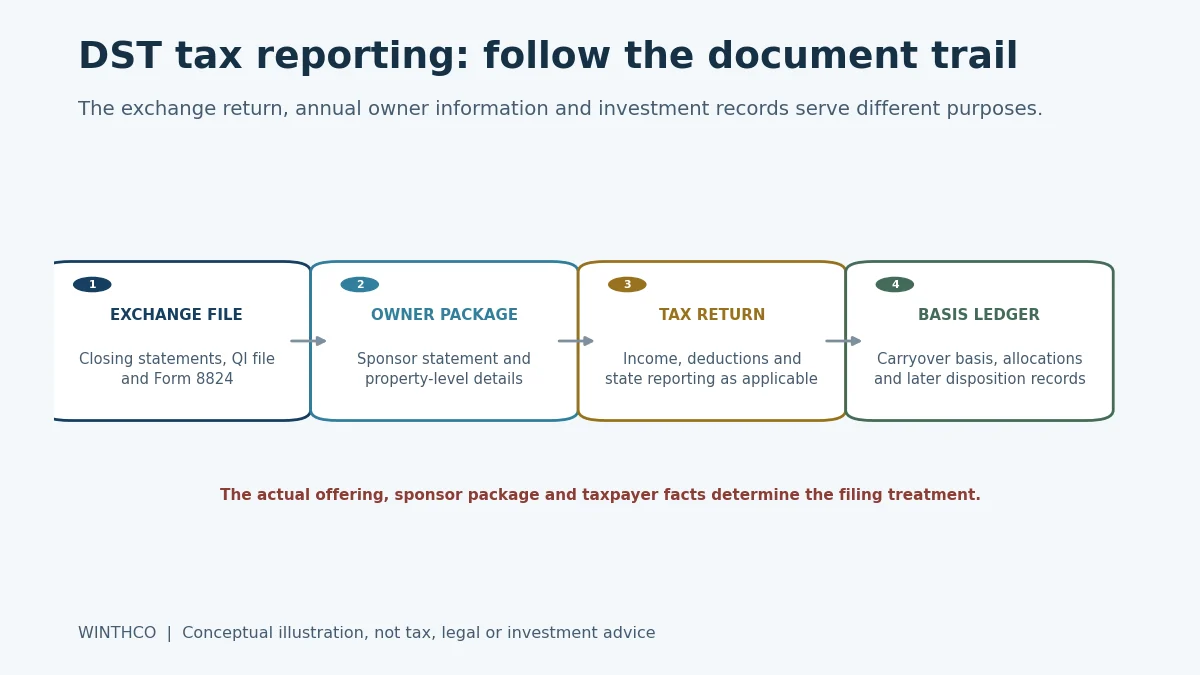
Start with the exchange file. The taxpayer should retain the relinquished-property closing statement, exchange agreement, written identification, replacement-property subscription, DST closing evidence and qualified intermediary statement. Federal Form 8824 is generally used to report a like-kind exchange, including the property transferred and received, dates, values, liabilities, cash or other property received, recognized gain and basis of replacement property. Winthco's 1031 exchange rules and deadlines overview explains the sequence, but the signed transaction documents and current IRS instructions control.
The DST interest does not erase the old property's tax history. In a qualifying deferred exchange, basis generally carries into the replacement real estate subject to adjustments for additional consideration, recognized gain and other items. That means the CPA needs more than the DST purchase amount. The return should reconcile adjusted basis, exchange expenses, liabilities, cash retained and every replacement interest. A qualified intermediary facilitates the exchange but does not prepare the investor's tax return or guarantee the result.
Share your timeline and investment range. A Winthco team member will follow up with you.
IRS Revenue Ruling 2004-86 concludes that beneficial owners of the specifically described, restricted DST are treated as owning undivided interests in the underlying real estate and may exchange into those interests if every other Section 1031 requirement is met. It does not approve every trust carrying a DST label. Tax counsel should review the actual trust powers and offering documents, while the CPA confirms how the exchange is reported for this taxpayer.
Do not assume one universal DST tax form. Revenue Ruling 2004-86 classifies its specified DST as an investment trust and applies the grantor-trust rules to the beneficial owners. Current IRS Form 1041 instructions explain that a grantor trust is generally ignored as a separate income-tax entity and that income, deductions and credits are treated as belonging directly to the owner. Depending on the permitted reporting method, an owner may receive an information statement and Forms 1099 rather than a partnership Schedule K-1.
The sponsor's package should identify the trust, the investor's ownership share and the items the investor needs to report. It may allocate rental income, interest, expenses, depreciation information, property taxes and other items across one or several properties. Timing and presentation differ by sponsor and structure. Ask in advance when tax information is expected, whether amended statements have occurred, which property-level schedules are supplied and whom the CPA may contact with a question. Winthco's DST tax reporting guide provides additional background.
A DST owner should give the full package to a tax professional familiar with passive activity, at-risk, basis and state rules. A summary distribution statement alone is not enough. The preparer may need the private placement memorandum, acquisition closing information, debt allocation, depreciation schedules and prior exchange records. If the package uses unfamiliar terminology or does not reconcile to ownership records, resolve the difference before filing rather than guessing at a Schedule E, Form 4797 or other entry.
Cash and taxable income measure different things. A DST may distribute cash collected from property operations after expenses, reserves and debt service, while the investor's tax return reflects allocated income and deductions under federal and state rules. Depreciation can reduce reported taxable income without reducing current cash. Principal payments, reserve activity, capital expenditures, lender escrows and non-deductible items can also make the two amounts diverge.
That difference is not automatically a tax benefit or a warning sign. It is a reconciliation issue. Build an annual schedule beginning with cash received, then list allocated revenue, operating expenses, interest, depreciation, reserves and other adjustments shown in the sponsor's package. The CPA should determine which items apply and how passive activity, at-risk or interest limitations affect the investor. Suspended losses, if any, need a continuing record rather than an assumption that every deduction is currently usable.
Investors should budget for the possibility that taxable income exceeds cash received. Debt reduction, reserve usage, sale activity or other property-level events can affect the calculation. Keep liquid funds outside the DST for estimated taxes and filing costs. Neither a projected distribution nor an estimated tax illustration is a promise of cash flow, deductible loss or a particular after-tax result.
Discuss your DST questions with Winthco →
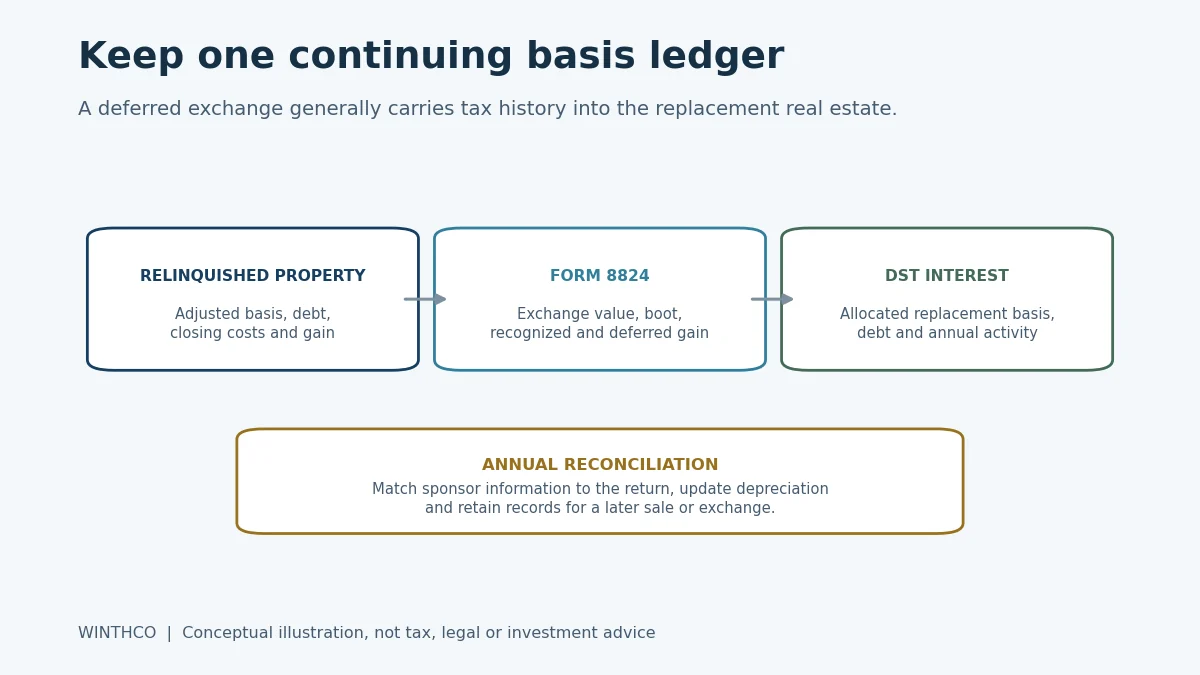
Use one continuing basis ledger that connects the old property to each replacement interest. Record relinquished-property adjusted basis, depreciation claimed, closing costs, cash, liabilities, realized gain, recognized gain and the replacement basis reported on Form 8824. Then allocate that basis across the DST properties or components as the tax package and professional advice require. Keep the underlying calculation with the filed return.
Depreciation may require more than copying the sponsor's schedule. The carryover portion of replacement basis can retain tax characteristics from the relinquished property, while additional basis may have different recovery periods or conventions. Cost segregation information, land allocations and later capital activity can add complexity. The investor's CPA should decide how the current rules apply and maintain the schedules that will support a later sale, exchange or estate filing. Winthco's Delaware Statutory Trust CPA checklist can help organize the handoff.
Debt belongs in both the tax file and the investment review. For exchange reporting, the CPA considers liabilities relieved and assumed along with cash and other property. For investment analysis, the investor should review allocated DST debt, rate, maturity, covenants, amortization and lender remedies. Debt can affect exchange calculations and projected cash flow, but matching a liability amount does not make leverage economically attractive or remove refinancing and foreclosure risk.
Potentially. A DST may own real estate in one or several states, and the investor may live in another. The owner can face nonresident income-tax returns, composite or withholding arrangements, state-specific depreciation adjustments or continuing deferred-gain reporting. State treatment is not determined by the word Delaware in the trust's name. Property locations, trust structure, source-income rules and the investor's residence matter.
Ask the sponsor for a list of property states and the prior year's sample tax package before investing, recognizing that future forms can change. Ask the CPA which returns may be required, whether estimated payments or extensions are likely and how much compliance work to expect. A small allocation across many states can create administrative cost that should be compared with the expected economic benefit. State obligations may also continue after an investor moves.
California illustrates why records matter. An exchange of California property for out-of-state replacement property can require annual Form FTB 3840 reporting until deferred California-source gain is recognized. Other states use different systems. Preserve the original state basis, every replacement step and any later sale or exchange. A sponsor's tax package can supply property data, but responsibility for a complete and timely personal return remains with the taxpayer.
WATCH & LEARN
Origin Investments' Mike O'Shea explains the DST structure and its use as replacement property. This third-party video is educational background, not a Winthco endorsement; current IRS guidance, offering documents and the investor's advisers control. Original resource · Watch on YouTube ↗
Educational context only. The discussion does not establish the suitability, returns or tax treatment of an investment.
At disposition, the sponsor may sell one property, several properties or the trust's entire portfolio. The investor may receive proceeds and a final tax package after the sale year ends. The CPA will need the continuing basis and depreciation records to calculate gain, recapture and any passive-loss consequences. If another exchange is considered, the investor must coordinate advisers before proceeds become available and confirm whether the transaction can satisfy current Section 1031 requirements.
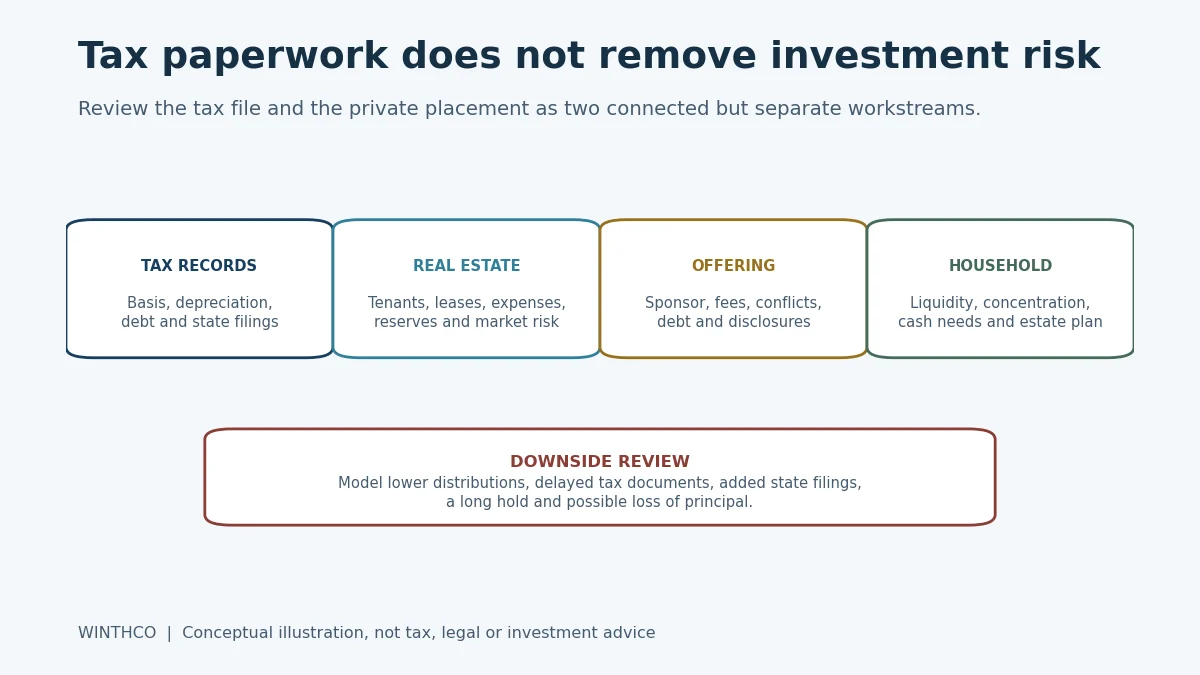
Tax records do not reduce private-placement risk. The SEC says private placements can involve limited disclosure, transfer restrictions, high illiquidity and possible total loss. FINRA advises investors to understand complex products, avoid overconcentration, review costs and recognize that limited secondary trading can force a sale at a significant loss or make a sale unavailable. Underwrite the real estate, sponsor, tenants, debt, reserves, fees, conflicts and exit authority separately from the tax analysis.
Maintain the private placement memorandum, trust agreement, subscription, closing statements, qualified intermediary file, Forms 8824, annual sponsor packages, federal and state returns, depreciation schedules and correspondence for as long as advisers recommend. Review the file annually and before any transfer, estate-planning change or proposed sale. A DST may reduce day-to-day landlord duties, but it does not promise tax deferral, current deductions, distributions, liquidity, sale timing or return of principal.
| Decision | Evidence to request | What to avoid assuming |
|---|---|---|
| Exchange-year file | Closing statements, QI records, identification, subscription and Form 8824 | The DST purchase confirmation is the complete tax file |
| Annual owner package | Actual sponsor statement, information returns and property schedules | Every DST always issues a partnership Schedule K-1 |
| Cash and tax | Reconcile distributions with allocated revenue, expenses and depreciation | Cash received always equals taxable income |
| State reporting | Property locations, residence and state deferred-gain rules | Delaware formation determines every state filing |
| Exit | Basis, depreciation, passive activity, sale documents and liquidity | The investor controls the sale date or can readily transfer the interest |
Federal Form 8824 is generally used to report a like-kind exchange. The taxpayer's CPA should complete it from the full sale, intermediary and replacement-property file.
No. A DST classified as an investment trust may use grantor-trust reporting methods rather than partnership reporting. The actual trust and sponsor package determine what the investor receives.
Yes. Cash flow and taxable activity measure different items, and property debt, reserves, expenses, depreciation and other adjustments can create a difference.
It depends on the owner statement, trust classification and underlying items. A qualified tax professional should map the sponsor package to the appropriate federal and state schedules.
Potentially. Property locations, the investor's residence and each state's source-income and deferred-gain rules can create filing or payment obligations.
Keep exchange documents, Form 8824, the offering and closing file, annual sponsor packages, returns, basis and depreciation schedules, state records and later sale documents.
No. DSTs are generally illiquid private placements exposed to real-estate, tenant, debt, sponsor, fee, concentration and possible loss-of-principal risks.
Sources checked October 8, 2026. This article explains general concepts; your facts and the applicable documents control.
Winthco DST services · Winthco evaluation overview · Editorial standards
1031 exchange planning
Plan the identification and completion periods for a deferred 1031 exchange, including the earlier tax-return deadline.
Read guide →1031 exchange planning
Understand DST debt replacement, added cash and mortgage boot with a worked example and questions for your CPA and qualified intermediary.
Read guide →DST ownership and exits
Understand DST holding periods, sponsor sale timing, early-exit limits and the tax decisions that may follow a trust's disposition.
Read guide →Explore Winthco’s main DST article collection
Share your timeline and investment range. A Winthco team member will follow up with you.