Risks and due diligence
DST investment risks: a practical due-diligence checklist
Review DST liquidity, leverage, sponsor conflicts, fees and distribution assumptions before making an investment decision.
Read guide →
Home / Learning center / DST ownership and exits
DST ownership and exits
Winthco Wealth Management · Updated October 4, 2026
A DST holding period has no universal promised length. Section 1031 requires replacement property to be held for investment or business use, while offering documents describe an expected business-plan term rather than a guaranteed sale date. Investors should plan for illiquidity, earlier or later disposition, and tax decisions at exit.
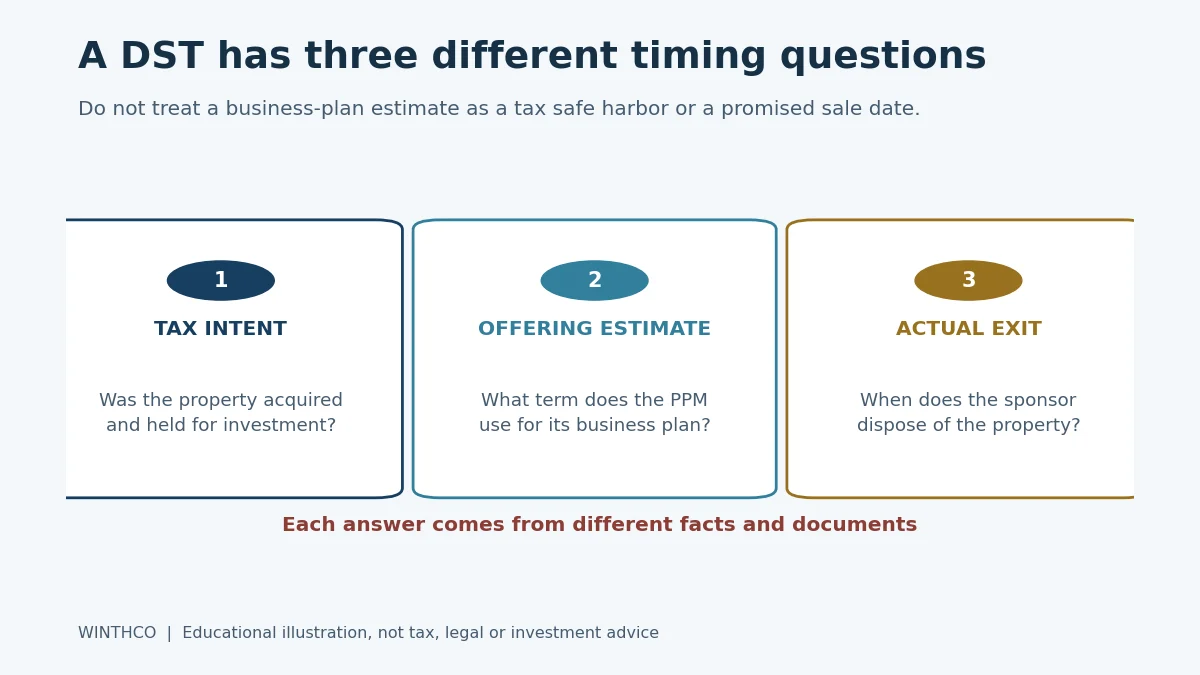
Section 1031 applies to real property held for productive use in a trade or business or for investment and received with that same purpose. The IRS fact sheet on like-kind exchanges repeats the held-for-business-or-investment requirement. Neither that fact sheet nor the statutory language supplies one numerical minimum that automatically proves investment intent for every DST replacement property. The exchange deadlines govern identification and receipt, but they do not turn an estimated sponsor sale year into an IRS-approved holding period.
Holding intent depends on the taxpayer's facts and conduct. A rapid, preplanned resale or acquisition primarily for sale can create a different issue from a sponsor deciding to dispose of a trust property under its business plan. Tax counsel should review the taxpayer's purpose, transaction documents and later actions rather than relying on an informal rule of thumb. Contemporaneous records can help explain why the property was acquired and how it was used.
Share your timeline and investment range. A Winthco team member will follow up with you.
IRS Revenue Ruling 2004-86 treats the beneficial interests in the specific Delaware statutory trust described there as interests in the underlying real property for federal tax purposes. The ruling is fact-specific and does not promise a holding period or disposition date. Review the actual structure, and use the main Winthco overview of the DST holding-period considerations as background rather than as a substitute for transaction-specific tax advice.
A private placement memorandum may describe an anticipated holding period, a business-plan horizon or assumptions used in projections. Those descriptions are planning estimates, not maturity dates and not guarantees that the property will be sold in a stated year. The trustee or sponsor generally controls the property sale under the trust documents, subject to the authority and restrictions disclosed in the offering. An investor usually cannot require a sale merely because the expected period has passed.
Read the language around the estimate. Ask whether the period starts when the sponsor acquired the property, when the offering began, when the investor subscribed or when the offering closed. Those dates can differ. Also ask whether the stated term is an objective, an assumption in a financial model or a limit that may be extended under specified circumstances. Compare the summary with the governing provisions, not just a marketing slide.
The business plan should be reviewed alongside leases, debt maturity, interest-rate terms, reserves, capital improvements and market assumptions. A planned sale can be delayed when financing markets are unfavorable, a tenant problem reduces value or improvements take longer than expected. A sale can also occur earlier when the sponsor determines that a disposition is permitted and appropriate. Neither outcome assures a favorable price.
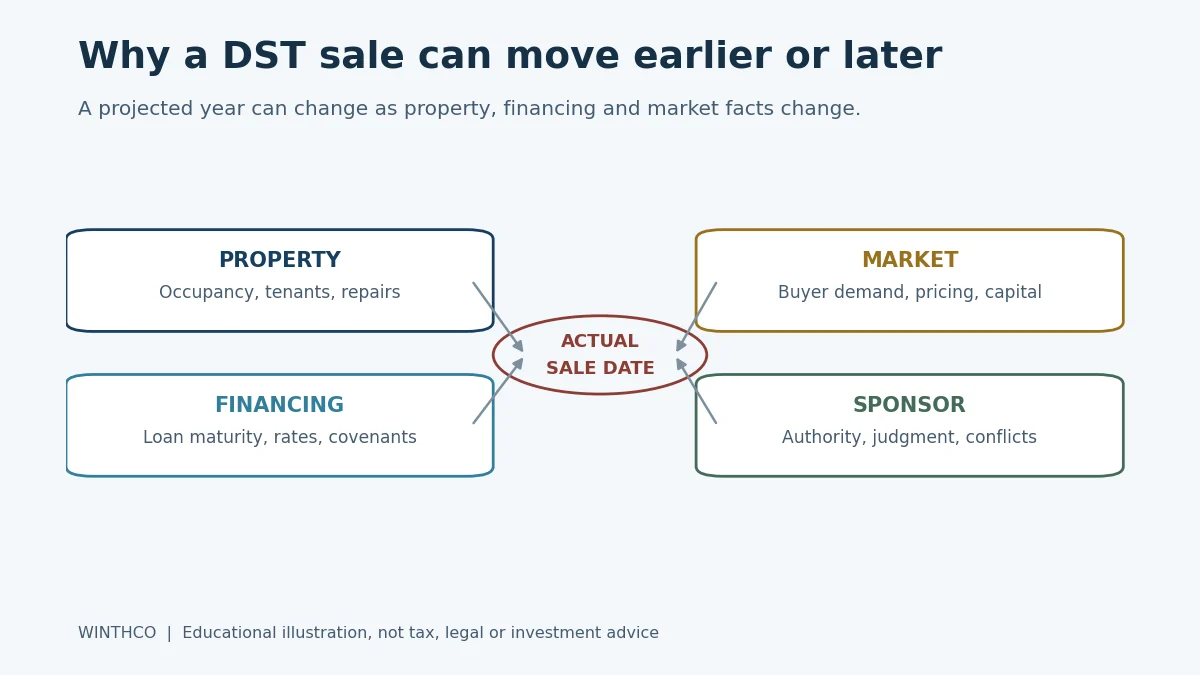
Property performance is one driver. Occupancy, rent collections, lease expirations, tenant credit, operating expenses and required repairs can change the timing and attractiveness of a sale. A portfolio with several properties may also require decisions about whether the trust can sell assets separately or must dispose of them together, as described in the governing documents.
Capital markets are another driver. Interest rates, lender requirements, buyer financing and capitalization rates can affect both demand and value. Debt maturity may create pressure to sell, refinance within the trust's limited powers or pursue another permitted transaction. Investors should examine the loan term and extension options rather than assume the stated business-plan horizon and the debt schedule match perfectly.
Sponsor judgment and conflicts also matter. Review who decides to sell, what fees may be paid at disposition, whether affiliates can participate and how proceeds are allocated. The framework for evaluating a DST should include exit authority and incentives, not only initial distributions. An earlier sale can trigger reinvestment decisions sooner than expected, while a delayed sale can keep capital illiquid longer.
Discuss your DST questions with Winthco →
A DST interest is generally an illiquid private-placement security. It is not traded on a national securities exchange, and a reliable secondary market may not exist. FINRA warns that limited secondary trading can leave an investor unable to sell or able to sell only at a significant loss. The SEC likewise cautions that private-placement investors may have difficulty reselling their securities.
A requested transfer may also be limited by securities laws, the trust agreement, sponsor consent, purchaser eligibility, lender restrictions and administrative requirements. Even when a transfer is legally possible, finding a qualified buyer and agreeing on a price can take time. The private placement memorandum and trust documents should explain transfer restrictions and any available procedures.
Do not build a spending or emergency plan around an assumed secondary sale. Before subscribing, identify liquid resources available for taxes, health costs, family needs and other obligations throughout a longer-than-expected hold. Also decide what level of discount or delay would make an early sale unacceptable. Accreditation permits access to certain offerings, but it does not create liquidity or protect principal.
When the trust disposes of its property, the documents determine how liabilities, transaction costs, reserves and net proceeds are handled. The result can be more or less than the original investment. Past distributions do not establish the sale value, and an appraisal or sponsor projection is not a promise of the price a buyer will pay.
For an investor who acquired the DST interest through Section 1031, a later taxable sale can bring deferred gain and additional gain into the tax analysis. The IRS explains that Section 1031 defers gain rather than eliminating it, and that when replacement property is later sold outside another exchange, the deferred gain plus additional gain may be subject to tax. Basis records should be maintained from the original exchange forward.
A future exchange may be possible if the investor and transaction satisfy the rules then in effect, but it is not automatic. The investor may need a qualified intermediary before the disposition, must meet identification and completion deadlines, and must acquire qualifying replacement property. The DST 1031 exchange process should be coordinated early because receiving proceeds directly can jeopardize a planned deferred exchange.
WATCH & LEARN
Winthco Wealth Management provides a general introduction to DST planning in its 1031 DST Welcome Video. Use it as background education and rely on the actual offering documents for holding-period and exit terms. Original resource · Watch on YouTube ↗
Educational context only. The discussion does not establish the suitability, returns or tax treatment of an investment.
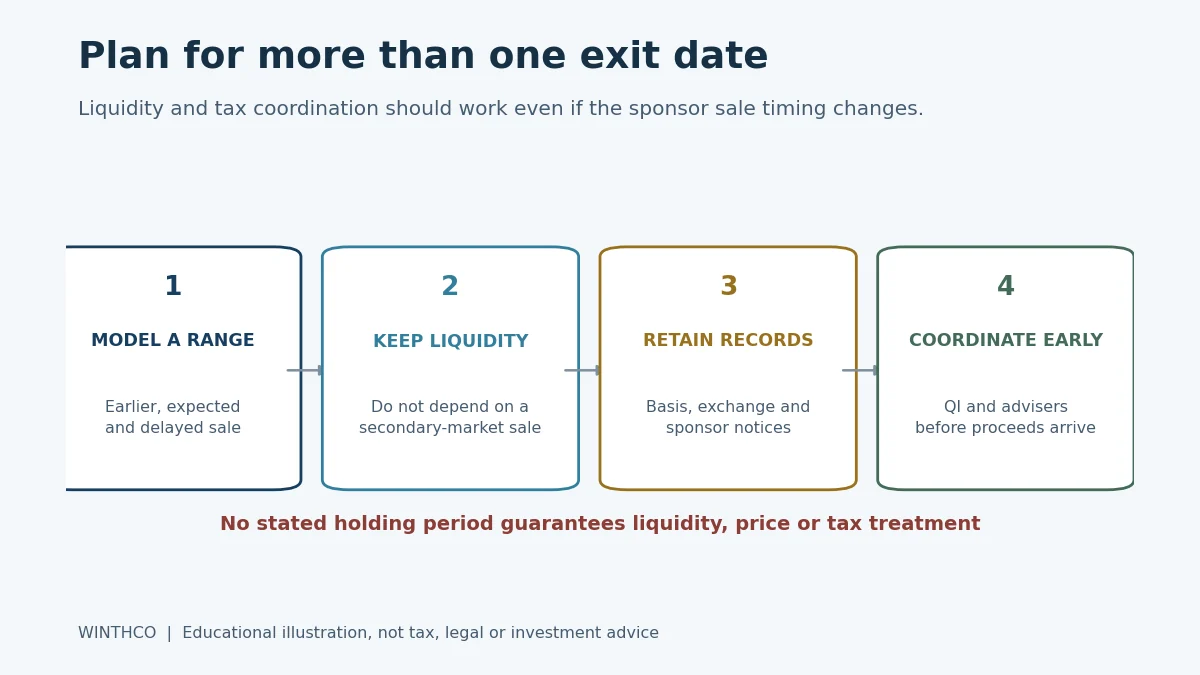
Start with a written range rather than a single expected year. Model an earlier disposition, the stated business-plan horizon and a meaningful delay. For each case, list cash needs, tax-adviser availability, qualified-intermediary steps and possible replacement-property research. Scenario planning cannot predict the sale, but it can show whether the household depends on timing it does not control. Include a case in which sale proceeds are lower than the original investment.
Track the property and financing throughout the hold. Review sponsor reports for occupancy, major tenants, lease expirations, capital work, reserves, loan covenants and maturity dates. Ask what changed from the original assumptions and whether a sale, refinance or extension is being considered. A reduced distribution or changed valuation should prompt questions, not an assumption that liquidation is imminent. Keep sponsor notices and tax records in one accessible file.
Before investing, confirm the planned hold aligns with age, health, estate objectives, other real estate exposure and available liquidity. Read the full offering documents and discuss the exit terms with securities, tax and legal professionals. No stated holding period guarantees a sale date, liquidity, distributions, appreciation, tax deferral or return of principal.
| Decision | Evidence to request | What to avoid assuming |
|---|---|---|
| Tax holding intent | Taxpayer purpose, conduct and property held for investment or business use | One informal minimum always proves Section 1031 intent |
| Expected offering hold | PPM language, assumptions, debt term and extension provisions | A projected year is a maturity date or sale promise |
| Early investor exit | Transfer restrictions, buyer eligibility, consent, price and timing | A ready secondary market will be available |
| Sponsor disposition | Sale authority, costs, conflicts, liabilities and net-proceeds process | Prior distributions predict the final sale value |
Offering materials often present an expected business-plan horizon, but no period is universal or guaranteed. The actual sale may occur earlier or later based on the property, financing, market and sponsor decision.
The cited Section 1031 statute and IRS fact sheet require property to be held for investment or business use, but they do not state a universal two-year minimum for every DST. Ask tax counsel to evaluate intent and the specific facts.
A transfer might be possible under the documents and applicable law, but DST interests are generally illiquid. Restrictions, consent requirements, purchaser eligibility and a limited buyer market can prevent or delay a sale or reduce the price.
Potentially, if the trust and offering documents permit continued ownership and the sponsor determines a sale is not appropriate. Review the disclosed authority, debt term and extension risks.
Distributions can continue, change, be reduced or stop depending on property cash flow, reserves, financing and expenses. They are not guaranteed by the expected holding period.
Potentially, if the transaction and replacement property meet the rules then in effect and the exchange is structured before the investor receives proceeds. Coordinate the qualified intermediary and tax adviser early.
Not necessarily. A sale can occur for favorable or unfavorable reasons, and the net result depends on price, debt, costs, property performance and the investor's tax situation.
Sources checked October 4, 2026. This article explains general concepts; your facts and the applicable documents control.
Winthco DST services · Winthco evaluation overview · Editorial standards
Risks and due diligence
Review DST liquidity, leverage, sponsor conflicts, fees and distribution assumptions before making an investment decision.
Read guide →Risks and due diligence
Learn how to review DST acquisition costs, ongoing expenses, financing charges and exit fees without relying on a single headline number.
Read guide →Investor decision-making
Use practical questions about registration, compensation, due diligence, coordination and follow-up when evaluating a DST advisor.
Read guide →Explore Winthco’s main DST article collection
Share your timeline and investment range. A Winthco team member will follow up with you.