1031 exchange planning
1031 exchange deadlines: the 45-day and 180-day rules
Plan the identification and completion periods for a deferred 1031 exchange, including the earlier tax-return deadline.
Read guide →
Home / Learning center / 1031 exchange planning
1031 exchange planning
Winthco Wealth Management · Updated November 11, 2026
If your 1031 replacement property falls through, first confirm whether the 45-day identification period is still open. You may be able to change a timely identification before it closes. After that, review what you already validly identified, whether it can close on time, and whether a qualifying DST backup still makes financial sense.
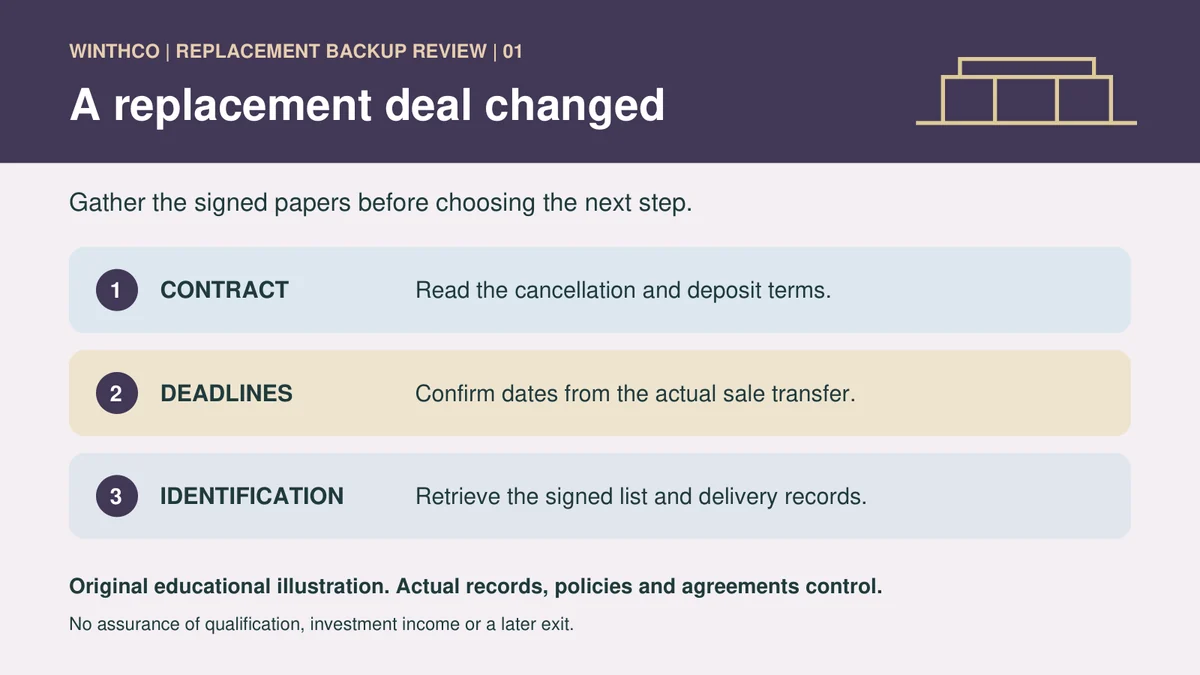
Interview a licensed broker who has sold comparable investment properties. Ask which closed sales support the expected price, how the broker evaluates a buyer's ability to close, and what inspection or financing contingencies could delay the transfer. Review fees and get an estimated settlement statement. If you want a deferred exchange, bring your CPA, attorney and qualified intermediary into the process before you close or receive the proceeds. Ask the CPA to estimate both an exchange and a taxable sale, so you can decide what to do if the replacement fails. Your broker can negotiate timing and contingencies but does not determine the tax result. If the disruption stems from a federally declared disaster, see disaster-related disruption and possible postponement before assuming the calendar changes.
Under Treasury Regulation 1.1031(k)-1, the identification period ends at midnight on the 45th day after transfer of the relinquished property. The exchange period ends at midnight on the earlier of the 180th day after that transfer or the federal income tax return due date for the transfer year, including extensions. Those periods run concurrently, not one after the other. Confirm the actual dates in writing with your intermediary and CPA. A replacement seller's cancellation, a lender's delay or a lost deposit does not by itself restart either period. Use Winthco's overview of 1031 exchanges with a DST to understand where a qualifying trust interest may fit.
Share your timeline and investment range. A Winthco team member will follow up with you.
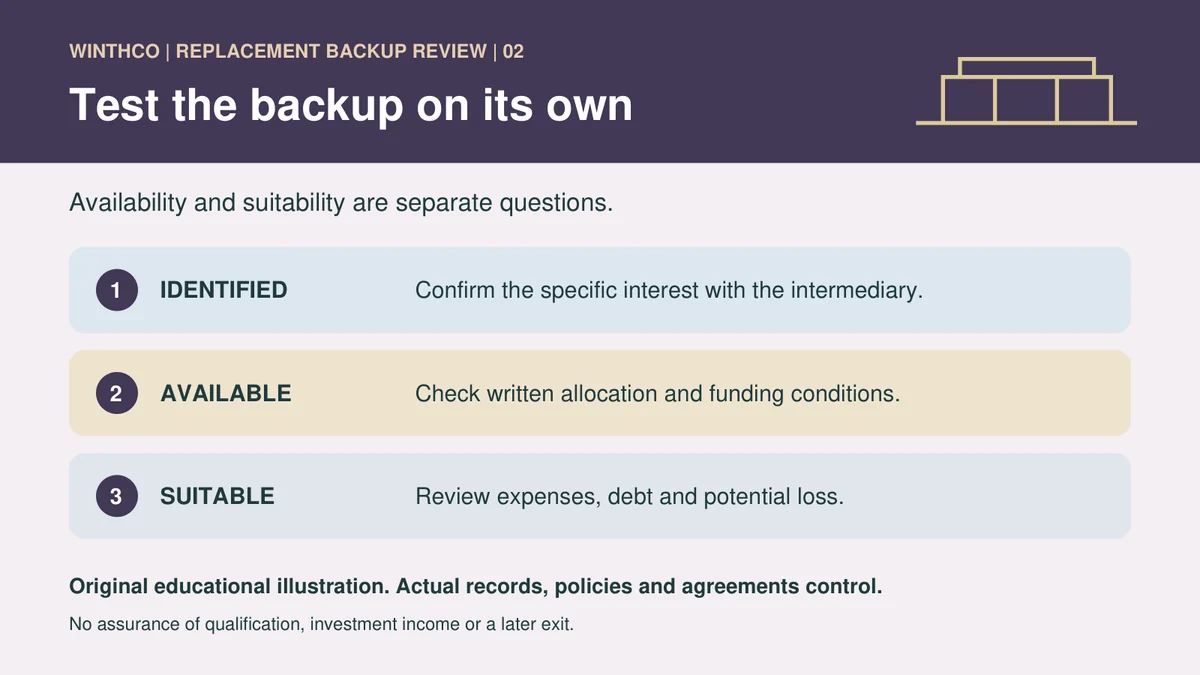
Tell your qualified intermediary immediately and send your attorney the purchase agreement and cancellation notice. Review whether the existing identification needs to be revoked, how a new identification must be delivered, and whether the replacement is realistic at the projected price. A replacement property generally must be identified in a signed writing with an unambiguous description and delivered in time to an eligible recipient. A revocation must be signed and sent in time to the person who received that identification. If the identification is in the exchange agreement itself, ask counsel about the written amendment rule. Canceling a purchase agreement is not the same as revoking a tax identification. Keep copies of the original and revised lists and the delivery evidence.
Discuss your DST questions with Winthco →
Ask the intermediary for the final list and documentation before calling a new seller. In the ordinary deferred exchange, you generally cannot add a new property after the identification period. A different property already validly identified may still work if you can receive substantially the same property identified by the applicable exchange deadline and otherwise meet the rules. Check price, financing, title, condition and timing independently. If the original property is the only valid identification and cannot close, do not assume a new letter or an attractive DST can salvage the exchange. Ask the CPA about reporting the sale and counsel about any rights under the canceled contract.
Put only candidates you would seriously consider through due diligence on the list. The three-property rule permits identification of up to three properties without regard to their fair market value. A different rule permits more properties if their aggregate fair market value does not exceed 200 percent of the aggregate fair market value of the relinquished properties, using the valuation dates specified in the regulation. Over-identification can invalidate the list, subject to limited exceptions. The 95-percent rule generally requires receiving at least 95 percent of the aggregate fair market value of the identified properties and is not an easy fallback. Ask the intermediary to confirm how the rules apply to the complete list, including the precise interest in any trust.
WATCH & LEARN
David and Tom Moore of Equity Advantage 1031 Exchange discuss the identification period and common mistakes. This third-party educational video does not determine whether a particular replacement qualifies. Original resource · Watch on YouTube ↗
Educational context only. The discussion does not establish the suitability, returns or tax treatment of an investment.
Imagine an owner identifies a small industrial property and a specific qualifying DST candidate. On day 60, the industrial seller cannot deliver clear title on time. The owner verifies whether the DST identification describes the interest accurately and asks for current written availability. Counsel and the CPA review the interest and deal terms; the intermediary confirms what documents and settlement steps are still required. If the trust interest is no longer available or the economics are unacceptable, the owner does not assume a similar DST can be substituted. The decision is whether the documented backup works on its own merits, not how to save the original plan at any price.
A DST may reduce direct management work, but it is not a reservation of property or a guarantee of qualification. Revenue Ruling 2004-86 applies to the trust structure and facts it describes. Ask counsel and your tax adviser to review the actual trust documents and your transaction. Use Winthco's guide to evaluating a DST offering to read the private placement memorandum, purchase terms and trust agreement alongside the loan, leases and reserve information. Ask about subscription cutoffs, availability, accreditation and funding conditions. A name on an identification list does not hold an allocation. Keep enough time to examine the actual terms and have a clear decision point if documents are not available.
Private DST offerings are generally directed to accredited investors. Interests can be hard to value or resell, and investors typically have limited control. Check up-front and ongoing costs, sponsor compensation and conflicts, tenant exposure, loan maturity and reserves. A distribution can decline or stop, and the hold can last longer than expected. A highly leveraged or concentrated property can lose value and investors can lose principal. Compare the DST with direct ownership and a taxable sale, including the cost of a lost deposit or time spent on a failed purchase. If the only available investment exposes you to risks you cannot absorb, do not treat possible deferral as the deciding factor.
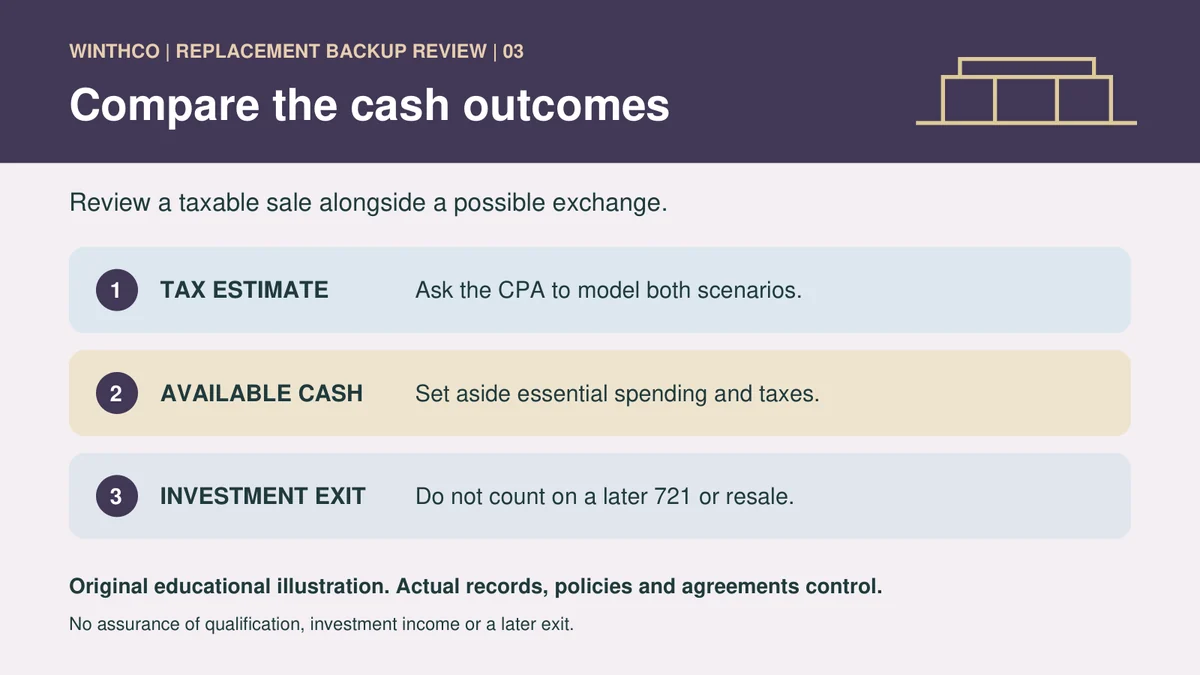
Read the exchange agreement before assuming the intermediary can release funds as soon as a purchase falls through. The qualified intermediary safe harbor generally limits when you can receive, pledge, borrow or otherwise benefit from the money. The agreement and applicable rules determine when a release is possible. Keep deposit refunds, settlement credits and exchange funds distinct and ask counsel how each should be handled. Have the CPA model potential recognized gain, depreciation consequences, cash or other non-like-kind property received and the effect of liabilities. Neither the timing of a release nor the cash balance alone determines what tax you owe or when it is reported.
No. A possible future contribution to a real estate operating partnership is a separate transaction under Section 721, with different documents, conditions and tax analysis. Ordinary REIT shares and operating partnership units are not direct replacement real property for Section 1031. A later 721 opportunity may never be offered or completed. If a contribution is proposed later, compare the valuation, control, fees, debt and any limits on conversion or redemption with your actual needs. Do not assume the units will produce cash on demand or that the potential transaction justifies accepting an unsuitable DST now.
Make a short decision sheet showing the deadline, qualified candidates still available, maximum acceptable property exposure and cash that must remain accessible for taxes and essential spending. Ask your CPA to compare what happens if the exchange does not close with the long-term cost and risk of the backup. Review taxable investments, existing IRAs and 401(k)s, beneficiary choices, expenses and account services with your financial advisor. Those retirement accounts are not exchange proceeds, and the property sale does not require a rollover. Winthco Wealth Management can help you compare liquidity and portfolio concentration across the alternatives alongside your tax and legal advisers.
| Decision | Evidence to request | What to avoid assuming |
|---|---|---|
| Failure before day 45 | Review written revocation and replacement identification with the intermediary | A purchase cancellation automatically changes the tax list |
| Failure after day 45 | Check what was validly identified and can still close | A similar property is automatically a permitted substitute |
| DST backup | Confirm exact interest, availability, documents and suitability | An identification reserves a trust allocation |
| No suitable closing | Compare tax, fund release and liquidity with advisers | Funds can always be released immediately |
No, an ordinary deal failure does not reset the identification period. Confirm your deadlines and any separately applicable relief with your tax team.
Not by itself. Review the signed revocation and timely delivery rules with your intermediary and attorney.
Potentially, if the specific interest was validly identified and the acquisition and trust structure meet the applicable requirements. A similar DST that was not on the list is not automatically interchangeable.
A separate value-based rule may permit more than three. Check the full list, valuation dates and fair market values with your exchange team rather than relying on a last-minute exception.
Compare the possible deferral with fees, liquidity and potential loss. Have your CPA model the taxable alternative and decide whether the investment makes sense without the deadline pressure.
Sources checked November 11, 2026. This article explains general concepts; your facts and the applicable documents control.
Winthco DST services · Winthco evaluation overview · Editorial standards
1031 exchange planning
Plan the identification and completion periods for a deferred 1031 exchange, including the earlier tax-return deadline.
Read guide →1031 exchange planning
Understand the three-property, 200 percent and 95 percent identification rules before naming DST replacement property.
Read guide →DST investment due diligence
Selling a rental property? Learn how to review a DST private placement memorandum, compare fees and risks, and assess separate 721 UPREIT terms.
Read guide →Explore Winthco’s main DST article collection
Share your timeline and investment range. A Winthco team member will follow up with you.