Risks and due diligence
DST investment risks: a practical due-diligence checklist
Review DST liquidity, leverage, sponsor conflicts, fees and distribution assumptions before making an investment decision.
Read guide →
Home / Learning center / DST investor eligibility
DST investor eligibility
Winthco Wealth Management · Updated October 4, 2026
The SEC published five notices on September 30, 2026 considering additional professional credentials and a possible FINRA exam for accredited investor status. These are not final changes. Current Regulation D standards still control, and qualifying as accredited would remain separate from DST suitability, 1031 eligibility and investment due diligence.
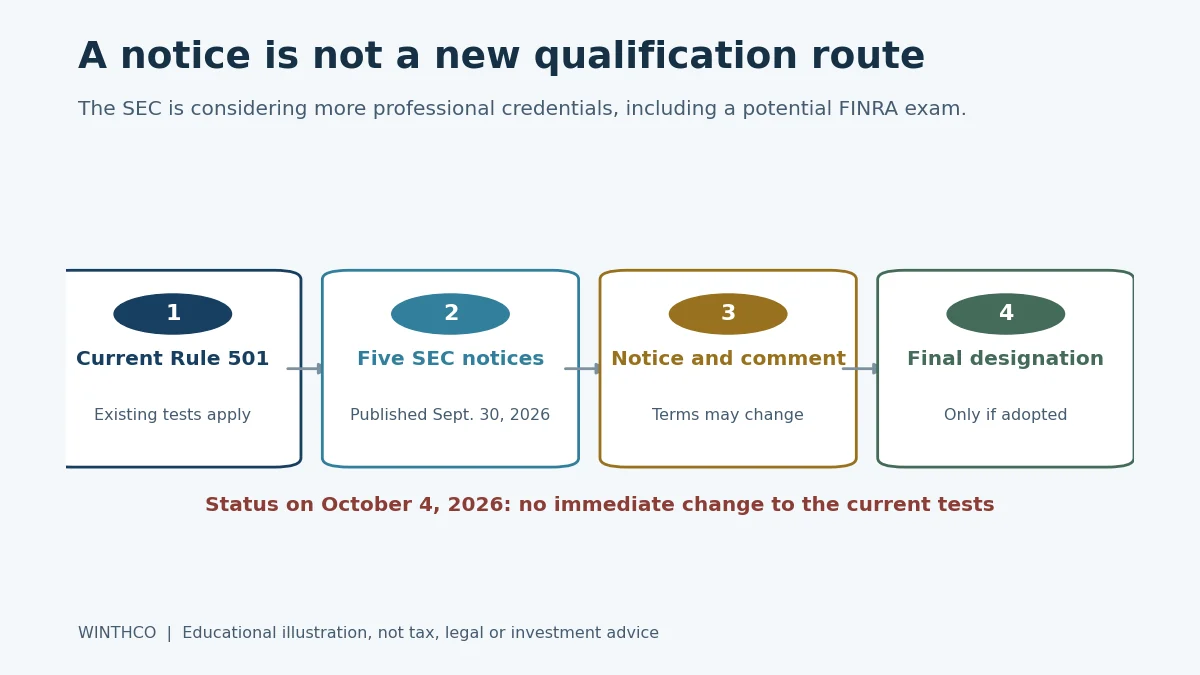
The Securities and Exchange Commission said it published five notices considering an expansion of the professional certifications, designations and credentials that could qualify an individual as an accredited investor. The SEC's official video specifically mentions a potential FINRA accredited investor examination. The announcement describes matters under consideration, not a final rule or an immediately available qualification path.
Current Rule 501(a)(10) already lets the SEC designate qualifying credentials by order after notice and an opportunity for public comment. The rule asks whether a credential is based on an examination, demonstrates securities and investing comprehension, supports an ability to evaluate merits and risks, and can be independently verified. Any additional path must go through that process before investors may rely on it.
Share your timeline and investment range. A Winthco team member will follow up with you.
As of October 4, 2026, use the existing tests when reviewing current DST accredited investor rules. Do not assume that studying for an anticipated exam, holding a credential discussed in a notice or meeting a sponsor's informal description changes legal status. The final scope, conditions and effective date could differ from what is being considered, or the Commission could decide not to designate a proposed credential.
Under the current SEC framework, an individual can qualify through net worth above $1 million, excluding the primary residence under the rule's calculation provisions. Another path is individual income above $200,000, or joint income with a spouse or spousal equivalent above $300,000, in each of the prior two years with a reasonable expectation of reaching the same level in the current year. Net worth requires more than adding account balances because the rule also addresses liabilities secured by a primary residence and certain increases in that debt.
Professional paths currently include holding a Series 7, Series 65 or Series 82 license in good standing. Other categories cover certain directors, executive officers or general partners of the issuer, qualifying family clients and knowledgeable employees of a private fund for investments in that fund. The applicable category and supporting evidence should be checked for the particular offering and purchaser.
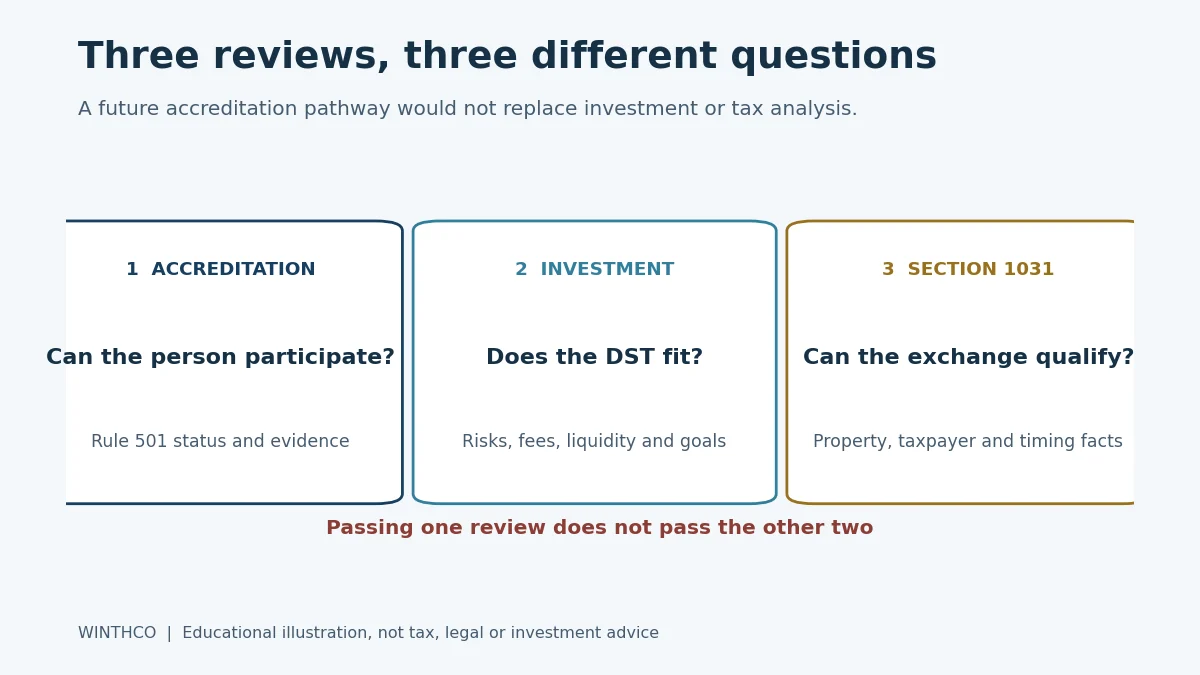
Accredited status is an eligibility standard used in private-market exemptions. It is not an SEC approval of the investor, the DST, the sponsor or the transaction. It does not establish that an investment is suitable, affordable or likely to perform. It also does not replace an issuer's or intermediary's verification procedures, the subscription agreement or any state-law and firm requirements that apply.
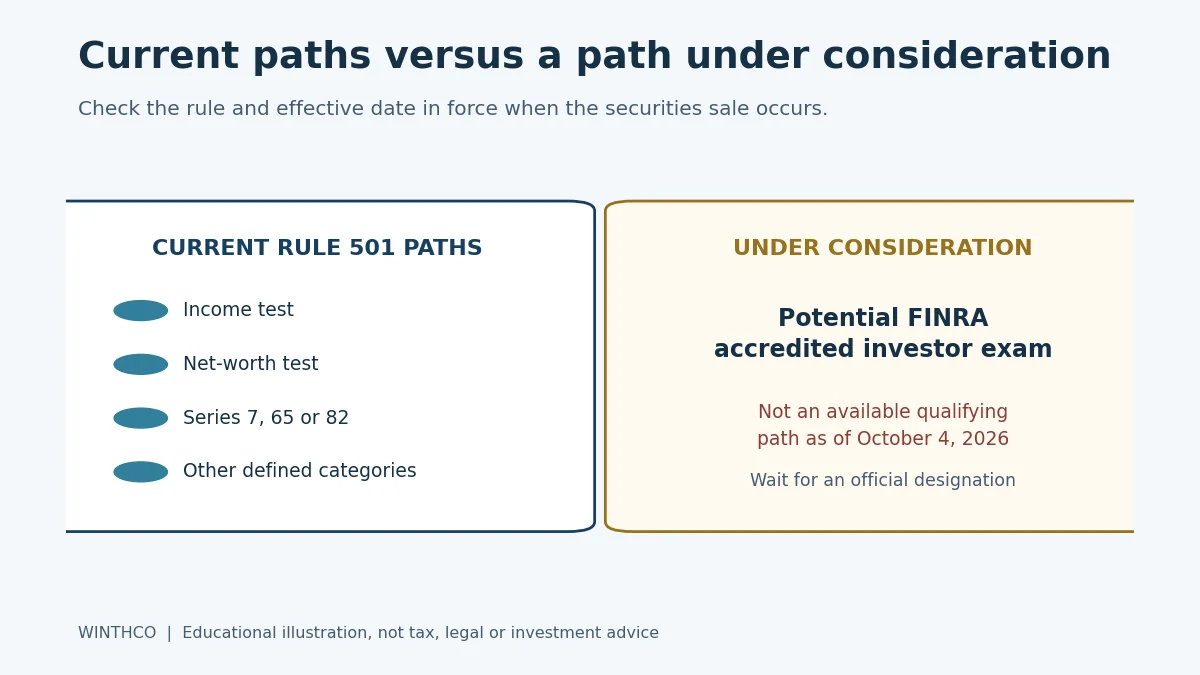
The SEC's September 30 announcement confirms only that a potential FINRA accredited investor exam is among the ideas being considered. It does not say that such an examination is available today. Until the Commission designates a credential and the relevant organization establishes an approved process, an investor cannot claim accredited status merely by planning to take, preparing for or passing a different exam.
Important operational questions remain open in the official summary. Investors should wait for primary-source details about the examination's content, passing standard, administration, verification, continuing requirements and effective date. They should also look for any limits on who may take it or how long qualification lasts. Marketing claims about an easy new pathway should be compared with the final SEC order and FINRA materials, if adopted.
Even if an examination becomes a qualifying credential, knowledge demonstrated on a test would not supply liquidity or absorb investment loss. It would not create a duty for a sponsor to accept a subscription, and it would not replace a financial professional's evaluation of the investor's objectives, time horizon, concentration, cash reserves and capacity to hold an illiquid security. Eligibility and suitability remain different questions.
Discuss your DST questions with Winthco →
Many syndicated DST interests are offered as unregistered securities through Regulation D private placements. A broader credential pathway could eventually allow some individuals who do not meet the income or net-worth tests to qualify for offerings that require accredited status. That potential access is the practical reason the SEC notices matter, but no investor should change plans until a final designation actually applies.
A credential would address only securities-law eligibility. It would not decide whether a particular DST interest is real property for Section 1031 purposes. IRS Revenue Ruling 2004-86 reached that conclusion for the specific trust and facts described in the ruling. A tax adviser and qualified intermediary should review the actual trust structure, taxpayer, identification, timing and closing steps before exchange funds are committed.
The process for investing in a Delaware statutory trust still requires separate tax, legal, securities and operational reviews. Exchange deadlines can also create pressure that the SEC credential process cannot relieve. An investor considering a DST replacement property should prepare alternatives before the relinquished property closes and should never assume a future accreditation route will become effective within the 45-day identification or exchange period.
The SEC warns that private placements can provide less information than registered offerings, can be difficult to resell and may expose investors to a substantial or total loss. DST interests generally have limited secondary markets, and investors usually surrender day-to-day control to the trustee or sponsor. Distributions can be reduced or suspended, property values can fall and a sale can occur later or at a lower price than projected.
Use a consistent framework for evaluating a DST: read the private placement memorandum, trust agreement and subscription documents; examine property condition, tenants, leases, market assumptions, reserves, financing, fees, conflicts and sponsor authority; and compare downside scenarios with the household's liquid resources. Projections are not promises, and accreditation does not cure a weak property, expensive capital structure or mismatched holding period.
FINRA advises investors to understand the features, risks, fees and expenses of alternative products and to consider concentration across correlated holdings. A household that already owns substantial real estate may remain heavily exposed after purchasing a DST. Review geographic, property-type, tenant, sponsor and debt concentrations, plus the ability to meet taxes and spending needs without selling the interest.
WATCH & LEARN
The U.S. Securities and Exchange Commission summarizes its September 30, 2026 notices considering additional ways individuals could qualify as accredited investors. The video is an official SEC resource and describes matters under consideration, not a final rule. Original resource · Watch on YouTube ↗
Educational context only. The discussion does not establish the suitability, returns or tax treatment of an investment.
First, verify status under the rules that are effective today. Use the current eCFR text, SEC accredited-investor resources and the offering's written requirements. Keep documents supporting the category used, but do not send sensitive financial information through an ordinary marketing form. A sponsor, broker-dealer, attorney, accountant or other authorized party may request specific evidence under the offering's verification procedure. Ask how the evidence will be transmitted, retained and protected before providing it.
Second, monitor official SEC and FINRA publications rather than headlines or social posts. If the Commission issues an order, read the designated credential, conditions and effective date. Confirm that any exam or professional status is independently verifiable and in good standing when required. A final order may not match the current discussion, so relying on draft descriptions can lead to a rejected or delayed subscription.
Third, keep the three reviews separate: accredited investor status, investment suitability and Section 1031 qualification. Coordinate the securities professional, tax adviser, attorney and qualified intermediary, while reading the actual offering documents. The SEC notices may change who can qualify in the future, but they do not guarantee acceptance, tax deferral, distributions, appreciation, liquidity or return of principal.
| Decision | Evidence to request | What to avoid assuming |
|---|---|---|
| Accredited status | Current Rule 501 category and required supporting evidence | A proposed exam or discussed credential is already effective |
| Investment review | Offering documents, risks, fees, liquidity and household fit | Accredited status establishes suitability or quality |
| 1031 review | Actual trust structure, taxpayer, identification, timing and receipt | Securities eligibility guarantees tax deferral |
| Future change | Final SEC order, conditions, effective date and verification method | A notice or video summary creates a new legal pathway |
No immediate change was announced. The SEC said it published five notices considering additional credentials and a potential FINRA exam. Current Rule 501 standards still apply unless and until an official designation becomes effective.
The SEC announcement describes a potential exam under consideration. It does not establish that an approved qualifying exam is currently available.
The SEC currently identifies Series 7, Series 65 and Series 82 licenses held in good standing as qualifying professional credentials. Other Rule 501 categories may apply based on the investor and offering.
No. Accreditation is only one eligibility element. The offering may impose additional verification, acceptance, suitability, availability, state-law and firm requirements.
No. DST private placements can be illiquid and may involve property, tenant, financing, sponsor, fee, concentration and loss risks.
No. Securities-law eligibility and Section 1031 tax treatment are separate. The actual trust, taxpayer, timing, identification and transaction documents must be reviewed.
Monitor SEC orders, the current eCFR text and FINRA publications. Confirm the final conditions and effective date before relying on any new pathway.
Sources checked October 4, 2026. This article explains general concepts; your facts and the applicable documents control.
Winthco DST services · Winthco evaluation overview · Editorial standards
Risks and due diligence
Review DST liquidity, leverage, sponsor conflicts, fees and distribution assumptions before making an investment decision.
Read guide →Investor decision-making
Use practical questions about registration, compensation, due diligence, coordination and follow-up when evaluating a DST advisor.
Read guide →DST eligibility and risk
Learn the DST accredited investor income, net worth, credential and entity tests before planning a 1031 exchange.
Read guide →Explore Winthco’s main DST article collection
Share your timeline and investment range. A Winthco team member will follow up with you.