Risks and due diligence
DST investment risks: a practical due-diligence checklist
Review DST liquidity, leverage, sponsor conflicts, fees and distribution assumptions before making an investment decision.
Read guide →
Home / Learning center / 1031 replacement property
1031 replacement property
Winthco Wealth Management · Updated October 6, 2026
A debt-free DST has no property-level mortgage, while a leveraged DST combines investor equity with property debt. Neither is inherently better. Compare the exchange's net liability calculation, added cash, interest and maturity terms, cash-flow resilience, reserves, fees, concentration and liquidity before choosing a structure.
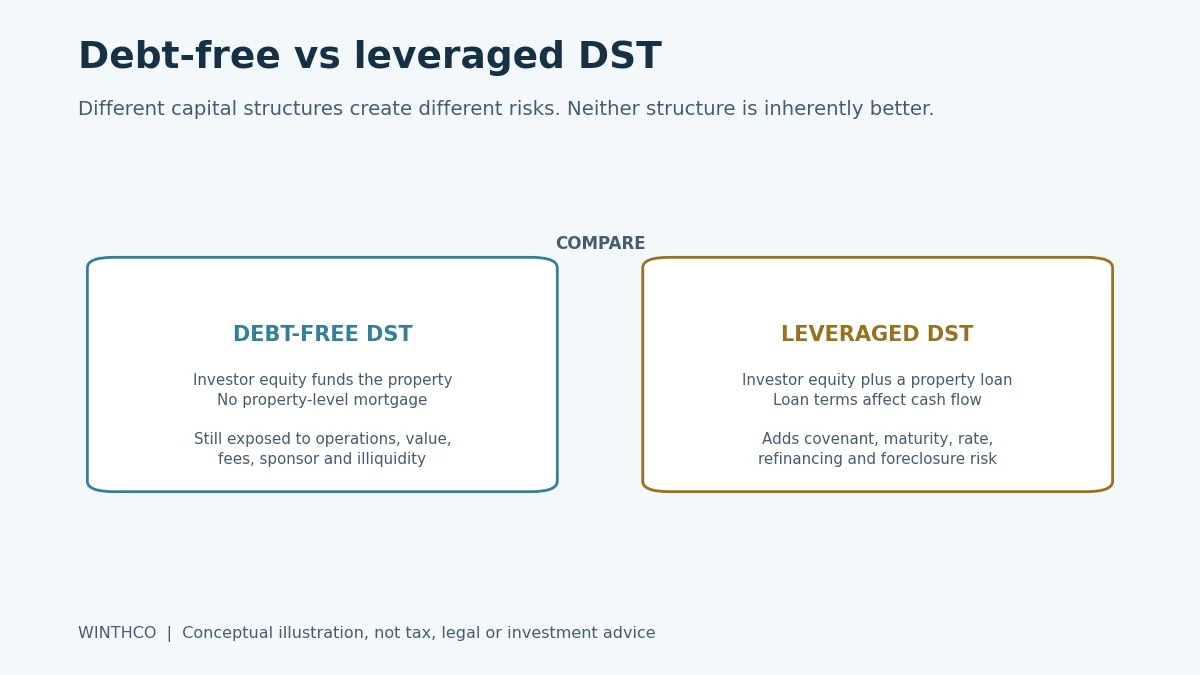
A debt-free Delaware statutory trust owns its property without a property-level mortgage. Investor equity and any established reserves make up the capital structure. Removing the loan avoids interest expense, payment defaults, lender covenants, maturity pressure and mortgage foreclosure. It does not make the investment safe. Property income can decline, expenses can rise, the sponsor can make poor decisions, and the property can lose value. Winthco's debt-free DST overview provides additional background on that structure.
A leveraged DST uses investor equity plus a loan secured by the property. Each investor is generally allocated a proportionate share of the trust's liabilities for the offering's tax and economic analysis, subject to the governing documents and applicable law. Debt can increase the amount of property acquired with a given amount of equity, but it also adds interest, covenants, amortization, maturity, refinancing and foreclosure risk. Leverage can magnify gains and losses.
Share your timeline and investment range. A Winthco team member will follow up with you.
The useful comparison is not debt versus no debt in isolation. Review the exact property, purchase price, leases, cash-flow assumptions, reserves, sponsor compensation and exit authority under both structures. A debt-free offering with weak tenants or an expensive purchase price may be less resilient than a conservatively financed property with durable income. Conversely, a sound property can still be impaired by an inflexible or poorly timed loan.
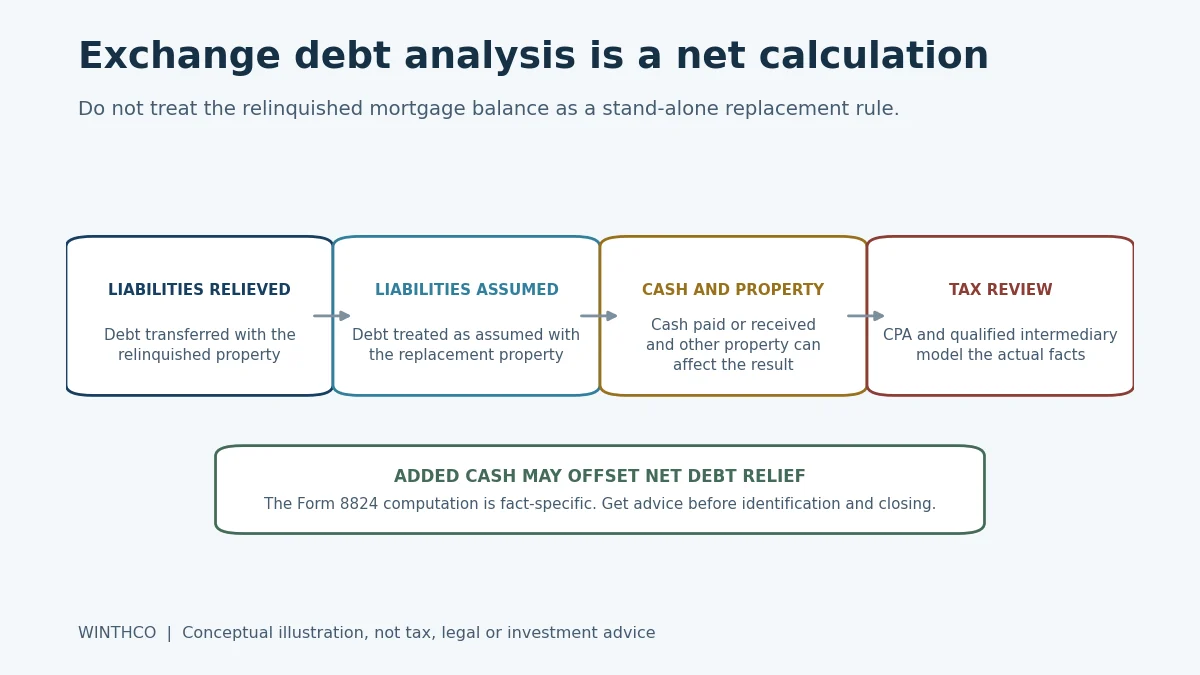
A common shortcut says an exchanger must replace the old mortgage dollar for dollar. The IRS calculation is more precise. The 2025 Instructions for Form 8824 include cash received, non-like-kind property received and net liabilities assumed by the other party in the amount potentially treated as other property or money. The instructions also account for liabilities the exchanger assumes, cash the exchanger pays and other property given.
Treasury Regulation 1.1031(d)-2 illustrates the netting principle. Consideration from transferring property subject to a liability can be offset by liabilities on replacement property and, in specified circumstances, cash paid. This means a taxpayer might acquire replacement property with less allocated debt and contribute additional cash, but the result depends on the full transaction. Added cash does not cure every defect, and a debt-free DST is not automatically appropriate.
Have a CPA and qualified intermediary model adjusted basis, fair market value, sale proceeds, liabilities, exchange expenses, cash added or received and all replacement properties before identification. The Winthco discussion of leveraged DST planning can frame the questions, but it cannot determine recognized gain for an individual taxpayer. State taxes, ownership changes and other property received can change the analysis.
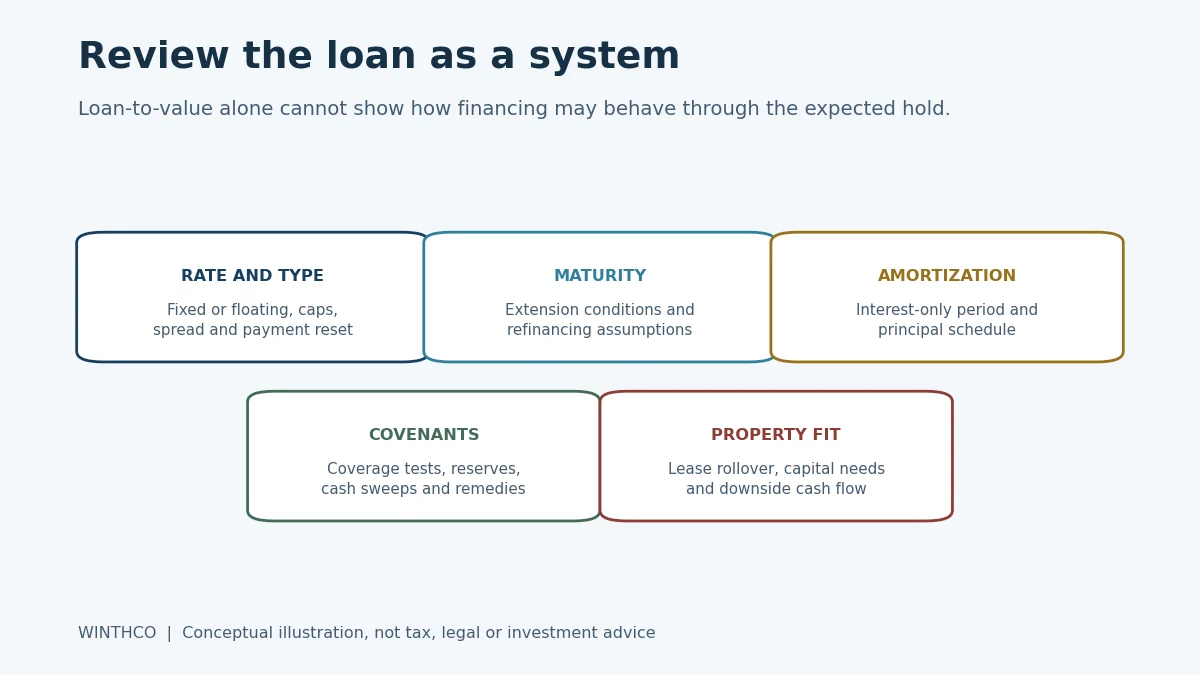
Loan-to-value ratio is only the first number. Read the loan agreement for the interest rate, whether it is fixed or floating, rate caps, amortization, interest-only period, maturity, extension rights, prepayment provisions, recourse, cash-management terms and lender remedies. Compare the loan maturity with major lease expirations and the projected holding period. A low initial payment can hide a later reset or refinancing problem.
Study coverage covenants and cash traps. A property may continue operating while a debt-service coverage test prevents cash from being distributed to investors. Required reserves, lender-controlled accounts and capital expenditures can also reduce distributable cash. Ask how much decline in rent or increase in expenses would trigger a covenant, who can negotiate with the lender and whether the DST structure limits new borrowing or material lease changes.
Then stress-test the exit. Model a sale before maturity, a delayed sale, higher refinancing rates, lower appraised value, a tenant default and an unsuccessful extension request. Estimate the effect on reserves, distributions and principal without assuming the sponsor can simply refinance. Projected distributions and sale proceeds are not guaranteed, and a favorable base case does not eliminate mortgage foreclosure risk.
Discuss your DST questions with Winthco →
A debt-free DST has fewer financing risks because there is no property mortgage to service or refinance. That can make property cash flow easier to understand and avoids a lender's power to foreclose. However, the trust still depends on tenants, leases, operating costs, insurance, taxes, repairs, property management and the sponsor's execution. A vacancy or major capital need can consume reserves even without debt.
Debt-free also does not mean liquid. DST interests are typically private-placement securities without an established public trading market. Transfers can be restricted, and investors may need to hold until the sponsor arranges a property sale. The SEC warns that private placements can be highly illiquid, involve limited disclosure and expose an investor to total loss. Accreditation permits access to certain offerings; it does not establish suitability or protect principal.
Capital concentration deserves special attention. Buying an unleveraged property requires more equity for the same property value, which can leave one investor more concentrated in one sponsor, market, tenant or asset. FINRA cautions that concentration in correlated or illiquid investments can limit timely, cost-efficient access to cash. Compare household liquidity and diversification, not merely the absence of a loan.
Leverage places a fixed claim ahead of investor equity. When net operating income falls, debt payments and required reserves usually remain due before distributions. A decline in property value also affects the smaller equity layer more sharply. If value or cash flow falls far enough, the lender may require more reserves, restrict cash, deny an extension or exercise remedies. Investors generally cannot make independent decisions to modify the loan.
Refinancing risk can become acute when loan maturity overlaps with a soft leasing market, high interest rates or major tenant rollover. The sponsor may project a sale before maturity, but neither the sale date nor price is guaranteed. Review extension conditions, interest-rate changes, appraisal tests and fees. Determine whether the DST has authority and resources to address the problem without violating tax-structure limits.
Fees and conflicts also affect the comparison. Trace acquisition, financing, selling, servicing, asset-management, property-management and disposition compensation. FINRA notes that high fees in alternative products can erode gains, while the SEC notes that private placements may provide less information than registered offerings. A leveraged structure may add financing fees, but a debt-free offering can still have substantial transaction and sponsor costs.
WATCH & LEARN
David Moore of Equity Advantage discusses replacing debt in a 1031 exchange. This third-party video is educational background, not a Winthco endorsement; use your own tax advisers for the actual liability calculation. Original resource · Watch on YouTube ↗
Educational context only. The discussion does not establish the suitability, returns or tax treatment of an investment.
Begin with the exchange facts. Confirm the taxpayer, qualified intermediary, identification deadline, completion deadline, adjusted basis, relinquished-property debt, expected proceeds and any other replacement property. Ask the CPA to calculate several combinations of debt and added cash instead of starting with a product label. Winthco's 1031 exchange mortgage considerations page offers further context, but the taxpayer's records control.
Next, compare offering documents using the same worksheet. For each DST, record purchase price, equity, loan balance, rate, amortization, maturity, covenants, reserves, tenant concentration, lease rollover, fees, sponsor conflicts, transfer limits and exit authority. Rebuild the cash flow after realistic vacancy, expense and capital assumptions. Verify which numbers are contractual, historical or projected.
Finish with household-level stress tests and independent advice. Consider a distribution suspension, prolonged hold, property loss, refinancing failure, tax recognition and a need for emergency cash. Keep adequate liquidity outside the investment and evaluate aggregate exposure across all real estate and private placements. Coordinate the qualified intermediary, CPA, tax attorney, estate adviser and licensed securities professional before funding. Neither debt-free nor leveraged status alone establishes 1031 eligibility, suitability or a favorable outcome.
| Decision | Evidence to request | What to avoid assuming |
|---|---|---|
| Property financing | Debt-free: investor equity and reserves; leveraged: investor equity plus property debt | No mortgage means no investment risk |
| 1031 debt analysis | Net liabilities, cash and other property under Form 8824 rules | The old mortgage must always be matched dollar for dollar |
| Cash flow | Property income after expenses, reserves, fees and any debt service | Projected distributions are guaranteed |
| Downside | Debt-free retains property risk; leverage adds covenant, maturity and foreclosure risk | A lower loan-to-value eliminates refinancing risk |
| Liquidity | Both are private placements with transfer limits and no dependable public market | Debt-free interests can be sold on demand |
Not as a stand-alone rule. IRS Form 8824 instructions apply a net calculation involving liabilities, cash and other property. A CPA and qualified intermediary should calculate the result for the complete transaction.
Cash paid can affect the net liability calculation illustrated in Treasury Regulation 1.1031(d)-2. Whether it prevents recognized gain depends on basis, values, liabilities and all consideration, so obtain transaction-specific tax advice.
No. It avoids mortgage default and refinancing risk, but property operations, tenants, expenses, sponsor decisions, fees, valuation, concentration, illiquidity and loss of principal remain.
A leveraged DST may provide an allocated share of property debt and access to a larger property capital structure for a given equity amount. Those features come with interest, covenant, maturity, refinancing and foreclosure risks.
Review rate type, amortization, interest-only period, maturity, extensions, coverage tests, reserves, cash sweeps, recourse and lender remedies. Compare those terms with leases, capital needs and realistic downside cash flow.
Yes. Property income, expenses, reserves, debt service and lender restrictions can reduce or suspend distributions. A projected distribution is not guaranteed and is not the same as total return.
Not necessarily. Both debt-free and leveraged DST interests are generally private placements with transfer restrictions and no dependable public market. Investors should be prepared for an extended hold.
Sources checked October 6, 2026. This article explains general concepts; your facts and the applicable documents control.
Winthco DST services · Winthco evaluation overview · Editorial standards
Risks and due diligence
Review DST liquidity, leverage, sponsor conflicts, fees and distribution assumptions before making an investment decision.
Read guide →1031 exchange planning
Understand DST debt replacement, added cash and mortgage boot with a worked example and questions for your CPA and qualified intermediary.
Read guide →1031 exchange planning
Learn how one 1031 exchange can combine directly owned real estate and a DST, including allocation, identification, closing and risk review.
Read guide →Explore Winthco’s main DST article collection
Share your timeline and investment range. A Winthco team member will follow up with you.