Risks and due diligence
DST investment risks: a practical due-diligence checklist
Review DST liquidity, leverage, sponsor conflicts, fees and distribution assumptions before making an investment decision.
Read guide →
Home / Learning center / 1031 exchange planning
1031 exchange planning
Winthco Wealth Management · Updated October 3, 2026
A taxpayer may be able to split one 1031 exchange between directly owned replacement real estate and a qualifying Delaware statutory trust interest. Both acquisitions must fit the exchange rules, identification and completion deadlines, and taxpayer's actual plan. The qualified intermediary, tax adviser and investment professional should coordinate the allocation before either closing.
A deferred exchange may involve one or more replacement properties. That makes a split approach possible when the taxpayer wants to buy a directly owned property and also acquire an eligible interest in a Delaware statutory trust. The direct property and DST are separate acquisitions, but they draw from the same exchange plan and must be coordinated with the qualified intermediary before funds are released.
The phrase split exchange describes an allocation, not a separate tax category. Each replacement asset must be real property held for investment or productive use in a trade or business, and the exchange must otherwise satisfy Section 1031. IRS Revenue Ruling 2004-86 addresses a specified DST structure, but it does not say that every trust or fractional interest qualifies. The legal documents and actual powers of the trustee matter.
Share your timeline and investment range. A Winthco team member will follow up with you.
Winthco's review of 1031 exchange investment options can help frame the available structures. Before choosing a mix, confirm that the taxpayer named in the sale will acquire the replacement property in the required manner. Entity changes, co-ownership arrangements and estate-planning transfers can affect continuity, so tax and legal advisers should review title and ownership rather than relying on a general same-taxpayer slogan.
Start with the gross sale price, debt paid off, exchange proceeds, expected transaction costs and the value of each proposed replacement property. Those figures serve different purposes. Net cash is not the same as real estate value, and the amount invested in a DST may not equal the investor's share of underlying property value when the trust has financing. A worksheet should keep equity, debt and acquisition value in separate columns.
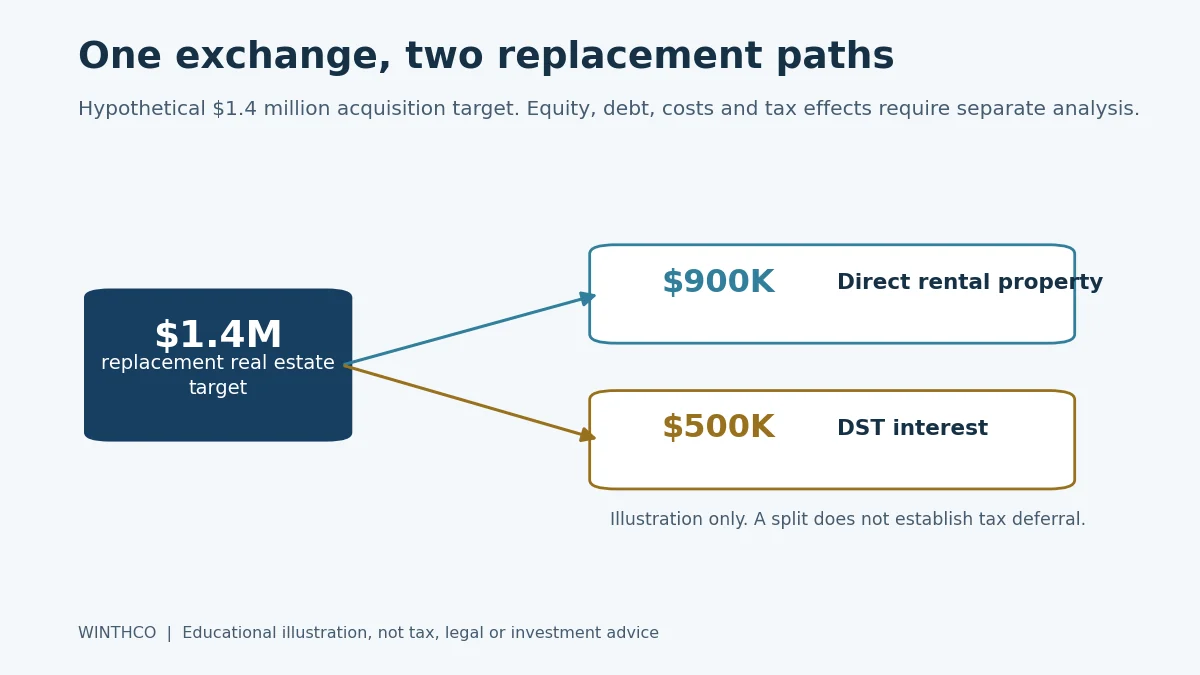
A hypothetical plan illustrates the distinction. Suppose a taxpayer targets $1.4 million of replacement real estate, allocating $900,000 to a direct rental and $500,000 to a DST interest. That division alone does not establish full tax deferral. The team still must analyze sale proceeds, liabilities, basis, expenses and any cash or other property received. The taxpayer should not treat the illustration as a formula or estimate of tax owed.
The allocation should also preserve practical flexibility. A direct purchase can require inspection, financing and negotiated repairs, while a DST subscription can depend on offering availability and investor qualification. Ask the qualified intermediary how funds will be reserved and disbursed, and review DST investment opportunities only after setting aside adequate household liquidity. Exchange urgency should not replace property-level diligence.
Both the direct property and DST interest must be addressed in the replacement-property identification analysis. Treasury Regulation 1.1031(k)-1 generally permits identification of up to three replacement properties regardless of value, or any number whose combined fair market value does not exceed 200 percent of the aggregate fair market value of the relinquished properties. A demanding 95 percent receipt test may apply when both limits are exceeded.
Do not assume that a portfolio offered under one DST name always uses one identification slot. Ask the qualified intermediary and tax counsel how the interest and its underlying real estate should be described and counted. Use the precise legal wording supplied for the proposed acquisition, deliver a signed writing to a permitted recipient by the end of day 45, and retain proof of delivery.
A backup candidate can be useful, but every identified asset should be plausible. Identification does not reserve a DST, compel a seller to close or permit a new substitute after the deadline. Review current availability and documents before day 45 while remembering that neither availability nor closing is assured. The exchange team should also track any written revocation before the same deadline.
Discuss your DST questions with Winthco →
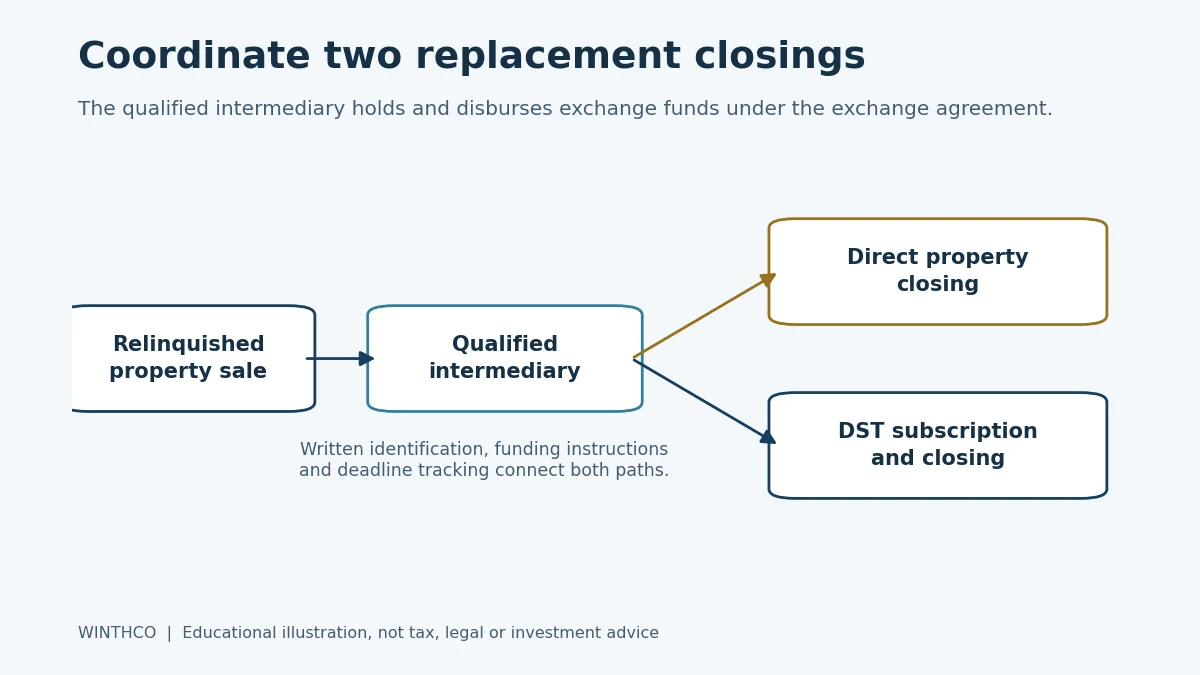
The exchange period generally ends at midnight on the earlier of 180 days after transfer of the relinquished property or the due date, including extensions, of the applicable federal income tax return. The direct property and DST do not have to close on the same day, but each closing that is intended to count must occur within the applicable exchange period and follow the qualified intermediary's procedures.
Give the qualified intermediary written closing instructions and enough time to review wiring details. The QI should transfer exchange funds directly under the exchange agreement. If the taxpayer actually or constructively receives the money outside a permitted safe harbor, the deferred-exchange treatment can be jeopardized. Independently verify all wiring instructions using trusted contact information because real estate transactions are frequent targets for fraud.
Sequencing deserves a contingency plan. If the direct purchase closes first, document how much exchange cash and value remain for the DST. If the DST closes first, confirm what remains available for earnest money and the direct closing. The guide on how to buy a DST explains the securities review process, which should proceed in parallel with, not after, the title, inspection and financing review for the direct property.
Direct ownership can provide control over leasing, financing and sale decisions, but it also brings operating responsibility, tenant issues, repairs, local-market exposure and possible capital calls. A loan can create default and refinancing risk. The property may take longer to sell or cost more to maintain than expected, and income or appreciation is not assured.
A DST interest is generally passive and may offer access to institutional-scale real estate, but the investor gives up most operating control. Private DST offerings can be illiquid, carry transfer restrictions and lack an active resale market. Fees, leverage, tenant concentration, sponsor conflicts and limited trustee powers can affect results. Distributions can decline or stop, property values can fall, and an investor can lose some or all principal.
Combining the two does not automatically create useful diversification. Both assets may share the same geography, tenant industry, property type, interest-rate sensitivity or sponsor exposure. FINRA cautions that concentration can amplify losses. Evaluate the combined household balance sheet, emergency reserves and existing real estate before deciding whether the split reduces or increases concentration. Accredited-investor status is an eligibility standard for certain offerings, not a government endorsement or finding of suitability.
WATCH & LEARN
David Moore of Equity Advantage discusses exchanging one property into multiple replacement properties in a January 23, 2019 third-party video. No Winthco affiliation or endorsement is implied. Original resource · Watch on YouTube ↗
Educational context only. The discussion does not establish the suitability, returns or tax treatment of an investment.
A split plan can fail because a direct seller withdraws, financing changes, a DST closes to new subscriptions, identification is defective or funds cannot be delivered in time. The result may be cash left in the exchange, an acquisition that does not qualify or a portfolio that differs from the taxpayer's intended risk mix. None of those outcomes should be described as automatically producing a particular tax bill.
Build decision points before the relinquished-property closing. Identify the taxpayer and QI, document the target allocation, decide which acquisition is the priority, and set internal dates earlier than the statutory deadlines. For each candidate, record what evidence is still needed, who owns the task and the last acceptable decision date. Do not let an exchange deadline compress the time needed to read an offering memorandum or inspect direct property.
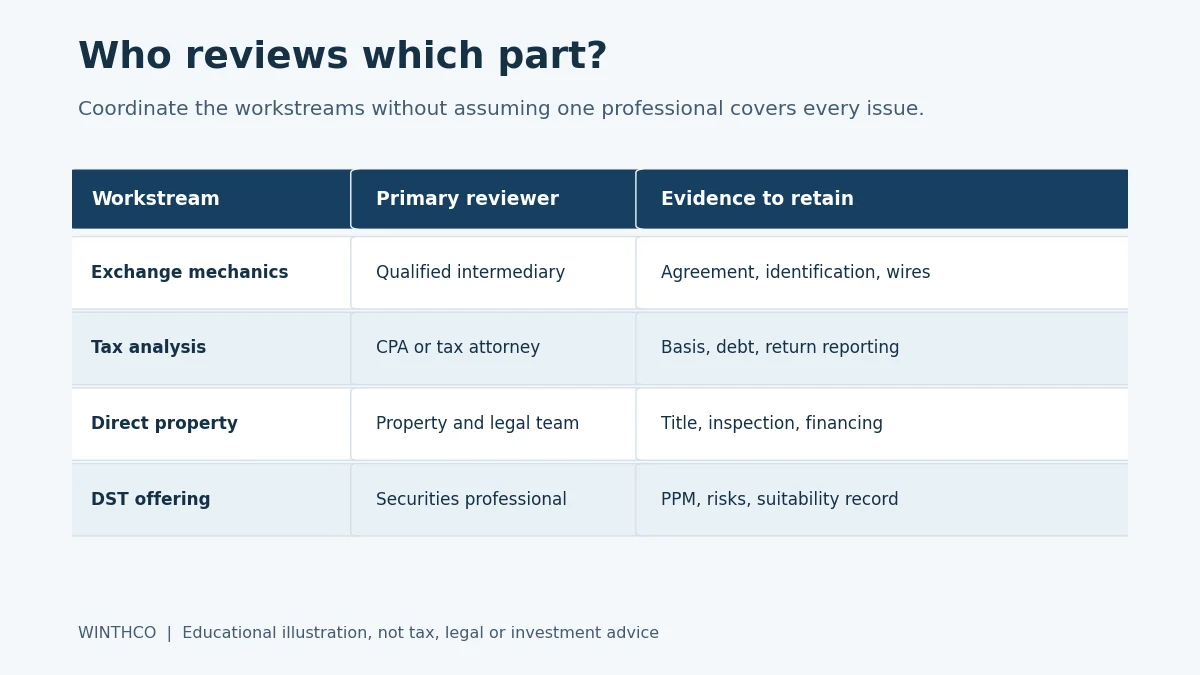
Keep professional roles distinct. The qualified intermediary administers exchange mechanics but generally does not provide individualized tax or investment advice. The CPA or tax attorney evaluates the taxpayer's facts and reporting. The securities professional explains the DST offering and suitability analysis, while real estate and legal professionals review the direct purchase. A coordinated plan is useful only when each professional confirms the part within that professional's scope.
| Decision | Evidence to request | What to avoid assuming |
|---|---|---|
| Allocation | Sale statement, debt schedule, QI ledger and target acquisition values | Net proceeds equal replacement-property value |
| Direct property | Contract, title, inspection, financing and operating projections | Control removes market or liquidity risk |
| DST interest | Offering memorandum, subscription documents, fees and risk factors | Passive ownership means predictable distributions |
| Combined plan | Written identification, closing calendar and household concentration review | Two assets automatically create diversification |
Potentially. Both acquisitions must be eligible replacement real estate, properly identified and completed within the exchange period. Confirm the actual structure with the qualified intermediary and tax adviser.
No. They may close on different dates, but each intended replacement acquisition must satisfy the applicable exchange deadline and qualified intermediary procedures.
No. Cash, equity, liabilities and property value are different. The full exchange and tax consequences should be modeled before treating any amount as available for a DST.
Not necessarily. Cash, liabilities and other nonqualifying property must be analyzed using the taxpayer's actual facts. A split allocation by itself does not determine the tax outcome.
Do not assume that. The legal structure and underlying real estate should be reviewed with the qualified intermediary and tax counsel for accurate description and counting.
Not inherently. The risk profiles differ. A DST can be illiquid and expose investors to sponsor, leverage, tenant and market risks, including loss of principal. Direct ownership also has operating, financing and market risks.
No. Tax results depend on the transaction and the taxpayer's facts. The qualified intermediary administers the exchange, while the taxpayer's tax adviser should evaluate qualification and reporting.
Sources checked October 3, 2026. This article explains general concepts; your facts and the applicable documents control.
Winthco DST services · Winthco evaluation overview · Editorial standards
Risks and due diligence
Review DST liquidity, leverage, sponsor conflicts, fees and distribution assumptions before making an investment decision.
Read guide →1031 exchange planning
Understand DST debt replacement, added cash and mortgage boot with a worked example and questions for your CPA and qualified intermediary.
Read guide →1031 exchange planning
Understand the three-property, 200 percent and 95 percent identification rules before naming DST replacement property.
Read guide →Explore Winthco’s main DST article collection
Share your timeline and investment range. A Winthco team member will follow up with you.