Risks and due diligence
DST investment risks: a practical due-diligence checklist
Review DST liquidity, leverage, sponsor conflicts, fees and distribution assumptions before making an investment decision.
Read guide →
Home / Learning center / 1031 exchange planning
1031 exchange planning
Winthco Wealth Management · Updated October 7, 2026
A DST can be one replacement-property option for a retiring landlord who wants to leave daily property management, but it exchanges direct control for sponsor-managed, illiquid ownership. Plan before the sale, protect Section 1031 procedure, compare debt and cash, read the offering documents, and test the investment against retirement income and liquidity needs.
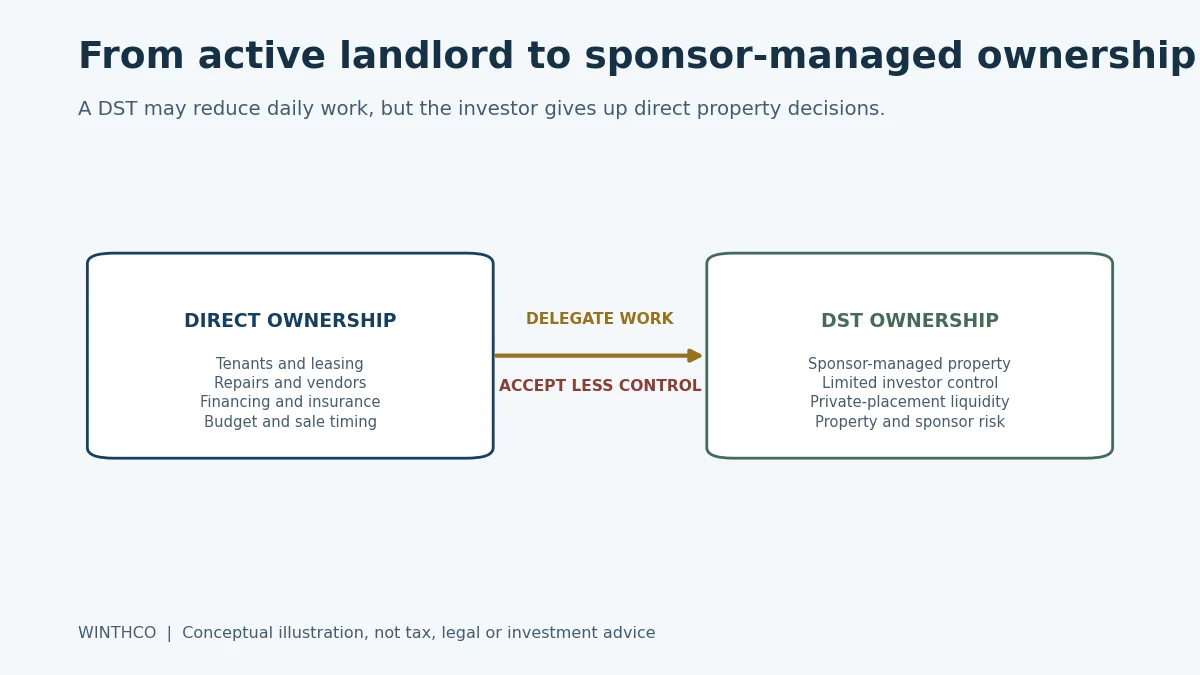
A landlord may be ready to stop handling tenants, leasing, repairs, vendors, insurance claims and property financing without immediately leaving real estate ownership. A Delaware statutory trust can hold income-producing real estate for multiple beneficial owners while a sponsor and trustee carry out the functions permitted by the trust documents. That shift may reduce an investor's daily workload, but it also removes the authority to choose tenants, approve repairs, refinance or decide when to sell. Winthco's 1031 exchange investment options page provides background on replacement-property paths for an owner who no longer wants another actively managed rental.
The word passive can be misleading. The investor may have fewer operational duties, yet the property still faces vacancy, tenant-credit, expense, casualty, market and valuation risks. The sponsor's underwriting and execution become more important because beneficial owners have limited decision rights. A DST is not a retirement account, a bond or a guaranteed-income product. It is an illiquid real estate investment, commonly offered through a private placement.
Share your timeline and investment range. A Winthco team member will follow up with you.
Start with the retiring landlord's objective rather than the product. Is the priority reducing work, keeping real estate exposure, deferring eligible gain, producing current cash flow, simplifying an estate or preserving flexibility? These goals can conflict. For example, a structure that removes management responsibility may also limit control and access to principal. Write down the priorities and the conditions that would make a DST unsuitable before reviewing any offering.
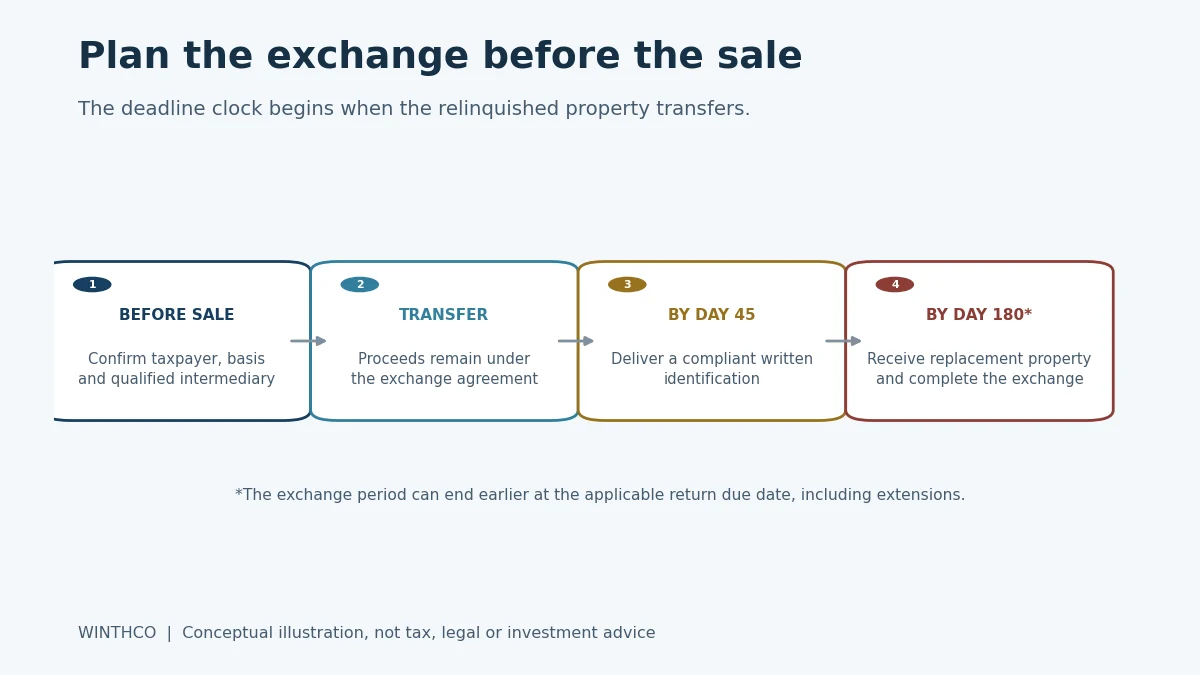
A deferred exchange must be arranged before the owner receives or controls the sale proceeds. IRS Publication 544 explains that a transfer for money followed by a purchase is a sale, not a deferred exchange. Exchangers commonly use a qualified intermediary under a written exchange agreement to restrict access to the funds. Engage the intermediary and tax advisers before the closing documents are final, not after the sale.
The taxpayer generally must identify replacement property within 45 days after transferring the relinquished property and receive it by the earlier of 180 days after that transfer or the due date, including extensions, of the applicable return. Identification must satisfy the regulatory rules, and holidays or weekends do not ordinarily extend the periods. Confirm the exact dates in writing and preserve evidence of the identification. A retiring owner should not let the deadline replace investment review.
Tax analysis also includes the taxpayer, title, adjusted basis, sale value, liabilities, exchange expenses, cash received or added, and every replacement property. Debt is not resolved by a slogan about matching the old mortgage. Have a CPA and qualified intermediary model the complete transaction, including any direct property and DST interests used together. Winthco's 1031 exchange investment alternatives discussion can frame the available paths, but the investor's records and advisers determine the result.
Direct ownership gives a landlord control over budgets, leasing strategy, improvements, financing and sale timing. It also requires decisions, oversight and sometimes personal guarantees. In a DST, those powers are generally exercised by the trustee or sponsor within restrictions intended to preserve the trust's tax classification. Investors usually cannot replace the property manager, renegotiate a lease, direct a refinancing or force a sale merely because their retirement needs change.
Delegation can solve a labor problem without solving an investment problem. Read the private placement memorandum, trust agreement, management agreements, property reports, leases and loan documents. Identify who may approve capital expenditures, how reserves are funded, what happens after a major tenant default, and what actions are restricted. IRS Revenue Ruling 2004-86 addresses a specific trust with tightly limited powers; it does not declare that every trust interest qualifies for every exchange.
Compare the DST with realistic alternatives. Another directly owned rental preserves control but keeps management and financing responsibilities. A professionally managed rental delegates some work while the owner retains more authority. A net-lease property can shift certain expenses to a tenant but can create tenant and lease concentration. A taxable sale may create an immediate tax cost while providing more liquidity and investment freedom. The right comparison includes workload, control, taxes, risk and family circumstances.
Discuss your DST questions with Winthco →
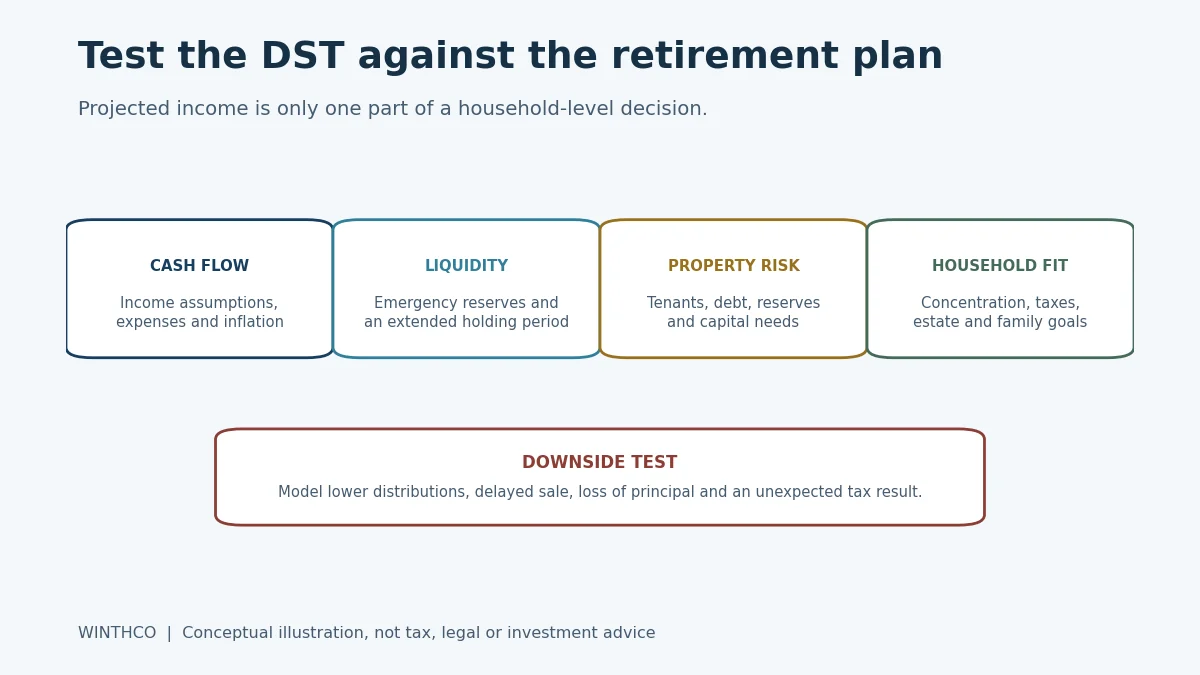
Projected DST distributions are estimates, not obligations comparable to government benefits or insured bank deposits. Property revenue may decline because of vacancy, concessions, tenant default or market rents. Expenses, insurance, taxes, repairs and reserves may rise. Debt service and lender-controlled cash accounts can further reduce distributable cash. Separate the projected distribution rate from total return and from the return of principal at sale.
Build a household cash-flow plan that does not depend on every projection occurring. List essential spending, discretionary spending, Social Security, pensions, required distributions, liquid reserves and other investments. Then model a DST distribution reduction or suspension, a longer holding period and a loss of principal. If the household would need to sell the interest quickly to pay ordinary expenses, an illiquid private placement may be a poor match regardless of the projected income.
Inflation and taxes also matter. A level distribution can buy less over time, and a multi-state portfolio may add state filing obligations. Ask the CPA how depreciation, suspended losses, state returns and a later sale may affect after-tax cash flow. Do not assume that a 1031 exchange makes income tax free or removes future tax. Deferral postpones eligible gain when the requirements are met; it does not guarantee a permanent outcome.
Most DST interests used in this context are private-placement securities. The SEC warns that private placements can be highly illiquid, may provide less information than registered offerings and can result in total loss. Accreditation is an eligibility standard for certain offerings, not a finding that an investment is suitable. An investor may need to hold until the sponsor sells the underlying real estate, and the timing and price of that sale are uncertain.
Trace every source of compensation and every dollar between the property's value and the investor's equity. Review acquisition, selling, financing, organization, management, servicing and disposition fees, plus any sponsor markups or affiliated-party arrangements. FINRA notes that high fees in alternative products can erode gains. Compare the purchase price with independent market evidence and rebuild the cash flow after fees, realistic vacancy, capital needs and reserves.
Concentration must be measured at the household level. Several DSTs can still share the same sponsor, property type, geography, tenant, lender or economic driver. FINRA cautions that correlated and illiquid holdings can create concentration risk and make cash difficult to access. Consider the existing rental portfolio, securities, business interests and retirement accounts together. More properties do not automatically mean meaningful diversification.
WATCH & LEARN
David Moore of Equity Advantage and Robert Zink discuss management time and DST ownership. This third-party video is educational background, not a Winthco endorsement; its general discussion does not replace review of a current offering. Original resource · Watch on YouTube ↗
Educational context only. The discussion does not establish the suitability, returns or tax treatment of an investment.
Use one comparison worksheet for every path. Record the expected tax result, closing schedule, management duties, control rights, income assumptions, fees, debt, reserves, liquidity, exit authority and estate implications. For a DST, distinguish contractual terms, historical property results and sponsor projections. For direct property, include the true cost of the owner's time, third-party management and future capital work. Winthco's Delaware statutory trust overview explains the structure, while the offering documents control any actual investment.
Stress-test the leading choices before identification. Model lower rent, higher expenses, tenant failure, a casualty, refinancing at a higher rate, a delayed sale, an unfavorable sale price and an unexpected tax bill. Ask who makes each decision and where the money would come from. The goal is not to predict a single outcome, but to see whether the retirement plan can absorb several plausible disappointments without forcing a sale.
Coordinate the qualified intermediary, CPA, tax attorney, estate adviser and appropriately licensed securities professional. Confirm taxpayer identity and title before the sale, tax calculations before identification, and investment review before funding. Keep adequate liquid assets outside the DST. A carefully reviewed DST may address a retiring landlord's management objective, but neither Section 1031 treatment nor a favorable investment result can be promised.
| Decision | Evidence to request | What to avoid assuming |
|---|---|---|
| Management and control | Who handles tenants, repairs, financing and sale decisions | Less daily work means the investor keeps the same control |
| Liquidity | Transfer restrictions, expected hold and outside cash reserves | An interest can be sold whenever retirement spending requires cash |
| Income | Property revenue after expenses, debt service, reserves and fees | A projected distribution is guaranteed or equals total return |
| Tax and debt | Basis, liabilities, cash, taxpayer identity and all replacements | A DST automatically completes the exchange or eliminates tax |
| Exit and estate | Sponsor authority, sale timing, valuation and estate documents | The investor controls the sale date or future tax outcome |
A DST can shift permitted operating responsibilities to a sponsor and trustee, but the investor also gives up substantial control. The property and investment risks remain.
Yes. A deferred exchange generally must be arranged before the owner receives or controls the sale proceeds. Engage a qualified intermediary and tax advisers before closing.
No. Distributions depend on property operations, expenses, debt, reserves and sponsor decisions. They may decline or stop, and projected income is not the same as total return.
Do not assume that it can. DST interests are generally private placements with transfer restrictions and no dependable public market, so an extended hold may be required.
No. Revenue Ruling 2004-86 addresses a specific restricted trust structure. The actual trust, property, taxpayer, identification and transaction must satisfy applicable requirements.
No. Debt-free offerings avoid mortgage risk but retain property, sponsor, fee, valuation, concentration and liquidity risks. Compare the complete offering and household plan.
Possible comparisons include another direct rental, professional management, a net-lease property, multiple replacement properties, a mixed exchange, or a taxable sale. Each has different tax, control, liquidity and risk consequences.
Sources checked October 7, 2026. This article explains general concepts; your facts and the applicable documents control.
Winthco DST services · Winthco evaluation overview · Editorial standards
Risks and due diligence
Review DST liquidity, leverage, sponsor conflicts, fees and distribution assumptions before making an investment decision.
Read guide →Investor decision-making
Compare Delaware statutory trust ownership with directly owned rental property across management, control, diversification, financing and exit flexibility.
Read guide →DST ownership and exits
Understand DST holding periods, sponsor sale timing, early-exit limits and the tax decisions that may follow a trust's disposition.
Read guide →Explore Winthco’s main DST article collection
Share your timeline and investment range. A Winthco team member will follow up with you.