Risks and due diligence
DST investment risks: a practical due-diligence checklist
Review DST liquidity, leverage, sponsor conflicts, fees and distribution assumptions before making an investment decision.
Read guide →
Home / Learning center / 1031 replacement property
1031 replacement property
Winthco Wealth Management · Updated October 5, 2026
A DST and a 721 UPREIT are not interchangeable tax strategies. A qualifying DST interest may serve as replacement real property in a Section 1031 exchange. Section 721 generally addresses a property contribution to a partnership for a partnership interest, with different transaction, debt, liquidity and future-exit consequences.
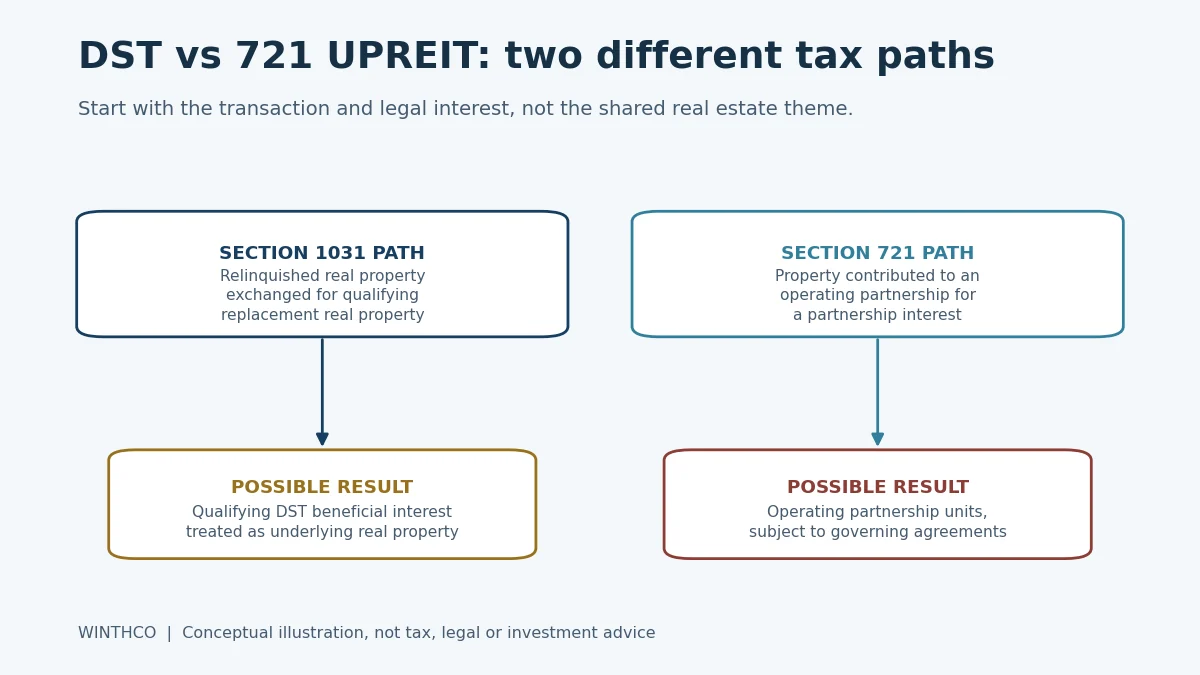
A Delaware statutory trust, or DST, can hold identified real estate for beneficial owners. Under the specific facts in IRS Revenue Ruling 2004-86, the beneficial owners were treated as owning interests in the trust's underlying real property. That treatment can make a properly structured DST interest eligible as replacement property in a Section 1031 exchange, but the actual trust and exchange must satisfy the governing rules. The main Winthco DST 1031 exchange overview explains the replacement-property process in more detail.
An UPREIT is an umbrella partnership real estate investment trust structure. Property is contributed to an operating partnership, and the contributor receives operating partnership units rather than buying direct replacement real estate. Section 721 usually provides nonrecognition when property is contributed to a partnership in exchange for a partnership interest, but exceptions and related rules can change the result. The transaction is a negotiated contribution, not a retail purchase available solely because a seller has cash.
Share your timeline and investment range. A Winthco team member will follow up with you.
The first planning question is therefore about the asset moving into the transaction. Section 1031 involves an exchange of qualifying real property for qualifying real property. Section 721 involves contributing property to a partnership and receiving a partnership interest. Neither route automatically applies to every property, every DST or every UPREIT program. Tax counsel should review title, taxpayer identity, debt, basis and the controlling agreements before a closing creates an irreversible result.
A completed sale for cash is not converted into a Section 721 contribution merely because the seller later invests the proceeds in a real estate partnership. Section 721 addresses a contribution of property to a partnership for a partnership interest. A direct contribution generally requires the operating partnership to accept the specific property and agree on value, liabilities, representations, closing conditions and the units to be issued. This can require substantial coordination well before a scheduled sale.
A deferred Section 1031 exchange follows a different sequence. The exchanger transfers relinquished real property, uses a qualified intermediary, identifies replacement property within the regulatory period and receives replacement real property within the applicable exchange period. A qualifying DST can sometimes fit that sequence because the IRS ruling treated the described interest as underlying real property. Operating partnership units are entity interests, not replacement real property for a direct Section 1031 exchange.
Sellers sometimes hear about a combined DST-to-UPREIT path. In that structure, an investor may first acquire a qualifying DST interest through Section 1031 and the sponsor may later propose contributing the DST property to an operating partnership. That later step is not automatic. It depends on the trust documents, sponsor decisions, lender consent, operating partnership acceptance and tax analysis at that time. The Winthco 721 UPREIT educational page provides additional background, but no page or presentation can guarantee a conversion.
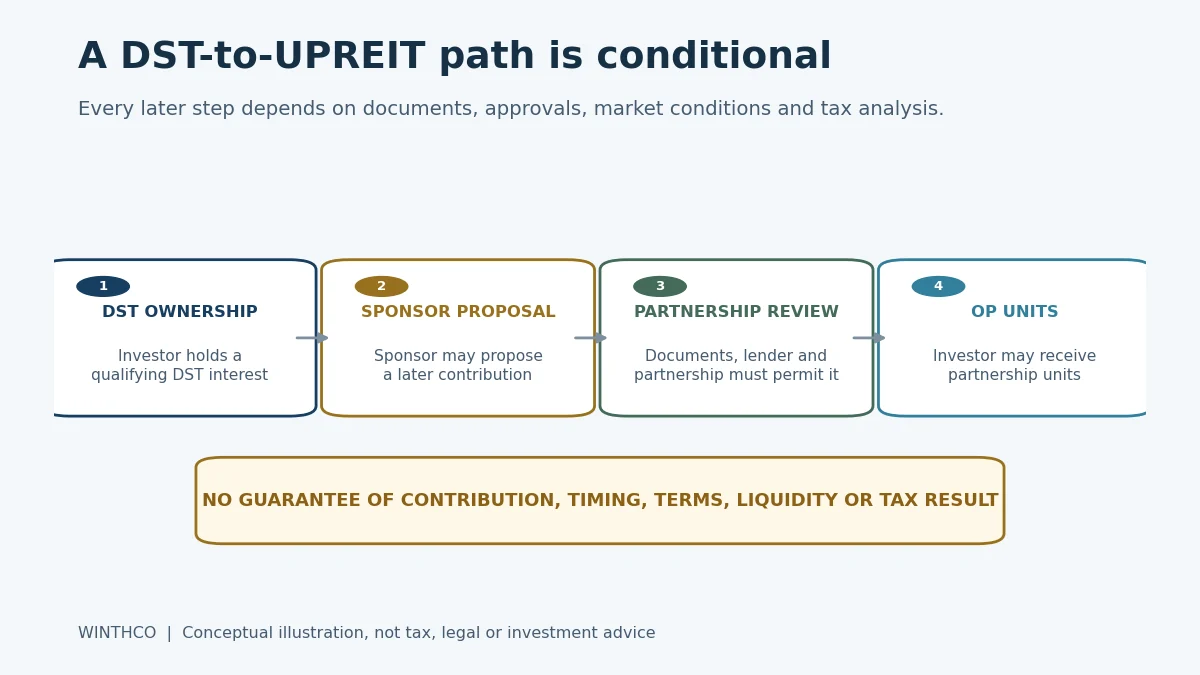
IRS Publication 541 states that neither the partner nor the partnership usually recognizes gain or loss when property is contributed to a partnership in exchange for a partnership interest. The same publication describes important qualifications. A contribution followed by a related distribution can be treated as a sale, and a contribution to a partnership treated as an investment company can trigger recognition. Built-in gain also affects later allocations and dispositions.
Debt requires separate attention. Publication 541 explains that when a partnership assumes a contributor's liability, the contributing partner's basis may be reduced because the other partners' assumption is treated as a distribution of money. If the deemed distribution exceeds basis, gain can result. This is why a headline describing Section 721 as tax deferred is not enough to establish an individual outcome, especially for highly leveraged property or ownership shared among several people.
The operating partnership units generally represent a partnership interest with tax basis and reporting consequences. The contribution does not erase the property's built-in gain or make future distributions, unit transfers or redemptions irrelevant. Later conversion or redemption mechanics may create taxable events depending on the documents and the investor's facts. A CPA and tax attorney should analyze contribution basis, liabilities, disguised-sale exposure, allocations, state taxes and the investor's intended exit before title moves.
Discuss your DST questions with Winthco →
Both paths usually reduce direct landlord control. A DST investor generally cannot direct leasing, refinancing, capital improvements or a property sale. The trustee and sponsor act within powers constrained by the trust documents and the tax structure. An operating partnership unit holder also does not manage individual buildings. The operating partnership's general partner makes portfolio and financing decisions under the partnership agreement.
Neither structure should be assumed liquid. DST interests are generally private-placement securities without a dependable public market, and transfers may require sponsor, lender and purchaser approval. Operating partnership units may have contractual holding periods, transfer restrictions and redemption procedures. A right to request redemption does not necessarily promise cash, timing or a specific value. Some programs may satisfy requests with REIT shares, subject to their agreements, market conditions and tax consequences.
The future exchange path is also different. A qualifying DST interest may be held as real property for a later Section 1031 exchange if the facts and law then support that treatment. Operating partnership units and REIT shares are entity interests, so an investor should not assume they can later be exchanged for new real property under Section 1031. Greater potential access to a redemption mechanism can come with market-price exposure, gates, delays, taxes and loss of control over the timing.
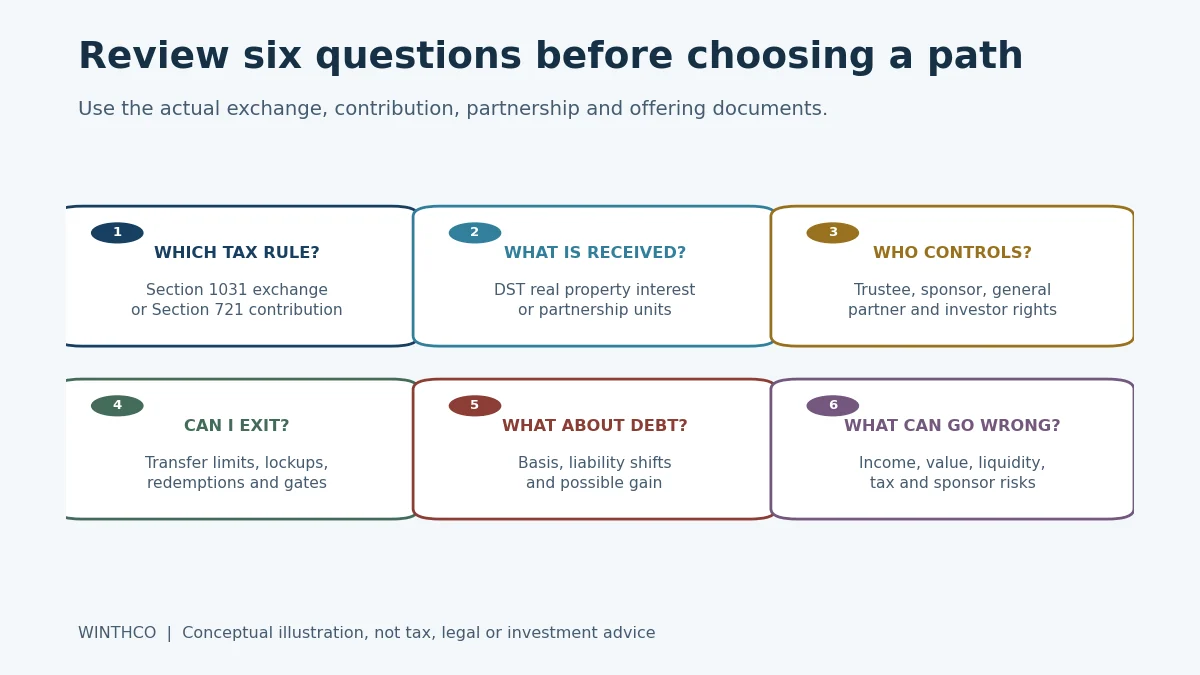
DST due diligence should examine the property, tenant concentration, lease terms, debt, reserves, sponsor conflicts, acquisition costs, selling compensation, management fees and disposition authority. Distributions can be reduced or stopped, debt may create refinancing or foreclosure risk, and the property may sell below its purchase price. Limited trustee powers can also restrict responses to changing conditions. The DST and REIT comparison helps frame ownership and liquidity differences without treating either structure as universally preferable.
A 721 UPREIT review should cover the operating partnership agreement, valuation process, leverage, unit restrictions, redemption mechanics, tax-protection provisions, fees, conflicts and the REIT portfolio. Tax-protection agreements may be limited in duration and scope, and remedies may not fully offset an investor's tax or economic loss. If redemption can result in REIT shares, the investor must also evaluate price volatility, dividend changes, sector concentration and whether the shares are publicly traded, non-traded or private.
The SEC warns that private placements can be highly illiquid. Its non-traded REIT bulletin notes that redemption programs may be limited or discontinued and may impose discounts. FINRA also cautions that concentration in illiquid investments can make timely, cost-effective access to cash difficult. These concerns apply alongside sponsor execution, property performance, interest-rate, tax-law and loss-of-principal risks. Projected distributions, appreciation, tax deferral, liquidity and return of capital are never guaranteed.
WATCH & LEARN
This video is embedded on Winthco Wealth Management's 721 UPREIT educational page. Use it as general background and rely on the actual contribution, partnership and offering documents for a proposed transaction. Original resource · Watch on YouTube ↗
Educational context only. The discussion does not establish the suitability, returns or tax treatment of an investment.
Start with the transaction that actually exists. Record the owner of the property, estimated closing date, adjusted basis, debt, co-owner approvals, liquidity needs and whether a qualified intermediary is already engaged. If a direct Section 721 contribution is being considered, confirm that an operating partnership is willing to accept the property before signing a sale contract that assumes cash proceeds. If Section 1031 is the path, protect the exchange structure before the relinquished property closes.
Next, compare documents rather than labels. For a DST, read the private placement memorandum, trust agreement, property reports, loan documents and financial projections. For a 721 UPREIT contribution, review the contribution agreement, operating partnership agreement, valuation support, liability allocation, lockups, redemption rights, tax-protection terms and REIT disclosures. Ask which party controls each step, which conditions can prevent closing and which outcomes are merely possible.
Finally, stress-test the plan. Consider lower property income, higher costs, a delayed exit, reduced distributions, an unfavorable unit or share value, a rejected redemption request and an unexpected tax result. Confirm that adequate liquid assets remain outside the investment. Coordinate the CPA, tax attorney, qualified intermediary where applicable, estate counsel and securities professional. Tax eligibility and investor accreditation do not establish suitability, and neither path should be selected only to meet a deadline.
| Decision | Evidence to request | What to avoid assuming |
|---|---|---|
| Tax provision | DST path: Section 1031 exchange; UPREIT path: Section 721 property contribution | Both labels produce the same tax result |
| What is transferred | DST: exchange proceeds acquire qualifying real property; UPREIT: property is contributed | Cash invested after a sale is automatically a 721 contribution |
| What is received | DST beneficial interest or operating partnership units | Both interests are freely tradable real property |
| Future liquidity | Actual transfer, lockup, redemption and gate provisions | A redemption request guarantees immediate cash |
| Tax risks | Basis, liabilities, disguised sales, allocations and later dispositions | The section number assures permanent tax elimination |
No. Section 1031 applies to qualifying exchanges of real property. Section 721 generally applies when property is contributed to a partnership for a partnership interest.
A cash investment after a completed sale is not itself a Section 721 property contribution. A direct 721 transaction generally requires the operating partnership to accept the property before it is sold.
A sponsor may propose a later contribution of DST property to an operating partnership if the documents and transaction permit it. Investors should not assume that conversion, timing, terms or tax treatment is guaranteed.
Not necessarily. Units may have holding periods, transfer restrictions and conditional redemption procedures. The partnership agreement controls, and a redemption request may be delayed, limited or settled in REIT shares.
Yes. IRS Publication 541 explains that liability assumptions can reduce a partner's basis and may cause gain when the deemed distribution exceeds basis. Individual modeling is essential.
Partnership units are entity interests rather than direct replacement real property. An investor should not assume that operating partnership units or REIT shares qualify for a later Section 1031 exchange.
Neither is universally better. The appropriate path depends on the actual property, tax facts, debt, timing, agreements, liquidity needs, concentration and risk tolerance, reviewed with tax, legal and securities professionals.
Sources checked October 5, 2026. This article explains general concepts; your facts and the applicable documents control.
Winthco DST services · Winthco evaluation overview · Editorial standards
Risks and due diligence
Review DST liquidity, leverage, sponsor conflicts, fees and distribution assumptions before making an investment decision.
Read guide →DST ownership and exits
Understand DST holding periods, sponsor sale timing, early-exit limits and the tax decisions that may follow a trust's disposition.
Read guide →1031 replacement property
Compare DST and TIC ownership, control, financing, closing mechanics, liquidity and risks before choosing 1031 replacement property.
Read guide →Explore Winthco’s main DST article collection
Share your timeline and investment range. A Winthco team member will follow up with you.