Risks and due diligence
DST investment risks: a practical due-diligence checklist
Review DST liquidity, leverage, sponsor conflicts, fees and distribution assumptions before making an investment decision.
Read guide →
Home / Learning center / 1031 replacement property
1031 replacement property
Winthco Wealth Management · Updated October 5, 2026
DST and TIC interests use different ownership and control structures. A TIC investor directly owns an undivided fractional interest in real property, while a DST investor holds a beneficial interest in a trust that owns the property. Either may fit a 1031 exchange only when the actual transaction satisfies applicable rules.
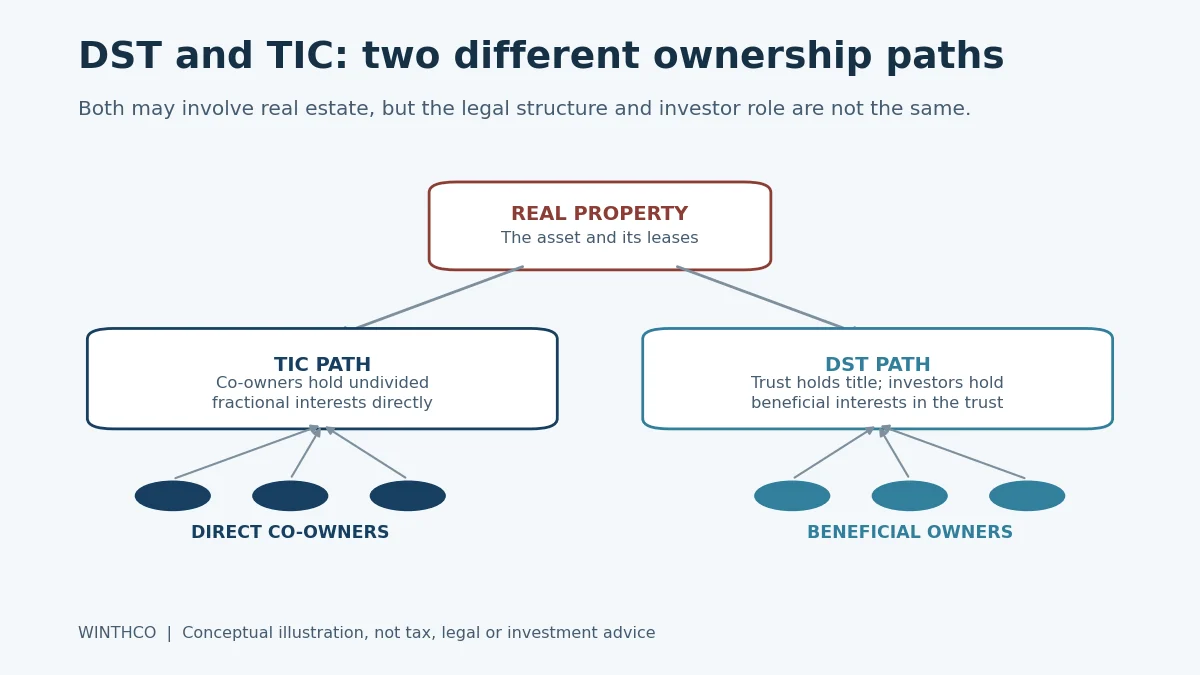
A tenancy in common, or TIC, divides direct ownership of real property among co-owners. Each owner has an undivided fractional interest rather than a claim to one physical portion of the building. The deed, co-ownership agreement, leases and financing documents determine the rights and obligations. A TIC label alone does not establish how the arrangement will be treated for federal tax, securities or liability purposes.
A Delaware statutory trust, or DST, is a separate state-law trust that holds title to property. Investors buy beneficial interests and generally do not make day-to-day property decisions. IRS Revenue Ruling 2004-86 concluded that interests in the particular trust it described were interests in the underlying real property for federal tax purposes. The ruling is fact-specific and does not make every trust interest eligible for Section 1031.
Share your timeline and investment range. A Winthco team member will follow up with you.
The practical distinction is direct co-ownership versus beneficial ownership through a trust. It affects who signs loan documents, who approves a sale, how operations are coordinated and what an investor can transfer. The main Winthco TIC and DST comparison provides additional background, but the recorded instruments and offering documents for the transaction control.
Treasury Regulation 1.1031(a)-1 says qualifying exchanges involve real property held for productive use in a trade or business or for investment. An interest in a partnership is excluded. This makes entity classification important: a direct fractional interest may be real property, while an interest treated as a partnership interest generally is not eligible replacement property under Section 1031. Tax counsel should evaluate the taxpayer, title and complete arrangement.
Revenue Procedure 2002-22 describes conditions under which the IRS will consider a request for a ruling that undivided fractional interests are not interests in a business entity. Those conditions address matters such as the number of co-owners, title, sharing of revenue and costs, management agreements, debt, transfers and voting. It is not a blanket approval of every TIC, and satisfying a checklist is not a substitute for advice on the actual structure.
Revenue Ruling 2004-86 analyzes a tightly limited DST whose trustee could not vary the investment through additional powers. It concludes that the described beneficial interests can be real property for Section 1031 if the other requirements are met. A DST with materially different powers or operations may require a different analysis. Neither guidance eliminates identification deadlines, receipt deadlines, qualified-intermediary requirements or the held-for-investment standard.
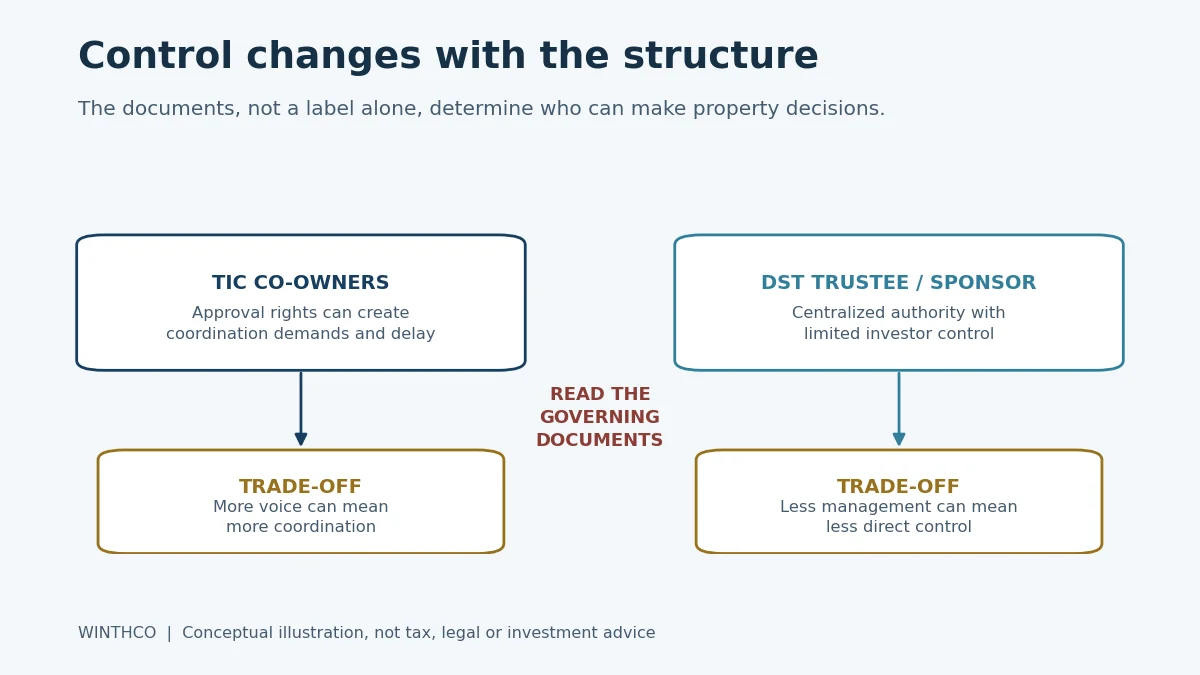
TIC owners retain direct ownership rights, but those rights can create coordination work. The co-ownership agreement may require approval for a sale, lease, manager or financing decision. Revenue Procedure 2002-22 includes voting and management conditions for ruling requests, yet a particular transaction may allocate authority differently. Review which actions require unanimity, a percentage vote or individual consent, and what happens after a disagreement or an owner's death.
DST investors generally delegate property decisions to the trustee or sponsor under the trust agreement. That can reduce active landlord duties, but it also means investors usually cannot replace a tenant, refinance the property, order improvements or force a sale. Revenue Ruling 2004-86 relied on significant limits on trustee powers, so the same limits that support the tax structure may restrict responses to changing property conditions.
Control is a trade-off, not an automatic advantage. A TIC may suit co-owners prepared to participate and coordinate, while a DST may suit investors willing to accept limited control for centralized administration. In either case, read the governing provisions, conflicts disclosures and transfer rules. A broader framework for evaluating a DST can help organize the document review without predicting which structure is suitable.
Discuss your DST questions with Winthco →
TIC financing often requires the lender to underwrite the property, the ownership arrangement and sometimes each co-owner. The loan may impose joint obligations, separate obligations or guarantees depending on the documents. A lender can restrict transfers and require approvals. If repairs, leasing costs or debt service exceed available cash, the co-ownership agreement may describe additional contributions and remedies when an owner does not fund.
A DST offering may include debt already placed at the trust or property level, with an investor allocated a share for tax reporting and exchange planning. Investors should not assume that an allocated debt amount is the same as a personal guarantee or that nonrecourse language removes economic risk. Loan maturity, covenants, reserves, tenant performance and restrictions on refinancing can affect distributions and the eventual sale.
For either structure, compare total debt, interest rate, maturity, extensions, reserve funding and downside scenarios. An exchanger also needs tax advice on replacing debt and reinvesting net equity, because receiving cash or reducing replacement value can create taxable consideration. Financing terms can delay a closing or force a sale, and neither a TIC nor a DST guarantees that expected income will cover every expense.
Many DST offerings involve property the sponsor has already acquired and financed, which can simplify subscription timing. A completed acquisition does not guarantee that an investor will be accepted, that capacity will remain available or that the exchange will qualify. A TIC acquisition may require coordination among sellers, co-owners, title parties and a lender. The actual closing calendar matters more than a general claim that one structure is faster.
Private DST interests are generally offered as securities, commonly through Regulation D private placements. The SEC warns that private placements can provide less information than registered offerings and can be difficult to resell. FINRA also notes that alternative products may involve complexity, limited liquidity and unique risks. Accreditation can permit access to an offering, but it does not show that the investment is suitable or protect principal.
A TIC interest may also be a security depending on how it is offered, managed and economically structured; the name on the deed is not conclusive. It can likewise be hard to transfer because of co-owner agreements, lender consent, securities restrictions and a limited buyer pool. Plan to hold either interest without a dependable secondary market, and confirm how a transfer, death, incapacity or default would be handled.
WATCH & LEARN
Jeff Peterson of CPEC1031 explains DSTs and replacement-property identification in an April 24, 2025 third-party video. No Winthco affiliation or endorsement is implied. Original resource · Watch on YouTube ↗
Educational context only. The discussion does not establish the suitability, returns or tax treatment of an investment.
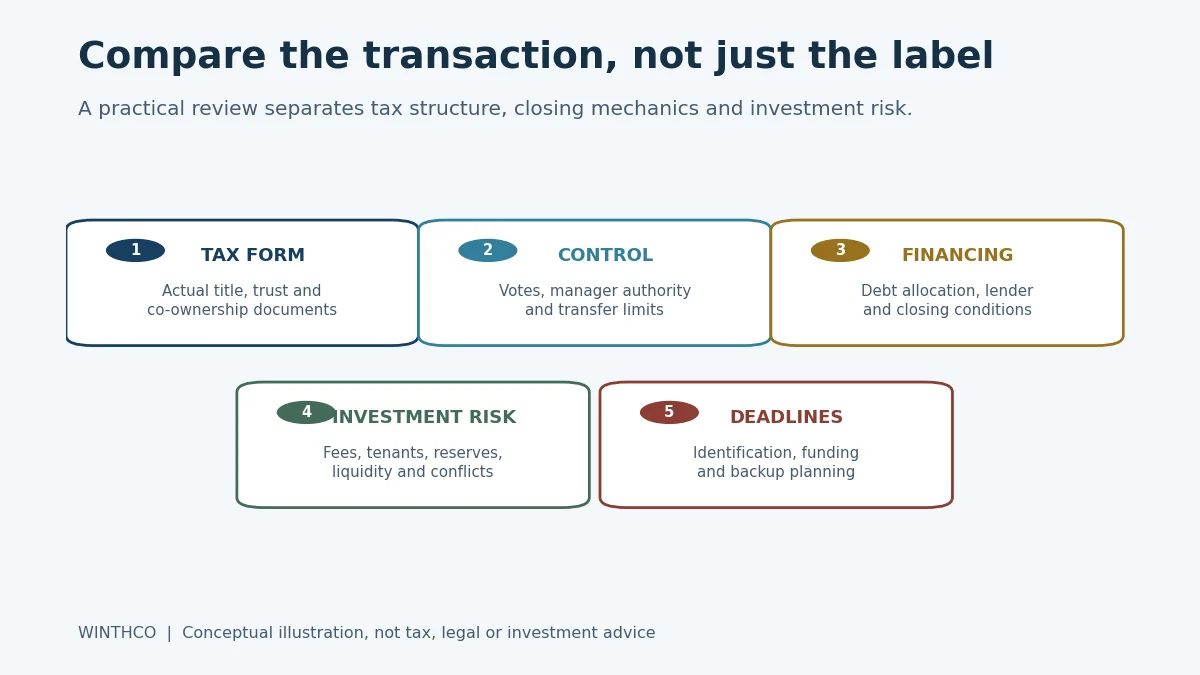
Start with separate tax and investment files. The tax file should identify the taxpayer, relinquished-property title, qualified intermediary, identification language, replacement-property legal description, planned equity and debt, and closing deadline. The investment file should cover property condition, tenants, leases, fees, financing, reserves, sponsor or manager experience, conflicts, projections, transfer restrictions and exit authority. One favorable conclusion does not answer the other questions.
Build a side-by-side matrix using the actual documents. Record who holds title, who controls decisions, what votes are required, who can request additional capital, what happens after a default, what fees apply and how a sale is approved. Place each assumption next to its source page. Review the broader Winthco overview of 1031 exchange investment options while remembering that neither a brochure nor an educational article replaces professional advice.
Keep backup planning realistic. The 45-day identification period and 180-day exchange period generally run concurrently, and missed dates are not cured because a loan or subscription took longer than expected. Consider more than one qualifying replacement-property path when appropriate, verify availability before relying on it and have tax, legal and securities professionals review the final transaction. No structure assures tax deferral, liquidity, distributions, appreciation or return of principal.
| Decision | Evidence to request | What to avoid assuming |
|---|---|---|
| Legal ownership | TIC: deeded undivided interest; DST: beneficial trust interest | The label alone determines federal tax treatment |
| Control | TIC votes and agreements; DST trustee and sponsor authority | More or less control is always better |
| Financing | Loan, guarantee, allocation, maturity and reserve documents | Debt allocation removes economic or tax risk |
| Liquidity | Transfer rules, consents and realistic buyer market | A secondary sale will be available on demand |
| 1031 execution | Taxpayer, QI, identification, value, debt and closing records | An offering's availability proves exchange qualification |
No. A direct undivided interest in qualifying real property may be eligible, but the taxpayer, use, entity classification, timing and complete arrangement must satisfy the rules. Revenue Procedure 2002-22 is guidance for ruling requests, not automatic approval.
No. Revenue Ruling 2004-86 addresses a specific trust with limited powers. The actual trust and transaction must be reviewed, and all other Section 1031 requirements still apply.
Often, but the governing documents control. TIC rights may come with approval and coordination burdens. DST investors generally delegate decisions to the trustee or sponsor and have limited voting power.
Revenue Procedure 2002-22 lists no more than 35 co-owners among the conditions for an IRS ruling request. That number should not be presented as a universal statutory ownership cap for every arrangement.
They can be, depending on how the interests are offered and managed and on the complete facts. Obtain securities counsel advice rather than assuming direct title removes securities-law obligations.
A DST with an acquired property and available subscription capacity may have fewer property-closing steps for the investor, while a TIC may require more lender and co-owner coordination. Neither structure guarantees acceptance or timely closing.
Neither is inherently safe. Risks differ across control, financing, liability, liquidity, property performance, fees and conflicts. Compare the actual documents and downside scenarios with qualified professionals.
Sources checked October 5, 2026. This article explains general concepts; your facts and the applicable documents control.
Winthco DST services · Winthco evaluation overview · Editorial standards
Risks and due diligence
Review DST liquidity, leverage, sponsor conflicts, fees and distribution assumptions before making an investment decision.
Read guide →Investor decision-making
Compare Delaware statutory trust ownership with directly owned rental property across management, control, diversification, financing and exit flexibility.
Read guide →Investor decision-making
Use practical questions about registration, compensation, due diligence, coordination and follow-up when evaluating a DST advisor.
Read guide →Explore Winthco’s main DST article collection
Share your timeline and investment range. A Winthco team member will follow up with you.