Risks and due diligence
DST investment risks: a practical due-diligence checklist
Review DST liquidity, leverage, sponsor conflicts, fees and distribution assumptions before making an investment decision.
Read guide →
Home / Learning center / 1031 replacement property
1031 replacement property
Winthco Wealth Management · Updated October 5, 2026
A qualifying DST interest may be used as replacement real property in a Section 1031 exchange under the IRS ruling's specific facts. A REIT investor owns company shares, not the underlying real estate, so buying REIT shares is not a direct Section 1031 replacement-property transaction. The investment trade-offs also differ substantially.
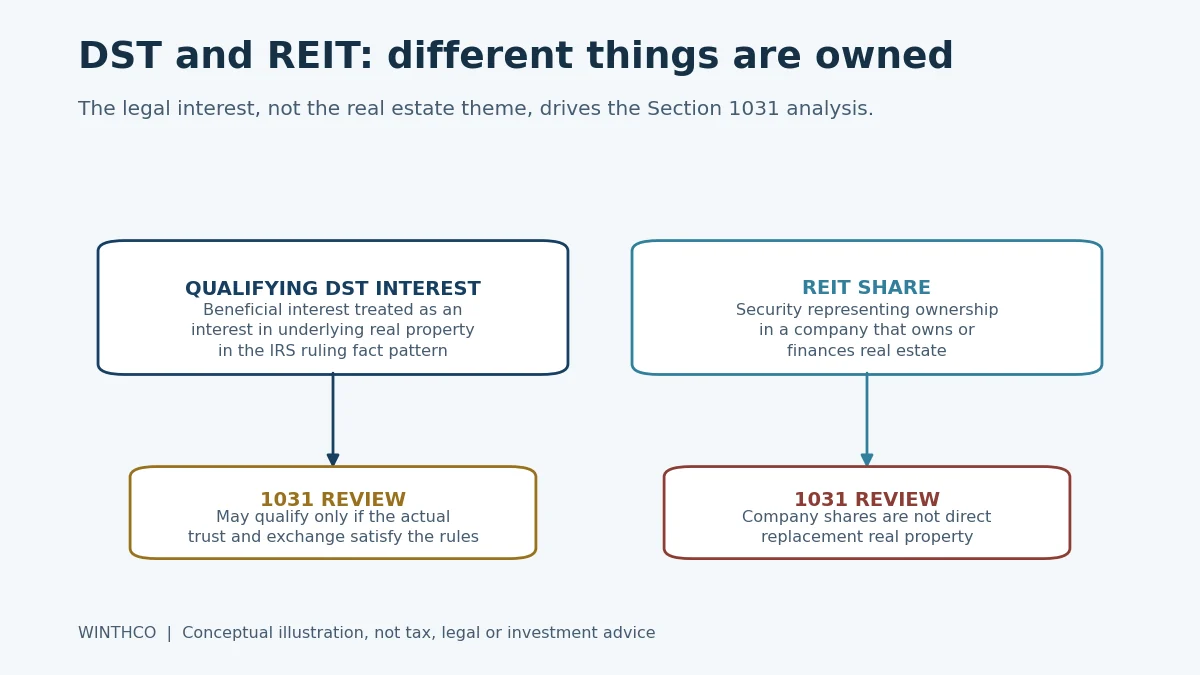
A Delaware statutory trust holds title to identified real property, and investors hold beneficial interests in the trust. IRS Revenue Ruling 2004-86 concluded that beneficial owners of the specific trust it described were treated as owning interests in the underlying real property for federal tax purposes. The trust's limited powers were important to that conclusion, so the ruling does not automatically cover every trust using a DST label.
A real estate investment trust, or REIT, is a company that owns or finances income-producing real estate or related assets. The investor owns shares of that company. The SEC describes publicly traded, public non-traded and private REITs, each with different trading, disclosure and access characteristics. Real estate may support the enterprise, but a REIT share remains a security rather than a deeded or beneficial interest treated as direct real property.
Share your timeline and investment range. A Winthco team member will follow up with you.
That legal distinction drives the initial Section 1031 question. A properly structured DST interest may be qualifying replacement property if the taxpayer and exchange satisfy every other rule. Purchasing REIT shares with exchange proceeds does not substitute company stock for required replacement real property. The main Winthco DST and REIT comparison offers background, while tax counsel should review the actual transaction rather than rely on a product name.
Section 1031 and Treasury regulations apply to an exchange of real property held for productive business use or investment for other qualifying real property. A REIT share represents ownership in an entity, not direct ownership of the entity's individual buildings or mortgages. An exchanger who receives cash and then buys REIT shares generally has not acquired replacement real property through the deferred exchange.
Revenue Ruling 2004-86 reaches a different result for its specific DST because federal tax rules treated each beneficial owner as owning an undivided fractional interest in the trust's real estate. The trust could not vary the investment through broad leasing, refinancing, acquisition or reinvestment powers. A sponsor's statement that a DST is exchange eligible should therefore be checked against the governing documents and the ruling's reasoning.
A Section 721 contribution to an operating partnership is a separate planning concept, sometimes associated with an UPREIT. It is not the same as directly buying REIT shares in a Section 1031 exchange, and it has separate tax, debt and transaction requirements. An investor considering that path should obtain advice before closing and confirm whether the actual property or DST documents permit any future contribution.
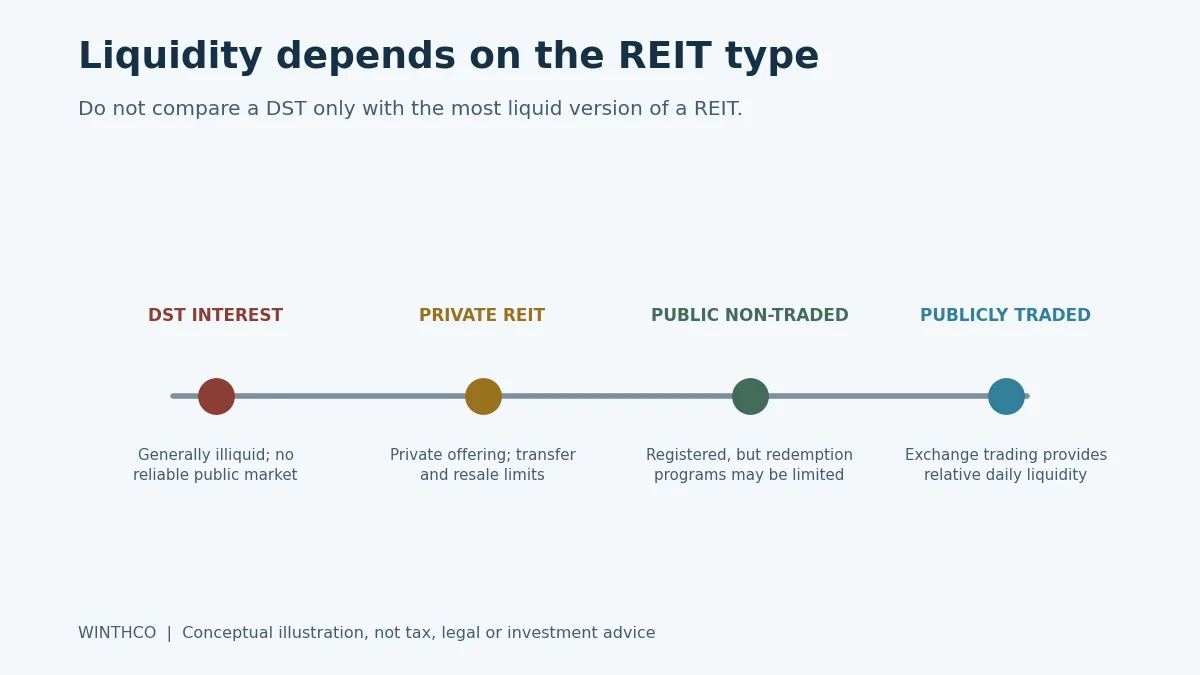
Publicly traded REIT shares are registered with the SEC and trade on a national securities exchange. Market prices are visible and investors can ordinarily place buy or sell orders during market hours, although the execution price and value can move materially. Public trading creates relative liquidity; it does not protect an investor from property cycles, interest-rate changes, leverage, dividend reductions or market losses.
Public non-traded REITs also register securities and file reports with the SEC, but their shares do not trade on a national exchange. The SEC warns that redemption programs may be limited, changed or suspended, and periodic valuations may not provide a current market-clearing price. Private REITs are not exchange traded and may rely on exemptions from SEC registration, with access commonly limited and resale restrictions potentially significant.
A DST interest is generally an illiquid private-placement security, usually offered to accredited investors. It is tied to the trust's identified property or portfolio and business plan, while a REIT manager may buy, sell or finance assets under the company's governing documents. Review the DST 1031 exchange process and the specific REIT prospectus or offering documents before comparing access, diversification and expected holding conditions.
Discuss your DST questions with Winthco →
A publicly traded REIT may provide the easiest route to selling shares, but market liquidity also means daily price volatility. A non-traded or private REIT can be far less liquid, and a redemption program is not a promise that all requests will be honored. DST interests generally lack a dependable secondary market, and transfers may require sponsor, lender and purchaser approval. Household liquidity planning should assume the restricted path stays restricted.
Both structures delegate property decisions. DST investors generally cannot direct leasing, refinancing, improvements or the sale, and the trustee's powers are intentionally limited. REIT shareholders may vote on corporate matters such as directors, but they do not select tenants or manage individual assets. The practical question is not which structure offers control in the abstract, but which decisions the documents reserve to investors, managers, trustees or boards.
Diversification also depends on facts. A REIT may own many properties across markets, yet it can still concentrate in one sector, borrower type or geography. A DST can hold one property or a portfolio, and a single DST may create substantial tenant, location or sponsor exposure. Count the actual assets and economic drivers, then compare those exposures with the investor's existing real estate, securities and income sources.
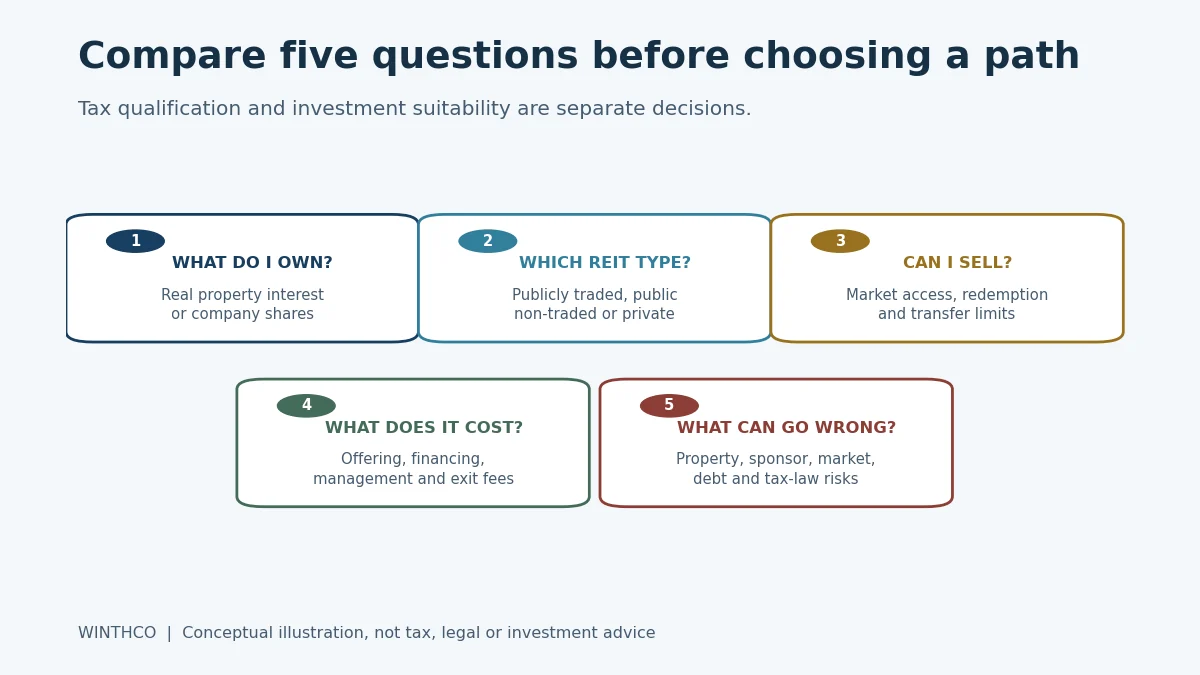
A DST private placement memorandum should disclose acquisition, selling, financing, management, reserve and disposition costs, plus conflicts involving the sponsor or affiliates. The investor's purchase price may exceed the underlying property equity allocated at closing. Compare projected property cash flow after all expenses, and do not treat a distribution estimate as yield, total return or a promise that capital will be returned.
REIT costs vary sharply by type. A publicly traded REIT's corporate expenses affect results even when an investor pays a modest brokerage charge. Public non-traded and private REIT documents may disclose selling commissions, dealer-manager fees, organizational expenses, management fees, incentive compensation and redemption limits. Review the prospectus, SEC filings or private offering materials and identify whether distributions can include borrowings, offering proceeds or return of capital.
Tax reporting is not interchangeable. A qualifying DST is commonly intended to pass through the owner's share of real estate income and deductions, while REIT shareholders generally receive dividend reporting from the company. Basis, depreciation, state filing, passive-activity and later-sale consequences depend on individual facts. Tax treatment can change, and neither structure assures distributions, appreciation, liquidity, tax deferral or protection from loss of principal.
WATCH & LEARN
Winthco Wealth Management provides a general introduction to DST planning in its 1031 DST Welcome Video. Use it as background and compare the actual DST documents with the REIT prospectus or offering materials. Original resource · Watch on YouTube ↗
Educational context only. The discussion does not establish the suitability, returns or tax treatment of an investment.
Begin by separating the exchange need from the portfolio decision. Record the taxpayer, relinquished property, qualified intermediary, identification deadline, completion deadline, required replacement value and debt analysis. If continued Section 1031 treatment is an objective, confirm that the proposed replacement interest is real property under the applicable guidance. Do not let a deadline convert a general real estate theme into a tax conclusion.
Next, identify the exact investment category. For a REIT, record whether it is publicly traded, public non-traded or private, then review registration, pricing, redemption, leverage, concentration, fees and dividend sources. For a DST, review the trust's powers, property, tenants, debt, reserves, sponsor conflicts, fees, transfer limits and exit authority. The Winthco overview of 1031 exchange investment options can frame the alternatives, but the offering documents control.
Finally, stress-test the downside. Model lower occupancy or borrower performance, higher expenses, reduced distributions, a delayed exit, refinancing limits and a sale below the initial investment. Confirm how much liquid capital remains outside the investment and how concentration changes after the transaction. Coordinate the qualified intermediary, CPA, attorney and securities professional before funds move. Eligibility, access and exchange treatment do not establish suitability.
| Decision | Evidence to request | What to avoid assuming |
|---|---|---|
| What the investor owns | DST: beneficial interest in a trust holding identified property; REIT: company shares | Both interests receive the same Section 1031 treatment |
| 1031 replacement property | Tax analysis of the actual DST and exchange documents | Real estate exposure makes REIT shares real property |
| Liquidity | DST transfer limits and the specific REIT's trading or redemption terms | Every REIT is exchange traded or readily redeemable |
| Control | Trustee, manager, board and shareholder authority | Passive ownership eliminates conflicts or execution risk |
| Costs and income | All offering, financing, management and exit costs plus distribution sources | A stated distribution equals total return |
Not as direct replacement real property. A REIT investor owns company shares, while Section 1031 applies to qualifying real property. Separate Section 721 planning should not be confused with a direct REIT-share purchase.
No. Revenue Ruling 2004-86 addresses a particular DST with limited powers. The actual trust and exchange must satisfy the applicable federal tax requirements.
No. Publicly traded REITs trade on exchanges, but public non-traded and private REITs can have significant redemption and transfer limits. Even exchange-traded liquidity does not prevent market losses.
It depends on the offering. Publicly traded and registered public non-traded REITs are not generally limited only to accredited investors, while private offerings may rely on exemptions and impose eligibility requirements.
A REIT may hold more properties, but the answer depends on sector, geography, tenants, borrowers and leverage. A multi-property DST can still be concentrated, and a large REIT can remain focused in one economic segment.
Both are generally passive at the property level. DST investors have limited authority under trust documents, while REIT shareholders may have corporate voting rights but do not manage individual properties.
No general safety conclusion is appropriate. The structures have different tax, liquidity, market, property, debt, sponsor and conflict risks that must be assessed from the actual documents and the investor's circumstances.
Sources checked October 5, 2026. This article explains general concepts; your facts and the applicable documents control.
Winthco DST services · Winthco evaluation overview · Editorial standards
Risks and due diligence
Review DST liquidity, leverage, sponsor conflicts, fees and distribution assumptions before making an investment decision.
Read guide →Investor decision-making
Compare Delaware statutory trust ownership with directly owned rental property across management, control, diversification, financing and exit flexibility.
Read guide →DST eligibility and risk
Learn the DST accredited investor income, net worth, credential and entity tests before planning a 1031 exchange.
Read guide →Explore Winthco’s main DST article collection
Share your timeline and investment range. A Winthco team member will follow up with you.