Risks and due diligence
DST investment risks: a practical due-diligence checklist
Review DST liquidity, leverage, sponsor conflicts, fees and distribution assumptions before making an investment decision.
Read guide →
Home / Learning center / Due Diligence
Due Diligence
Winthco Wealth Management · Updated November 20, 2026
Before funding a DST, confirm the receiving account and payment process through an independently established contact channel, not merely an email reply. Coordinate any exchange funds with your qualified intermediary. Verifying where money goes is essential, but it does not establish investment suitability, subscription acceptance or qualification for Section 1031 tax deferral.
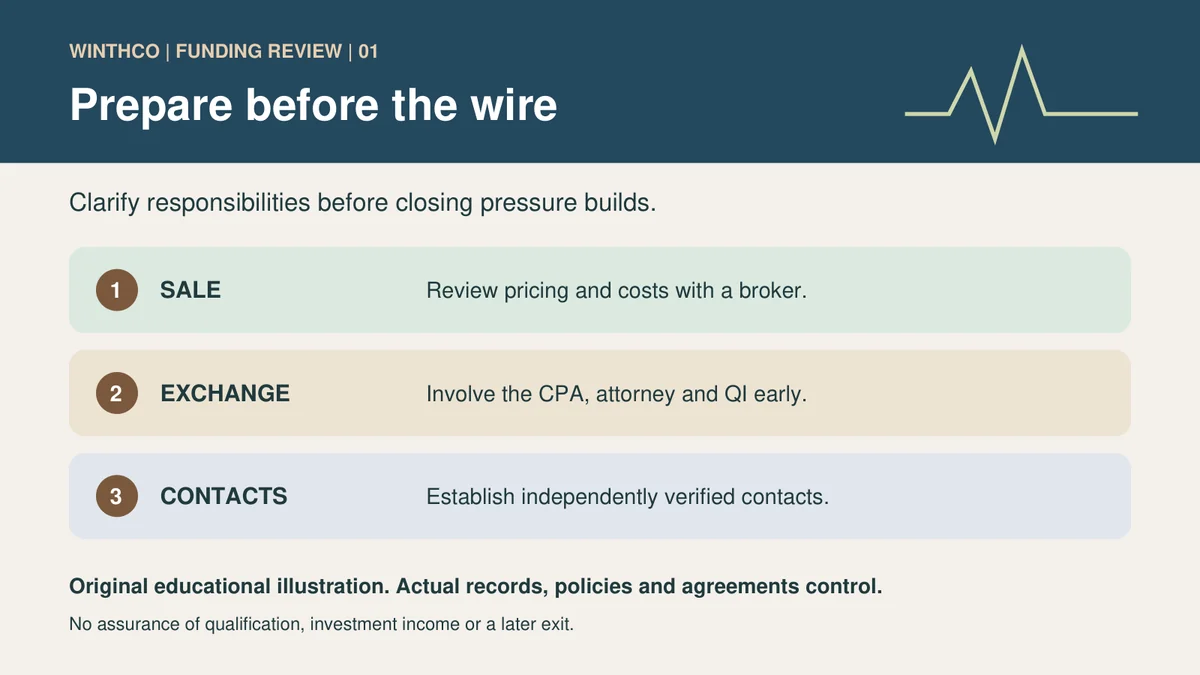
An owner preparing to sell a rental property usually starts with valuation, broker selection and marketing. Add payment coordination to that early conversation. Interview an appropriately licensed realtor or commercial broker about relevant property experience, fees, closing responsibilities and how the sale team handles changes to instructions. Do not assume the person marketing the building is also responsible for authorizing every transfer.
If a deferred exchange is contemplated, involve the CPA, attorney and qualified intermediary before closing or receipt of proceeds. Ask who prepares each document and who is authorized to communicate with the sending institution. Winthco's DST purchase process overview provides background for the replacement-investment discussion. Agreeing on responsibilities early leaves more time to resolve conflicting instructions before a deadline creates pressure.
Share your timeline and investment range. A Winthco team member will follow up with you.
A DST subscription can involve several separately named parties, such as the issuer, a selling firm and an escrow arrangement. Ask the authorized parties to explain the receiving account's role in the specific transaction. Do not infer that every DST uses the same account structure or that a familiar sponsor name makes every message authentic. This article supplies questions, not account details or authorization to send funds.
Have the responsible transaction professionals reconcile the offering name, subscription amount, investor registration and payment instructions. If the receiving account name differs from the name you expected, ask why and obtain independent confirmation before proceeding. A difference may have an explanation, but an unexplained discrepancy is not something to dismiss because the document includes a recognizable logo.
Ask what constitutes receipt of funds, acceptance of the subscription and completion of the acquisition. These may be separate events under the actual documents. A bank confirmation establishes something about a transfer, not every legal condition of an investment. Keep the subscription terms available when discussing the next step, rather than treating a payment message as the entire transaction file.
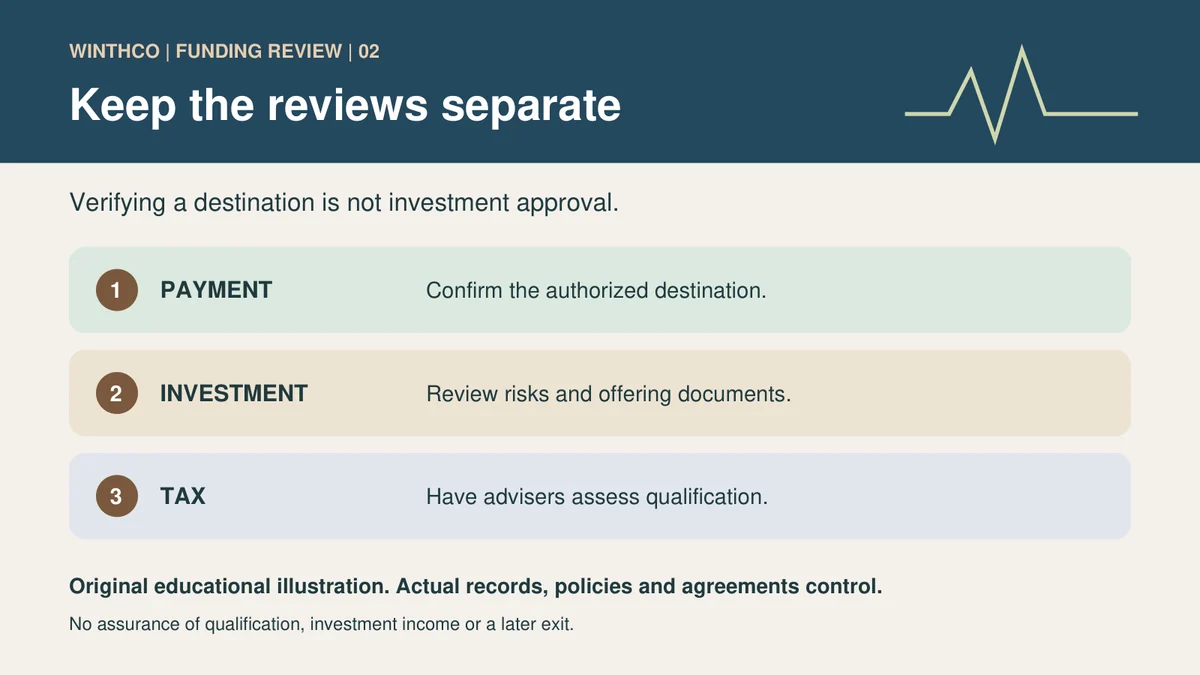
The FBI's business-email-compromise guidance recommends verifying payments and changes through a separate contact method, watching for urgency and inspecting addresses carefully. A compromised conversation can contain convincing transaction details. Replying to the same email therefore does not independently establish who controls the receiving account.
Before a transfer is due, establish a verified contact route with the relevant institution and transaction team. When instructions arrive, use that route to confirm the intended beneficiary and bank details through the institution's approved process. Do not use a new telephone number supplied only in the message being questioned. Ask how the team documents confirmation and who can authorize a change.
If there are two different versions of instructions, pause the transfer request and resolve which one is valid with the responsible parties. Do not combine the beneficiary from one version with the account details from another. Record when the discrepancy was resolved without circulating sensitive account information unnecessarily. This is a practical coordination approach, not a promise that any checklist can eliminate fraud.
Discuss your DST questions with Winthco →
The tax structure and the payment controls need to work together. IRS Publication 544 explains the deferred-exchange requirements, including limits on actual or constructive receipt. Do not take sale proceeds into your personal account merely to make a later DST transfer easier. Ask the QI and tax adviser to establish the authorized funds flow for your particular exchange before the sale closes.
The ordinary identification period is 45 days after transfer. Replacement property must be received by the earlier of 180 days or the federal return due date, including extensions. Deferral is not tax elimination, and cash or other non-like-kind consideration may produce recognized gain. Our exchange timing guide explains the broader framework; advisers should calculate the dates for the actual sale.
Confirm the QI's operational requirements, such as document review, authorization and bank cutoff arrangements, separately from the federal deadlines. Do not assume a fraud concern, incomplete subscription or delayed wire creates an automatic tax extension. Raise unresolved issues promptly with the QI and counsel. A looming deadline is a reason to coordinate earlier, not evidence that an unverified destination should be trusted.
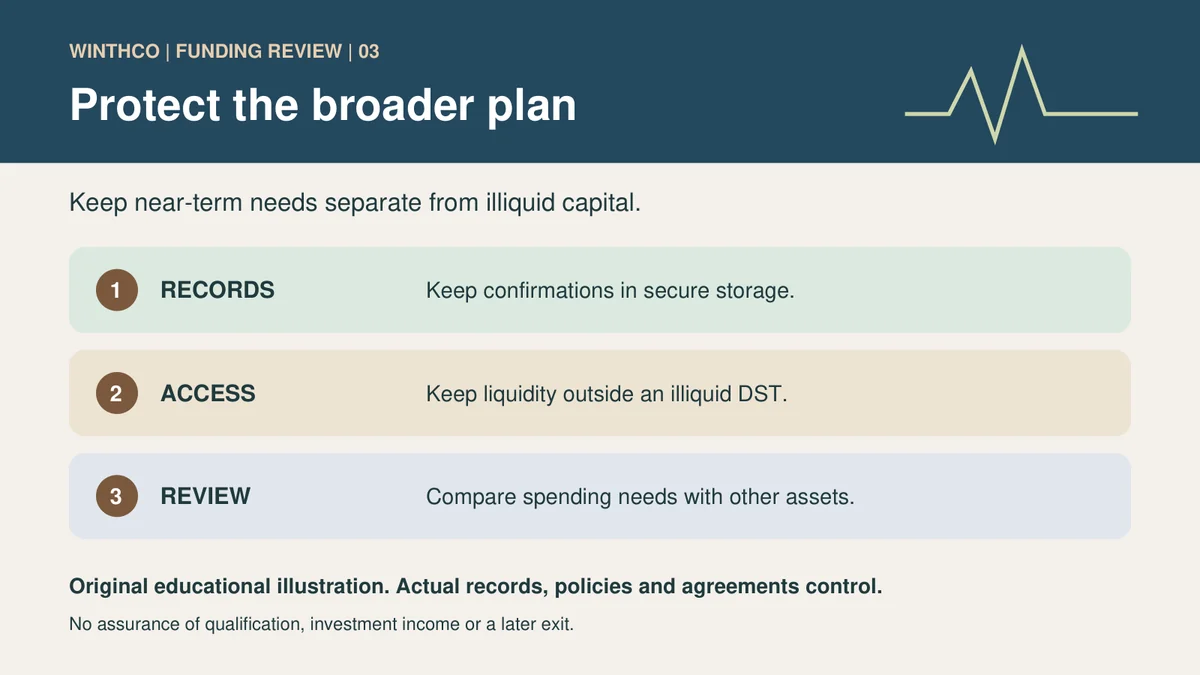
No. A correctly addressed transfer can still fund an unsuitable investment. Winthco's framework for evaluating a DST addresses a different decision: whether the property, financing, fees, control restrictions and business plan fit the investor. Keep those questions separate from the narrower question of where funds are going. Completing one review should never be used as evidence that the other has been completed.
IRS Revenue Ruling 2004-86 addresses the tax treatment of a particular DST arrangement. It is not approval of every trust, promoter or funding request. Ask tax and legal advisers to review the proposed structure. A document that mentions the ruling does not establish that the proposed transaction satisfies its relevant conditions or your individual exchange requirements.
FINRA Regulatory Notice 23-08 discusses reasonable investigation obligations when broker-dealers recommend private placements. Ask the recommending professional to explain the supporting investigation and any unresolved concerns. Review the private placement memorandum and subscription documents before authorizing funding. Our offering-document review guide can help organize questions, but it cannot substitute for reviewing the actual terms or obtaining professional advice.
WATCH & LEARN
Accruit explains DST replacement-property ownership. Third-party background for the investment review, not wire instructions, a security guarantee or a Winthco affiliation. Original resource · Watch on YouTube ↗
Educational context only. The discussion does not establish the suitability, returns or tax treatment of an investment.
Hypothetical: a seller has arranged a DST replacement purchase when a late email announces a different receiving bank. The seller does not reply with account details or treat the email signature as verification. Instead, the seller contacts the QI and the established transaction representative through previously verified channels and asks them to resolve the change. This is an invented example, not a client experience or a recovery story.
Discuss in advance who must be available if a discrepancy appears late in the process. Ask how the parties will notify each other without spreading confidential documents to an unnecessary distribution list. The purpose is to make responsibility clear. An investor should not have to decide alone which of two conflicting account numbers is correct while also trying to interpret tax deadlines.
If money may already have been misdirected, contact the sending financial institution immediately and request urgent assistance. The FBI recommends reporting business email compromise to IC3. For account-takeover incidents, IC3 also advises contacting the originating institution about a recall or reversal and addressing compromised credentials. Preserve the relevant communications for the institution and authorities. Do not assume a recovery request will succeed.
DST private placements generally are available only to accredited investors and are offered through a private placement memorandum. The SEC warns that private placements can be illiquid, provide limited disclosure and result in total loss. Funding verification does not reduce property vacancy, tenant failure, financing stress, sponsor conflicts or the economic effects of fees. Distributions can decline or stop, and principal can be lost.
Reduced day-to-day landlord duties also mean less direct control over decisions. Review the expected holding period and transfer restrictions without assuming a secondary-market sale will be available when you need money. Ask how reserves, debt terms and expenses could affect distributable cash. Legitimate ownership and predictable retirement income are not the same thing.
A proposed later Section 721 UPREIT contribution requires a separate review of terms, valuation, conflicts, tax treatment and liquidity. It is not an automatic continuation of the original exchange. Ordinary REIT shares and partnership units are not direct Section 1031 replacement real estate. Do not rely on a possible later transaction to remedy an unsuitable initial purchase or provide a dependable withdrawal date.
Keep enough accessible resources outside illiquid investments for foreseeable spending and unexpected needs. Review existing taxable assets, 401(k)s, IRAs, debt and retirement-income needs with a financial advisor. Retirement accounts are not exchange proceeds. Any proposed rollover or transfer deserves its own comparison of costs, services and access rules, rather than being bundled into the property transaction as an automatic next step.
Keep transaction confirmations and investment records in an appropriate secure location. Ask the team how future changes to distribution instructions will be authenticated. IC3 warns that fraudulent login pages and callers can seek passwords or one-time codes; use established access routes and do not share those credentials with an unexpected caller. Payment vigilance should continue after the initial purchase.
Use either prospect form on this page or our dedicated contact page for general timing and planning questions. Do not put bank account numbers, wire instructions, passwords or tax documents in that initial message. Winthco's wealth-management discussion can connect the property sale with broader financial priorities. The form requests a conversation; it is not a funding channel or authorization to transfer money.
| Decision | Evidence to request | What to avoid assuming |
|---|---|---|
| Payment destination | Independently verified instructions | Investment is suitable |
| Bank confirmation | Transfer status | Subscription is accepted |
| Subscription acceptance | Actual offering terms | 1031 treatment is assured |
| Later 721 proposal | Separate professional review | Liquidity is automatic |
Yes. Familiar names and transaction details do not independently authenticate a payment request. Use an established separate contact route.
Do not do that merely for convenience. Ask the QI and tax adviser to establish a compliant funds flow before closing.
Not by itself. Confirm subscription acceptance and acquisition completion under the actual documents.
Pause and independently resolve the change with the responsible parties. Do not rely only on a reply to the message containing the new details.
No. Use the form only for general planning questions. Sensitive funding details belong in the verified process established with the transaction team.
Sources checked November 20, 2026. This article explains general concepts; your facts and the applicable documents control.
Winthco DST services · Winthco evaluation overview · Editorial standards
Risks and due diligence
Review DST liquidity, leverage, sponsor conflicts, fees and distribution assumptions before making an investment decision.
Read guide →1031 exchange planning
Learn what a qualified intermediary does in a DST 1031 exchange and how to review agreements, fund controls, deadlines and professional roles.
Read guide →DST investment due diligence
Selling a rental property? Learn how to review a DST private placement memorandum, compare fees and risks, and assess separate 721 UPREIT terms.
Read guide →Explore Winthco’s main DST article collection
Share your timeline and investment range. A Winthco team member will follow up with you.