Risks and due diligence
DST investment risks: a practical due-diligence checklist
Review DST liquidity, leverage, sponsor conflicts, fees and distribution assumptions before making an investment decision.
Read guide →
Home / Learning center / DST due diligence
DST due diligence
Winthco Wealth Management · Updated October 6, 2026
Evaluating a DST sponsor requires reviewing the sponsor and the specific offering separately. Examine management history, completed and troubled programs, property underwriting, debt, fees, conflicts, reserves, reporting, transfer limits and exit authority. Then test those facts against the private placement memorandum, third-party reports and your own liquidity and concentration needs.
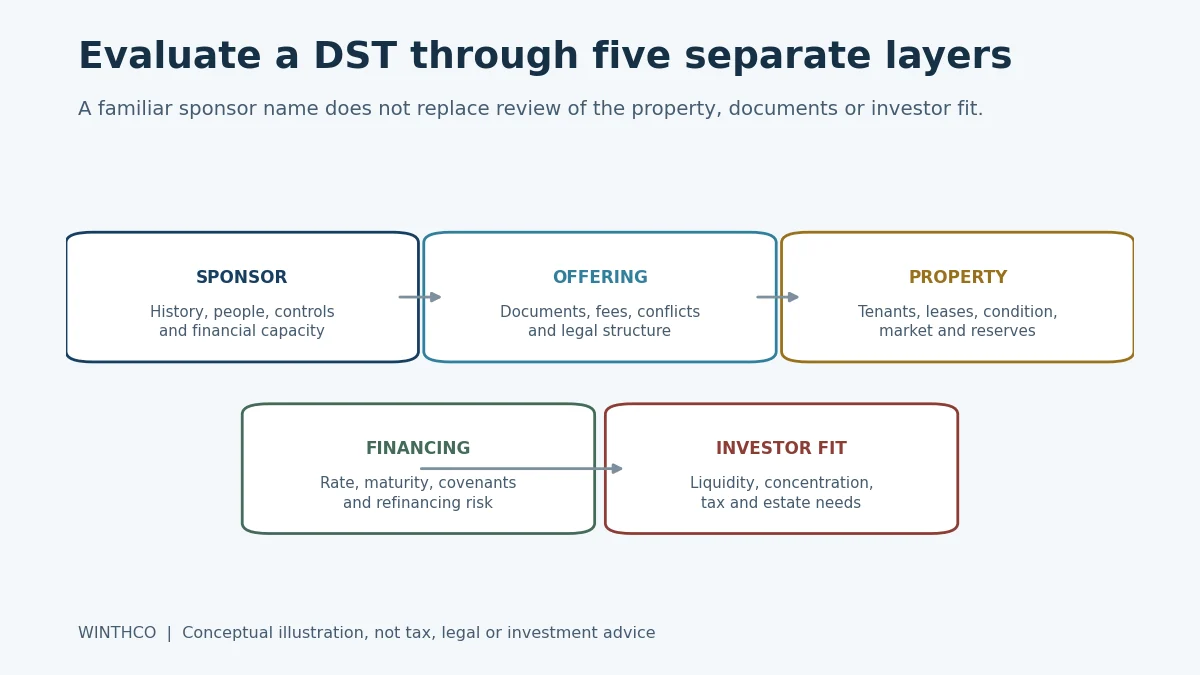
A Delaware statutory trust sponsor generally organizes the trust, selects and acquires the property, arranges financing, prepares the private offering, coordinates selling firms and oversees the business plan through affiliated or third-party managers. The sponsor may also receive acquisition, financing, asset-management, property-management and disposition compensation. Those roles can align the sponsor with execution, but they can also create conflicts that must be understood from the documents.
The sponsor is not the same as the property or the offering. A capable organization can still present an offering with aggressive leverage, concentrated tenancy, thin reserves or an expensive purchase price. Conversely, a strong asset cannot eliminate execution, financing or conflict risk. The Winthco guide on how to evaluate a DST offering provides a useful starting framework, but the current private placement memorandum and exhibits control.
Share your timeline and investment range. A Winthco team member will follow up with you.
Tax eligibility is another separate layer. IRS Revenue Ruling 2004-86 treated interests in the specific trust it described as interests in the underlying real property because the trust and trustee had tightly limited powers. A sponsor's history or reputation cannot make a nonqualifying structure eligible for Section 1031. Tax counsel should review the actual trust agreement, while investment due diligence examines whether the sponsor and offering fit the investor's objectives and risks.
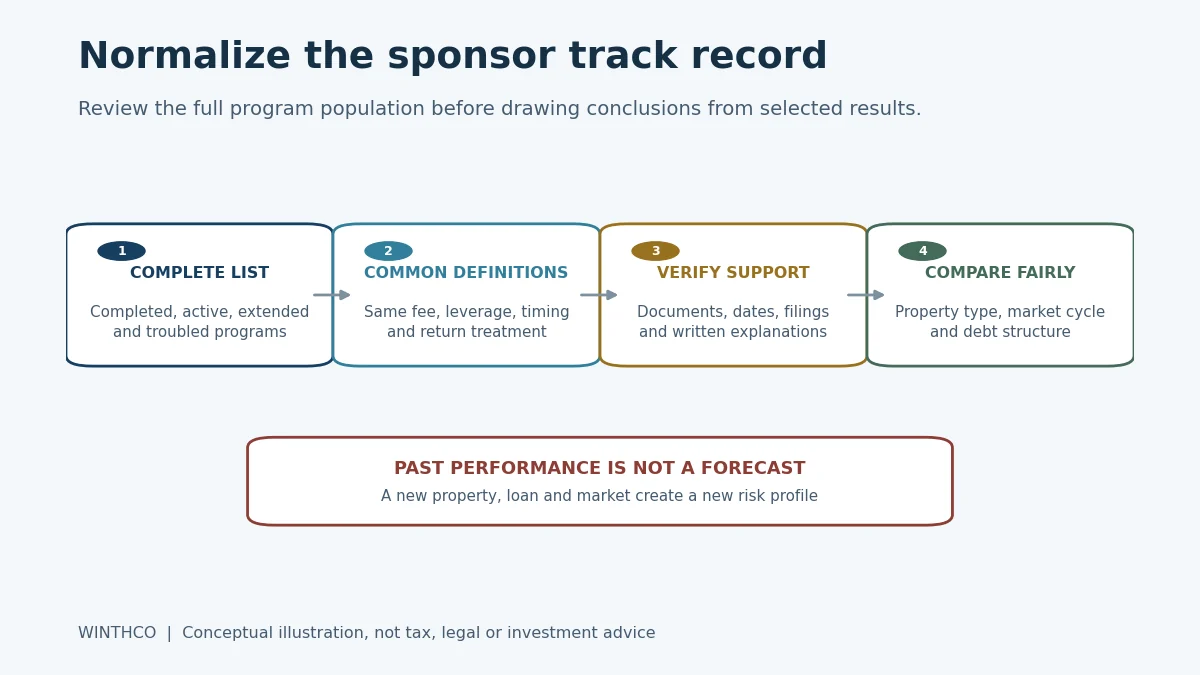
Start with a complete program list, not selected success stories. Request every realized program, active program, extension, default, foreclosure, capital call, distribution reduction and unresolved property. Record acquisition date, sale date, property type, original equity, leverage, distributions, sale proceeds and the reason any program departed from its plan. Averages can hide dispersion, so examine individual outcomes and the number of observations behind each statistic.
Normalize the record before drawing conclusions. A program purchased in a different interest-rate, credit or property cycle may not be comparable with a current offering. Separate leveraged from debt-free programs, single-tenant from multi-tenant assets and realized results from projections. Confirm whether reported results include fees and whether unsuccessful or incomplete programs remain in the denominator. Past performance does not predict the outcome of a new property.
The SEC advises private-placement investors to ask about management experience, the issuer's operating history, prior offerings and audited financial statements. Search EDGAR for Form D filings, while remembering that a Form D is a notice filing and not SEC approval. Review regulatory histories of the investment professionals involved through FINRA BrokerCheck or the SEC's Investment Adviser Public Disclosure database. Ask the sponsor to reconcile any omissions or inconsistent dates in writing.
Review the property as if you were buying it directly. Examine location, physical condition, environmental reports, title, insurance, appraisal, rent roll, tenant credit, lease expirations, concessions, comparable rents, occupancy history, capital expenditures and replacement reserves. For a portfolio, identify which assets or tenants drive most of the income. A long lease is not sufficient if the tenant has weak credit, termination rights or costly obligations at renewal.
Test the assumptions behind projected cash flow. Compare revenue growth, vacancy, bad debt, repairs, taxes, insurance, management costs and capital needs with recent operating statements and third-party market evidence. Determine whether early distributions rely on reserves, fee waivers, interest-only debt or assumptions that may not persist. A distribution projection is not the same as property yield or total return, and no distribution is guaranteed.
Study the exit plan without treating the target date or sale price as a promise. Ask who decides when to sell, what conditions could extend the hold and whether the trust's limited powers may restrict leasing, refinancing or capital improvements during stress. The main Winthco article on choosing an appropriate Delaware statutory trust identifies property type, sponsor history, fees, holding time, taxes and debt as separate factors rather than one score.
Discuss your DST questions with Winthco →
Build a debt schedule that lists original balance, loan-to-value ratio, interest rate, fixed or floating status, maturity, amortization, covenants, reserves, recourse provisions and extension options. Compare loan maturity with the projected hold and major lease expirations. A low initial payment can mask refinancing risk, while high leverage magnifies both property gains and losses. Debt-free offerings avoid mortgage default risk but still face operating and valuation risks.
Trace every dollar in the sources-and-uses table. Separate property price from closing costs, reserves, selling compensation, acquisition fees, financing fees and other sponsor or affiliate payments. Then list ongoing asset-management, property-management, financing, servicing and disposition compensation. Determine which fees are based on equity, property value, revenue or a transaction, and whether an affiliate benefits even when investor results fall below projections.
Map every related-party role. The sponsor, depositor, signatory trustee, master tenant, property manager, lender affiliate and selling participants may have different duties and compensation. Read the conflicts section and ask what independent approvals exist for transactions with affiliates. The SEC specifically advises investors to ask how their investment professional is compensated and whether business ties create incentives. Disclosure of a conflict does not remove its economic effect.
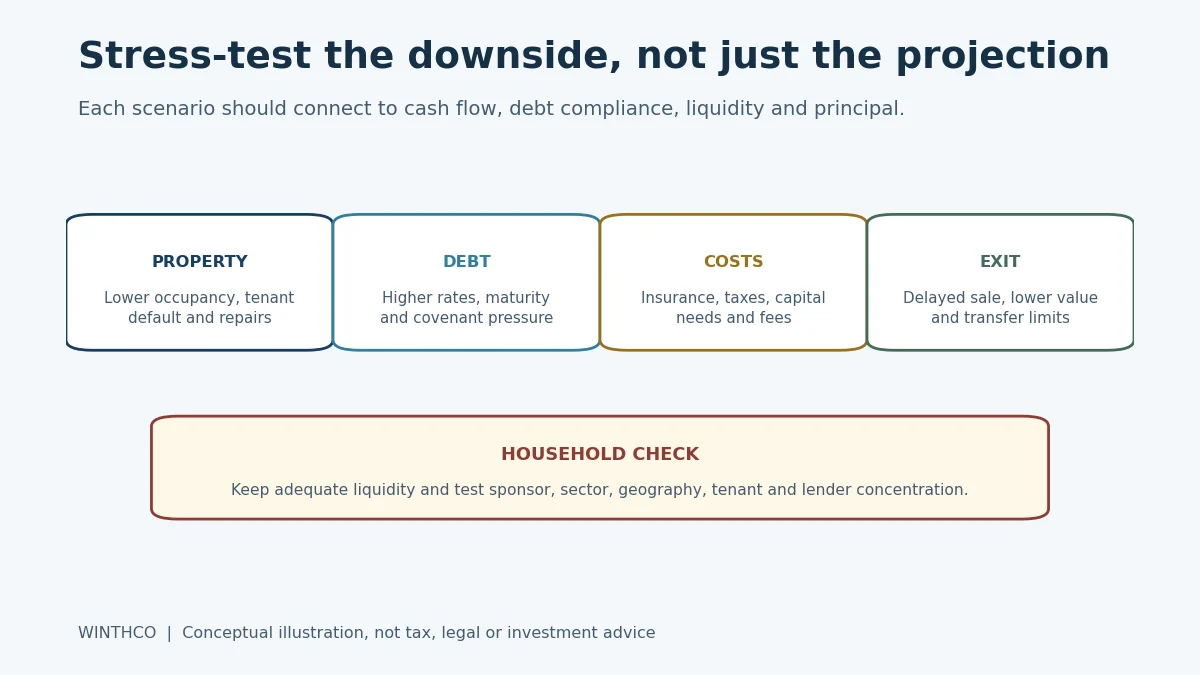
Model conditions that differ from the base case: lower occupancy, tenant default, slower rent growth, higher insurance and taxes, unexpected repairs, lender covenant pressure, a delayed sale and a lower exit value. For each scenario, estimate the effect on cash reserves, distributions, loan compliance and principal. Ask which party can respond and which actions the DST structure or loan documents prohibit.
Assume the investment cannot be sold on demand. The SEC describes private placements as highly illiquid and notes that offering documents may provide limited information and are generally not regulator-reviewed. FINRA likewise warns that alternative products can have liquidity, concentration, disclosure and fee risks. An accredited-investor determination is an offering-access standard; it does not establish that a DST is suitable or that an investor can withstand a long hold or loss.
Evaluate concentration across the whole household balance sheet. Multiple DSTs do not create meaningful diversification if they share the same sponsor, property sector, geography, lender, master tenant or economic driver. FINRA cautions that correlated assets and concentrations in illiquid investments can impair timely access to cash. Keep adequate liquid resources outside the DST and compare the proposed allocation with existing real estate, securities, tax and estate needs.
WATCH & LEARN
Winthco Wealth Management provides a general introduction to DST planning in its 1031 DST Welcome Video. Use it as background, then evaluate the sponsor and offering through the current documents and independent review. Original resource · Watch on YouTube ↗
Educational context only. The discussion does not establish the suitability, returns or tax treatment of an investment.
Begin before the Section 1031 identification deadline compresses the decision. Confirm the exchange taxpayer, qualified intermediary, identification date, completion date, required replacement value and debt analysis. Then request the private placement memorandum, trust agreement, subscription documents, property reports, loan documents, sponsor financial information, track-record schedule and written fee summary. Missing material should pause the review rather than be filled with assumptions.
Create a comparison sheet using the same definitions for every candidate. Score sponsor history, property fundamentals, tenant exposure, leverage, reserves, fees, conflicts, reporting, transfer restrictions, exit authority and downside resilience. Record the supporting document and page for each conclusion. The Winthco 1031 DST sponsor overview can frame the available questions, but sponsor marketing and third-party labels should never replace source documents.
Finish with independent review and a written decision record. A CPA can model basis, debt and state reporting; tax counsel can review exchange and trust structure; an attorney can evaluate contracts; and a licensed securities professional can address investment fit and disclosures. Document why the offering fits the investor's liquidity, concentration and risk limits, plus the facts that would cause rejection. Eligibility, timing pressure and projected income are not substitutes for suitability.
| Decision | Evidence to request | What to avoid assuming |
|---|---|---|
| Sponsor history | Complete realized, active, extended and troubled program schedule with consistent definitions | A few selected full-cycle examples represent every outcome |
| Property underwriting | Operating statements, rent roll, leases, market evidence, reports and reserves | A strong location or long lease removes property risk |
| Financing | Rate, maturity, covenants, amortization, extensions and lease-expiration overlap | Low initial payments mean low refinancing risk |
| Fees and conflicts | Sources and uses, ongoing compensation and every related-party role | Disclosure makes a conflict economically harmless |
| Liquidity and exit | Transfer limits, sale authority, downside cases and household cash needs | The projected hold or sale price is guaranteed |
No. Experience may provide more evidence to review, but it cannot remove property, financing, sponsor, conflict, tax, liquidity or loss-of-principal risks. Evaluate the current offering on its own documents and facts.
It generally refers to programs that acquired and later disposed of their properties. Review each result, the calculation method, fees, holding period and every program that remains active, extended or troubled rather than relying on a selected average.
No. The SEC states that Form D is a notice filing and does not represent approval or registration of the offering. Private placement memoranda are also generally not reviewed by a regulator.
Review selling compensation, acquisition, organization, financing, reserves, asset management, property management, servicing, disposition and any affiliate compensation. Identify the amount, calculation base, timing and recipient.
There is no universal answer. Analyze the property's cash-flow resilience, interest rate, maturity, covenants, amortization, lease expirations and investor tax objectives, then compare the downside with a debt-free alternative.
A dependable public market generally does not exist. Transfers can be restricted and may require approvals, so investors should be prepared for an extended hold and should not rely on early liquidity.
No. A projected distribution is only one assumption-driven measure and is not total return. Property quality, debt, reserves, fees, conflicts, liquidity, concentration and downside risk must also be evaluated.
Sources checked October 6, 2026. This article explains general concepts; your facts and the applicable documents control.
Winthco DST services · Winthco evaluation overview · Editorial standards
Risks and due diligence
Review DST liquidity, leverage, sponsor conflicts, fees and distribution assumptions before making an investment decision.
Read guide →Investor decision-making
Use practical questions about registration, compensation, due diligence, coordination and follow-up when evaluating a DST advisor.
Read guide →DST eligibility and risk
Learn the DST accredited investor income, net worth, credential and entity tests before planning a 1031 exchange.
Read guide →Explore Winthco’s main DST article collection
Share your timeline and investment range. A Winthco team member will follow up with you.