1031 exchange planning
1031 exchange deadlines: the 45-day and 180-day rules
Plan the identification and completion periods for a deferred 1031 exchange, including the earlier tax-return deadline.
Read guide →
Home / Learning center / Exchange Planning
Exchange Planning
Winthco Wealth Management · Updated November 14, 2026
No. Section 1031 does not treat real estate outside the United States as like-kind to real estate inside it. A qualifying Delaware statutory trust interest whose underlying real estate is in the United States does not change that rule. Separate the foreign sale's tax analysis from the decision to make a new U.S. investment.
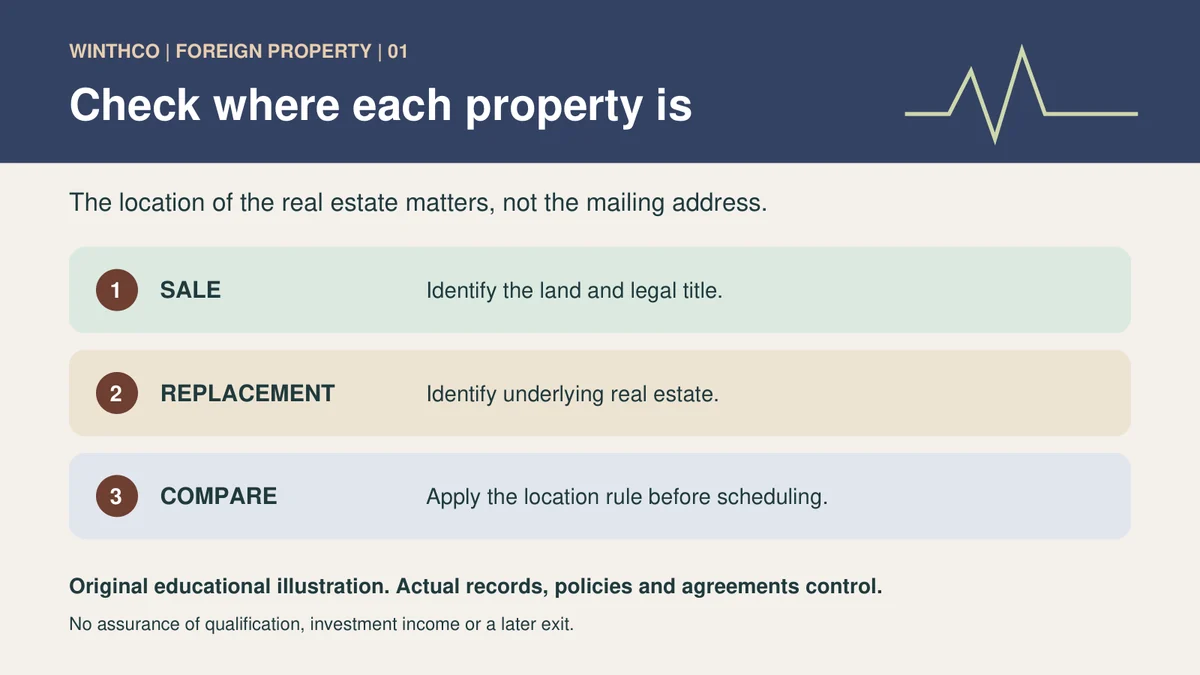
Section 1031(h) compares where the real estate is located. An overseas apartment does not become U.S. real estate because the owner lives in the United States, collects rents in dollars or uses a domestic bank. Likewise, the word Delaware in a Delaware statutory trust describes the legal structure, not necessarily the physical location of every property. Verify the actual address and the legal and tax interest transferred or acquired.
When planning a foreign sale, interview a broker authorized to work where the property is located and experienced with that type of rental. Ask which comparable sales support the estimate, which fees reduce proceeds, when a transfer becomes effective and what conditions remain before closing. Give advisers the title records, purchase and improvement history, depreciation records, expected closing statement and currencies involved. Get advice in both jurisdictions before signing terms that depend on a particular tax result.
Share your timeline and investment range. A Winthco team member will follow up with you.
A person who lives abroad can own real estate physically located in a U.S. state, and a person who lives in the United States can own a rental physically located abroad. The property location rule is not a residency test. Residency and legal ownership nevertheless matter to other questions, such as who reports the sale, possible withholding and how domestic and foreign tax rules interact. A U.S. property sale by a person treated as foreign for tax purposes deserves separate withholding advice before closing, even when the parties are exploring an exchange.
If both properties are outside the United States, the U.S.-versus-foreign rule is not itself the answer. Have counsel determine whether both interests are qualifying real property, whether the same taxpayer exchanges them, whether they are held for investment or business, and whether local law allows the planned transactions. Jurisdictions may treat the same transfer differently. Potential U.S. treatment does not establish relief from local tax or reporting where either property is located.
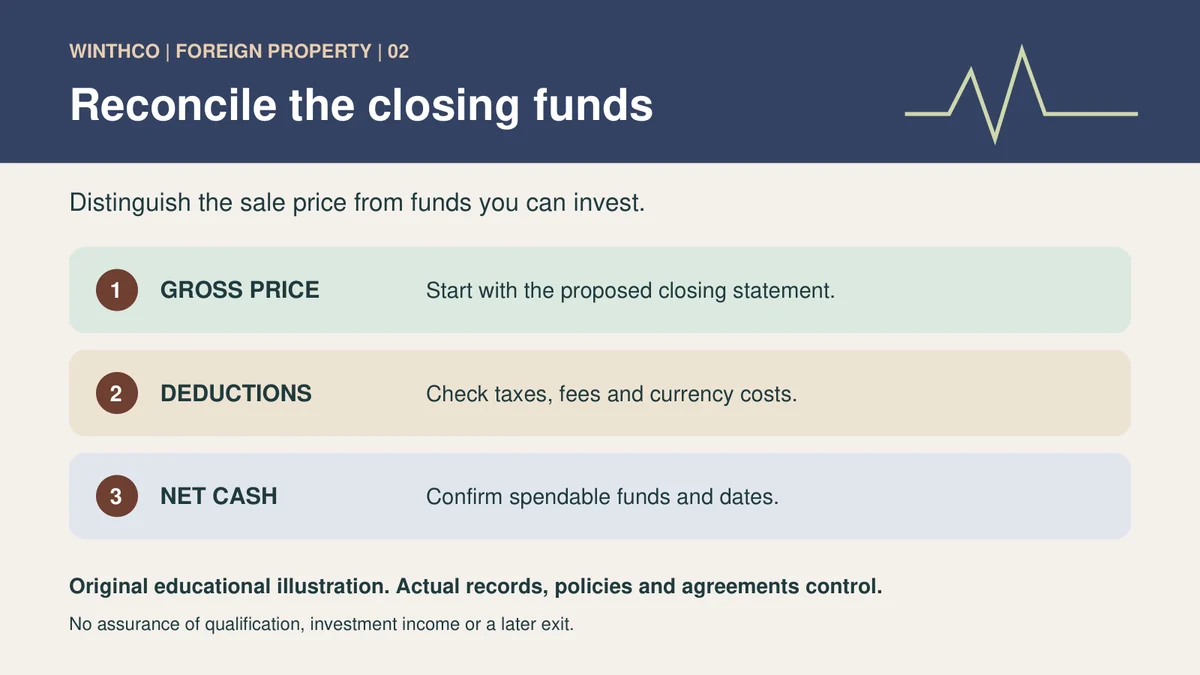
If an exchange is potentially eligible, arrange a qualified intermediary and consult your CPA and attorney before transfer or receipt of proceeds. For an ordinary deferred exchange the taxpayer generally has 45 days after transfer to identify replacement property and until the earlier of 180 days after transfer or the federal return due date, including extensions, to acquire it. Cash or other non-like-kind consideration received in an otherwise qualifying exchange may cause recognition of gain. Winthco's explanation of the 1031 exchange rules describes the usual process; neither identification nor timely funding fixes a foreign-to-domestic location mismatch.
Hypothetical: A U.S. taxpayer plans to sell a rental abroad. A U.S. DST has an allocation the seller could purchase shortly after the sale. Even if the purchase would close within 45 days, the rental is foreign real estate and the potential replacement interest is in domestic real estate, so the location rule still applies. Instead of budgeting the gross proceeds for a DST, the seller asks advisers to model taxes, closing costs, conversion charges and the cash needed to meet obligations before considering any new investment.
Discuss your DST questions with Winthco →
A taxable sale and a new investment are separate transactions. A private DST offering may accept a separate cash subscription if the investor meets the offering's requirements. The purchase does not retroactively turn the sale into an exchange. Revenue Ruling 2004-86 analyzes a particular trust whose beneficial owners were treated as owning interests in the underlying property for federal tax purposes. It is not blanket approval of all DSTs or a way to change where real estate is located. Winthco's overview of DST replacement property explains the structure in the exchange setting.
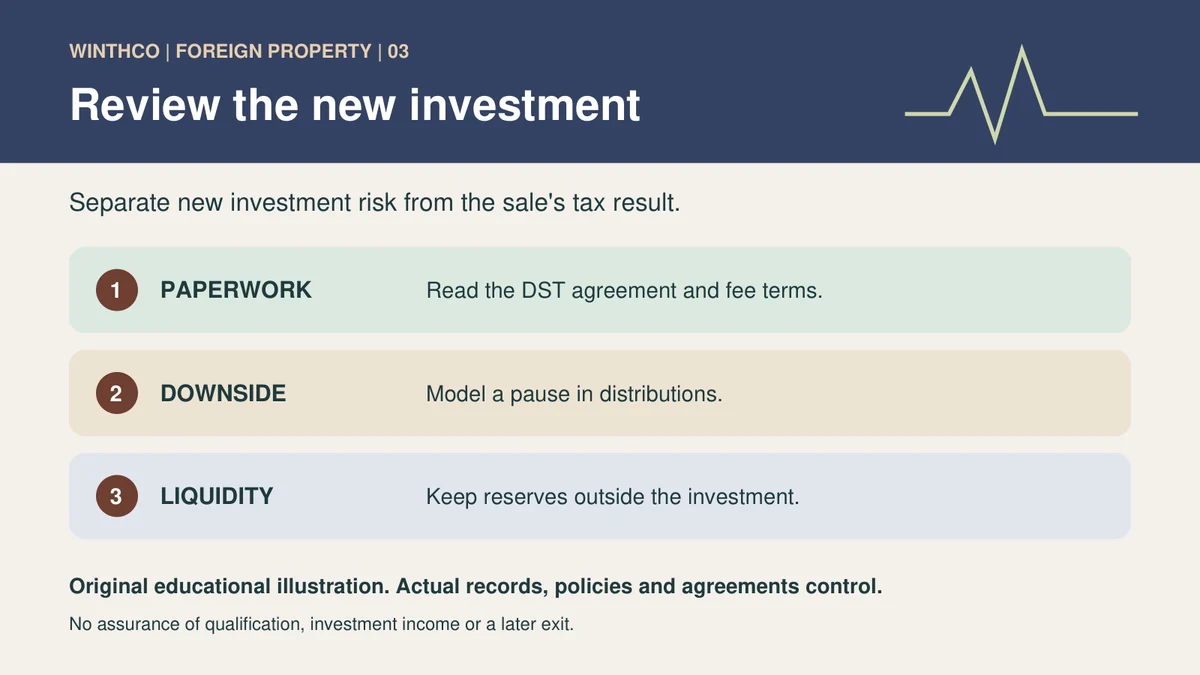
Less day-to-day landlord work comes with trade-offs. Review the private placement memorandum, trust agreement, subscription terms and property locations. Ask how much of the purchase goes to real estate after fees, who receives compensation, which costs recur and whether affiliates are paid again at exit. Compare loan maturity against the expected hold, check whether stated reserves are already funded and ask what happens if the largest tenant stops paying or insurance costs rise. The sponsor's decisions and market conditions can change distributions, and investors can lose principal.
Accredited investor status is often required but does not establish suitability. Private placements may disclose less than public investments and can be difficult to resell. Ask what transfers are permitted, whether buyers can readily be found and who controls the property sale. A later Section 721 contribution is separate, is not assured and does not reverse the tax result of the original foreign property sale. Do not count on such a contribution as a source of cash on a particular date.
Set apart the amount expected at closing, the amount that may be held back and the amount needed later. Identify the source of each figure: the proposed settlement statement, a local tax estimate, the lender payoff or an actual bank conversion quote. For any foreign withholding, ask whether it is a prepayment, a final liability or an amount that could be recovered, and what documentation or deadlines apply. Ask your U.S. adviser which exchange rates, dates and original records matter. A local gain computed in a foreign currency is not necessarily the amount reported on a U.S. return.
Give each professional a clear assignment. The broker handles marketing and negotiations; the attorney works through title and transfer requirements; tax advisers determine treatment in each jurisdiction. The QI helps administer a potentially eligible exchange, while a financial adviser compares investment risk and portfolio fit. A proposed closing timetable is not a substitute for these reviews. Keep the gross price and the net amount available for investment on separate lines so a tax reserve or potential holdback is not accidentally counted as spendable. If the foreign purchase or improvement receipts are incomplete, ask what secondary evidence can support the amounts before relying on estimates. A translation may make a document readable, but it does not resolve a missing payment date, a mismatch in the named owner or a currency conversion question. Keep those uncertainties visible in the proceeds estimate.
WATCH & LEARN
Tina Colson-Jones of Equity Advantage 1031 Exchange discusses general property examples. Use Section 1031(h) and IRS guidance to determine the location rule. Original resource · Watch on YouTube ↗
Educational context only. The discussion does not establish the suitability, returns or tax treatment of an investment.
Compare keeping cash, direct ownership and a DST using the same estimate of after-tax proceeds. List essential expenses and expected tax payments by currency and date. Use ranges where amounts are uncertain. If a DST does not distribute cash for a period, identify where funds would come from without assuming an early sale. Consider whether the position would concentrate too much household wealth with one sponsor, tenant, loan structure or geographic market.
Review taxable savings, 401(k)s, IRAs, beneficiary instructions and estate arrangements separately from the property sale. Compare the costs and services of retirement account options without presuming a rollover. Bring a summary of expected net proceeds and cash needs to the planning discussion. Use either prospect form on this guide or the dedicated contact page; save account statements and tax documents for a secure channel agreed with your advisers. If currency or tax-payment timing is unresolved, model a smaller initial investment or wait until those amounts are clearer. A decision to preserve flexibility can be valuable even if a larger allocation is available today.
| Decision | Evidence to request | What to avoid assuming |
|---|---|---|
| Foreign to U.S. real estate | Property location and title | A U.S. DST changes the location rule |
| Foreign seller of U.S. property | Location and separate withholding analysis | A mailing address decides eligibility |
| Taxable sale and DST purchase | Net proceeds, investment terms and liquidity | A fast purchase creates an exchange |
No. Section 1031(h) addresses where the real estate is located, not citizenship.
No. An intermediary cannot make U.S. and foreign property like-kind.
A separate cash purchase may be possible if permitted by the offering. It does not change the tax character of the earlier sale.
No. Check the actual property locations and the nature of the interests being acquired.
No. Check the interests, taxpayer, purpose, exchange structure and applicable local rules.
Sources checked November 14, 2026. This article explains general concepts; your facts and the applicable documents control.
Winthco DST services · Winthco evaluation overview · Editorial standards
1031 exchange planning
Plan the identification and completion periods for a deferred 1031 exchange, including the earlier tax-return deadline.
Read guide →DST fundamentals
Learn how a cash DST purchase differs from a 1031 exchange, what tax benefits it does not create, and which costs and liquidity risks to review.
Read guide →1031 exchange planning
Selling through a single-member LLC? Check federal tax ownership, closing documents and DST subscription records before a 1031 exchange.
Read guide →Explore Winthco’s main DST article collection
Share your timeline and investment range. A Winthco team member will follow up with you.