Risks and due diligence
DST investment risks: a practical due-diligence checklist
Review DST liquidity, leverage, sponsor conflicts, fees and distribution assumptions before making an investment decision.
Read guide →
Home / Learning center / 1031 exchange planning
1031 exchange planning
Winthco Wealth Management · Updated November 12, 2026
A single-member LLC may hold title to property in a 1031 exchange without being a separate federal income-tax taxpayer. Verify who owns the LLC, how it is classified, and who will receive the replacement property. If you are considering a Delaware statutory trust, align the identification and subscription documents before closing.
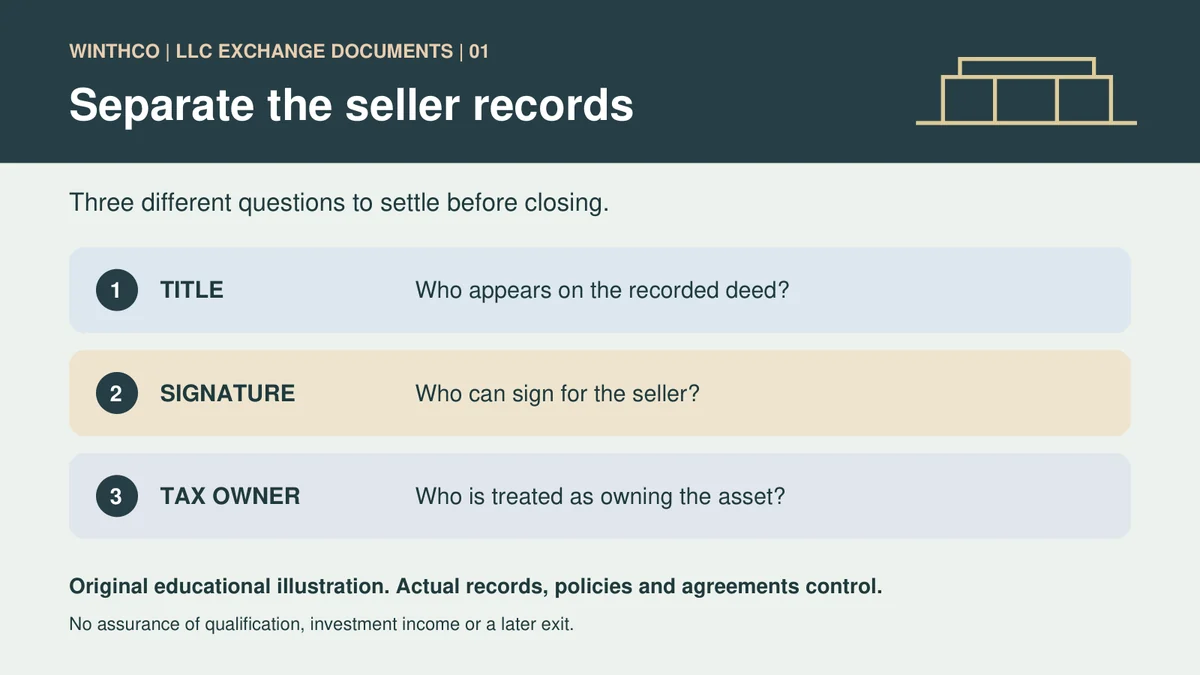
Bring the recorded deed, lease and operating records, mortgage documents, and the names of the parties authorized to sign for the seller. Ask a licensed broker with comparable investment-property sales for closed sales that support a price range, a description of marketing and fees, and a plan for handling buyer contingencies and escrow. Tell the broker if the sale contract must accommodate an exchange. A broker can help organize a sale, but a broker's understanding of who owns the building is not a federal tax determination. Have your CPA and attorney compare the deed, LLC documents and tax reporting before accepting a contract that names a different seller.
A domestic single-member LLC is generally disregarded as separate from its owner for federal income tax unless it elects corporate treatment. Its name can still appear on the deed and closing documents. For federal income tax, the relevant owner is the person or entity that owns the disregarded LLC, not necessarily the individual who signs for it. Two LLCs with similar names, the same manager or the same mailing address are not necessarily owned by the same taxpayer. Winthco's guide to exchanges involving multiple owners gives broader ownership context. For the specific LLC, confirm its member, effective ownership dates and tax classification rather than relying on a label.
Share your timeline and investment range. A Winthco team member will follow up with you.
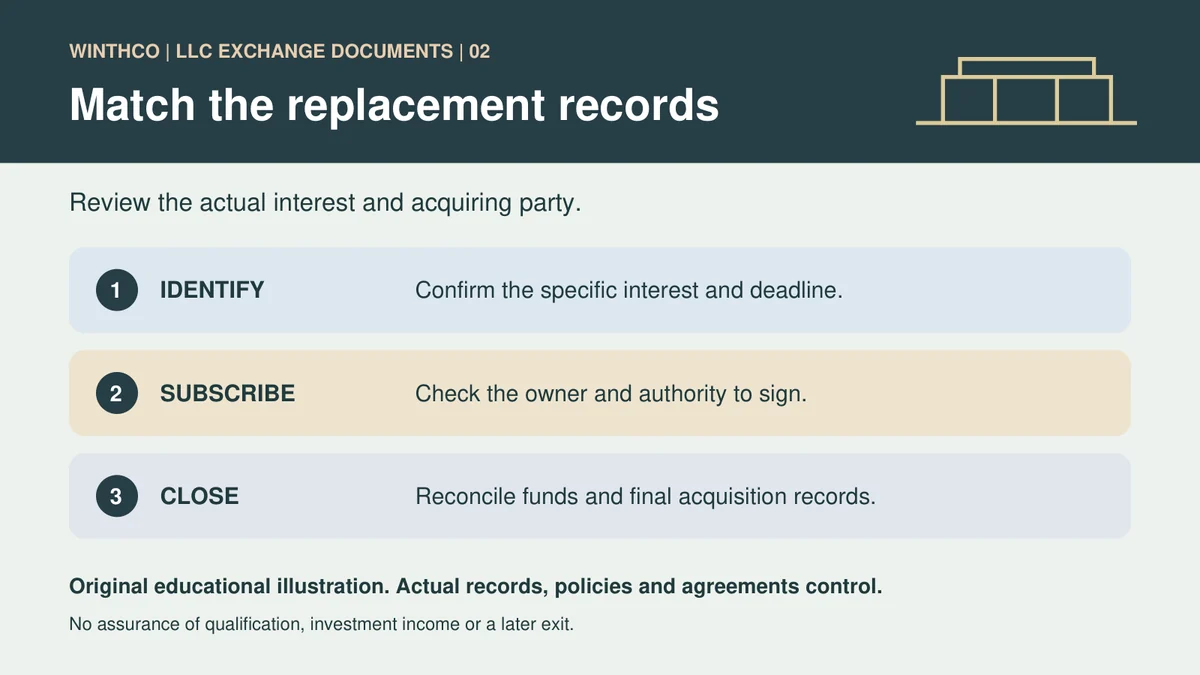
Have your CPA identify the federal income-tax owner and your attorney verify the seller's authority and chain of title. Bring the qualified intermediary in before closing or receiving proceeds and align the sale, exchange and replacement documents. Section 1031 can defer eligible gain for a qualifying exchange of investment or business real property; it does not erase the tax. Identify replacement property in writing within 45 days after the transfer and receive it by the earlier of 180 days after transfer or the federal return due date, including extensions. Cash or other non-like-kind property received and liability treatment can affect recognized gain. Ask your CPA to model both exchange and taxable sale scenarios.
Discuss your DST questions with Winthco →
Imagine that Alex owns all of a domestic LLC that holds a rental building and is disregarded for federal income tax. Alex considers acquiring a replacement through another domestic LLC that Alex owns entirely and that is also disregarded. The two names on the deeds need not mean two federal income-tax owners. That observation does not establish qualification: the team must still verify the actual classification, owner, investment use and exchange documents. A small change can alter the analysis. If a co-investor becomes a member of the receiving LLC, do not assume it is still disregarded. Have counsel and the CPA review the timeline and structure before the membership or title changes.
Flag corporate elections, admission or departure of members, transfers to a trust, distributions from an entity and a proposal to vest title in another family member. Ask which events are effective now and which are only planned. A multi-member domestic LLC is generally classified as a partnership by default unless it elects corporate treatment, subject to special rules that may require separate review. Partners should not assume that they can exchange their partnership interests as real property or that an entity's property sale belongs to them individually. If a change is proposed after identification, confirm whether the replacement and acquisition documents still match. Avoid rushing an entity restructuring simply to meet an exchange deadline.
WATCH & LEARN
Paul Holloway of Accruit discusses the same-taxpayer rule and examples involving disregarded entities. This third-party video does not determine how any particular owner or DST interest is treated. Original resource · Watch on YouTube ↗
Educational context only. The discussion does not establish the suitability, returns or tax treatment of an investment.
A qualifying DST interest may be considered as replacement property and may reduce direct management work. IRS Revenue Ruling 2004-86 describes a particular trust and its beneficial interests on specific facts, not a blanket approval of every DST. Use Winthco's overview of a DST in a 1031 exchange to frame the questions. Check who will subscribe, whose funds will be used, which interest the identification describes and how the closing and tax records will identify the investor. Ask the intermediary and offering administrator which entity documents they need and have counsel review signature authority. A DST accepting your subscription does not by itself establish that your exchange meets the tax rules.
After resolving title and tax ownership, compare the replacement's economics with the seller's goals. Review the private placement memorandum, trust agreement, debt terms, leases, cash reserves and fees. Ask who has authority over repairs and sales, what happens if a tenant leaves and what cash remains if a repair and refinancing challenge occur together. Check whether the same sponsor, tenant or market appears elsewhere in the household portfolio. A directly held replacement might offer more decision-making authority but may require more management. The DST due diligence guide offers additional questions about testing the sponsor's assumptions rather than treating the projected cash flow as a commitment.
Private DST offerings are generally directed to accredited investors. Interests can be difficult to value or sell, and control over operations and exit timing is limited. Acquisition, administration and exit costs can reduce cash available to investors. Sponsor execution, tenant credit, property condition, leverage and refinancing can all change outcomes. Distributions can decline or stop, the holding period can exceed expectations and investors can lose principal. Correct documentation does not fix a poor investment, and a deadline does not justify taking risk you cannot absorb. Compare the net cash and investment tradeoffs of a taxable sale, a directly owned replacement and a qualifying DST with your advisers.
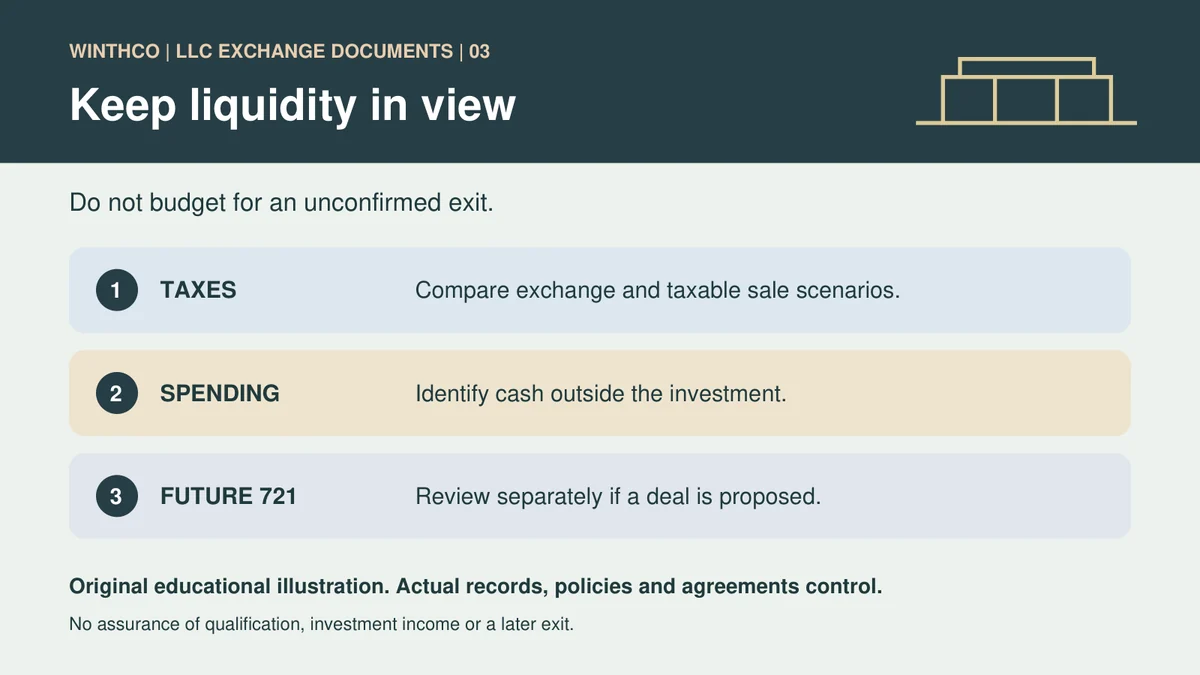
No. A possible later contribution to an UPREIT operating partnership is separate from the original Section 1031 exchange and may never be available. Operating partnership units and ordinary REIT shares are not direct Section 1031 replacement real property. If a later Section 721 opportunity arises, have legal and tax advisers review the actual contributing party, what is being contributed, how it is valued, the liabilities involved and the terms of any eventual redemption. Do not rely on a possible transaction to fix a defect at the original closing or to provide ready cash. Evaluate the initial replacement on its own merits.
Before committing, list upcoming taxes and essential spending alongside assets that can be accessed independently of the proposed property. Test the budget without a distribution or early exit. Review taxable holdings, existing 401(k)s and IRAs, investment costs, account services and beneficiary arrangements with your advisers. Retirement accounts are not exchange proceeds, and a property sale does not require a rollover. If estate planning calls for changing ownership, ask counsel and your CPA to coordinate the timing with the exchange team before signing new documents. Winthco Wealth Management can help compare liquidity and concentration across the alternatives without assuming every asset belongs in the same investment.
Use a separate line for the seller on the deed, the federal income-tax owner, the person signing, the recipient of replacement property and the supporting document for each. Record ownership changes and their effective dates, the latest dates for identification and acquisition, and which adviser must resolve any disagreement. Match the proposed DST subscription or direct purchase agreement to that sheet. If two documents conflict, pause and verify which is right rather than changing names at escrow without review. Then compare the tax estimates and cash needed outside the investment. The goal is a documented decision that still makes sense if the replacement takes longer or produces less income than expected.
| Decision | Evidence to request | What to avoid assuming |
|---|---|---|
| Recorded deed | Name of the legal title holder | The deed alone determines federal tax ownership |
| LLC records and returns | Member and federal tax classification | Every single-member LLC is disregarded |
| Replacement paperwork | Acquiring party and specific interest | Similar entity names establish the same taxpayer |
| Financial plan | Cash needed even without a DST exit | A future 721 transaction will provide liquidity |
No. A domestic single-member LLC is generally disregarded for federal income tax unless it elects corporate treatment. Confirm how the specific LLC is classified.
No. Deed names can differ from federal income-tax ownership. Have your advisers check the underlying owner and structure.
Generally no. A partnership interest is not itself eligible replacement real property, though the partnership may own real property that needs separate analysis.
It may be possible if the specific trust interest and exchange qualify. Review the taxpayer, documents and closing process before making a commitment.
Your attorney checks title and signing authority, your CPA checks federal tax ownership, and the intermediary coordinates exchange documents. Ask them to reconcile conflicts before closing.
Sources checked November 12, 2026. This article explains general concepts; your facts and the applicable documents control.
Winthco DST services · Winthco evaluation overview · Editorial standards
Risks and due diligence
Review DST liquidity, leverage, sponsor conflicts, fees and distribution assumptions before making an investment decision.
Read guide →1031 ownership planning
Learn how co-owners and LLC members evaluate separate 1031 exchange paths, DST replacements, ownership rules, deadlines and risks.
Read guide →1031 exchange planning
Learn what a qualified intermediary does in a DST 1031 exchange and how to review agreements, fund controls, deadlines and professional roles.
Read guide →Explore Winthco’s main DST article collection
Share your timeline and investment range. A Winthco team member will follow up with you.