1031 exchange planning
1031 exchange identification rules for DSTs
Understand the three-property, 200 percent and 95 percent identification rules before naming DST replacement property.
Read guide →
Home / Learning center / 1031 ownership planning
1031 ownership planning
Winthco Wealth Management · Updated October 8, 2026
Multiple owners can pursue different sale-proceeds paths only when the ownership and exchange documents support separate taxpayers. Direct tenants in common may be able to exchange their own undivided interests, while members generally cannot exchange partnership interests. A DST can be one replacement option, but advance tax and legal review is essential.
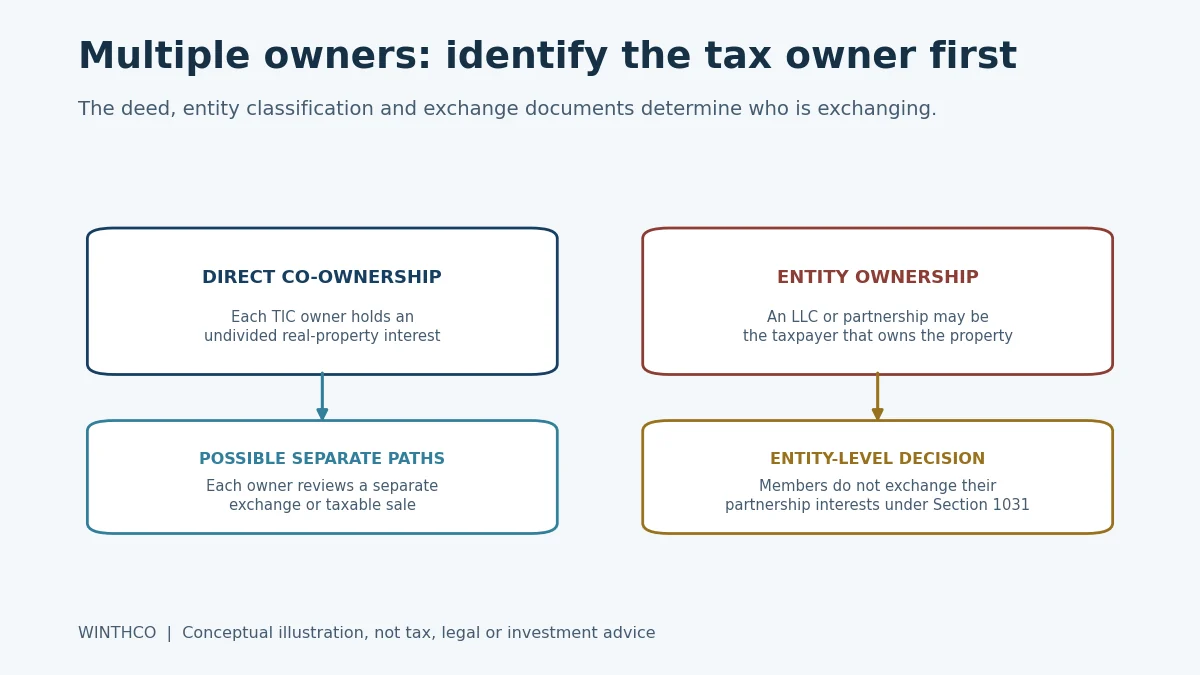
The first question is not which replacement property each person wants. It is who owns the relinquished real estate for federal tax purposes. The deed, operating agreement, tax returns, lender records and sale contract may show direct co-ownership or ownership by an LLC, partnership, corporation or trust. Winthco's multiple-owner 1031 exchange planning page introduces common structures, but the taxpayer's actual documents and classification control.
Direct co-owners may hold separate undivided real-property interests, often as tenants in common. If each owner is treated as owning real property, each can evaluate what to do with that owner's share of the sale. One owner might pursue a Section 1031 exchange, another might recognize gain in a taxable sale, and another might exchange into different replacement real estate. The closing and qualified-intermediary documents must preserve the correct seller and proceeds for each path.
Share your timeline and investment range. A Winthco team member will follow up with you.
Entity ownership is different. When a multi-member LLC is classified as a partnership, the entity generally owns the real estate and the members own interests in the entity. Treasury Regulation 1.1031(a)-1 excludes interests in a partnership from Section 1031 treatment. The entity itself may exchange its qualifying real property, but an individual member generally cannot treat the sale of a partnership interest as an exchange of that member's proportionate part of the building.
A tenant in common can own a direct fractional interest in an entire property rather than an interest in a separate entity. That distinction may allow co-owners to make separate exchange choices for their respective interests. Each owner should have an adviser confirm title, percentage ownership, basis, liabilities, sale proceeds and investment use. The sale documents should allocate consideration consistently with those rights rather than treating everyone as one informal partnership.
IRS Revenue Procedure 2002-22 describes conditions under which the IRS will consider a ruling request that an undivided fractional interest in rental real estate is not an interest in a business entity. Among other points, it addresses title as tenants in common, no partnership return or common entity presentation, voting rights, transfer rights, proportionate sharing of revenue and debt, management agreements and limits on business activity. The procedure says these are ruling-request guidelines, not substantive audit rules or an automatic safe harbor for every co-ownership.
Co-owners should compare both ownership and replacement structures. Winthco's TIC and DST comparison explains how direct co-ownership differs from a Delaware statutory trust. A TIC owner may retain meaningful voting and transfer rights under the agreement. A DST beneficial owner generally gives the trustee or sponsor much more authority and cannot direct ordinary property decisions. The reduced management role can be useful, but the control trade-off should be explicit.
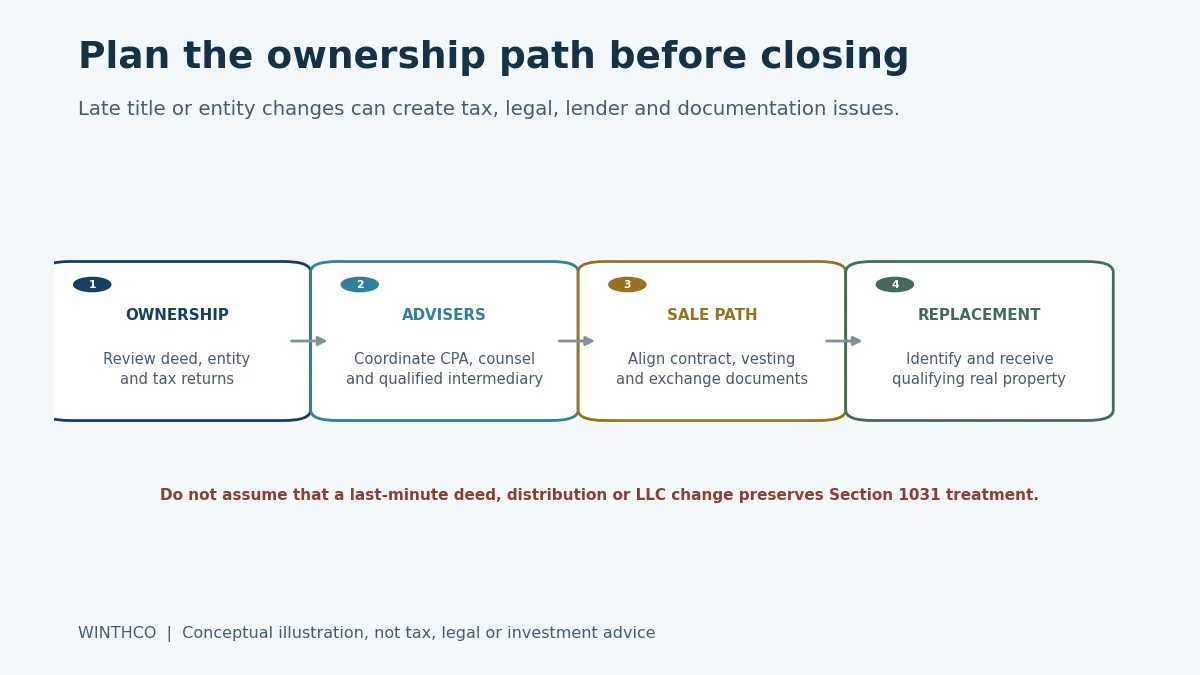
If an LLC taxed as a partnership owns the property, begin with an entity-level analysis. The partnership can sell and recognize gain, or it can potentially complete a Section 1031 exchange of its qualifying real property. The partners may have different economic preferences, but those preferences do not convert their partnership interests into separate real estate. A vote or distribution that changes ownership near closing can raise federal tax, state law, lender and contract issues.
A transaction sometimes called a drop and swap distributes undivided real-property interests to partners before a sale so the former partners can consider separate paths. That label is not an IRS approval, and there is no universal seasoning period that automatically makes a transaction qualify. Investment intent, timing, prearranged sale facts, entity documents and what the parties actually do all matter. Revenue Procedure 2002-22 also says the IRS generally will not issue a ruling under that procedure when co-owners held the property through a partnership or corporation immediately before forming the co-ownership.
Do not change title based on a checklist or online example. Partnership distributions can affect basis, liabilities and gain; deeds can trigger transfer taxes, reassessment, due-on-sale provisions or lender consent requirements; and a pending sale can complicate the claimed investment purpose. A CPA and tax attorney should analyze the complete sequence before any binding sale commitment. A qualified intermediary should be engaged before the taxpayer transfers the relinquished interest.
Discuss your DST questions with Winthco →
For a qualifying direct owner, a DST may be one replacement option when the investor wants professional management and can accept limited control and liquidity. IRS Revenue Ruling 2004-86 concludes that interests in the specifically described, restricted DST are treated as interests in the underlying real property for Section 1031 purposes. The ruling does not state that every trust bearing the DST name qualifies. Tax counsel should review the current trust agreement and transaction.
The ruling's DST had a single class of beneficial interests and a trustee with narrowly limited powers. The trustee could not freely sell and replace the property, refinance the debt, renegotiate ordinary leases, accept new capital or make more than limited modifications. Those restrictions support the tax treatment but also explain why an investor cannot expect operating control comparable with direct ownership. Winthco's DST 1031 exchange structure page provides background for evaluating this ownership form.
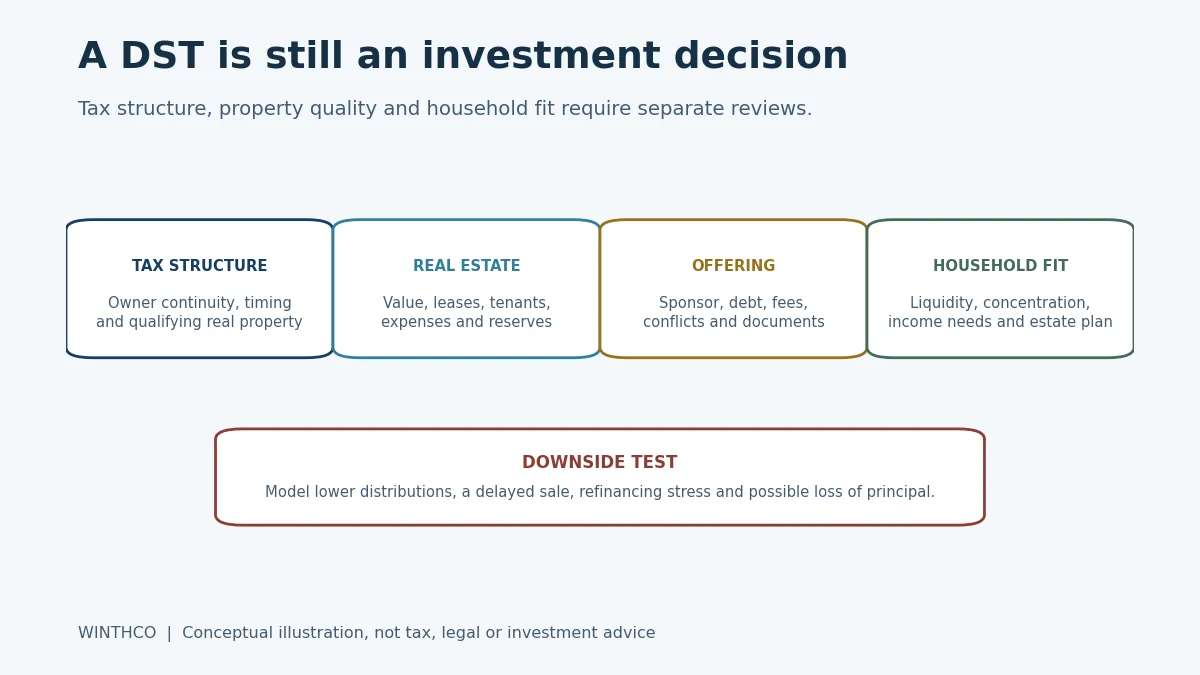
One co-owner's DST choice should be documented independently from another owner's cash sale or direct-property exchange. Confirm the subscribing taxpayer, tax identification number, source of funds, allocated debt, cash amount and replacement identification. A DST subscription is also an investment decision. The property, sponsor, financing, fees, conflicts, reserves, projected cash flow and possible exit deserve separate review from the exchange mechanics.
A deferred exchange should be organized before the seller receives or controls sale proceeds. The qualified intermediary normally signs an exchange agreement and holds the funds subject to Treasury Regulation restrictions. For multiple owners, the sale contract, assignments, closing statement, deed, intermediary agreements and escrow instructions should identify the correct taxpayer and percentage. A shared bank transfer or ambiguous closing allocation can undermine otherwise careful planning.
The identification period generally ends 45 days after the taxpayer transfers the relinquished property. The exchange period generally ends on the earlier of 180 days after that transfer or the applicable federal income tax return due date, including extensions. Identification must be written, signed and delivered to a permitted party. Weekends and holidays do not ordinarily extend the periods, and co-owner disagreement does not pause either clock.
Each exchanging owner should maintain an individual file. Include the deed and entity records, proof of investment use, basis schedule, liabilities, sale closing statement, intermediary agreement, identification notice, replacement closing documents, subscription package and Form 8824 workpapers. If an entity changes ownership or distributes property, retain legal and tax memoranda explaining the sequence. Consistent records matter when several taxpayers share one sale but pursue different outcomes.
WATCH & LEARN
Accruit's Paul Holloway explains the same-taxpayer rule and selected disregarded-entity and trust considerations. This third-party video is educational background, not a Winthco endorsement; current law and the investor's advisers control. Original resource · Watch on YouTube ↗
Educational context only. The discussion does not establish the suitability, returns or tax treatment of an investment.
Most DST interests used for exchange planning are offered through private placements. The SEC warns that private placements can be highly illiquid, may provide less information than registered offerings and can expose an investor to total loss. A beneficial owner may face transfer restrictions and no dependable public market. The sponsor controls major property decisions, and there is no assurance about distributions, refinancing, sale timing or sale price.
Fees and leverage can compound real estate risk. Trace acquisition, selling, financing, organization, asset-management, property-management and disposition compensation. Read the loan terms, covenants, maturity, extension options and lender remedies. Rebuild projected cash flow after vacancy, rent changes, expenses, reserves, capital work and debt service. Replacing relinquished-property debt for tax planning does not make leverage economically beneficial or protect principal.
Measure concentration across the household, not just within the sale. Co-owners who choose different DSTs may still share a sponsor, lender, tenant, property type, geography or economic driver. FINRA cautions that correlated and illiquid holdings can magnify losses and make cash hard to access. Keep adequate liquidity outside the investment, compare a taxable sale and direct ownership alternatives, and obtain individualized tax, legal and securities advice before committing.
| Decision | Evidence to request | What to avoid assuming |
|---|---|---|
| Tax owner | Deed, entity classification, tax return and operating documents | Each economic owner automatically owns a matching part of the real estate |
| Separate paths | Direct interests, allocated proceeds and owner-specific exchange records | Partners can exchange their partnership interests under Section 1031 |
| Ownership change | Tax and legal analysis before a sale commitment or distribution | A last-minute deed change is automatically respected |
| DST replacement | Trust powers, property, debt, fees, sponsor and liquidity | Tax eligibility establishes investment suitability |
| Household fit | Liquidity reserve, concentration map and downside scenarios | Projected distributions or sale timing are guaranteed |
Potentially, when the co-owners directly own separate real-property interests and the sale and exchange documents preserve those interests and proceeds. The owners should obtain tax and legal advice before closing.
Generally no when the LLC is classified as a partnership. Treasury regulations exclude partnership interests from Section 1031, even if the partnership owns qualifying real estate.
Potentially. The partnership may exchange qualifying real property that it owns, provided the transaction satisfies Section 1031 and the replacement remains an entity asset.
It is a commonly used label for distributing undivided real-property interests before a sale so former partners can consider separate paths. Qualification depends on the complete facts, and no fixed waiting period guarantees the tax result.
Potentially, if each is a separate exchanging taxpayer and follows the identification and completion rules. Each owner must also qualify for and independently evaluate any private placement.
No. Revenue Ruling 2004-86 addresses a specific trust with restricted powers. The actual trust and exchange documents must be reviewed.
No. Ownership continuity, basis, liabilities, cash received, timing and other facts affect recognition. A CPA should calculate the expected federal and state treatment.
Sources checked October 8, 2026. This article explains general concepts; your facts and the applicable documents control.
Winthco DST services · Winthco evaluation overview · Editorial standards
1031 exchange planning
Understand the three-property, 200 percent and 95 percent identification rules before naming DST replacement property.
Read guide →1031 exchange planning
Learn how one 1031 exchange can combine directly owned real estate and a DST, including allocation, identification, closing and risk review.
Read guide →1031 replacement property
Compare DST and TIC ownership, control, financing, closing mechanics, liquidity and risks before choosing 1031 replacement property.
Read guide →Explore Winthco’s main DST article collection
Share your timeline and investment range. A Winthco team member will follow up with you.