Risks and due diligence
DST fees and expenses: what investors should compare
Learn how to review DST acquisition costs, ongoing expenses, financing charges and exit fees without relying on a single headline number.
Read guide →
Home / Learning center / DST fundamentals
DST fundamentals
Winthco Wealth Management · Updated October 18, 2026
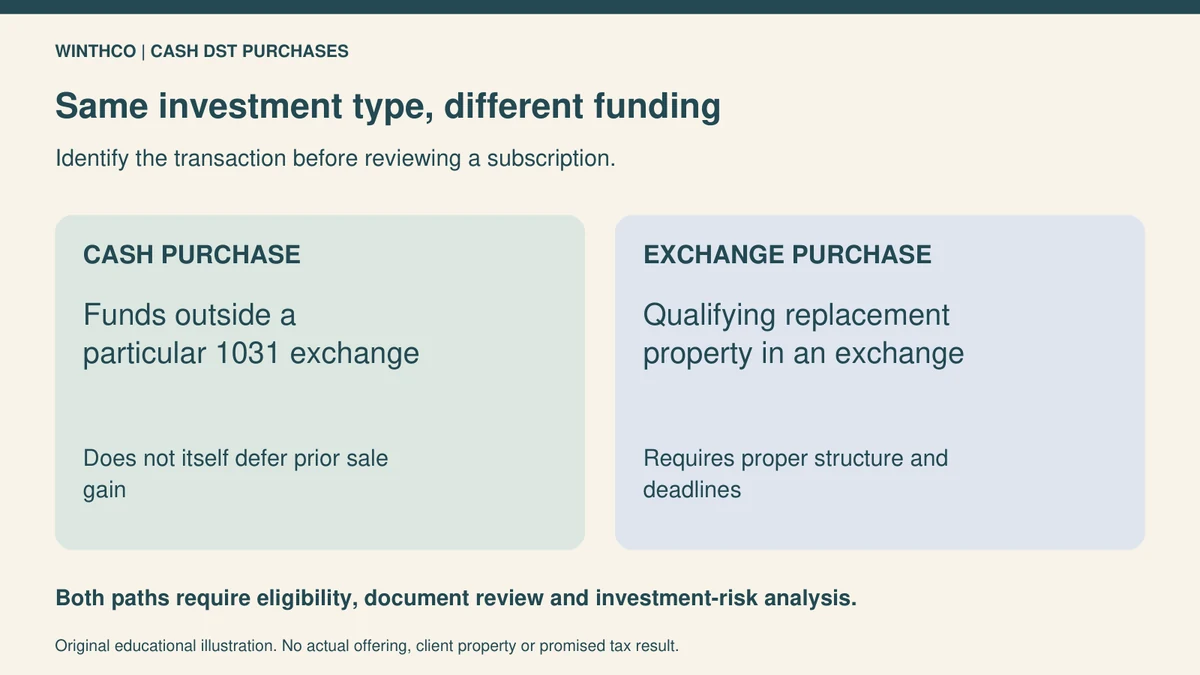
Yes, eligible investors may buy interests in certain Delaware statutory trusts with cash outside a 1031 exchange, subject to the offering's requirements. That purchase does not itself defer gain from an earlier sale. Evaluate the DST's economics, fees, restrictions and risks separately from any potential exchange or tax-planning benefit.
Before listing an investment property, decide which questions need answers before a buyer is found. Interview an appropriately licensed realtor or commercial broker about property-type experience, comparable sales, marketing, fees and closing coordination. Ask your CPA to compare the estimated after-tax proceeds of a taxable sale with a properly arranged exchange. Neither a DST purchase nor a 1031 exchange should be assumed necessary simply because you are selling.
If an exchange is under consideration, involve the attorney and qualified intermediary before closing or receiving proceeds. If you instead have independently available cash, explain that distinction to your investment professional. Winthco's overview of the DST investment process describes the exchange-oriented path; this guide addresses the separate question of investing without an exchange. Do not route exchange funds as ordinary personal investment cash without professional direction.
Share your timeline and investment range. A Winthco team member will follow up with you.
A cash investor subscribes using funds outside a particular 1031 exchange. An exchange investor acquires qualifying replacement real property through an exchange arrangement. Both may own interests in the same type of trust, but their starting tax positions and transaction requirements can differ. Confirm whether the specific offering accepts cash investors; a general explanation of DSTs is not evidence that an investment is currently available to you.
Industry educational material from Inland discusses cash investors as well as exchange investors. That supports the availability of the general structure, not a recommendation of any sponsor or offering. There is no universal minimum investment, acceptance rule or closing schedule stated here. Read the applicable private placement memorandum, subscription agreement and investor questionnaire, and have the relevant professionals confirm your eligibility and the actual terms.
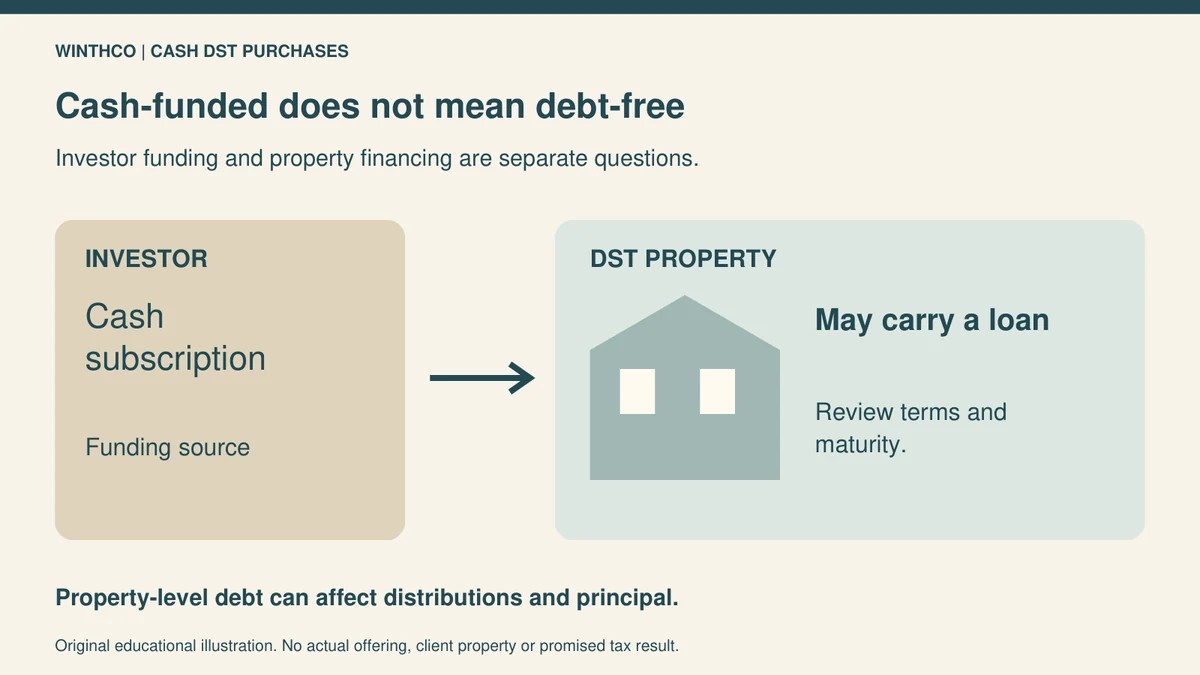
The word cash describes the investor's funding source, not necessarily the property's financing. A cash subscription can buy an interest in a leveraged DST. Conversely, an exchange investor may consider a debt-free structure if it fits the tax and investment analysis. Ask what debt the property carries, how it is serviced and when it matures. Your lack of a personal mortgage payment does not remove property-level financing risk.
Do not assume so. The IRS explains that a deferred exchange requires compliance with Section 1031, including restrictions on actual or constructive receipt of sale proceeds. Simply selling a rental, receiving the money and later buying another investment is not the same as arranging a qualifying exchange. Ask a tax professional to evaluate the actual transaction rather than treating a DST subscription date as a cure for an earlier step.
The same distinction matters if the cash came from selling stocks or another asset that is not qualifying exchange real property. A DST investment does not retroactively turn that disposition into a real-property exchange. Keep the prior sale's tax analysis separate from the new purchase. Request a written explanation of any claimed tax benefit, the legal basis and the assumptions required, especially if marketing combines several different strategies.
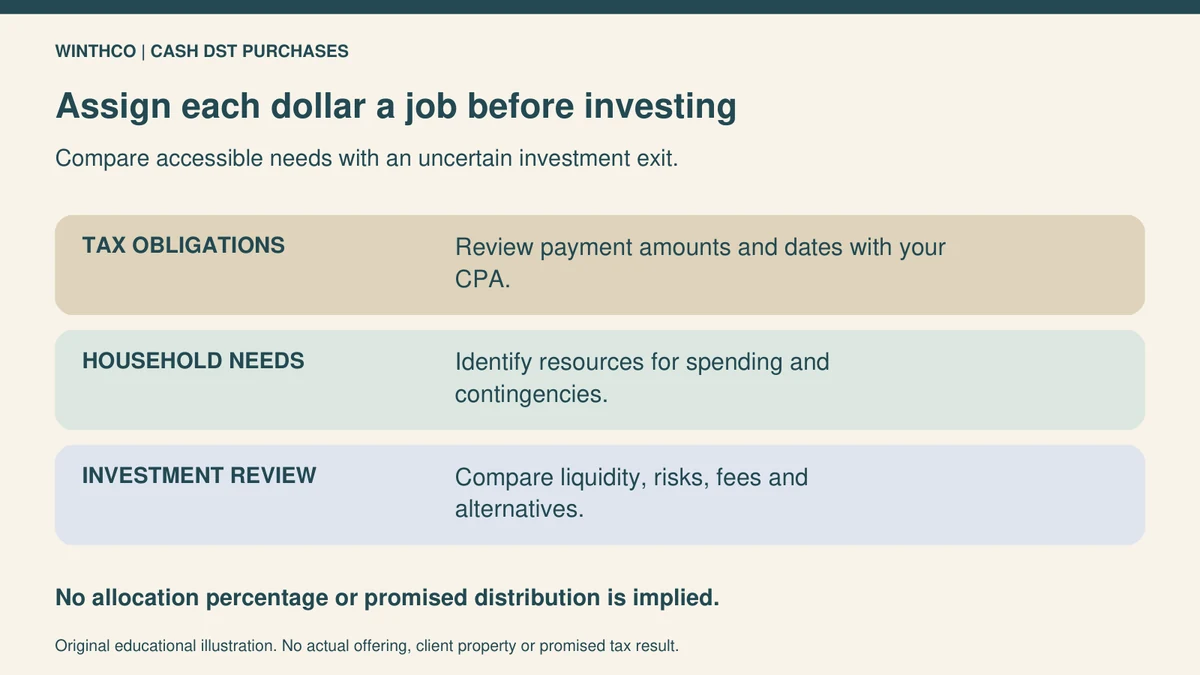
A later investment also should not consume money needed to pay a tax bill. Have your CPA estimate any required payments, and identify the resources you intend to keep accessible. A tax reserve and an investment allocation serve different purposes. Do not count on selling an illiquid DST interest or receiving a projected distribution to meet a fixed payment date.
Discuss your DST questions with Winthco →
The IRS Form 8824 instructions describe a 45-day replacement-property identification period and receipt by the earlier of 180 days or the tax-return due date, including extensions, for deferred exchanges. Those are not a general countdown imposed on every cash purchase of a DST. A cash investor not conducting an exchange should not be told that Section 1031 requires an immediate purchase merely because the product is often used by exchangers.
Offering-specific subscription deadlines, capacity limits and closing procedures may still apply. Request the actual documents and distinguish a contractual deadline from a tax deadline. If an investment cannot be reviewed adequately before its closing, missing that offering may be preferable to accepting risks you do not understand. Winthco's DST purchase steps and document questions can help organize a conversation, but actual offering terms control.
Start with the investment objective, not a projected distribution rate. Are you seeking less direct property management, real-estate exposure, potential income, or some combination? Explain what you are willing to give up in control and access to capital. Compare a DST with other appropriate investments on a consistent basis, including costs, liquidity, concentration and downside scenarios. A tax-oriented sales explanation does not replace this comparison.
Read the sources and uses of funds and the compensation disclosures. Identify acquisition, financing, offering, management and disposition expenses where applicable. Ask which costs are paid upfront, which recur and which depend on a future transaction. Separate gross property income from cash available to investors. A distribution may not equal economic profit, and the amount distributed can change or stop. No rate or return is assumed in this guide.
Consider a hypothetical investor with cash available after a taxable property sale. The investor also expects a household expense before the proposed DST's anticipated exit. Even if the property looks attractive, the decision should separately identify money needed for taxes, that expense and other contingencies. The remaining amount is not automatically the right DST allocation. It is the starting point for comparing investment choices with the advisor, not a recommendation to invest a particular percentage.
WATCH & LEARN
Equity Advantage's discussion provides background on reduced day-to-day property-management tasks. Its simplified debt language does not mean investment risk disappears: property debt can affect distributions and principal. This is not cash-purchase tax advice or an endorsement of a current offering. Original resource · Watch on YouTube ↗
Educational context only. The discussion does not establish the suitability, returns or tax treatment of an investment.
Use the same property and sponsor diligence you would require for an exchange investment. Review leases, tenant quality, market exposure, valuation assumptions, reserves, financing and exit provisions. Ask who can make decisions and what happens when actual results differ from projections. The recent DST environmental report review adds questions about findings, responsibility and funding without treating a report as a guarantee.
Read the risk factors and any material supplements, not just a brochure. Request explanations of inconsistencies and keep unresolved questions visible. Winthco's DST investor and offering requirements is a starting point for eligibility questions, not a substitute for the actual documents. Securities offered through DST programs are generally available to accredited investors through a private placement memorandum. Accreditation does not establish suitability or the quality of an investment.
IRS Publication 551 explains that purchased property's basis is usually its cost, subject to applicable rules and adjustments. An exchange investment involves a different basis calculation that can preserve deferred gain. Have your CPA determine the treatment of your particular DST interest, including allocated assets, debt, capitalized costs and depreciation. Two investors contributing the same cash amount should not assume identical tax results if they arrived through different transactions.
Revenue Ruling 2004-86 addresses a specified trust arrangement and its treatment as replacement real property. It does not approve every trust or promise that every later exit qualifies for another exchange. Ask how the actual trust is structured, who controls disposition and what alternatives may exist when assets are sold. Plan before an exit; do not assume a cash investment today creates unrestricted control over a future exchange.
Some programs contemplate a separate Section 721 contribution to an UPREIT operating partnership. That depends on the documents, acceptance, valuation and tax analysis and may not occur. Operating partnership units and ordinary REIT shares are not direct Section 1031 replacement real property. A possible conversion is not assured liquidity, and FIFO redemption language does not guarantee tax-free withdrawal of basis. Compare the separate DST and 721 ownership decisions before relying on that pathway.
The SEC warns that private placements can be highly illiquid and provide less disclosure than registered offerings. A cash-funded DST still exposes the investor to sponsor, property, tenant, debt and valuation risks, fees, limited control and possible loss of principal. Holding periods can extend and tax laws can change. Professional management reduces direct tasks but does not eliminate the need to review reports or understand the investment.
FINRA highlights concentration across investments, asset classes and correlated exposures. Review the proposed position alongside existing rentals, real-estate funds, securities and other illiquid holdings. Winthco's financial advising and wealth-management discussion can also address 401(k)s, IRAs, retirement-income needs, asset allocation, accessible reserves and beneficiary or estate coordination. Retirement accounts are not themselves 1031 exchange proceeds. Do not assume a rollover or asset transfer is appropriate; compare relevant options, costs and services first.
Bring your funding source, timing needs and unanswered document questions to a prospect planning conversation. The initial contact form is not an investment subscription and should not include sensitive financial records. The practical next step is to determine whether a DST deserves further review, not to purchase merely because cash is available or a projected tax benefit sounds appealing.
| Decision | Evidence to request | What to avoid assuming |
|---|---|---|
| Question | Cash purchase outside an exchange | Qualifying exchange purchase |
| Funding | Funds outside a particular exchange | Exchange arrangement coordinated with professionals |
| Prior sale gain | Purchase does not itself defer earlier gain | Eligible gain may be deferred if all requirements are met |
| Timing | Offering terms and personal planning needs | Offering terms plus applicable exchange deadlines |
| Tax basis | Purchase-basis analysis and adjustments | Exchange-basis calculation and adjustments |
| Investment risk | Full property and offering review needed | Full property and offering review needed |
Not necessarily. Certain offerings accept eligible cash investors outside a 1031 exchange; confirm the actual terms and suitability before proceeding.
The purchase does not itself turn a stock sale into a Section 1031 exchange. Have your tax professional evaluate the prior sale separately.
Not merely because they are buying a DST. The 45-day identification rule concerns deferred exchanges, while the offering may impose its own deadlines.
No. A cash subscription can invest in a leveraged property. Review the DST's actual financing and related risks.
No universal minimum is stated here. Confirm the current offering's subscription documents, eligibility and acceptance requirements.
Do not assume that you can. Private-placement transfer restrictions and a limited resale market can prevent a timely sale or require an extended holding period.
Sources checked October 18, 2026. This article explains general concepts; your facts and the applicable documents control.
Winthco DST services · Winthco evaluation overview · Editorial standards
Risks and due diligence
Learn how to review DST acquisition costs, ongoing expenses, financing charges and exit fees without relying on a single headline number.
Read guide →DST eligibility and risk
Learn the DST accredited investor income, net worth, credential and entity tests before planning a 1031 exchange.
Read guide →DST ownership and exits
Understand DST holding periods, sponsor sale timing, early-exit limits and the tax decisions that may follow a trust's disposition.
Read guide →Explore Winthco’s main DST article collection
Share your timeline and investment range. A Winthco team member will follow up with you.