DST investment due diligence
DST Private Placement Memorandum: What to Review
Selling a rental property? Learn how to review a DST private placement memorandum, compare fees and risks, and assess separate 721 UPREIT terms.
Read guide →
Home / Learning center / Due diligence
Due diligence
Winthco Wealth Management · Updated October 18, 2026
DST environmental due diligence means reviewing the property's environmental reports, unresolved findings and response plan before investing. A Phase I assessment is useful evidence, not a guarantee that contamination is absent or that every liability is covered. Ask qualified environmental and legal professionals how the findings affect the proposed investment.
Start with the property you intend to sell. Interview an appropriately licensed realtor or commercial broker about relevant property-type experience, valuation evidence, marketing, fees and coordinating buyer investigations. Assemble prior environmental reports, permits and records of known issues for your attorney's disclosure review. Do not assume an old report remains sufficient for a new transaction.
If you are considering a deferred exchange, involve your CPA, attorney and qualified intermediary before closing or receiving sale proceeds. Identify who will review environmental evidence for potential replacements while the sale is being prepared. Winthco's guide to evaluating a DST beyond its brochure provides broader document-review context; a financial advisor's review does not replace an environmental professional's technical judgment.
Share your timeline and investment range. A Winthco team member will follow up with you.
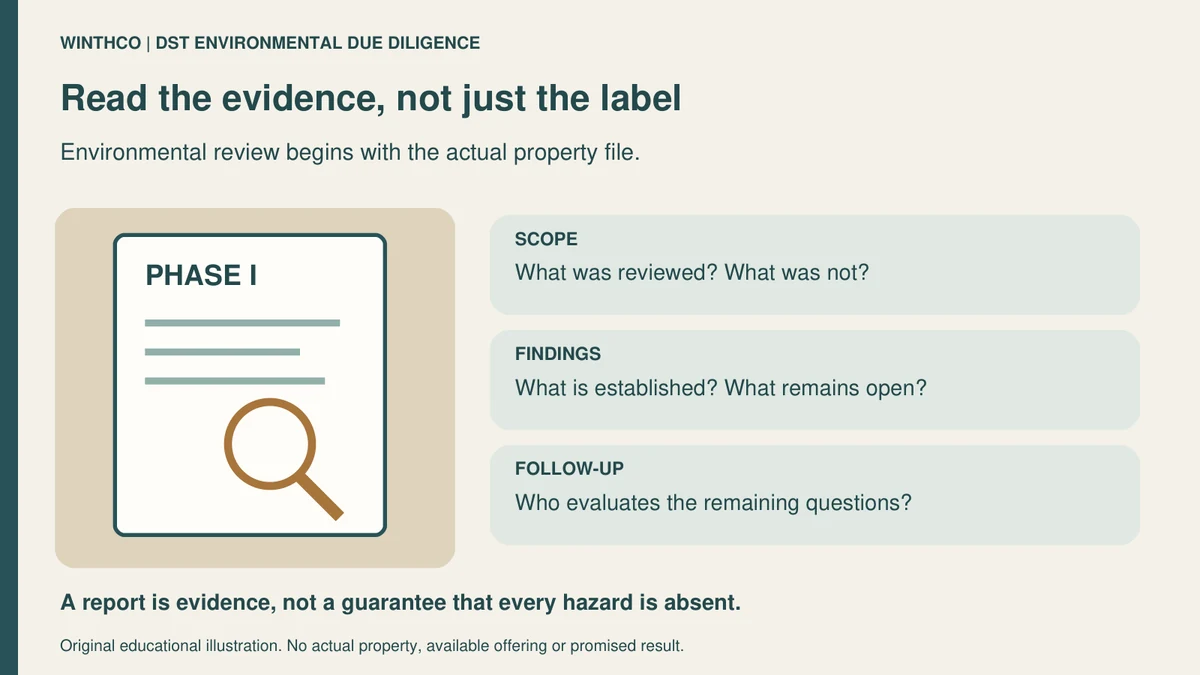
EPA describes All Appropriate Inquiries, or AAI, as evaluating environmental conditions and potential contamination liability. The process examines past uses and records, interviews and site observations. EPA recognizes ASTM E1527-21 as one method consistent with its AAI rule. Ask which standard, scope and property boundaries the actual report uses rather than relying on the words environmental review in a marketing summary.
Read the conclusions alongside limitations and significant information gaps. EPA identifies sampling and analysis, as well as matters such as asbestos, mold and indoor air quality, as potential additional services. A Phase I label alone therefore does not establish that those investigations occurred. Ask the environmental professional what further work, if any, is appropriate for the specific findings.
A useful investor question is: which uncertainty could change the decision? Ask for the report or the documented access process, a plain-language explanation of outstanding recommendations and identification of the person responsible for answering technical questions. If access is restricted, record what information remains unavailable. A confident presentation cannot substitute for evidence that you or your retained specialists have not received.
EPA's AAI guidance calls for inquiry within one year before property acquisition, with specified components updated within 180 days. These are environmental assessment timing requirements, not the Section 1031 exchange deadlines. The relevant acquisition, report user and compliance requirements require professional analysis; do not simply restart an environmental clock when an investor purchases a DST interest.
Ask counsel and the environmental professional to identify the party for whom the report was prepared, any permitted reliance, and needed updates or supplemental work. Put the report date, inspection date, subsequent changes and outstanding tasks on one review sheet. If the sponsor acquired the property earlier, ask how later events are monitored. Treat an unexplained gap between investigation and offering as a question to resolve, not automatic proof of a defective property.
Discuss your DST questions with Winthco →
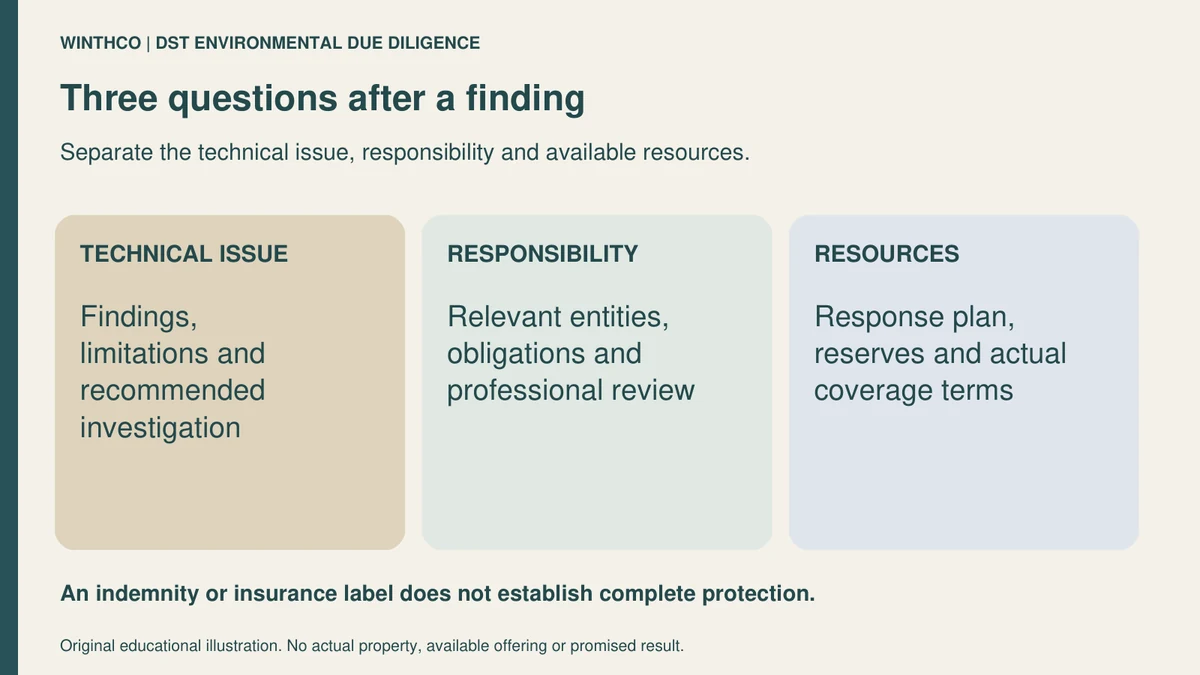
Request a document-based explanation of the response plan. Who decides whether to investigate further? Which entity must act? What funding is available, and what happens if costs exceed it? Compare the environmental discussion in the private placement memorandum with the reserve schedule, financing documents and any relevant insurance explanation. Ask for inconsistencies to be resolved in writing rather than treating each document as a separate reassurance.
An indemnity is a promise by a named party, not cash already available. Ask counsel to explain its covered claims, exclusions, survival period, enforcement provisions and the counterparty's ability to perform. Similarly, ask a qualified insurance professional whether a particular policy addresses the identified issue, who is insured, what deductibles or limits apply and when coverage expires. Do not assume ordinary property coverage pays every pollution-related expense.
EPA explains that bona fide prospective purchaser protection requires threshold criteria and ongoing obligations, including appropriate care concerning hazardous substances. Obtaining a report is not the entire legal analysis. Counsel should explain which entities seek which protections and how continuing duties are managed. This article does not determine whether a particular DST, owner or investor qualifies for a liability defense.
Consider a hypothetical replacement property with a historical use that prompts additional investigation. The sponsor supplies a Phase I report but the follow-up work is unfinished. That does not by itself prove contamination, and a reassuring estimate does not prove the issue is immaterial. The decision file should distinguish established facts, open questions, proposed actions and funding assumptions.
For this hypothetical, ask your team to compare proceeding after adequate answers, selecting a different eligible replacement, or accepting a different tax and investment outcome. Review how delay, investigation expense or restrictions could affect operating cash, lender requirements and a future sale. These are scenario questions, not predictions about an offering. The separate DST reserve review explains how to compare intended uses of cash without treating the stated reserve as sufficient in every scenario.
A seller approaching an exchange deadline may feel pressure to accept incomplete answers. That pressure is not evidence of suitability. Winthco's discussion of DST failure risks and investor questions is a starting point for broader downside review, not a forecast that environmental findings will cause failure. Ask what facts would cause your professionals to stop, seek further evidence or reject the proposed investment.
WATCH & LEARN
Winthco Wealth Management's 1031 DST Welcome Video provides general planning context, not environmental, legal or offering-specific advice. Review the qualifications and risks in this article. Original resource · Watch on YouTube ↗
Educational context only. The discussion does not establish the suitability, returns or tax treatment of an investment.
IRS Form 8824 instructions require identification of replacement property within 45 days of transferring relinquished property. Receipt generally must occur by the earlier of 180 days or the tax-return due date, including extensions. Environmental investigation does not itself suspend those deadlines. Your qualified intermediary and tax advisor should coordinate identification and closing requirements, and your CPA should evaluate possible taxable boot and other limitations.
Revenue Ruling 2004-86 addresses a particular trust arrangement whose interests could qualify as replacement real property. It is not approval of every DST, property or environmental condition. Have tax counsel review the actual structure and powers. The ability to defer eligible gain is separate from the investment's economics, and deferral is not tax elimination.
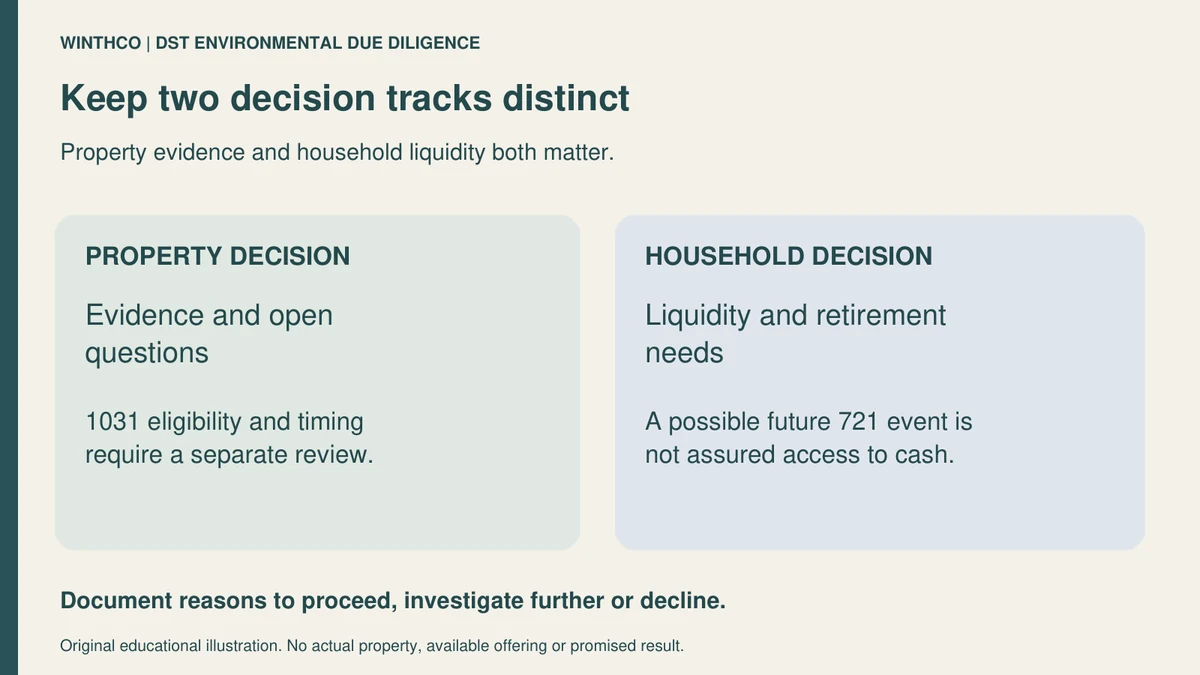
A possible later Section 721 UPREIT contribution is another distinct transaction. It depends on actual terms, eligibility, valuation and tax analysis; it is not an automatic remedy for a problematic property. Operating partnership units and ordinary REIT shares are not direct 1031 replacement real property. A projected conversion, redemption or FIFO treatment does not guarantee liquidity or tax-free withdrawal of basis. Review the separate DST and 721 decisions before relying on an exit narrative.
A favorable environmental review does not eliminate sponsor, tenant, debt, valuation or concentration risk. Investors generally surrender day-to-day control, bear fees and expenses, and may be unable to sell when desired. Distributions can change or stop, holding periods can extend and principal can be lost. Tax law and the investor's circumstances can also change. Environmental diligence belongs within the full underwriting review, not above it as a single pass-or-fail certificate.
The SEC warns that private placements can be highly illiquid and provide less disclosure than registered offerings. DST securities are generally offered to accredited investors through a private placement memorandum and related documents; accreditation does not establish suitability. Use Winthco's questions for choosing a DST to organize a broader comparison, then verify each answer against the specific documents. No current offering is evaluated or recommended here.
Connect the unresolved property questions with the money you need outside the investment. FINRA cautions that concentrated exposure can amplify losses and that illiquid holdings can be difficult to access. Owning several interests is not necessarily diversification if they share correlated risks. Ask your advisor to consider the proposed DST alongside existing real estate and other investments rather than evaluating it in isolation.
Winthco's financial advising and wealth-management discussion can include existing financial assets, 401(k)s, IRAs, retirement-income needs, asset allocation and beneficiary or estate coordination. Retirement accounts are not themselves exchange proceeds. No rollover, transfer or advisory engagement should be assumed appropriate; compare relevant account options, costs and services with the professionals responsible for those decisions.
Bring your sale timeline, available property documents and written unresolved questions to a prospect planning conversation. Keep sensitive reports and financial records out of the initial public form; arrange a suitable review process with the team. The practical goal is a documented decision you understand, including reasons to decline, not completing an exchange or purchasing a DST at any cost.
| Decision | Evidence to request | What to avoid assuming |
|---|---|---|
| Evidence | Question to resolve | Do not assume |
| Phase I assessment | What scope, dates, limitations and findings apply? | Every hazard was tested or ruled out. |
| Follow-up investigation | What remains unknown and who evaluates it? | A recommendation is already completed. |
| Indemnity or insurance | Which party, claims, limits and resources apply? | Every potential cost is covered. |
| Response plan and reserves | Who acts and how are costs funded? | A stated reserve ensures sufficient cash. |
No. Its scope, evidence and limitations matter. Ask the environmental professional whether further investigation is appropriate.
Do not treat them as interchangeable. Ask which documents address environmental conditions, physical condition and any separately commissioned investigations.
The appropriate report, user and reliance analysis depend on the transaction. Ask qualified counsel and the environmental professional rather than assuming the answer from the date of your subscription.
Additional environmental work does not itself extend the exchange deadlines. Coordinate alternatives with the qualified intermediary and tax advisor before time runs short.
No policy should be treated as universal protection. Have a qualified professional review the actual coverage, exclusions, limits and insured parties.
Do not assume it will occur or solve the issue. A potential contribution has separate acceptance, valuation, legal and tax requirements.
Sources checked October 18, 2026. This article explains general concepts; your facts and the applicable documents control.
Winthco DST services · Winthco evaluation overview · Editorial standards
DST investment due diligence
Selling a rental property? Learn how to review a DST private placement memorandum, compare fees and risks, and assess separate 721 UPREIT terms.
Read guide →DST due diligence
Before exchanging a rental into a DST, review repair budgets, restricted reserves and funding limits. Know which questions to ask before committing.
Read guide →DST due diligence
Review DST property insurance, exclusions, deductibles and rent-loss coverage before exchanging a rental. Prepare questions about cash flow and reserves.
Read guide →Explore Winthco’s main DST article collection
Share your timeline and investment range. A Winthco team member will follow up with you.