Alternatives and comparisons
DST Distributions vs. Rental Cash Flow
Compare DST distributions with rental cash flow, fees, tax reporting and retirement spending before selling an investment property.
Read guide →
Home / Learning center / DST due diligence
DST due diligence
Winthco Wealth Management · Updated October 17, 2026
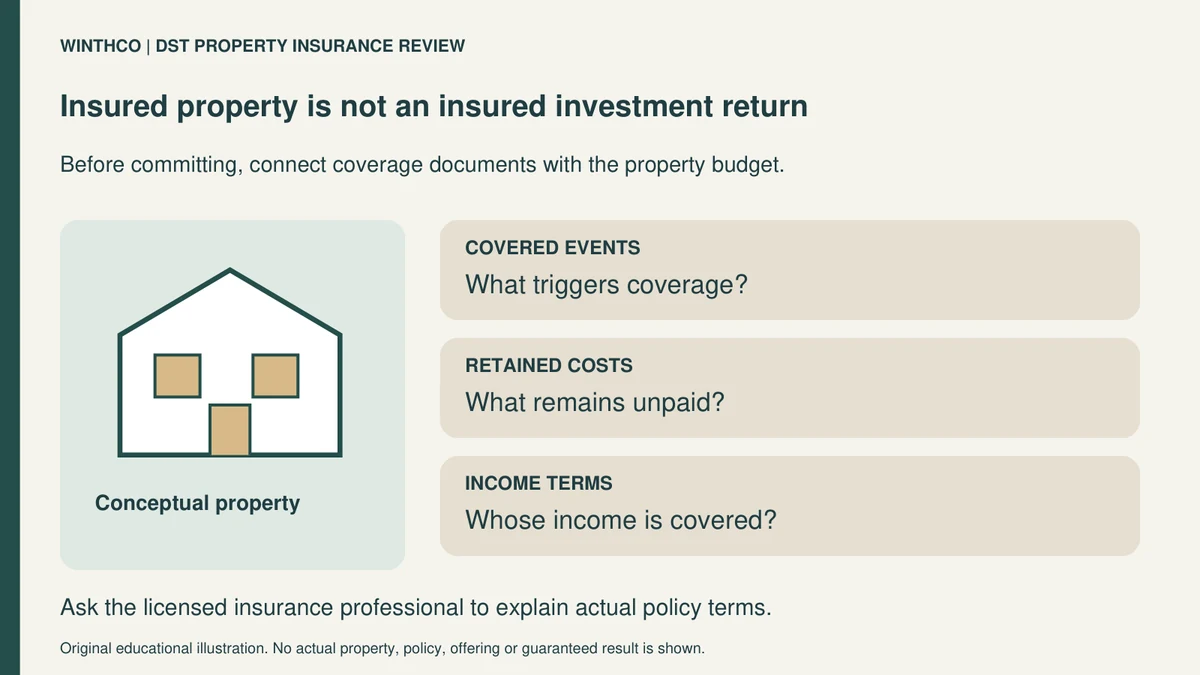
DST property insurance can help address specified property losses, but it does not insure your investment return. Before buying an interest, review covered events, exclusions, limits, deductibles and any rental-income coverage. Ask who bears uninsured costs and how a claim, renewal or interrupted rent could affect the property's budget and investor distributions.
Selling a rental can reduce the owner's direct maintenance workload without removing property risk from the next investment. Interview an appropriately licensed realtor or commercial broker about valuation, marketing, fees and sale readiness. Assemble current insurance and repair records alongside leases. If an exchange is contemplated, involve the CPA, attorney and qualified intermediary before closing or receiving proceeds.
Start the replacement-property review while there is still time to ask questions. Winthco's DST property-ownership overview introduces the transition from direct ownership to a passive interest, but passive ownership is not loss protection. Ask the sponsor to explain which party arranges coverage, pays premiums and handles claims. Keep that operational responsibility separate from the financial consequences investors may bear.
Share your timeline and investment range. A Winthco team member will follow up with you.
Request a dated coverage summary supported by the applicable policy documents, declarations, schedules and endorsements. Identify the insured entities and properties, policy period and material limits. Ask the sponsor's licensed insurance professional to explain the relationship between those documents and the offering memorandum. A statement that a property is insured does not answer which event or amount is covered.
The California Department of Insurance explains that commercial-property coverage depends on policy wording, exclusions and endorsements. Its guide distinguishes listed covered perils from open-perils coverage, which still has exclusions, and notes flood and earth movement as common exclusions. That is a starting point for questions, not an interpretation of a particular DST policy or every state's rules.
Prepare a short list of exposures relevant to the actual property, such as wind, flood, earthquake or equipment failure. Ask the insurance professional to identify whether each is covered, excluded or addressed separately, and where that answer appears. Do not infer coverage from an address, a lender's involvement or the sponsor's description of a building as institutional quality.
A policy limit and a property's purchase price answer different questions. Ask which valuation method applies to a covered loss and how the insured amount was established. California's guide describes replacement-cost coverage as the cost of replacing property with comparable new property, subject to limits, and explains that coinsurance provisions can affect payment when required insurance levels are not maintained.
Request a written explanation of each material deductible, including whether it is a dollar amount or a percentage and what the percentage applies to. Ask about any separate limits for particular losses. Have the insurance professional calculate an example using the actual terms. Investors should not treat a percentage on a summary page as self-explanatory or assume every loss uses the same calculation.
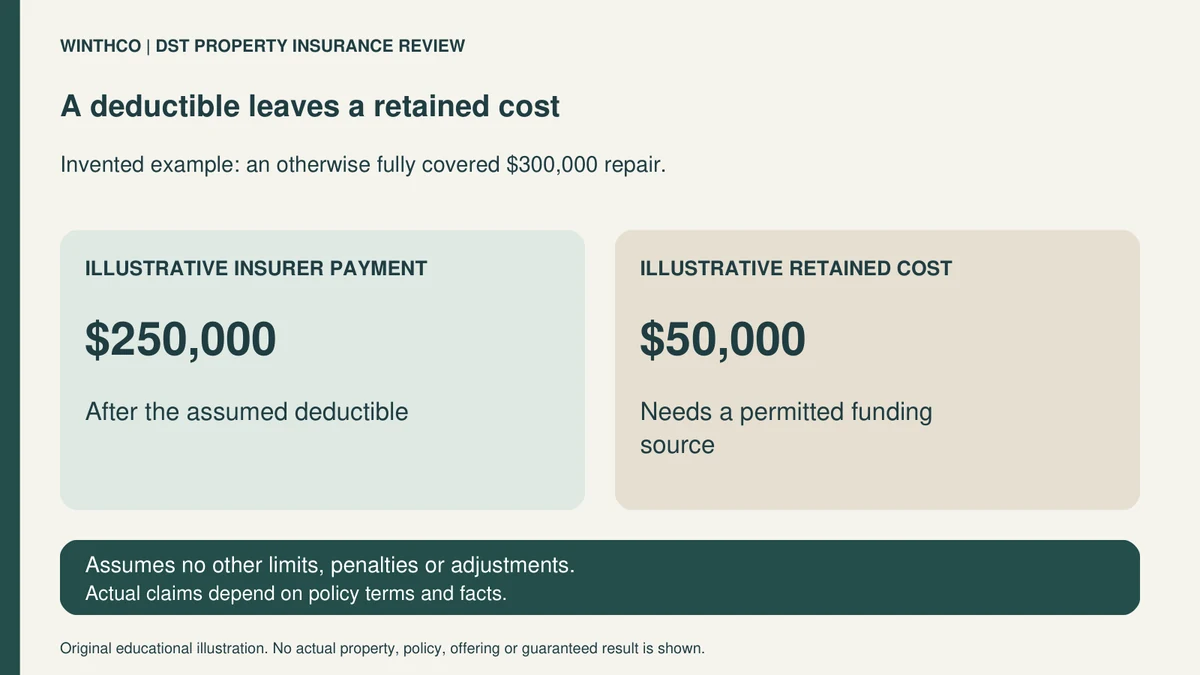
For a deliberately simplified example, suppose an otherwise fully covered $300,000 repair is subject only to a $50,000 deductible, with no other limits, penalties or adjustments. The arithmetic leaves $250,000 payable by the insurer and $50,000 retained by the insured. These invented assumptions illustrate the distinction, not a real claim outcome. Actual settlement depends on the policy and facts.
Discuss your DST questions with Winthco →
No. The NAIC explains business-interruption coverage in terms of income losses following covered events and property damage, subject to policy conditions. It is different from coverage for repairing physical damage. A tenant's business-income policy is also not automatically the landlord's rental-income coverage. Ask whose income is insured and what must occur before a claim qualifies.
Request the applicable rental-income or business-income provisions, limits, waiting periods and restoration-period terms. Ask how a delayed repair or a tenant unable to resume operations would be addressed. Do not assume the projected holding period and the insured period are identical. Coverage intended for a specified interruption is not a promise to replace every future rent payment.
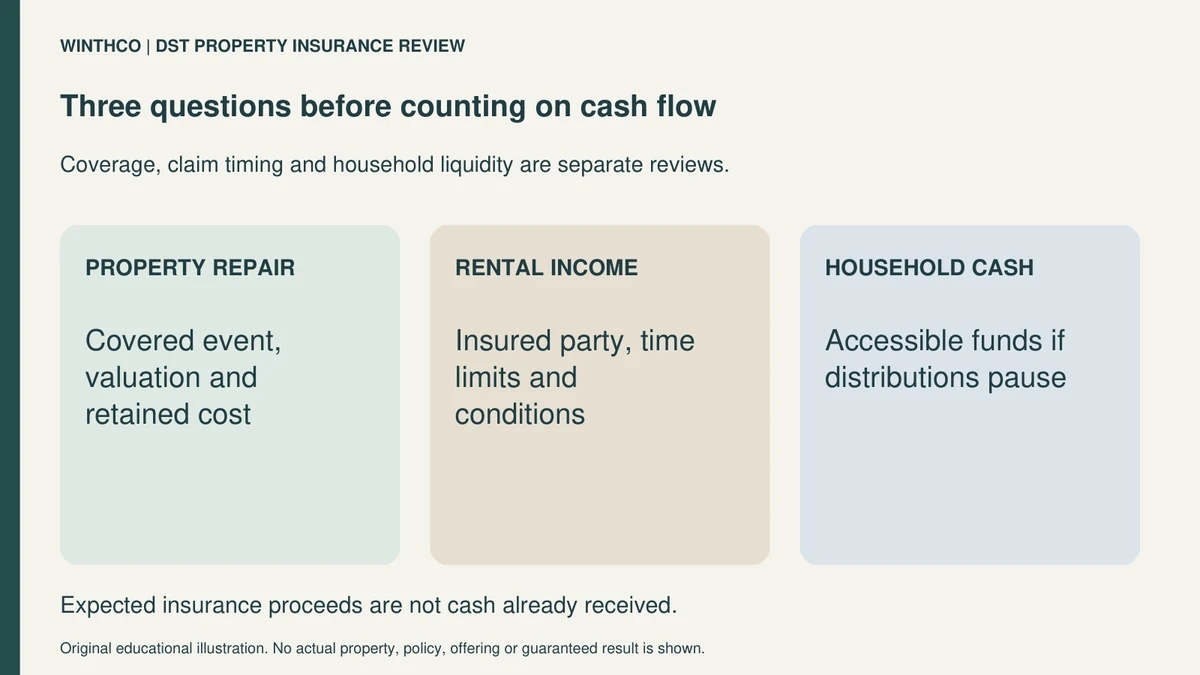
Then connect the policy discussion to the property budget. Ask which obligations continue during an interruption, when an insurer might pay and which permitted funds could meet costs in the meantime. An expected recovery is not cash already received. Even a covered event can require a separate review of payment timing, debt obligations, reserves and the amount available for distributions.
Use Winthco's offering-document evaluation framework to place insurance beside the reserve schedule, operating budget and lease responsibilities. Ask whether the landlord, tenant or master tenant must pay a particular premium or loss. Counsel should explain contractual obligations; the sponsor should explain the financial assumptions. A contractual promise from another party is not identical to unrestricted cash held by the trust.
Compare the current premium with the budgeted amount and request the next renewal date. Ask whether a future figure is a bound quote, an estimate or a planning assumption. Request a scenario with a higher premium, a larger retained loss or both, while other assumptions remain unchanged. This tests the budget's sensitivity without predicting that a particular insurer will raise prices.
Do not assume the trust can solve any shortfall by calling for additional investor capital or refinancing. IRS Revenue Ruling 2004-86 analyzes a specified trust with limited powers; it is not a universal operating manual for every DST. Have tax and legal professionals explain the actual permitted responses and any proposed structural change, including ownership and tax consequences.
WATCH & LEARN
Accruit introduces DSTs as replacement property in a 1031 exchange. This third-party video provides general ownership context, not an insurance assessment or a promise of income, diversification or tax treatment. Accruit is the creator, not a Winthco representative. Original resource · Watch on YouTube ↗
Educational context only. The discussion does not establish the suitability, returns or tax treatment of an investment.
A qualifying DST interest may serve as replacement real property under the applicable tax rules, but eligibility does not establish adequate insurance. IRS Form 8824 instructions generally require identification within 45 days after transfer and receipt by the earlier of 180 days or the applicable return due date, including extensions. Section 1031 can defer eligible gain when requirements are met, not eliminate it.
Keep both reviews moving before a deadline becomes urgent. Ask the CPA and QI to analyze cash, liabilities, possible boot and alternatives, while the investment and insurance professionals address the proposed property's risks. Do not select a replacement solely to complete paperwork. An unresolved material coverage question remains an investment concern even when the exchange timeline is short.
A potential later Section 721 contribution to an UPREIT operating partnership is separate and may never occur. IRS Publication 541 describes the general partnership-contribution framework and exceptions. Review any proposed partnership's property exposures, fees, debt, control and liquidity on its own terms. OP units and ordinary REIT shares generally are not direct 1031 replacement property, and FIFO treatment does not guarantee tax-free basis withdrawals.
Insurance does not remove sponsor conflicts, fees, tenant weakness, financing risk, illiquidity or the possibility of principal loss. Distributions can decline or stop, and tax law can change. Private DST offerings are generally limited to accredited investors and offered through a private placement memorandum. The SEC highlights limited disclosure, restricted resale and possible total loss in private placements.
Winthco's discussion of reviewing DST investments provides additional context, but a general review or favorable description cannot replace the actual documents. Ask for written answers to material questions and identify which professional supports each answer. Do not equate a sponsor's willingness to discuss coverage with an insurer's agreement to pay a future claim.
FINRA warns that concentration can include related exposures and illiquid holdings. In applying that principle, ask whether multiple real estate interests share the same region or catastrophe exposure. That question is distinct from counting the number of properties or sponsors. More holdings do not automatically mean that losses or liquidity needs would occur independently.
Bring the sale and replacement decision into a broader conversation with Winthco's financial-advising and wealth-management team. Review other real estate, financial assets, 401(k)s, IRAs, accessible cash and essential retirement spending. Ask how the household would respond if property distributions paused while a claim or repair remained unresolved. Personal liquidity should not depend on a promised insurance settlement.
Coordinate beneficiary and estate questions with counsel and tax estimates with the CPA. Retirement accounts are not Section 1031 proceeds, and a property sale does not automatically justify a rollover, transfer or advisory engagement. Compare relevant options, costs and services separately. Use the prospect form to discuss your sale timeline and coverage-review questions; request a verified secure channel before sharing confidential policies or statements.
| Decision | Evidence to request | What to avoid assuming |
|---|---|---|
| Property damage | Covered causes, valuation, limits and exclusions | Every repair will be reimbursed |
| Retained loss | Deductible basis and available funding | The policy limit eliminates out-of-pocket costs |
| Rental income | Insured party, triggering event and time limits | Investor distributions are guaranteed |
| Renewal | Current policy period and future budget assumptions | Today's terms remain unchanged throughout ownership |
No. Property coverage addresses specified insured losses under its terms. It does not guarantee the value of your beneficial interest or prevent investment losses.
No. Open-perils coverage still contains exclusions. Ask the insurance professional to explain the actual policy and endorsements.
Not necessarily; those figures answer different questions. Ask how insured values were established and which valuation and coinsurance provisions apply.
No. Coverage depends on the insured interest, event and policy conditions. Investor distributions also depend on the property's other obligations and governing documents.
That requires the actual policy, leases and trust documents. Ask counsel and the sponsor to explain responsibility and permitted funding sources rather than assuming an investor capital call.
Review material risks before committing. Tax deadlines do not establish that an investment or its insurance program is suitable for your circumstances.
Sources checked October 17, 2026. This article explains general concepts; your facts and the applicable documents control.
Winthco DST services · Winthco evaluation overview · Editorial standards
Alternatives and comparisons
Compare DST distributions with rental cash flow, fees, tax reporting and retirement spending before selling an investment property.
Read guide →DST investment due diligence
Review who owes rent in a DST master lease, what supports payment, and how lease risks fit a property sale, 1031 exchange and retirement plan.
Read guide →DST due diligence
Before exchanging a rental into a DST, review repair budgets, restricted reserves and funding limits. Know which questions to ask before committing.
Read guide →Explore Winthco’s main DST article collection
Share your timeline and investment range. A Winthco team member will follow up with you.