Risks and due diligence
DST fees and expenses: what investors should compare
Learn how to review DST acquisition costs, ongoing expenses, financing charges and exit fees without relying on a single headline number.
Read guide →
Home / Learning center / Alternatives and comparisons
Alternatives and comparisons
Winthco Wealth Management · Updated October 13, 2026
DST distributions and rental cash flow are not directly comparable until you account for operating expenses, debt, reserves, fees and taxes. A projected distribution is neither a promised paycheck nor total return. Before selling a rental, compare the cash you can actually spend under both ownership structures and under adverse conditions.
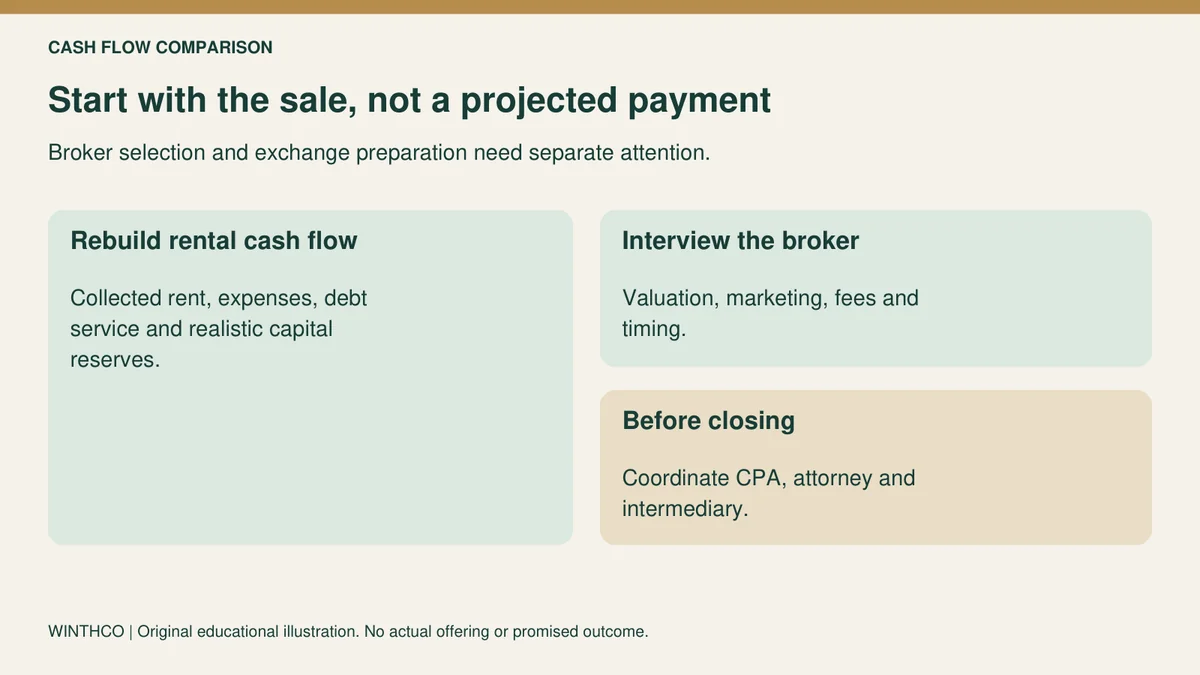
Start with the property sale, not the largest distribution figure in a presentation. Interview appropriately licensed real estate agents or commercial brokers who understand your property type. Ask how comparable sales, leases, condition and buyer financing support the valuation, how the property will be marketed, what services and fees apply, and who coordinates closing. Verify credentials through the relevant state regulator. This is a broker-selection framework, not a claim that Winthco operates a real estate brokerage.
At the same time, involve your CPA, attorney and qualified intermediary before closing or receiving sale proceeds if a deferred exchange is contemplated. Prepare leases, operating statements, mortgage details, improvement records and tax-basis information. Separate the expected sale price from net equity and from capital actually available for replacement property. Winthco's DST evaluation questions can help organize the investment discussion once those facts are clear.
Share your timeline and investment range. A Winthco team member will follow up with you.
Use actual receipts and expenses over a representative period, not gross scheduled rent. Subtract vacancy, operating costs, insurance, property taxes and management charges. Account separately for mortgage payments, major replacements and reserves. A year without a roof replacement does not prove that the building has no capital needs. If you manage the rental yourself, identify that work even if no management fee appears in the bank account.
Keep the accounting definitions visible. Net operating income generally precedes debt service and owner income taxes, while cash available to spend must reflect the obligations that actually consume money. Mortgage principal payments use cash but differ from deductible operating expenses. Depreciation can affect taxable income without creating a matching current cash payment. Ask your CPA to reconcile the operating statement, bank activity and tax return rather than treating any one as the complete answer.
Avoid manufacturing precision. An uncertain repair estimate should remain an identified assumption with a range or sensitivity, not become an apparently exact annual expense. Record which amounts are historical, which are estimates and which have written support. This makes the rental side of the comparison more useful than a single remembered monthly deposit.
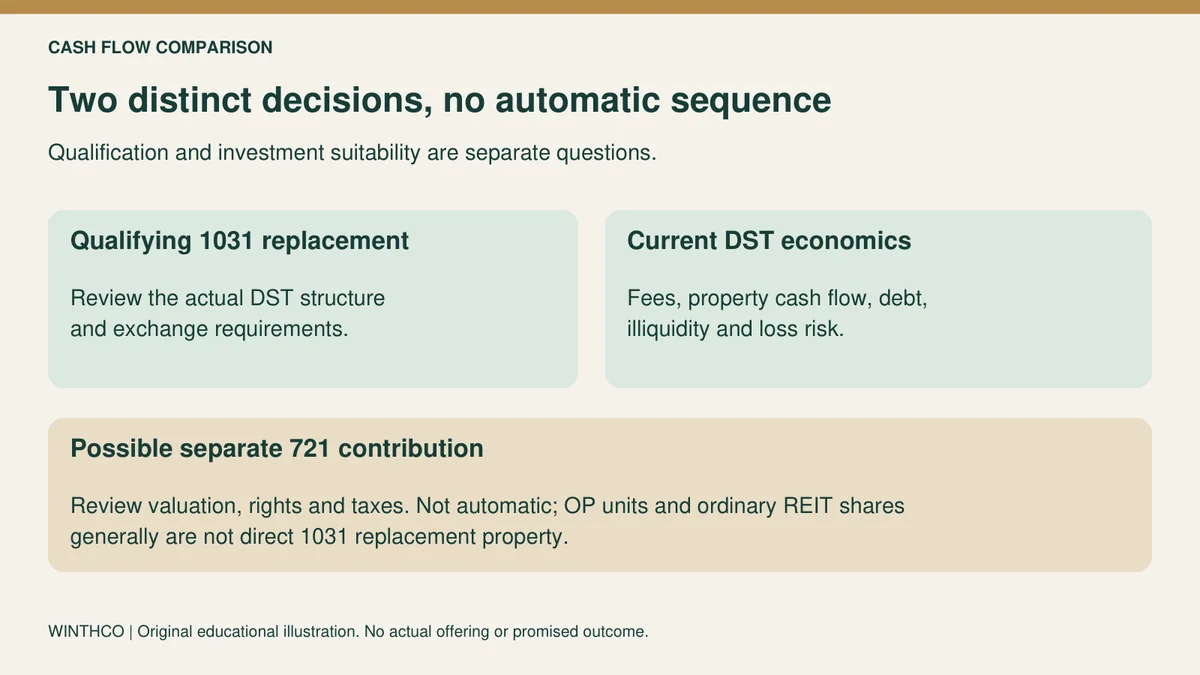
A Delaware statutory trust may hold investment real estate while a sponsor and property managers handle operations under the governing documents. That can reduce direct landlord responsibilities, but it does not remove economic exposure to tenants, property expenses or financing. A distribution is a payment to the investor; its timing and amount do not by themselves establish investment profit or capital preservation.
Request the private placement memorandum, financial assumptions and distribution policy. Ask whether anticipated payments are supported by property operations or could include reserves, financing proceeds or other sources. Determine who may adjust payments and what happens when expenses increase or collections weaken. Use the written documents to reconcile the answer. A payment funded from capital is not the same economic evidence as recurring property operating cash flow.
Clarify the denominator when comparing percentages. A figure based on original contributed equity answers a different question from a yield measured against a current valuation. Neither establishes what an investor could receive on an early sale. Upfront expenses can reduce capital deployed into the property, while ongoing costs affect what remains for investors. Do not compare a rental's gross rent with a DST's projected investor distribution, or ignore fees on either side.
Discuss your DST questions with Winthco →
Begin with leases, occupancy, tenant concentration and recurring expenses. Ask how results change if rents grow more slowly, insurance costs rise, a major tenant leaves or a repair consumes reserves. Review property condition and lease rollover dates alongside the operating budget. An attractive starting payment cannot resolve weak underlying assumptions.
Then review debt maturity, interest-rate terms, lender covenants and any planned refinancing. A fixed interest rate does not remove maturity or property-value risk. A debt-free structure avoids some borrowing risks but still faces operating losses, fees, illiquidity and property-market uncertainty. The DST distribution and ownership risks overview can frame questions, but the actual financing and trust documents determine the investment's constraints.
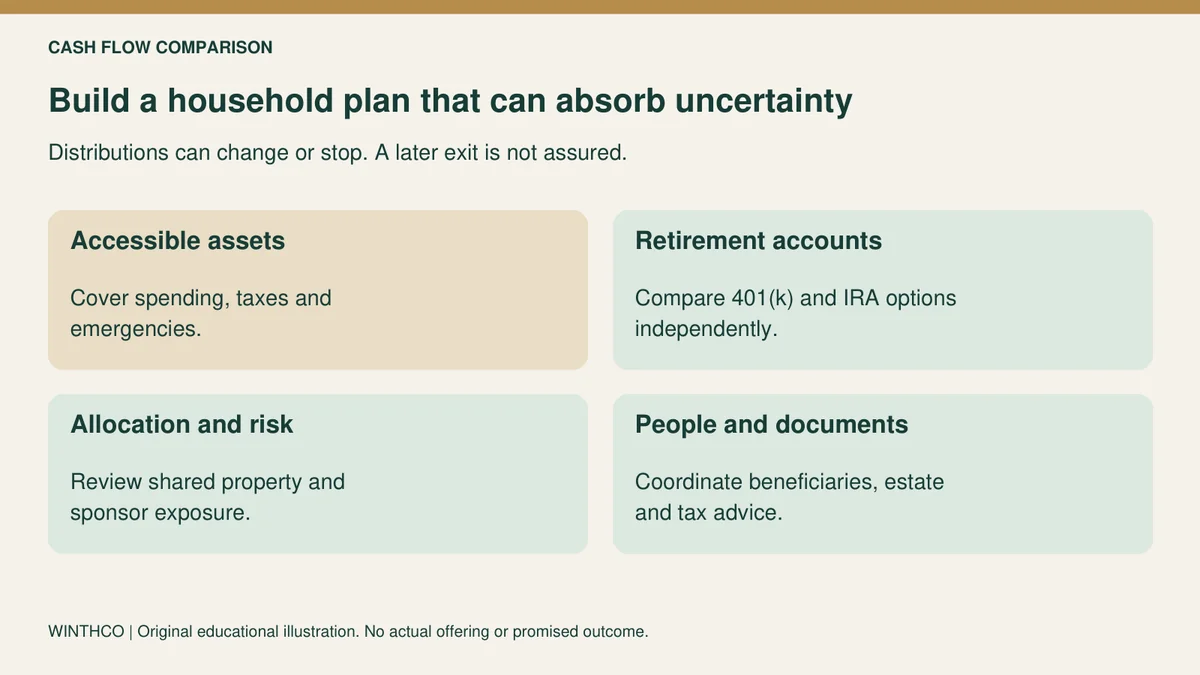
Model reduced distributions, a period with no distributions and a later exit than anticipated. Identify which household expenses would be covered by accessible assets if those events occurred together. This is a resilience exercise, not a forecast or a recommendation to hold a standard reserve amount. Different households have different obligations and capacities for loss.
Section 1031 can defer eligible gain in a qualifying exchange of business or investment real property; it does not eliminate tax or make an unsuitable investment appropriate. The IRS requires identification within 45 days after transfer and receipt by the earlier of 180 days or the federal return due date, including extensions. Treasury Regulation 1.1031(k)-1 governs deferred exchanges. Arrange the intermediary before closing and avoid taking control of proceeds without professional advice.
Revenue Ruling 2004-86 addresses a particular DST arrangement whose beneficial interests receive real-property treatment. It is not a blanket approval of every trust. Have the professionals verify the replacement interest and the overall exchange. Cash retained and net debt relief can create taxable boot, subject to the transaction's details. A partial exchange may deserve comparison when retaining cash supports genuine spending needs, but its tax cost must be modeled.
The cash received from a DST and the taxable income reported from it can differ. Review allocation statements, expenses, depreciation and carried-over exchange basis with the CPA. Winthco's DST tax reporting overview provides background, not a substitute for the actual tax package. Do not assume the purchase price creates an entirely new depreciable basis or that every dollar distributed is tax-free.
WATCH & LEARN
Origin Investments' Mike O'Shea explains DST structure and its use in 1031 exchanges. This specialist's third-party overview is background, not a Winthco endorsement or evidence that projected distributions will occur. Current tax guidance and actual offering documents control. Original resource · Watch on YouTube ↗
Educational context only. The discussion does not establish the suitability, returns or tax treatment of an investment.
No. A possible later Section 721 contribution to an operating partnership is a separate transaction with separate economics and documents. It may change the assets supporting distributions, the investor's rights, fees, reporting and future choices. Review whether a contribution is merely contemplated, who controls the decision, how value is determined, and what happens if it never occurs.
IRS Publication 541 explains the general nonrecognition framework for property contributions to partnerships and exceptions that need individual analysis. Ordinary REIT shares and operating-partnership units generally are not direct Section 1031 replacement real property. Redemption or conversion can have tax consequences, and redemption rights can be restricted. Never build a spending plan on an assumed conversion date or a claim that FIFO withdrawals automatically recover basis tax-free.
Consider a hypothetical rental owner whose bank deposits look steady but whose property will need substantial work. The owner wants fewer management duties and is considering a sale followed by a qualifying DST exchange. The planning team first reconstructs rental cash flow after realistic maintenance reserves and debt service. It separately estimates sale expenses and potential taxes under taxable-sale, full-exchange and partial-exchange alternatives.
Next, the owner compares the DST's documented distribution assumptions and fees with the rental's normalized spending capacity. A second worksheet assumes reduced payments and a longer holding period. A third tracks total capital at risk and possible exit costs. No projected return is assigned in this example: the lesson is to compare consistent definitions, not to manufacture a numerical winner. The owner could conclude that continued ownership, professional management or another allocation fits better.
Private DST offerings are generally limited to accredited investors and offered through the applicable private placement memorandum. The SEC warns that private placements can be highly illiquid, disclose less than registered offerings and involve total loss. FINRA highlights concentration across correlated holdings. Multiple DSTs can still share sponsors, property sectors, regions or financing exposures. Distributions can change or stop, principal can be lost, and tax rules can change.
Connect the sale decision to Winthco's financial advising and wealth-management discussion. Review existing financial assets, 401(k)s, IRAs, retirement spending, liquidity, allocation and beneficiary or estate arrangements with the appropriate professionals. Retirement accounts are not themselves exchange proceeds. Compare account options, costs, services and restrictions before considering any rollover or transfer; moving assets is not an assumed next step.
Bring the rental reconciliation, sale estimate, offering documents and household spending priorities to a prospect conversation. Keep sensitive statements and tax returns out of the public contact form and use an agreed secure channel. A contact request does not reserve an offering, establish suitability or create a tax or legal engagement. The goal is a coherent household plan that can withstand uncertainty, not merely replacing one deposit with another.
Before relying on a payment illustration, read the DST offering documents to reconcile assumptions, reserve sources and the authority to change distributions.
Where a separate master tenant owes rent, examine master-lease payment obligations and supporting financial resources before treating scheduled rent as dependable household cash flow.
| Decision | Evidence to request | What to avoid assuming |
|---|---|---|
| Rental cash flow | Receipts, expenses, debt service and capital reserves | Gross rent equals spendable income |
| DST distributions | Offering policy, payment sources and all fees | A distribution equals investment profit |
| Tax reporting | Basis, depreciation and actual tax packages | Cash received equals taxable income |
| Possible 721 contribution | Valuation, rights, restrictions and tax review | A future conversion or redemption is assured |
No. Payments depend on the investment and its governing documents and can be reduced or suspended. A projected distribution is not a contractual assurance of profit.
No. Total economic results also depend on changes in investment value, sale proceeds and costs. Receiving periodic cash does not prevent a capital loss.
No. Reconstruct rental cash after relevant expenses, debt payments and realistic reserves. Keep taxes and noncash items separately reconciled so both alternatives use consistent definitions.
Retaining cash can affect recognized gain and exchange treatment. Ask the CPA and qualified intermediary to model a partial exchange before closing rather than withdrawing exchange funds casually.
No. A contribution may not occur, and operating-partnership units can have lockups or redemption restrictions. Review the actual documents and tax effects independently.
No automatic transfer follows from a property-planning conversation. Review retirement-account alternatives, services, fees and restrictions on their own merits.
Sources checked October 13, 2026. This article explains general concepts; your facts and the applicable documents control.
Winthco DST services · Winthco evaluation overview · Editorial standards
Risks and due diligence
Learn how to review DST acquisition costs, ongoing expenses, financing charges and exit fees without relying on a single headline number.
Read guide →Investor decision-making
Compare Delaware statutory trust ownership with directly owned rental property across management, control, diversification, financing and exit flexibility.
Read guide →DST tax reporting
Learn how DST tax reporting can involve Form 8824, owner statements, basis, depreciation, state filings and private-placement risks.
Read guide →Explore Winthco’s main DST article collection
Share your timeline and investment range. A Winthco team member will follow up with you.