DST due diligence
How to evaluate a DST sponsor
Learn how to evaluate a DST sponsor's history, property underwriting, debt, fees, conflicts, liquidity and exit plan before a 1031 exchange.
Read guide →
Home / Learning center / DST investment due diligence
DST investment due diligence
Winthco Wealth Management · Updated October 14, 2026
A DST master lease can place a separate tenant between the trust and the occupants using its property. The central questions are who owes rent, what resources support that obligation, and what happens if payment fails. A contractual rent obligation is not a guarantee of investor distributions, principal protection or liquidity.
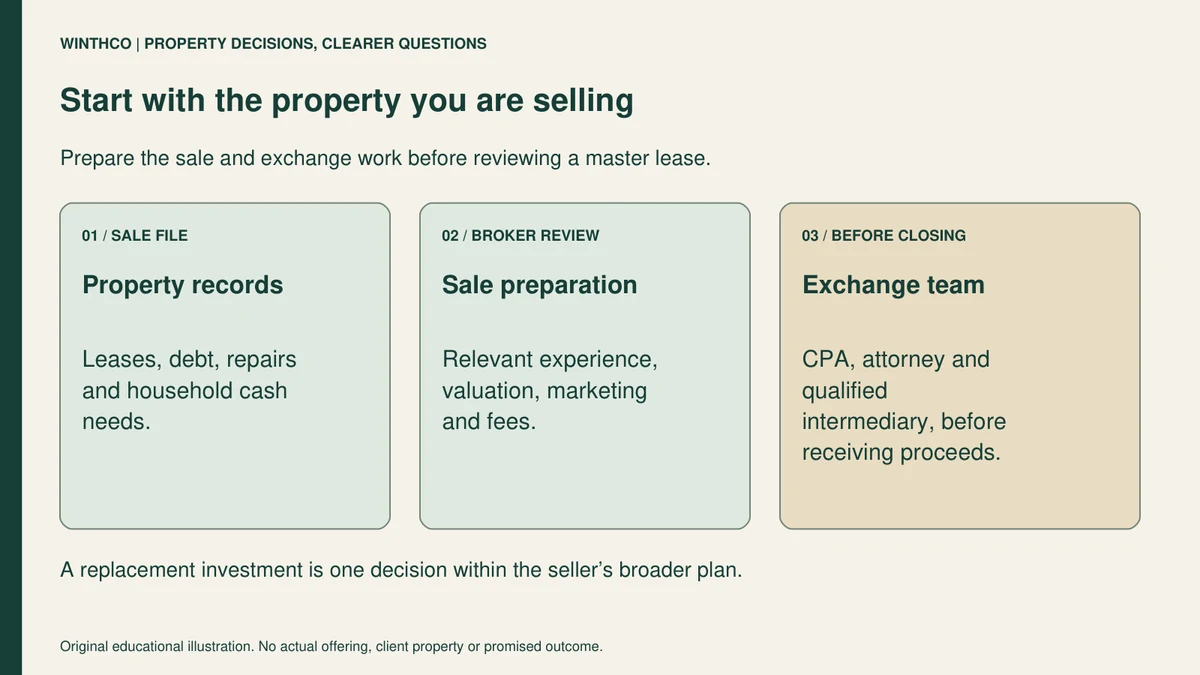
Before comparing replacement investments, prepare the property sale. Interview appropriately licensed realtors or commercial brokers about relevant property experience, valuation evidence, marketing, fees and closing coordination. Assemble leases, debt statements, improvement records and known repair issues. Ask who will handle tenant communications and transaction questions. This guide does not imply a Winthco brokerage service or an unverified referral relationship.
If a deferred exchange is contemplated, engage the CPA, attorney and qualified intermediary before closing or receiving proceeds. Compare continued ownership, professional management, a taxable sale and an exchange against household needs. Winthco's guide to evaluating a DST investment is a starting point for investment questions; the master lease and current offering documents are necessary for understanding the actual arrangement.
Share your timeline and investment range. A Winthco team member will follow up with you.
Section 1031 can defer eligible gain when qualifying business or investment real property is exchanged for qualifying replacement real property and all requirements are met. It does not eliminate tax or investment risk. Under the deferred-exchange rules, identification generally occurs within 45 days of transfer, with receipt by the earlier of 180 days or the applicable federal return due date, including extensions. Taxable boot and transaction costs require separate analysis.
Some DST structures may provide qualifying replacement interests and reduce direct management duties. A master lease is an operating arrangement to examine, not a separate exemption from exchange requirements. IRS Revenue Ruling 2004-86 considers specified facts involving a trust, a net lease and a tenant allowed to sublease. Have tax counsel compare the proposed structure with applicable law rather than treating the ruling as approval of every DST.
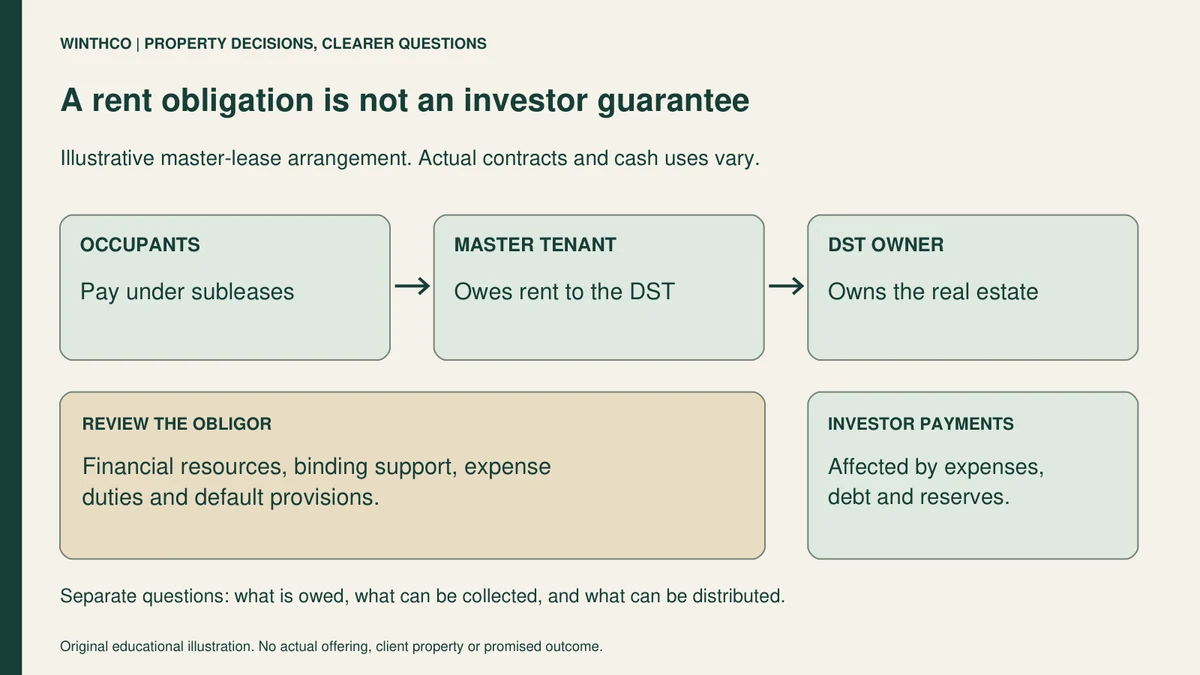
Draw the legal relationships before reviewing projected payments. Identify the trust owning the real estate, the master tenant signing the lease, the occupants under any subleases, and the property manager providing services. The master tenant and property manager may have different contractual duties even when related to the same sponsor. Ask which entity can be required to perform each obligation and where that obligation appears in the documents.
In the arrangement addressed by Revenue Ruling 2004-86, the tenant's obligation to pay rent did not depend on its ability to sublease or on its sales or profits. That feature describes the ruling's facts. It does not prove that a particular tenant has enough resources to pay, that every offering uses identical terms, or that investor payments cannot change. Separate what is legally owed from the evidence supporting collection.
Discuss your DST questions with Winthco →
Request financial information for the actual rent obligor, not merely a sponsor presentation or a recognizable affiliated name. Ask about capitalization, available cash, other obligations, operating history and exposure to the same properties. Determine whether any support is committed under an enforceable agreement or is only a stated intention. Counsel should explain the parties, limits, conditions and duration of any guarantee or credit support.
If the master tenant is an affiliate, ask how the lease was negotiated, how conflicts are addressed and which payments flow to related parties. Do not assume common ownership makes the parent responsible for every subsidiary obligation. Conversely, an affiliate relationship alone does not establish that an arrangement will fail. The relevant task is to understand documented responsibilities, financial capacity and the consequences if support is unavailable.
FINRA Regulatory Notice 10-22 discusses reasonable investigation of private placements by recommending broker-dealers, including the issuer, management, assets, business claims and intended use of proceeds. Its examples include reviewing significant contracts and leases. Ask the investment professional what investigation supports the proposed arrangement and what material questions remain. A familiar brand and a completed subscription form are not substitutes for that work.
Read the rent calculation, payment dates, escalation provisions and any variable components in the actual lease. Ask whether payments depend on operating conditions or defined financial measures. Compare the offering summary with the executed or proposed agreement and request an explanation of inconsistencies. A label such as net lease is not enough to establish who bears every expense in a particular transaction.
Make an expense-responsibility list covering taxes, insurance, maintenance, capital work, utilities and management. Identify exclusions, reimbursement rules and limits. Ask what happens when an expense exceeds the forecast or a responsible party cannot perform. Understand who controls reserves, what those reserves may fund and how replenishment is addressed. These are document-review questions, not a claim that every DST has the same allocation of costs.
Trace the path from property collections to master-lease rent and then to amounts available for investor distributions. Debt service, trust expenses and reserves may also matter. Ask whether projected payments depend on temporary support or other disclosed sources. A distribution is not the same as total return. Payments can decline or stop, and selling property for less than expected can reduce principal even after earlier distributions.
WATCH & LEARN
Accruit presents this educational video about DSTs as replacement property in a 1031 exchange. It provides general structural background, not a review of a particular master lease or a promise of tax treatment, distributions or liquidity. Original resource · Watch on YouTube ↗
Educational context only. The discussion does not establish the suitability, returns or tax treatment of an investment.
Use a downside discussion rather than relying only on the base-case forecast. Ask about weaker occupancy, delayed collections, higher insurance costs and unexpected capital work. Which party absorbs the shortfall first? What information would investors receive, and when? Request the relevant default, notice, cure and enforcement provisions. Do not assume immediate replacement of a tenant or uninterrupted payments during a dispute.
Trust powers and tax-structure restrictions matter when circumstances change. Revenue Ruling 2004-86 limits trustee activities under its facts and addresses a specific exception for entering new leases when the tenant is bankrupt or insolvent. That is not a general promise of flexibility. Counsel should explain the actual trust's permitted responses, any restructuring provisions and potential tax consequences without assuming a successful rescue.
For financed properties, compare lease terms with loan maturity, covenants and repayment assumptions. Winthco's discussion of leveraged DST ownership provides background, but debt suitability and exchange tax calculations are separate questions. Have the CPA assess cash, liabilities and potential boot for the actual exchange. Do not assume a particular loan-to-value ratio is required or that a lease will solve a financing shortfall.
No. A contemplated later contribution to a REIT operating partnership is a separate decision with its own conditions. Evaluate the current DST even if that contribution never occurs. Ask who controls timing, how value would be determined, which conflicts exist and what investors could choose. A potential future transaction is not a substitute for understanding today's rent obligor and property economics.
The 721 UPREIT overview introduces the broader concept. Section 721 generally addresses property contributions for partnership interests, subject to exceptions and transaction-specific tax analysis. IRS Publication 541 discusses liabilities and related transfers that can complicate the result. Ordinary REIT shares and operating-partnership units generally are not direct Section 1031 replacement real property. Do not collapse the initial exchange and a later partnership contribution into one automatic process.
Review any future partnership terms, fees, distribution discretion, lockups and redemption or conversion restrictions independently. A stated target date does not guarantee cash availability. Later transactions can create tax consequences, and FIFO selection does not guarantee tax-free withdrawals of basis. Missing future terms remain uncertainties; they should not be filled in with assumptions about tax results or liquidity.
Consider a hypothetical rental owner preparing to retire from direct management. Two offering summaries describe scheduled payments, but only the complete documents identify different rent obligors, support arrangements and expense duties. The owner asks the advisor for evidence and the attorney to compare enforceable rights. This is an illustrative review process, not an actual client experience or a prediction that either arrangement performs better.
Private DST offerings are generally limited to accredited investors and offered through a private placement memorandum. Review the complete current package and supplements. The SEC warns that private placements can be illiquid, provide limited disclosure and involve substantial loss. A PPM or Form D is not SEC approval. Master leases do not remove sponsor, property, debt, concentration, tax-law, fee or limited-control risks. Principal can be lost.
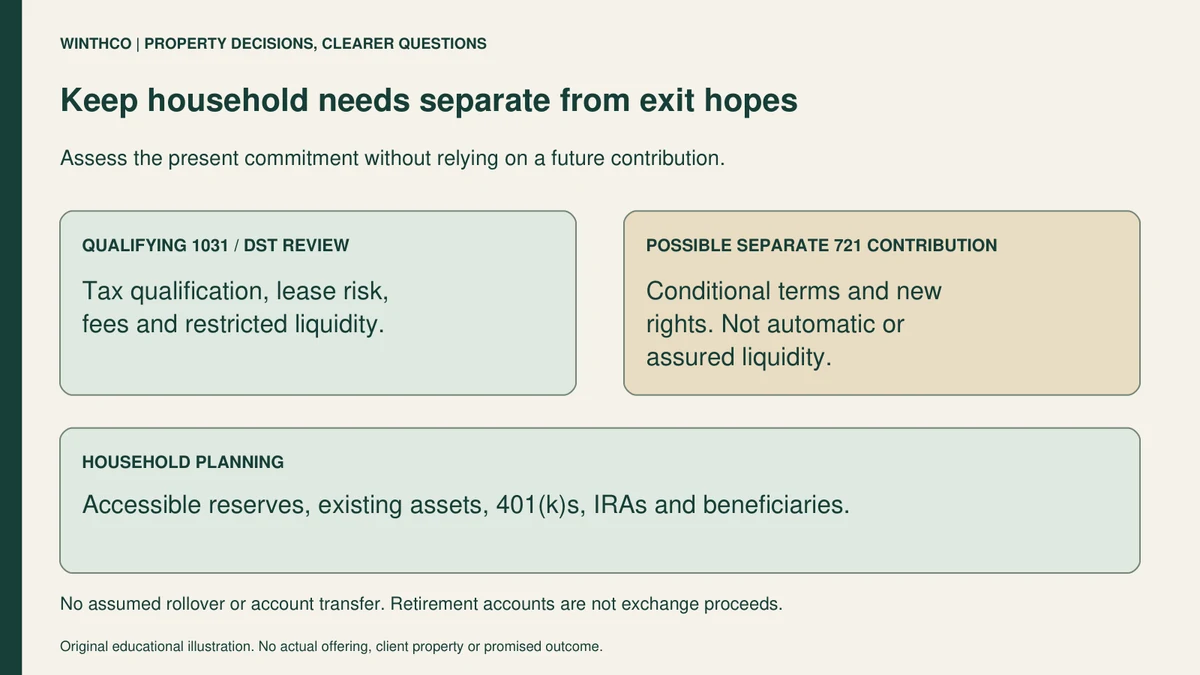
Bring the findings into a broader Winthco financial-advising and wealth-management conversation. Review existing financial assets, other property, 401(k)s, IRAs, retirement spending and accessible reserves. FINRA explains that different holdings can still create concentration in a shared asset class or economic exposure. Test whether essential spending remains workable if distributions fall and the investment cannot be sold when desired.
Retirement accounts are not themselves Section 1031 exchange proceeds. Compare account alternatives, costs, services and restrictions before any rollover or transfer; moving assets is not assumed to be appropriate. Coordinate beneficiaries, estate documents and tax reporting with the relevant professionals. Use the prospect contact form for an initial conversation about the seller's plan, and arrange a secure channel before sharing private financial or offering documents.
| Decision | Evidence to request | What to avoid assuming |
|---|---|---|
| Rent obligation | Named party, calculation and payment terms | Scheduled rent means certain collection |
| Credit support | Executed terms, limits and financial resources | A related parent automatically guarantees rent |
| Operating stress | Expense duties, reserves and default remedies | The trust can always replace a tenant immediately |
| Possible 721 contribution | Conditions, valuation and future partnership terms | A future contribution cures current risks |
Do not assume one structure applies to every offering. Identify the actual ownership, leasing and management arrangements in the current offering documents.
No. A rent obligation is different from the ability to collect payment and the amount available for investor distributions. Property costs, debt, reserves and other terms can affect results.
Do not assume so. Identify the named obligor and ask counsel to evaluate any binding guarantee or support agreement, including its limits and conditions.
The actual lease, trust powers and applicable law determine available responses. Obtain legal and tax analysis rather than assuming unrestricted flexibility or uninterrupted payments.
No. It may not occur and has separate terms, costs and tax considerations. Evaluate the current DST without relying on a future transaction.
Share basic contact information and a general planning question. Use an agreed secure channel for confidential financial records or offering documents.
Sources checked October 14, 2026. This article explains general concepts; your facts and the applicable documents control.
Winthco DST services · Winthco evaluation overview · Editorial standards
DST due diligence
Learn how to evaluate a DST sponsor's history, property underwriting, debt, fees, conflicts, liquidity and exit plan before a 1031 exchange.
Read guide →Alternatives and comparisons
Compare DST distributions with rental cash flow, fees, tax reporting and retirement spending before selling an investment property.
Read guide →DST investment due diligence
Selling a rental property? Learn how to review a DST private placement memorandum, compare fees and risks, and assess separate 721 UPREIT terms.
Read guide →Explore Winthco’s main DST article collection
Share your timeline and investment range. A Winthco team member will follow up with you.