Alternatives and comparisons
DST Distributions vs. Rental Cash Flow
Compare DST distributions with rental cash flow, fees, tax reporting and retirement spending before selling an investment property.
Read guide →
Home / Learning center / DST due diligence
DST due diligence
Winthco Wealth Management · Updated October 16, 2026
DST reserves are funds set aside within an investment for specified property expenses. Before exchanging a rental into a DST, examine the amount, permitted uses, access conditions and repair assumptions. A reserve balance does not guarantee that every future expense is covered, and it is not a personal emergency fund investors can withdraw.
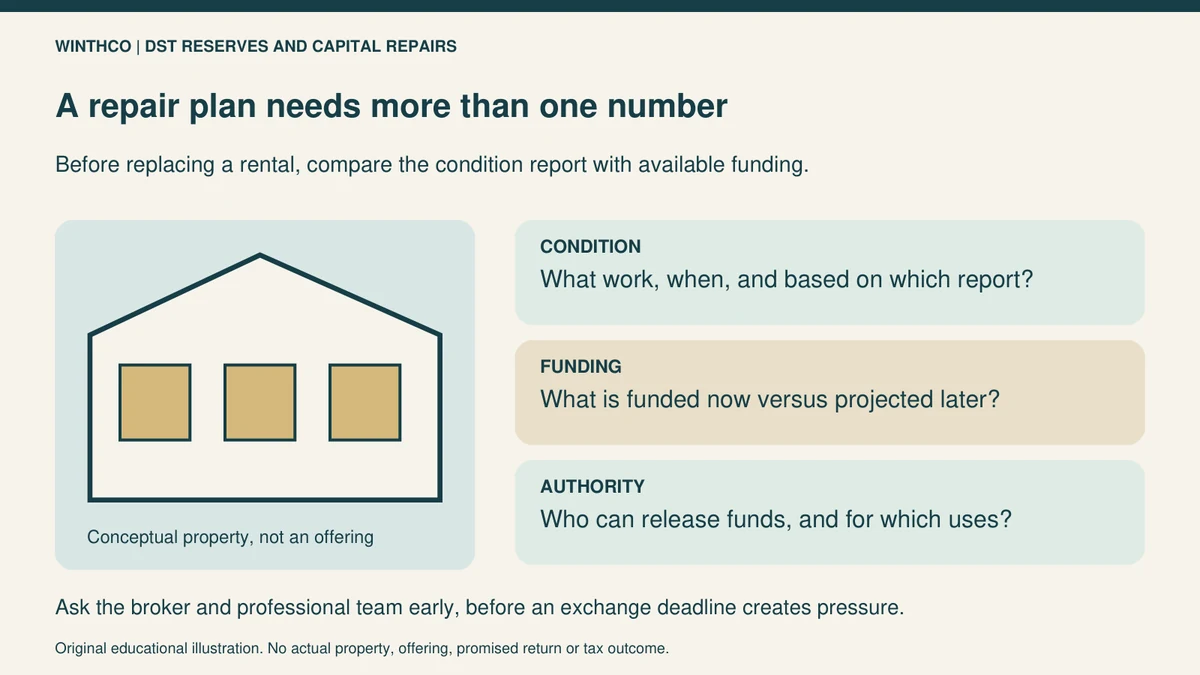
An owner tired of arranging repairs may reasonably want less hands-on responsibility. Start with a licensed realtor or commercial broker who can explain valuation, marketing, fees and sale readiness. Assemble your property's maintenance records and known repair needs. Then distinguish the job you want to stop doing from the financial exposure you may still accept through a replacement investment.
If a deferred exchange is contemplated, involve the CPA, attorney and qualified intermediary before closing or receiving proceeds. Start the replacement-property review early, using Winthco's framework for evaluating a DST to organize the documents. A sponsor may handle maintenance decisions, but the investment still depends on a workable property budget. Moving responsibility to a manager does not make the cost disappear.
Share your timeline and investment range. A Winthco team member will follow up with you.
Request a dated schedule showing each reserve account, its purpose, current balance and expected future funding. Ask which figures represent money already deposited and which represent forecast contributions from operations. A line in a projected budget is not evidence that cash is available today. Request an explanation of material differences between the offering summary, loan documents and operating budget.
Separate repair funds from tax and insurance escrows, operating cash and amounts held for other obligations. Ask who controls withdrawals and what approval or documentation is required. If a lender holds an account, ask the sponsor to explain any release conditions. Do not count the same dollar twice merely because it appears in both a property-level summary and a financing schedule.
This is a document-review framework, not a standardized reserve formula. Properties differ in age, construction, tenant responsibilities and expected work. A larger reserve balance does not automatically make one offering better than another. Compare the identified needs, timing and restrictions, and ask the investment professional to explain why the assumptions fit the specific property.
IRS Revenue Ruling 2004-86 addresses a specified trust arrangement, not every entity called a DST. Its facts allow reasonable expense reserves while limiting additional contributions, debt renegotiation and property modifications. The described trustee may make minor nonstructural modifications, with an exception for work required by law. Have tax and legal professionals assess the actual trust documents rather than relying on a shorthand list of restrictions.
The practical question is how the investment would respond to a funding gap within its permitted powers. Ask counsel to identify the applicable provisions and explain any proposed restructuring, including ownership and tax consequences. Do not assume the trustee can simply collect more investor money, refinance on demand or undertake any desired renovation while retaining the same tax treatment.
Keep the reserve discussion separate from eligibility for your exchange. A qualifying DST interest can provide a different way to own replacement real property, but the classification analysis does not establish a prudent repair budget. Obtain both answers: whether the transaction qualifies under the applicable rules and whether the investment's funding plan is acceptable for your circumstances.
Discuss your DST questions with Winthco →
Ask for the available property-condition report and its date, scope and exclusions. Have the sponsor identify urgent work, scheduled replacements and estimates outside the contemplated ownership period. Request the assumptions behind remaining useful-life estimates and any updates since the inspection. A report is a snapshot; ask how newly identified conditions will be communicated before you subscribe.
Then compare the report with the capital plan and operating projections. Are the same systems and repair dates reflected in both? Which costs are estimates, supported bids or completed work? Ask how the budget handles timing uncertainty and cost changes. This comparison can uncover unanswered questions without pretending that an investor can diagnose a roof or mechanical system from a summary brochure.
Read responsibility alongside cost. Ask whether the landlord, tenant, master tenant, insurer or another party is contractually responsible for each material item. Counsel should explain relevant exclusions and obligations; the investment professional should explain the supporting financial information. A tenant obligation, insurance policy or warranty is not interchangeable with unrestricted cash already held by the trust.
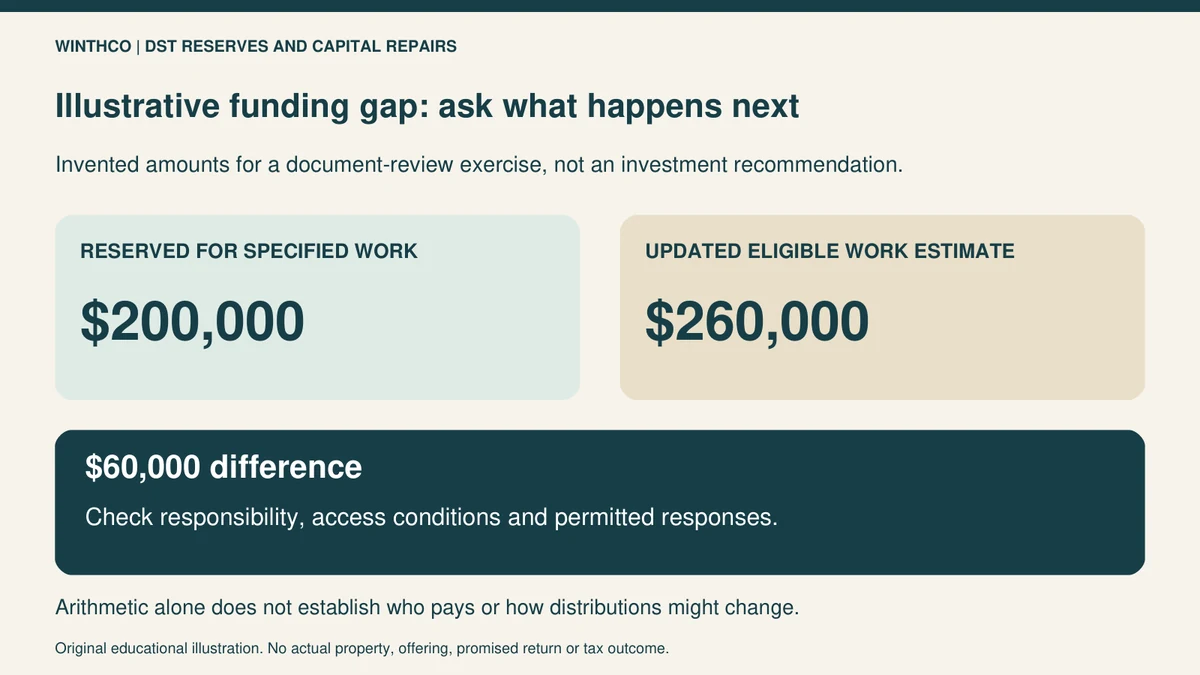
Consider an invented example: a property has $200,000 reserved for specified repairs, and an updated estimate identifies $260,000 of eligible work due sooner than expected. The $60,000 difference is only arithmetic. These figures are not an offering, recommended reserve level or prediction. They do not establish who owes the expense, whether all reserved funds can be used or what happens next.
Ask the sponsor to walk through the actual documents: which costs qualify, when payment is due, which approvals apply and what permitted sources could meet the gap. Request a scenario with less operating cash than projected as well as higher repair costs. The goal is to understand dependencies, not to choose a reassuring assumption that makes the spreadsheet balance.
Ask how each response could affect distributions, property operations, debt compliance or the anticipated sale. Avoid treating a reduction in distributions as either inevitable or impossible without reviewing the facts. If the explanation depends on a future transaction or unsupported funding source, identify that dependency explicitly. An unresolved material question can justify further review rather than a rushed subscription.
WATCH & LEARN
Winthco Wealth Management introduces general DST and property-sale planning. This background video is not a property-condition assessment or a promise that reserves cover every expense. Review the offering documents and current primary sources with qualified professionals. Original resource · Watch on YouTube ↗
Educational context only. The discussion does not establish the suitability, returns or tax treatment of an investment.
A property without acquisition debt can still need repairs, insurance, taxes and operating funds. Winthco's overview of debt-free DST ownership can frame the financing comparison, but debt-free does not mean expense-free or risk-free. Review the capital plan on its own merits. Where debt exists, separately examine reserve controls, loan maturity and obligations that might compete for cash.
A possible Section 721 contribution to an UPREIT operating partnership is a separate decision, not a guaranteed solution to an underfunded property. IRS Publication 541 explains the general partnership-contribution framework and exceptions. Ask the CPA and attorney to analyze the actual proposal, including liabilities and related transfers. Do not assume that a proposed contribution will be accepted or occur on schedule.
The current DST should make sense even if that later transaction never happens. OP units and ordinary REIT shares generally are not direct Section 1031 replacement real property. Review partnership fees, control, liquidity and redemption terms independently. Later dispositions or redemptions can have tax consequences, and FIFO treatment does not guarantee tax-free withdrawals of basis.
Reserves do not eliminate sponsor, property, tenant, financing or concentration risk. Private DST offerings are generally limited to accredited investors and offered through a private placement memorandum. The SEC warns that private placements can involve limited information, restricted resale and loss of the entire investment. Review compensation, conflicts, transfer restrictions and the complete documents, not just the reserve table.
Distributions may change or stop, and principal can be lost. Winthco's questions about a DST holding period introduce the liquidity discussion, but a planned sale date is not a promise that you can withdraw money then. FINRA cautions that concentrated holdings in illiquid investments may be difficult to access when needed. Property reserves do not resolve that household-level concern.
Exchange deadlines also remain separate. IRS Form 8824 instructions generally require identification within 45 days after transfer and receipt by the earlier of 180 days or the applicable tax-return due date, including extensions. Section 1031 defers eligible gain when requirements are met; it does not eliminate tax or validate investment quality. Discuss taxable cash, incomplete-exchange consequences and alternatives with the professional team.
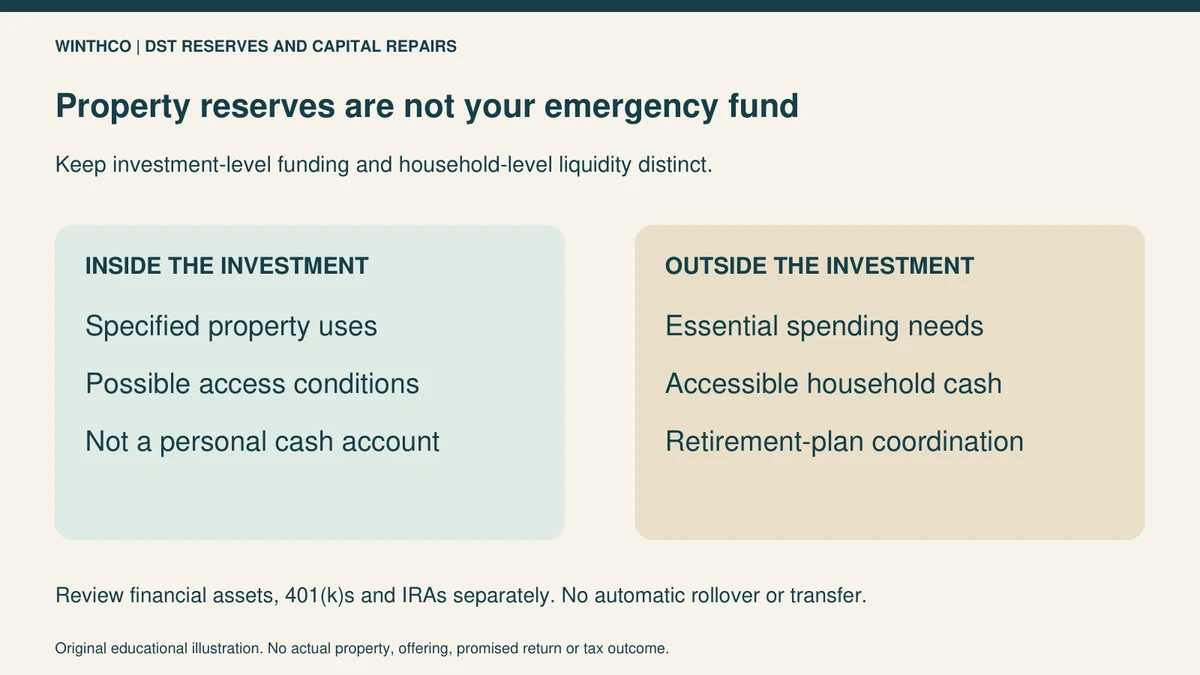
Bring the proposed investment into a broader conversation with Winthco's financial-advising and wealth-management team. Review financial assets, remaining real estate, 401(k)s, IRAs and accessible cash alongside essential retirement spending. Ask what the household would do if distributions declined while the property needed work. Set aside personal liquidity according to the household plan rather than counting money restricted inside the DST.
Coordinate beneficiary and estate questions with counsel and tax reporting with the CPA. Retirement accounts are not Section 1031 proceeds, and a property sale does not automatically call for an account rollover or transfer. Compare relevant options, costs and services separately. Use the prospect form to discuss your sale timeline and reserve-review questions; request a verified secure channel before sharing private statements or offering documents.
| Decision | Evidence to request | What to avoid assuming |
|---|---|---|
| Reserve balance | Dated funded amount, purpose and restrictions | Every reported dollar is available for any repair |
| Capital plan | Work scope, timing, estimates and supporting reports | A forecast ensures costs will stay on budget |
| Expense responsibility | Lease, insurance, warranty and trust provisions | Someone else will certainly pay |
| Household liquidity | Accessible funds outside the restricted investment | Property reserves can fund personal withdrawals |
There is no single dollar amount appropriate for every property and structure. Ask for a supported budget based on the property, expected work, obligations and access restrictions.
No. Funds within the investment may be restricted to property purposes and are not a personal withdrawal account. Review accessible household cash separately.
Do not assume they can. The specified arrangement in Revenue Ruling 2004-86 limits additional contributions; have counsel explain the actual documents and any proposed structural change.
Yes, the absence of acquisition debt does not eliminate property expenses. Review repair funding and other obligations without treating the financing label as a complete risk assessment.
Not necessarily. The effect depends on responsibilities, permitted funding sources and the documents. Request a supported explanation rather than assuming either uninterrupted payments or an automatic suspension.
A possible contribution may never occur and requires a separate review. Evaluate the current investment without relying on that uncertain event to resolve a material funding question.
Sources checked October 16, 2026. This article explains general concepts; your facts and the applicable documents control.
Winthco DST services · Winthco evaluation overview · Editorial standards
Alternatives and comparisons
Compare DST distributions with rental cash flow, fees, tax reporting and retirement spending before selling an investment property.
Read guide →DST investment due diligence
Selling a rental property? Learn how to review a DST private placement memorandum, compare fees and risks, and assess separate 721 UPREIT terms.
Read guide →DST investment due diligence
Review who owes rent in a DST master lease, what supports payment, and how lease risks fit a property sale, 1031 exchange and retirement plan.
Read guide →Explore Winthco’s main DST article collection
Share your timeline and investment range. A Winthco team member will follow up with you.