Risks and due diligence
DST investment risks: a practical due-diligence checklist
Review DST liquidity, leverage, sponsor conflicts, fees and distribution assumptions before making an investment decision.
Read guide →
Home / Learning center / 1031 exchange planning
1031 exchange planning
Winthco Wealth Management · Updated October 4, 2026
One 1031 exchange may acquire interests in multiple Delaware statutory trusts when each interest is eligible replacement property and every identification, timing, taxpayer and closing requirement is satisfied. The structure can spread exposure, but it also creates separate subscriptions, fees and risks that require coordinated tax, legal and investment review.
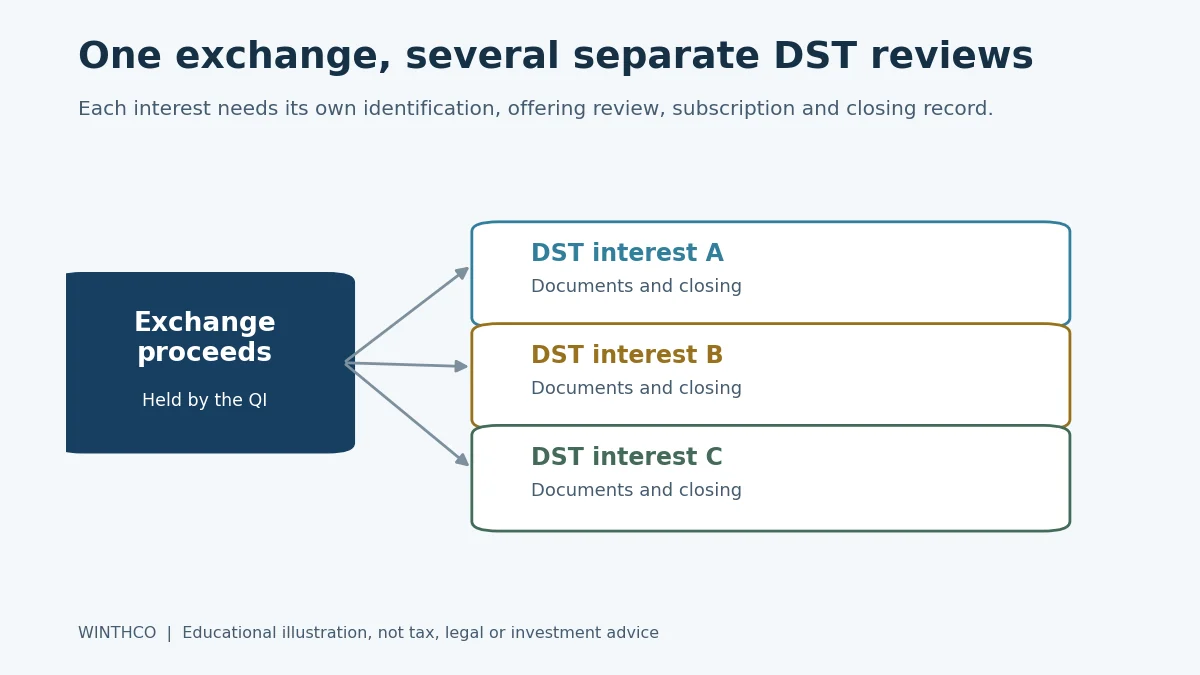
A deferred Section 1031 exchange can receive one or more replacement properties. IRS guidance describes deferred exchanges that acquire one or more like-kind replacement properties, and Treasury Regulation 1.1031(k)-1 expressly addresses multiple identified properties. That framework can accommodate more than one DST interest, but it does not automatically qualify every trust or every offering.
IRS Revenue Ruling 2004-86 concluded that beneficial interests in the specific Delaware statutory trust described in that ruling were treated as interests in the underlying real property for federal tax purposes. The ruling is fact-specific. A taxpayer should not assume that a trust interest qualifies merely because its name includes DST. Tax counsel and the qualified intermediary should review the structure and documents for every proposed interest, including whether the trust's powers and activities remain within the ruling's stated facts.
Share your timeline and investment range. A Winthco team member will follow up with you.
Multiple multiple DST investment opportunities may give an investor more ways to allocate exchange proceeds, but availability and acceptance can change. Each private placement also has separate eligibility, suitability, subscription and funding requirements. Begin the review before the relinquished property closes, while preserving alternatives in case an offering fills, the subscription is rejected or the documentation cannot be completed on time.
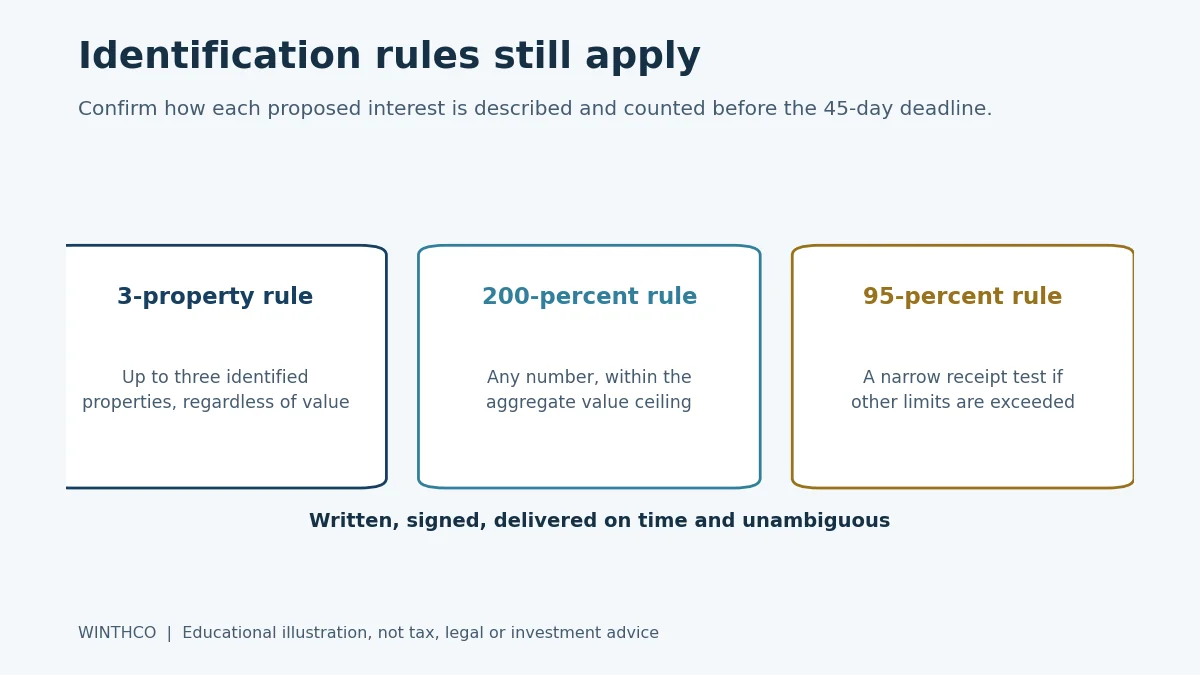
The identification period ends at midnight on day 45 after the relinquished property transfers. Replacement property must be unambiguously described in a signed writing delivered on time to an eligible person involved in the exchange. Marketing brochures, a verbal selection or an internal spreadsheet do not replace the formal identification. Ask the qualified intermediary for the exact description it needs for each proposed DST interest.
Treasury Regulation 1.1031(k)-1 generally allows three identified replacement properties without regard to value. Alternatively, the 200-percent rule permits any number when the aggregate fair market value of all identified property does not exceed 200 percent of the aggregate fair market value of the relinquished property. The 95-percent receipt rule is a narrow backstop, not a casual planning method.
Do not guess whether two classes, phases or fractional allocations within a sponsor program count as one property or several. The regulation applies the identification and receipt requirements to each replacement property, and all unrevoked identifications count. Before day 45, have the qualified intermediary and tax adviser confirm how every DST interest will be described, valued and counted under the identification rule being used.
Build an allocation worksheet that starts with net exchange proceeds, expected closing amounts and the liabilities involved in the transaction. For each proposed DST interest, record the cash allocation, the offering's stated debt allocation, any outside cash, fees paid from other sources and the closing date. Then ask the tax adviser to model recognized gain under the taxpayer's actual basis and liability facts.
Avoid the shortcut that debt must always be replaced dollar for dollar. Liability relief, liabilities assumed, cash contributed and the total value of like-kind property received interact in the tax calculation. A debt-free DST can be appropriate for some facts and produce recognized gain in others. Only a transaction-specific calculation can show the effect, and an estimated sponsor allocation can change before closing.
The practical steps for buying a DST include coordinating the investor, qualified intermediary, securities professional, sponsor, escrow and tax adviser. When several DSTs are involved, set a minimum and maximum amount for each interest, identify who may approve changes and decide where any residual exchange cash will go. No allocation should depend on a projected distribution or sale price being achieved.
Discuss your DST questions with Winthco →
Treat each DST interest as its own closing workstream within one exchange. The subscribing taxpayer name should be consistent with the exchange plan, subject to advice on disregarded entities and other permitted ownership structures. Match the subscription agreement, accredited-investor verification, identification notice, wiring instructions and closing confirmation for each interest before funds move.
Use a closing map with four columns: responsible party, required document, approval status and deadline. Confirm that the qualified intermediary, not the taxpayer, will transfer exchange funds under the exchange agreement. Independently verify wiring instructions through an approved contact method. A funding error, rejected subscription or late document can affect only one interest operationally but still disrupt the overall tax plan.
Sequence matters when offerings have different acceptance dates. Keep enough exchange cash available for later closings and do not release funds for a larger early allocation without checking the remaining plan. After each closing, reconcile the amount received, the beneficial interest issued and the balance still held by the qualified intermediary. Keep acceptance notices and final closing statements together because Form 8824 requires dates, values, liabilities and property descriptions. The entire exchange must finish by the applicable exchange-period deadline, generally the earlier of day 180 or the tax-return due date including extensions.
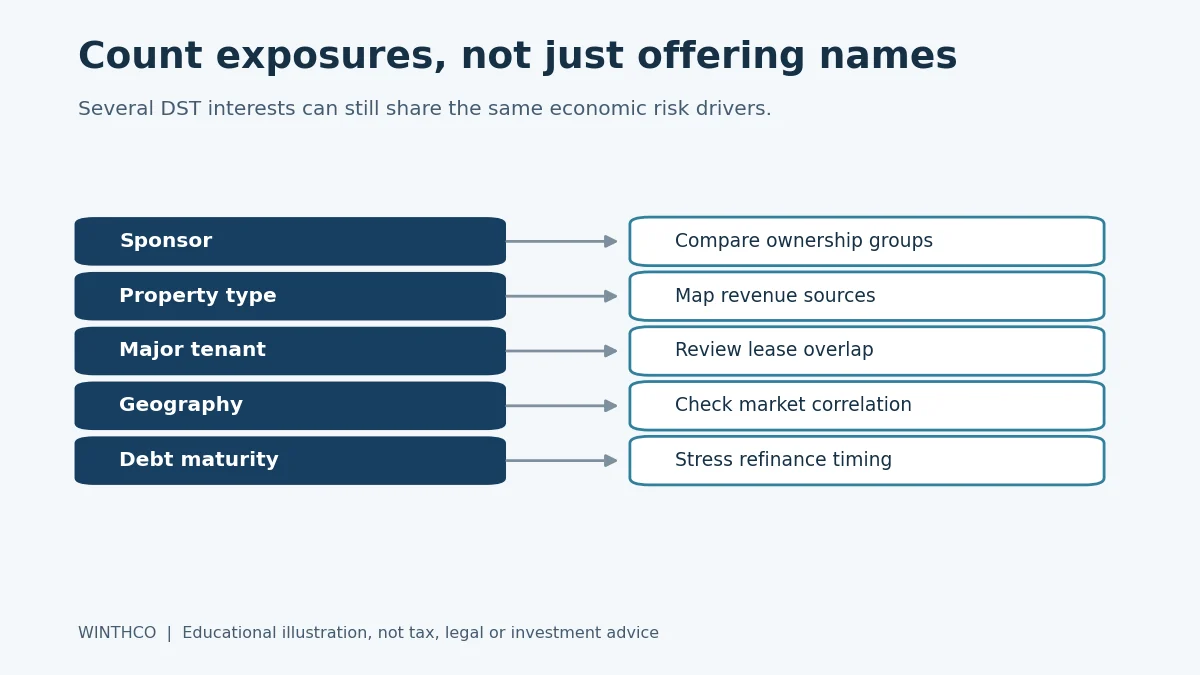
Several DST interests can spread exposure across properties, tenants, sponsors, regions, lease structures or debt profiles. That may help manage certain concentration risks, but the number of offering names is not a reliable diversification measure. Two DSTs can own similar property types in the same market, depend on the same major tenant or face refinancing during the same interest-rate environment.
Review the holdings beneath each offering. Map sponsor and property manager, property type, metropolitan area, major tenants, lease expirations, lender, loan maturity, interest-rate terms and business-plan assumptions. The criteria for choosing a DST should be applied to every interest and then to the combined allocation. Diversification does not assure profit, prevent loss or create liquidity.
Also compare the proposed group with the investor's assets outside the exchange. A household already concentrated in real estate may remain concentrated after dividing proceeds among several real estate securities. FINRA notes that correlated holdings and illiquid investments can create hidden concentration. Consider whether the same economic shock could affect several interests at once, and whether other liquid resources can cover taxes and spending without a forced sale. Keep cash needs, time horizon, other investments and the ability to tolerate reduced or suspended distributions in view.
WATCH & LEARN
David Moore of Equity Advantage discusses exchanging one property into multiple replacement properties in a January 23, 2019 third-party video. The video provides general exchange context, not advice on any DST offering. No Winthco affiliation or endorsement is implied. Original resource · Watch on YouTube ↗
Educational context only. The discussion does not establish the suitability, returns or tax treatment of an investment.
Each DST is generally a private placement with limited liquidity and fewer prescribed disclosures than a registered offering. The SEC warns that private placement investors may have difficulty reselling and should be able to withstand a substantial or total loss. Read every private placement memorandum, subscription agreement and risk section. Compare property condition, tenants, reserves, financing, fees, conflicts and sponsor authority.
Multiple interests multiply documents and may multiply acquisition costs, tax reporting, state filings and administrative work. They can also create inconsistent assumptions. One offering may use aggressive rent growth, another may rely on a near-term refinance and a third may depend heavily on one tenant. Build a common comparison table instead of accepting each sponsor's presentation format at face value.
Common mistakes include identifying more properties than the chosen rule permits, changing an interest after day 45 without valid prior identification, assuming a partial allocation is substantially the same property, mismatching the taxpayer name, missing subscription deadlines and treating projected distributions as dependable cash flow. Before funding, obtain coordinated advice from tax and legal professionals and complete the investment review. No structure guarantees deferral, income, appreciation or return of principal.
| Decision | Evidence to request | What to avoid assuming |
|---|---|---|
| Identification | Signed description, delivery record, value and property count for each interest | A sponsor name or verbal selection is sufficient |
| Allocation | Cash, liabilities, outside funds, fees and remaining QI balance | Debt must always be replaced dollar for dollar |
| Closing | Taxpayer name, subscription acceptance, wiring verification and confirmation | One accepted subscription means all interests will close |
| Diversification | Underlying sponsor, tenant, market, property type and debt exposures | More offering names automatically means less risk |
Potentially, yes. Both interests must be eligible replacement property and the identification, timing, taxpayer, exchange and closing requirements must be satisfied.
Do not assume the count. Ask the qualified intermediary and tax adviser how each specific beneficial interest, class or allocation should be described and counted under Treasury Regulation 1.1031(k)-1.
Potentially, if another regulatory rule is satisfied, such as the 200-percent rule. Exceeding the applicable identification limit can cause all identifications to fail unless a narrow exception applies.
Not necessarily. Each identified replacement property must be received within the exchange period, and the sequencing must preserve enough funds and satisfy the exchange agreement.
No. Different offerings can share sponsors, tenants, property types, regions, lenders or debt risks. Diversification cannot assure profit or protect against loss.
The remaining plan depends on what was validly identified, what other subscriptions remain available and how much time is left. Contact the qualified intermediary, tax adviser and securities professional immediately.
A change may be possible only within the interests that were validly identified and under the documents and tax rules that apply. Do not change an amount or interest without coordinated review.
Sources checked October 4, 2026. This article explains general concepts; your facts and the applicable documents control.
Winthco DST services · Winthco evaluation overview · Editorial standards
Risks and due diligence
Review DST liquidity, leverage, sponsor conflicts, fees and distribution assumptions before making an investment decision.
Read guide →1031 exchange planning
Understand DST debt replacement, added cash and mortgage boot with a worked example and questions for your CPA and qualified intermediary.
Read guide →1031 exchange planning
Understand the three-property, 200 percent and 95 percent identification rules before naming DST replacement property.
Read guide →Explore Winthco’s main DST article collection
Share your timeline and investment range. A Winthco team member will follow up with you.