1031 exchange planning
1031 exchange deadlines: the 45-day and 180-day rules
Plan the identification and completion periods for a deferred 1031 exchange, including the earlier tax-return deadline.
Read guide →
Home / Learning center / Local Guides
Local Guides
Winthco Wealth Management · Updated November 20, 2026
A Pasadena DST advisor can help evaluate replacement real estate, but the first task is preparing the property you plan to sell. Coordinate tenancy records and local sale requirements with your broker and attorney, involve the exchange team before closing, and compare passive ownership with your need for control, income and accessible savings.
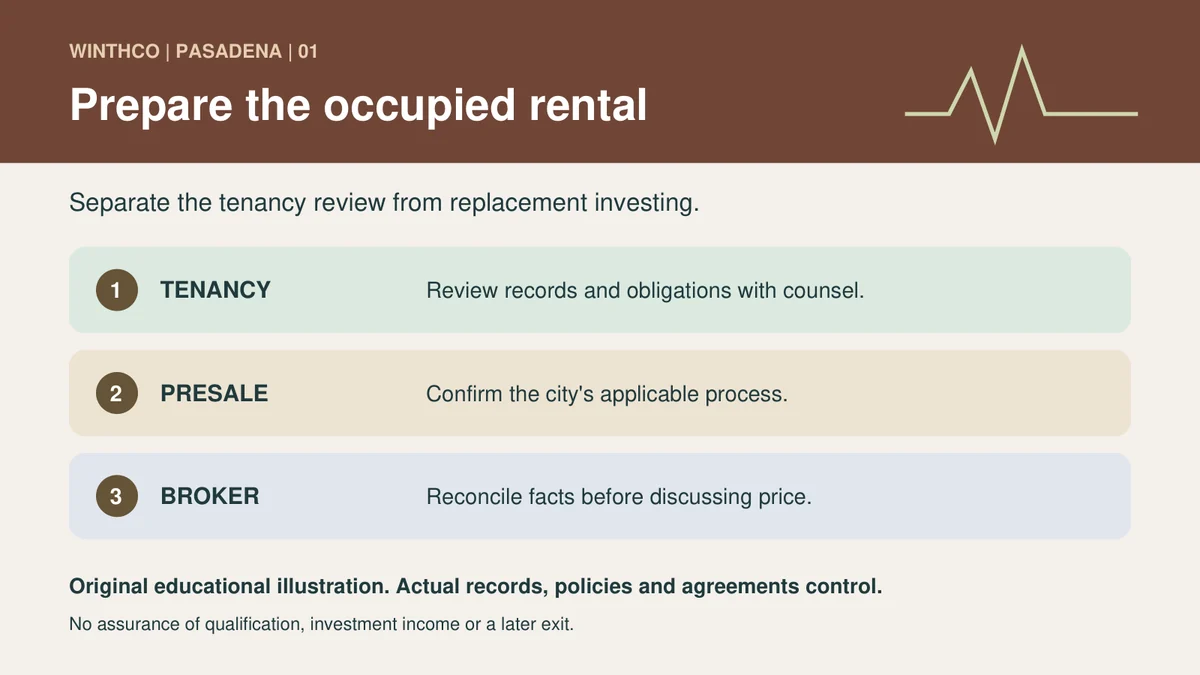
For a tenant-occupied property, the buyer is reviewing an existing tenancy as well as a building. Pasadena's Rent Stabilization Department explains that a sale or change of ownership is not itself a just cause for eviction. It also advises buyers and sellers to understand the property's rent-control and registration status. Have counsel determine the rules applicable to the particular units before making promises about vacancy or future rental income.
Choose a licensed realtor or commercial broker with relevant property-type experience. Ask how the broker will evaluate comparable sales, present occupied units, coordinate buyer questions and explain compensation. Keep the replacement-investment review separate: Winthco's DST due-diligence starting points can help organize that discussion. A persuasive sale presentation does not establish that a DST is appropriate, and a desire to stop managing tenants should not become a reason to accept unclear investment terms.
Share your timeline and investment range. A Winthco team member will follow up with you.
Create a file for the sale team containing leases, rent records, deposit information, relevant correspondence and property work records. Ask counsel which documents and disclosures are required and how to protect tenant information during marketing. Reconcile the information used in the broker's valuation with the actual records. Avoid describing a proposed rent increase or change in use as settled when it still requires legal or municipal review.
Pasadena's Presale Self-Certification Program identifies single-family houses, condominiums, townhouses and duplexes as property types requiring a certificate before escrow closes. Eligible properties can use self-certification; other properties require inspection. Confirm the current process and eligibility directly with the city. Do not assume that an apartment building with more units follows the same procedure or that an old permit resolves every current question.
Hypothetical: an owner prepares to sell a rented Pasadena duplex and discovers that the listing information and property records need reconciliation. The owner asks the broker, attorney and city to resolve the sale requirements while the CPA and QI evaluate a possible exchange. This is an invented coordination example, not a client story. Resolving the sale file does not approve the replacement investment or assure that either transaction will close.
The broker manages the sale assignment, the attorney addresses legal questions, the CPA reviews tax treatment and the qualified intermediary structures the deferred exchange. Ask each professional to identify responsibilities and information needed before transfer or receipt of proceeds. Someone searching for a Pasadena DST CPA should verify an actual CPA's credentials; an investment-advisor designation does not establish tax-preparer or legal qualifications.
Section 1031 can defer eligible gain on qualifying business or investment real property. It does not erase tax. The ordinary identification period is 45 days after transfer, and replacement receipt must occur by the earlier of 180 days or the federal return due date, including extensions. Cash or other non-like-kind consideration can create recognized gain. The QI and tax adviser should confirm the actual dates and transaction treatment.
Use our exchange deadline guide as background, then work from the specific exchange agreement. Local inspection or tenant issues do not automatically extend federal deadlines. Discuss alternatives if a suitable replacement cannot be secured. Knowing the possible tax consequences of declining an investment can help prevent the identification deadline from becoming the only reason for buying it.
Discuss your DST questions with Winthco →
A Delaware statutory trust can offer real-estate exposure without assigning the investor everyday leasing and maintenance duties. Winthco's explanation of DST replacement ownership describes the structure. IRS Revenue Ruling 2004-86 addresses a particular arrangement that can qualify for Section 1031 treatment, not a blanket approval of every trust. Have advisers review the proposed structure and your own eligibility rather than assuming that the letters DST establish a tax result.
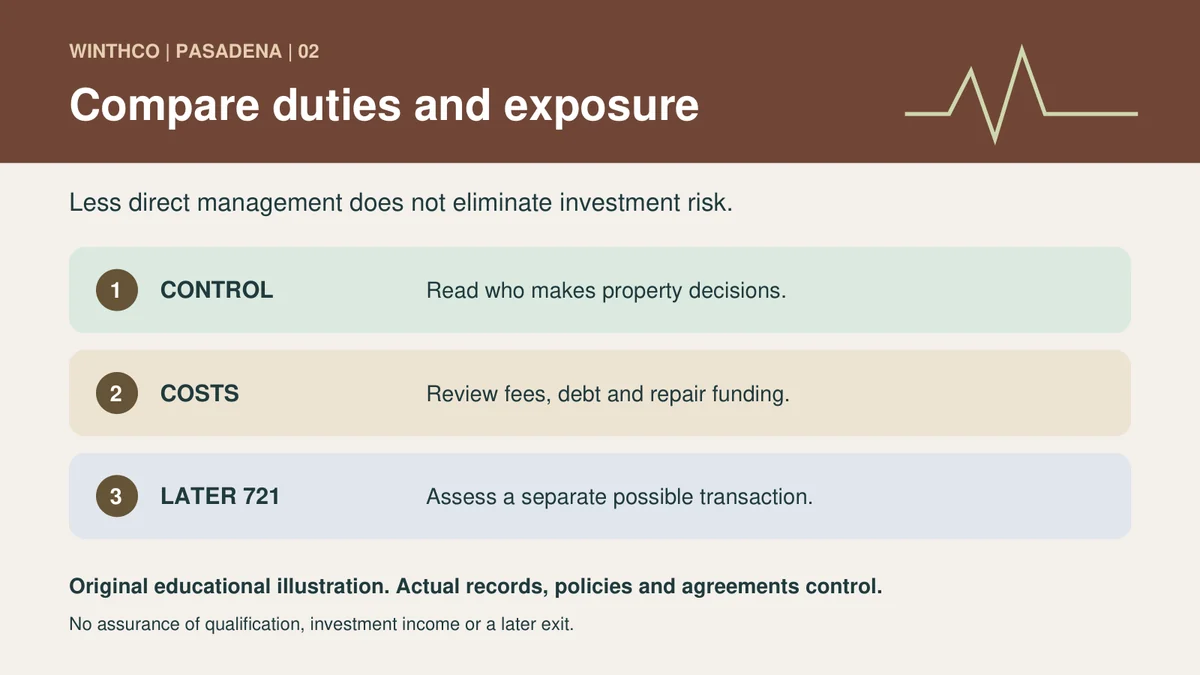
The tradeoff is reduced decision-making authority. A direct landlord may choose contractors, evaluate lease proposals and decide when to market the building. A passive investor generally cannot independently direct those decisions for the underlying DST property. Read who holds that authority, what investor rights remain and what happens if the original business plan becomes impractical. Less hands-on work does not mean the investment has no operational risk.
Write down which responsibilities you want to leave behind and which financial exposures you can accept. For example, avoiding tenant calls is different from reducing dependence on one property's income. Consider whether the proposed investment changes the tenant mix, location, property type and financing in a way you understand. Moving away from a familiar Pasadena rental should involve learning the new risks, not simply exchanging one label for another.
Start with collected rent, operating costs and capital needs rather than an illustrated distribution percentage. Ask what supports the proposed income, when leases expire and which assumptions depend on new tenants or renewals. Review taxes, insurance, management expenses and anticipated repairs. Compare the underlying records and assumptions with the information you required when evaluating your own property.
Next, identify acquisition expenses, selling compensation, ongoing fees, financing costs and disposition charges. Ask which payments go to related parties and how compensation affects the recommendation. A comparison should show what you contribute, how costs are paid and what remains exposed to property performance. The same illustrated distribution percentage can accompany materially different risks and expenses.
Our reserve and capital-repair guide explains why maintenance funding deserves its own discussion. Ask whether projected spending is supported by property-condition information and what could happen if costs exceed expectations. A larger reserve number is not useful without understanding its permitted uses. Review the financing terms alongside reserves, because money held for one purpose may not be freely available for another.
WATCH & LEARN
Tina Colson-Jones of Equity Advantage 1031 Exchange explains the QI's role. Third-party education, not a Winthco affiliation or an individual tax determination. Original resource · Watch on YouTube ↗
Educational context only. The discussion does not establish the suitability, returns or tax treatment of an investment.
Read the loan maturity, repayment terms, rate exposure and cash restrictions. A property can face refinancing or sale pressure even when an investor would prefer to continue holding it. Ask how a weaker tenant market or higher expenses would affect the plan. Distributions can decrease or stop, and loss of principal is possible. Do not treat a monthly payment illustration as a pension or a contractual promise of investment income.
Consider concentration across the whole household. Several interests may still depend on similar tenants, a common sponsor, one region or comparable financing conditions. Ask what actually differs between them. Our related guide to multiple DSTs can help frame allocation questions, but increasing the number of holdings alone does not eliminate correlated risks.
DST private placements generally are available only to accredited investors and are offered through a private placement memorandum. The SEC highlights private-placement illiquidity, limited disclosure and possible total loss. FINRA's guidance discusses reasonable investigation by recommending broker-dealers. Ask the professional what evidence supports the recommendation and which uncertainties remain. Meeting eligibility requirements does not establish that tying up capital fits your circumstances.
A potential later Section 721 partnership contribution should be evaluated separately from the initial 1031 replacement purchase. Ordinary REIT shares and partnership units are not direct Section 1031 replacement real estate. If an investment discusses a later UPREIT transaction, ask tax and legal advisers to explain the distinction and the terms that would need a new review. Do not assume the contribution will happen.
Ask a 721 UPREIT advisor who determines value, who approves participation, whether the proposal is optional and what additional compensation or restrictions could apply. Review conflicts involving related parties. A possible later transaction should not excuse missing information about the current property, loan or fees. The initial investment must make sense even if that future proposal never arrives.
Avoid budgeting around a redemption date or assuming withdrawals will be tax-free. Ask how liquidity and tax treatment could change under the actual terms. The value of a planning conversation lies in identifying uncertainties before capital is committed, not in presenting a sequence of future transactions as inevitable.
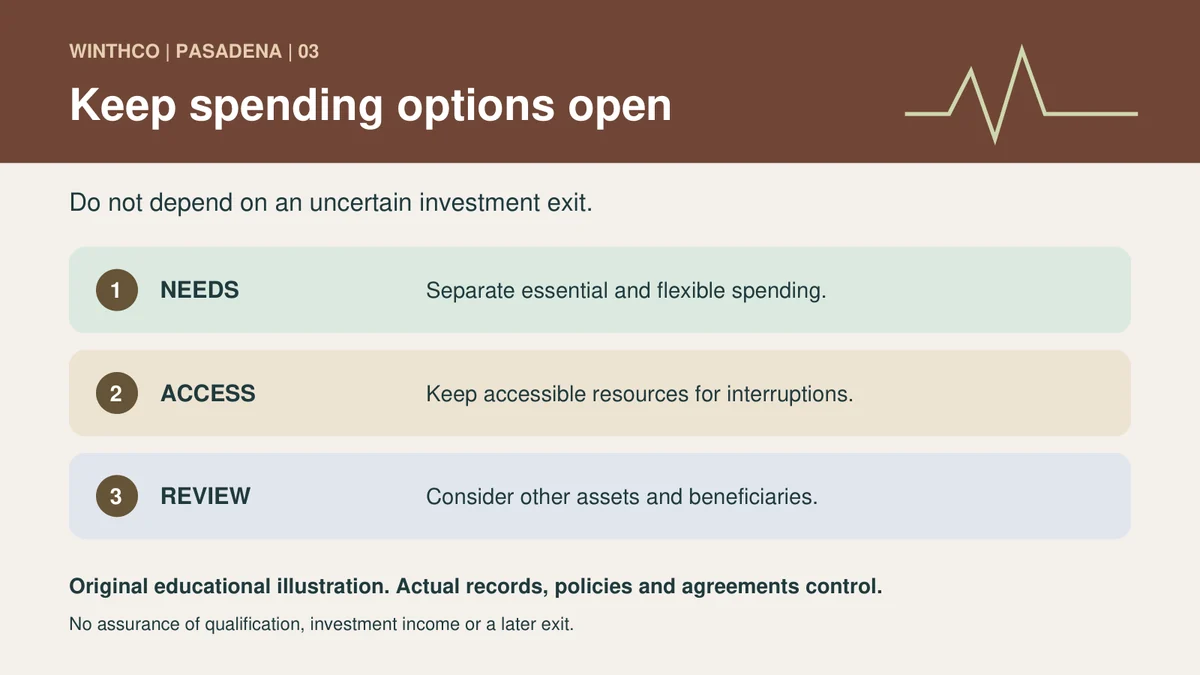
Keep an accessible pool of assets for near-term spending and unexpected needs. Compare the household effect of interrupted distributions, a longer holding period and a lower eventual sale value. Review taxable investments, 401(k)s, IRAs and other resources with a financial advisor. Qualified retirement accounts are not exchange proceeds, and any rollover or transfer requires its own comparison of costs, services and access rules.
For California property exchanged into out-of-state property, ask the CPA about Form FTB 3840 when California-source gain or loss remains unrecognized. Reporting generally continues until the deferred amount is recognized. Keep basis and transaction records organized, and coordinate beneficiary and estate questions with the appropriate professionals. The location of the adviser does not determine the location or tax treatment of underlying property.
Use either prospect form on this page or the dedicated contact page to share general timing and planning goals. Avoid tenant details, account numbers and tax returns in the initial message. Winthco's wealth-management discussion can connect the property decision with broader financial needs without assuming an engagement or asset transfer is appropriate. The Pasadena map shows city-area context only, not a Winthco office or a parcel-specific legal determination.
City-area context only, not a property boundary or Winthco office.
| Decision | Evidence to request | What to avoid assuming |
|---|---|---|
| Sale preparation | Tenancy and city records | Sale itself permits eviction |
| Exchange planning | QI dates and tax review | City processes extend IRS deadlines |
| DST ownership | Property, fee and loan documents | Less work means no risk |
| Retirement | Accessible resources and spending needs | Future distributions are assured |
The city's guidance says a sale or ownership change is not itself just cause. Ask qualified counsel how current protections apply to the particular tenancy.
The city includes duplexes in its presale program. Confirm current eligibility and the certificate or inspection process before closing.
It may reduce direct leasing and maintenance responsibilities. It also generally reduces investor control and does not remove financial risk.
No. It is a separate potential transaction with its own terms and approvals. Evaluate the initial DST on its own merits.
No. It shows Pasadena for geographic context only. No Pasadena office is claimed.
Sources checked November 20, 2026. This article explains general concepts; your facts and the applicable documents control.
Winthco DST services · Winthco evaluation overview · Editorial standards
1031 exchange planning
Plan the identification and completion periods for a deferred 1031 exchange, including the earlier tax-return deadline.
Read guide →1031 exchange planning
Learn how multiple DSTs affect identification, closings, allocation and concentration risk in a 1031 exchange.
Read guide →DST due diligence
Before exchanging a rental into a DST, review repair budgets, restricted reserves and funding limits. Know which questions to ask before committing.
Read guide →Explore Winthco’s main DST article collection
Share your timeline and investment range. A Winthco team member will follow up with you.