1031 exchange planning
1031 exchange deadlines: the 45-day and 180-day rules
Plan the identification and completion periods for a deferred 1031 exchange, including the earlier tax-return deadline.
Read guide →
Home / Learning center / Local Guides
Local Guides
Winthco Wealth Management · Updated November 17, 2026
A Redondo Beach DST advisor can help you compare replacement investments when selling a rental, but the sale needs its own preparation. Review the city's residential building-record requirements with your broker and counsel, arrange a qualified intermediary before closing, and assess DST fees, liquidity and household needs separately from potential tax deferral.
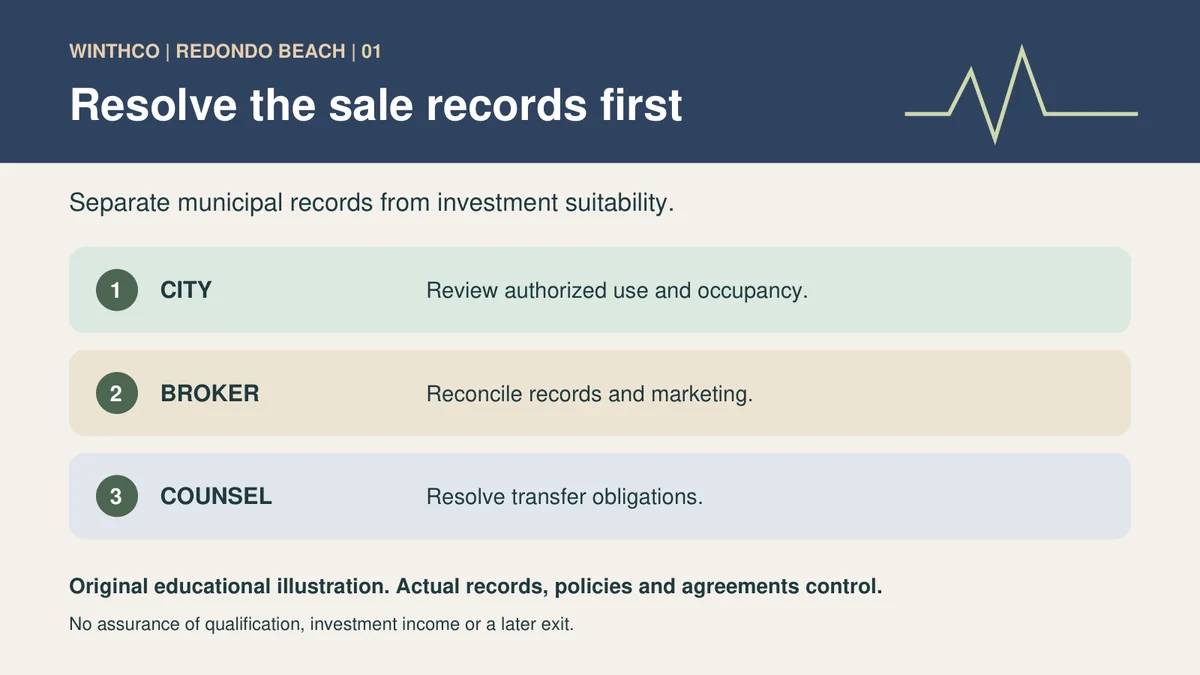
Start with the property you actually own, not the investment you might buy. Redondo Beach's municipal code, Chapter 9-10, addresses reports of residential building records. Section 9-10.03 calls for the owner or authorized representative to obtain the report before entering a sale or exchange agreement, subject to the chapter's exception. The report concerns authorized use, occupancy and zoning; it is not a federal tax-qualification opinion. Confirm applicability and current processing with the city and your attorney.
Ask a licensed realtor or commercial broker how the report, leases and permit history affect the marketing description and buyer review. Section 9-10.05 addresses delivery to the buyer before consummation and return of the buyer's receipt to the city. Have the closing team assign responsibility rather than assuming escrow has handled it. Interview brokers about relevant rental-property experience, pricing evidence, compensation, tenant communication and contingencies. A realistic net sheet and transaction calendar are more useful than an unsupported promise of a quick sale.
Share your timeline and investment range. A Winthco team member will follow up with you.
Your broker handles the property sale within the engagement; your CPA evaluates tax facts; your attorney reviews ownership and legal obligations; the qualified intermediary structures the exchange mechanics. A financial advisor evaluates how an investment fits your assets and goals. Asking for a Redondo Beach DST CPA does not make an investment advisor a CPA. Verify each professional's credentials, role and compensation, and decide who will resolve overlapping questions before deadlines arrive.
Hypothetical: an owner plans to sell a small Redondo Beach rental and stop managing repairs. A buyer raises a question about the permitted occupancy shown in city records. The owner should resolve the sale issue with the broker, city and counsel, while the QI tracks the intended transfer. An unresolved records question is not a reason to sign a DST subscription prematurely. There is no invented client or projected return in this example; it illustrates why sale readiness and replacement readiness need separate decisions.
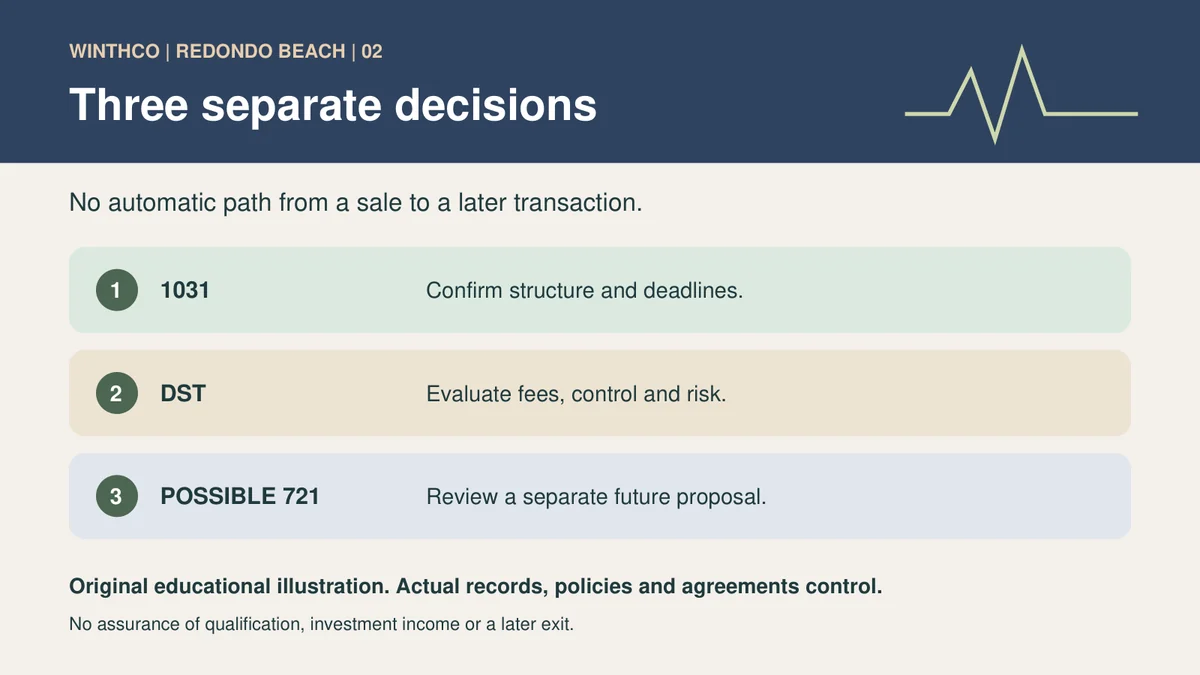
Section 1031 can defer eligible gain when qualifying investment or business real property is exchanged for qualifying replacement real property. Deferral is not elimination of tax. Personal-use property and the taxpayer's actual holding purpose require separate analysis. A QI generally needs to be arranged before the relinquished transfer; receiving or controlling proceeds can defeat the intended deferred-exchange structure. IRS Publication 544 explains these rules. Winthco's overview of DST replacement interests provides additional background on the investment structure.
The ordinary identification period is 45 days after transfer. Replacement receipt is due by the earlier of 180 days or the federal return due date, including extensions. Have the QI confirm the written identification, permitted property list and calendar dates. Ask the CPA to reconcile debt relief, replacement debt, outside cash, basis and closing costs rather than estimating qualification from net proceeds alone. Cash or other non-like-kind consideration can result in recognized gain. The exchange deadline guide explains why a postponed plan is not automatically an extended deadline.
Discuss your DST questions with Winthco →
A qualifying Delaware statutory trust interest may be used as replacement real estate in a 1031 exchange. Revenue Ruling 2004-86 analyzes a specific trust arrangement; it is not blanket approval of every DST. Have your tax advisers review the structure and your transaction. Operationally, you exchange direct decisions about tenants and repairs for a beneficial interest governed by trust and offering documents. That may reduce workload, but it also limits your ability to change the business plan.
Start with the private placement memorandum, not a distribution headline. Winthco's guide to evaluating DST documents describes why the full documents matter. Request the acquisition budget, property information, financing terms, sponsor disclosures and fee schedules. Ask which expenses are paid initially, which recur and which arise at sale or a later transaction. Understand compensation paid to the recommending professional and affiliates. Two investments with similar stated distributions may have materially different costs, leverage and assumptions.
For a seller accustomed to personally approving every repair, control deserves a direct conversation. Who decides when to sell? Who negotiates leases? What happens when unexpected work is needed? Which reserves are available, and which are restricted? A sponsor's experience should be supported by relevant evidence, not a familiar brand name alone. Ask what authority and resources exist under the actual documents if the original plan becomes impractical.
Read the property-level downside before considering an allocation. Tenant concentration, expiring leases, vacancies, maintenance and insurance costs can affect cash flow. A property outside Redondo Beach adds a different local market and regulatory setting rather than removing real-estate risk. Compare the assumptions with supporting evidence. Do not treat multiple addresses as complete diversification if they share one tenant, sponsor, industry or regional exposure.
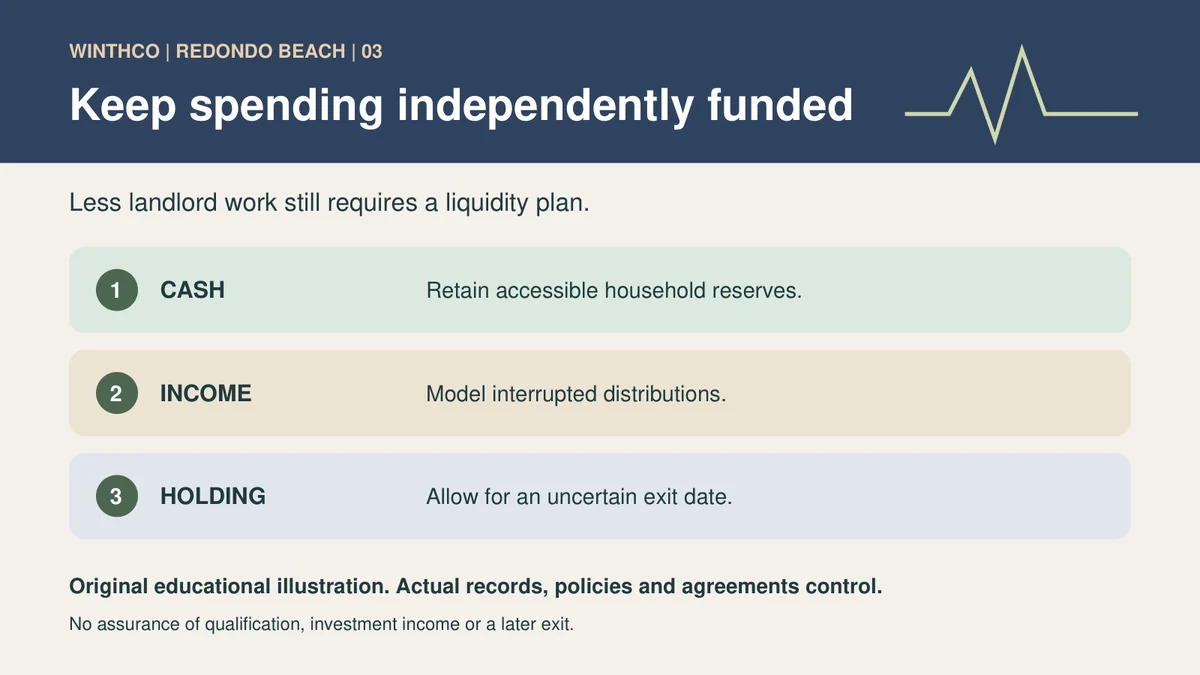
Debt adds another set of questions. Confirm maturity, interest-rate structure, required reserves, lender restrictions and potential refinancing exposure. Ask how the investment performs if operating income weakens or a sale is delayed. An illustrated exit value is not an appraisal of what you will receive. Distribution payments may decline or stop, and principal can be lost. Review a period with no distributions instead of funding household commitments from an uninterrupted-income assumption.
The SEC warns that private placements can be highly illiquid and provide limited disclosure compared with registered offerings. DST investments are generally limited to accredited investors and offered through a private placement memorandum. Accreditation is not a recommendation or assurance of suitability. FINRA's private-placement guidance supports asking the recommending firm about its investigation and unresolved red flags. You should be able to explain why the investment fits without relying on the exchange deadline as the primary reason.
WATCH & LEARN
Tina Colson-Jones of Equity Advantage 1031 Exchange explains the QI's role. Third-party education, not a Winthco affiliation or an individual tax determination. Original resource · Watch on YouTube ↗
Educational context only. The discussion does not establish the suitability, returns or tax treatment of an investment.
A potential later Section 721 contribution is a separate transaction, not a guaranteed final stage of every DST. A sponsor may describe a possible UPREIT path, but availability, approvals, documents and individual tax circumstances matter. Ordinary REIT shares and partnership interests are not direct Section 1031 replacement real estate. Evaluate the initial DST as an investment you may need to hold even if the later transaction does not occur.
Ask a 721 UPREIT advisor what changes in fees, governance, valuation and liquidity would accompany a proposed transaction. Review who can decide whether to proceed, what conflicts exist and what choices investors retain. Do not assume a stated redemption program permits cash on your preferred date or that any redemption is tax-free. A future exit should not be the only source available for health costs, debt payments or required household spending.
The California Franchise Tax Board requires Form FTB 3840 when California property is exchanged for out-of-state property and California-source realized gain or loss remains unrecognized. Reporting generally continues until that deferred amount is recognized. Ask your CPA how the rule applies to the locations underlying a proposed DST and retain the basis records. Moving the investment or changing residence does not by itself establish that California reporting ends.
Build the wealth plan around spending needs and existing assets, not a goal of reinvesting every available dollar. Review emergency cash, taxable accounts, retirement income, 401(k)s, IRAs, beneficiaries and estate arrangements with the appropriate professionals. Retirement accounts are not themselves exchange proceeds. Compare costs, services and access before considering a rollover or account transfer. A reduction in landlord work can be valuable, but the chosen investment must still fit concentration limits and your ability to tolerate loss.
For a first conversation with Winthco, bring general property information, the anticipated sale window and your goals for management responsibility and retirement. Use either prospect form on this page or the dedicated contact page; do not send account numbers or tax returns in the initial message. This guide concerns Redondo Beach property owners, not a claimed Winthco office in the city. The map below provides city-area context only. Individual tax, legal and investment conclusions require review.
City-area context only, not a parcel boundary or Winthco office.
| Decision | Evidence to request | What to avoid assuming |
|---|---|---|
| City records | Authorized use and occupancy | Tax eligibility or investment quality |
| QI and CPA | Structure, deadlines and tax accounting | A suitable replacement recommendation |
| DST evaluation | Fees, control, property and debt risks | A promised income stream |
| Wealth planning | Liquidity and retirement needs | A guaranteed later 721 exit |
No. The city-area map is geographic context, not an office location.
No. It addresses city records; federal qualification requires a separate review of the facts.
Not automatically. Verify credentials and retain tax and legal professionals for those decisions.
No. Distributions may change or stop and invested principal can be lost.
No. Any potential later transaction depends on the actual structure, approvals and circumstances.
Sources checked November 17, 2026. This article explains general concepts; your facts and the applicable documents control.
Winthco DST services · Winthco evaluation overview · Editorial standards
1031 exchange planning
Plan the identification and completion periods for a deferred 1031 exchange, including the earlier tax-return deadline.
Read guide →1031 exchange planning
Learn how multiple DSTs affect identification, closings, allocation and concentration risk in a 1031 exchange.
Read guide →DST due diligence
Before exchanging a rental into a DST, review repair budgets, restricted reserves and funding limits. Know which questions to ask before committing.
Read guide →Explore Winthco’s main DST article collection
Share your timeline and investment range. A Winthco team member will follow up with you.