DST fundamentals
What is a Delaware statutory trust?
Understand DST ownership, potential 1031 exchange eligibility and the practical trade-offs of passive real estate investing.
Read guide →
Home / Learning center / 1031 exchange planning
1031 exchange planning
Winthco Wealth Management · Updated October 11, 2026
A related-party 1031 exchange can face special limits under Section 1031(f). A two-year disposition rule applies to many direct exchanges, and an indirect purchase from a related seller who receives cash may be denied under the anti-avoidance rule. Adding a qualified intermediary or DST does not automatically remove the issue.
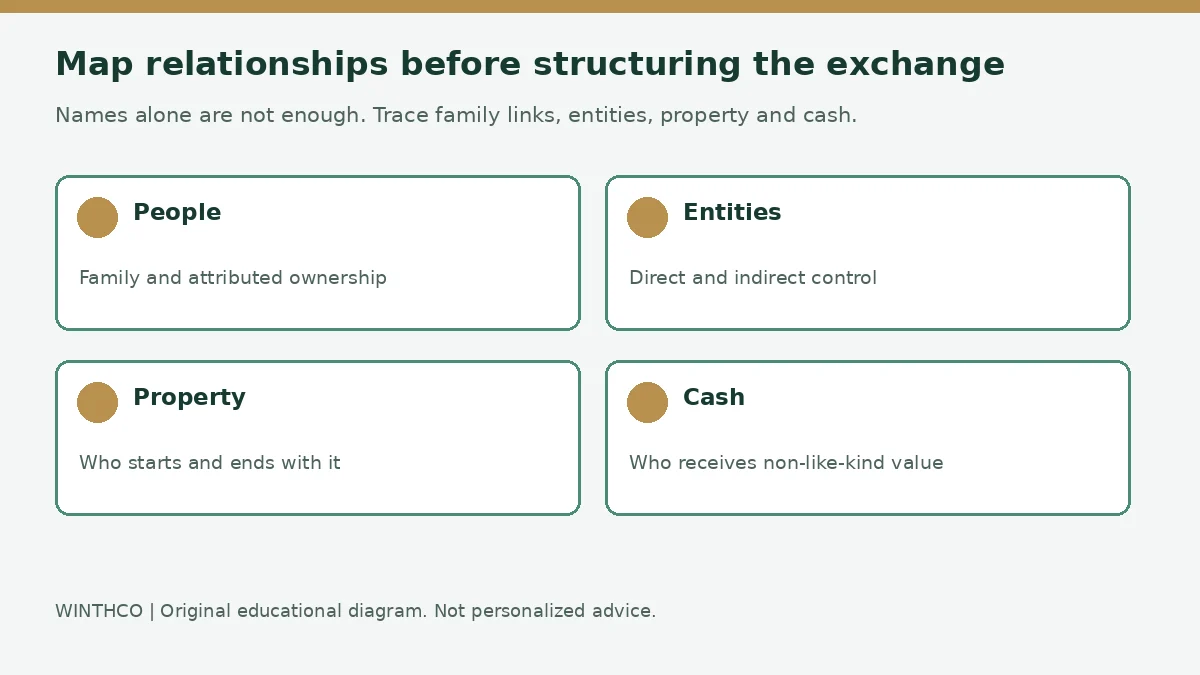
Section 1031(f) refers to the relationship rules in Sections 267(b) and 707(b)(1). The definitions cover specified family relationships and many relationships between people and entities with more than 50 percent ownership or control. They can also reach commonly controlled entities. A friend, business contact or distant relative is not automatically a related person, but labels alone do not settle the question.
Build a relationship map before the exchange is structured. List the taxpayer, owners of the relinquished property, owners of the proposed replacement property, partners, corporations, trusts and disregarded entities. Record direct and indirect ownership percentages. This review should happen before contracts, identification or funding because an entity between two people may not remove a statutory relationship.
Share your timeline and investment range. A Winthco team member will follow up with you.
The tax professional should apply the definitions to current facts, including attribution rules that can treat one person's ownership as another person's ownership. Winthco's 1031 exchange rules overview can help organize the general exchange questions, but it cannot determine who is related for a specific taxpayer. Obtain written advice when family or common ownership appears anywhere in the transaction.
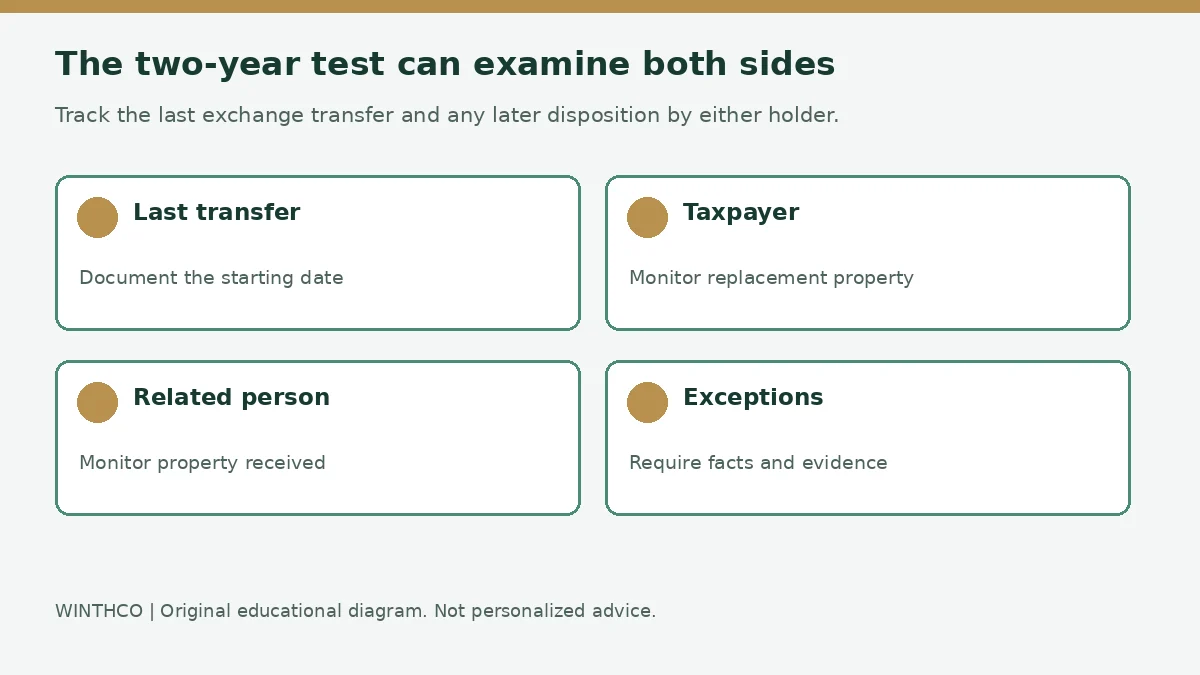
For an exchange of property between related persons, Section 1031(f)(1) generally requires recognition if either person disposes of the property received within two years after the date of the last transfer that was part of the exchange. IRS Publication 544 explains that the gain or loss is recognized on the date of the later disposition, subject to the statutory exceptions.
The rule tests both sides of a direct related-party exchange. It is not enough for only the taxpayer to retain replacement property if the related person quickly disposes of what that person received. Preserve the exchange agreement, deeds, settlement statements, ownership records and later transfer documents so the CPA can evaluate the holding period and reporting.
The two-year period can be suspended during a period when a holder's risk of loss is substantially diminished by certain arrangements, according to the Form 8824 instructions. The statute also has exceptions for death, certain involuntary conversions, and a disposition shown not to have tax avoidance as a principal purpose. Those are narrow factual rules, not automatic waivers.
A qualified intermediary supports deferred exchange mechanics, but the intermediary does not change family ownership, entity control or the substance of the replacement acquisition. The 2025 Form 8824 instructions expressly describe indirect exchanges through a qualified intermediary or exchange accommodation titleholder as subject to related-party rules.
IRS Revenue Ruling 2002-83 addresses a taxpayer who used a qualified intermediary to acquire replacement property formerly owned by a related person. The related person received cash for that property, and the IRS concluded that Section 1031(f)(4) denied nonrecognition under the stated facts because the transaction was structured to avoid the related-party restrictions. Interposing the intermediary did not make the related seller's cash-out irrelevant.
Form 8824 asks whether the exchange was with a related party and requires identifying information when that answer is yes. The transaction team should disclose every relationship to the qualified intermediary, CPA and attorney. Do not rely on the intermediary to deliver individualized tax or legal conclusions, and do not omit a relationship because the closing documents use an unrelated facilitator.
Discuss your DST questions with Winthco →
No. Revenue Ruling 2004-86 concludes that interests in the particular Delaware statutory trust described there are treated as interests in real property for federal tax purposes. The ruling does not approve every DST and does not override Section 1031(f), the anti-avoidance rule or the relationship definitions.
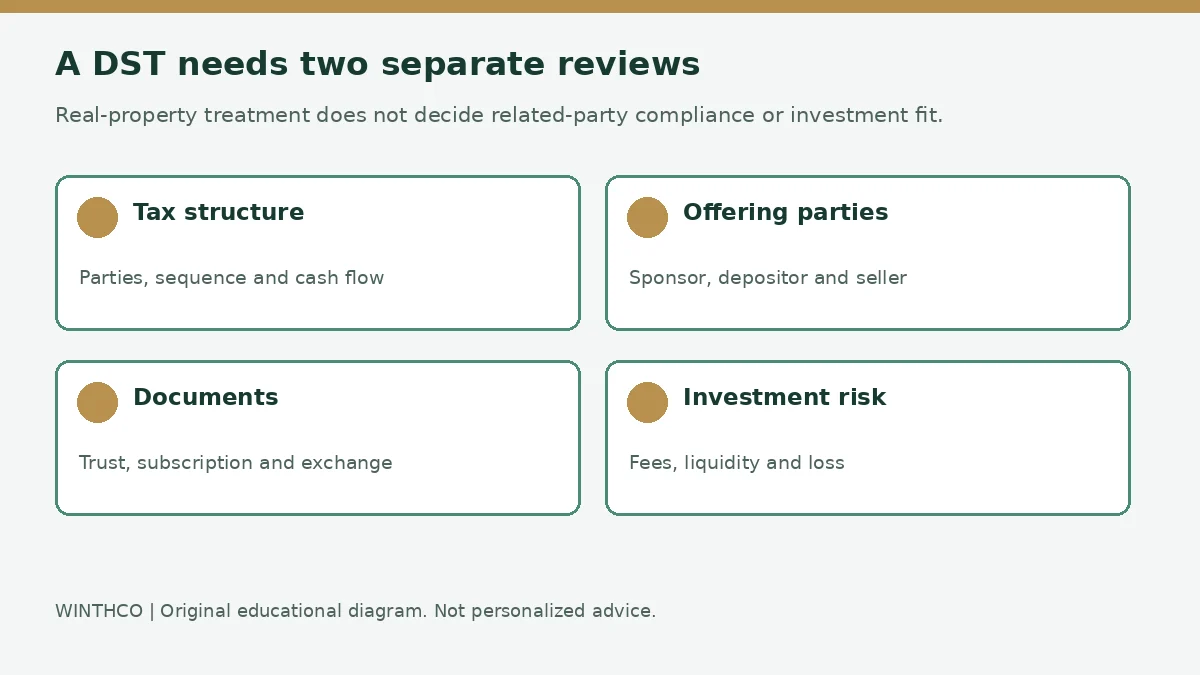
A purchase of an unrelated sponsor's DST interest in an arm's-length offering may present no obvious related-party seller. Still, the team should verify the trust, depositor, sponsor, manager, selling property owner and their ownership connections to the taxpayer. The Delaware statutory trust 1031 guide explains the general replacement-property concept, while the actual trust and subscription documents identify the parties that matter.
A DST can also introduce questions about later transactions. The trust may sell real estate, refinance, merge or liquidate under its governing documents, and the beneficial interest may be subject to transfer restrictions. Whether a later trust-level event or transfer affects a taxpayer's related-party holding rule is fact specific. Tax counsel and the CPA should evaluate the actual documents rather than applying a blanket answer.
Direction matters, but simple slogans are dangerous. Revenue Ruling 2002-83 specifically addresses an acquisition of replacement property from a related person who receives cash through the intermediary. That fact pattern differs from selling relinquished property to a related buyer and acquiring replacement property from an unrelated seller. Each sequence still requires review under the statute and anti-avoidance rule.
A direct swap between related people may fall within the two-year framework when both parties receive qualifying property and retain it. An indirect deal can receive different treatment when it produces a result that Section 1031(f) was designed to prevent. The two-year rule is not a universal cure for a prearranged related seller cash-out.
Map who starts with each property, who ends with it, and who receives cash or other non-like-kind property. If multiple owners are involved, Winthco's 1031 exchange planning for multiple owners article can frame the taxpayer-identity issue. It does not resolve a related-party transaction, which requires advice based on the ownership chart and complete closing sequence.
WATCH & LEARN
Accruit explains who may be a related party and introduces rules for 1031 exchanges involving related people or entities. This third-party video is educational, not a Winthco endorsement; the tax code, IRS guidance and transaction documents control. Original resource · Watch on YouTube ↗
Educational context only. The discussion does not establish the suitability, returns or tax treatment of an investment.
Tax analysis and investment analysis are separate. The SEC warns that private placements can involve limited disclosure, transfer restrictions, illiquidity and total loss. Many DST interests are offered through private placements to accredited investors. Accredited status is an eligibility threshold, not proof that an investment is suitable or that tax deferral will be respected.
Review the private placement memorandum, trust agreement, subscription documents, property financials, leases, debt, reserves, fees, conflicts and exit provisions. Identify compensation paid to the sponsor, dealer, representative, manager and affiliates. Distributions can change or stop, financing may increase losses, and the eventual sale can occur earlier or later than expected.
FINRA explains that concentration can arise across an asset class, geography, security type and illiquid investments. Several DSTs may still depend on the same sponsor, tenants, markets or debt conditions. Compare the proposed allocation with direct real estate and other private investments, and keep liquid resources for taxes and foreseeable needs. A tax-motivated deadline does not shorten investment due diligence.
Consider a hypothetical taxpayer whose family-controlled LLC owns a rental building. The taxpayer wants the exchange to acquire a DST interest from a trust connected to another family entity. Before any sale, identification or subscription, the team creates an ownership chart and asks tax counsel to determine which parties are related under Sections 267 and 707. This is not a client example or recommendation.
The CPA models the taxable sale, unrelated replacement property and proposed related transaction. Counsel reviews Section 1031(f), Revenue Ruling 2002-83 and the actual cash flows. The qualified intermediary reviews exchange mechanics but does not promise tax treatment. The securities professional reviews the DST offering, conflicts, compensation, liquidity and loss risks separately.
If the related seller would receive cash or the ownership records are unclear, the taxpayer pauses rather than assuming the intermediary or DST solves the problem. The professionals document any conclusion and preserve the evidence. A prospect form begins a conversation with Winthco; it does not appoint a qualified intermediary, create a tax or legal engagement, reserve an offering or establish suitability.
Start with names, tax identification numbers, family relationships, entity charts and current ownership percentages. Add contracts, deeds, operating agreements, trust documents, subscription records and expected cash flows. Mark every planned transfer and the date on one timeline, including later sales that are already contemplated.
Ask the CPA and attorney to state which relationships and transfers they analyzed, which exceptions are being considered and what evidence supports the conclusion. Ask the qualified intermediary to confirm the exchange procedure and Form 8824 information. Ask the securities professional to explain offering risks, compensation and alternatives without presenting tax qualification as investment approval.
This guide uses AI-assisted research and drafting with Winthco Wealth Management organization attribution. IRS, SEC and FINRA sources and the Accruit video were checked on October 11, 2026. Confirm current law, offering facts and ownership details with the professionals responsible for the transaction before transferring property or funds.
| Decision | Evidence to request | What to avoid assuming |
|---|---|---|
| Related persons | Ownership chart, family links and attribution analysis | Only immediate family can be related |
| Two-year rule | Last transfer date and both parties' later dispositions | Only the taxpayer's holding period matters |
| Indirect acquisition | Seller identity, cash flows and Revenue Ruling 2002-83 | A qualified intermediary removes the relationship |
| DST structure | Trust, sponsor, depositor, property seller and ownership ties | Revenue Ruling 2004-86 resolves every tax issue |
| Investment fit | Offering risks, fees, liquidity and household exposure | Tax eligibility establishes suitability |
A related-party exchange is not automatically prohibited, but Section 1031(f) can impose special rules, including a two-year disposition test. The relationships, property flow, cash flow and purpose must be reviewed before closing.
Section 1031(f) measures two years from the date of the last transfer that was part of the related-party exchange. The period can be suspended in specified circumstances, so the CPA should calculate it from the actual documents.
Not automatically. Revenue Ruling 2002-83 denied nonrecognition where a taxpayer used an intermediary to acquire replacement property from a related person who received cash under the stated facts.
No. Section 1031(f)(4) can deny nonrecognition when a transaction is structured to avoid the related-party rules. The two-year period is not a universal safe harbor for an indirect related seller cash-out.
It analyzes the specific DST arrangement described in that ruling as real property for federal tax purposes. It does not approve every DST or displace related-party, reporting, securities or suitability requirements.
No. A DST can remain illiquid and can involve limited control, property, tenant, debt, sponsor, fee, valuation and total-loss risks. Related ownership may also create conflicts that require added review.
Sources checked October 11, 2026. This article explains general concepts; your facts and the applicable documents control.
Winthco DST services · Winthco evaluation overview · Editorial standards
DST fundamentals
Understand DST ownership, potential 1031 exchange eligibility and the practical trade-offs of passive real estate investing.
Read guide →1031 ownership planning
Learn how co-owners and LLC members evaluate separate 1031 exchange paths, DST replacements, ownership rules, deadlines and risks.
Read guide →DST tax reporting
Learn how DST tax reporting can involve Form 8824, owner statements, basis, depreciation, state filings and private-placement risks.
Read guide →Explore Winthco’s main DST article collection
Share your timeline and investment range. A Winthco team member will follow up with you.