1031 exchange planning
1031 exchange deadlines: the 45-day and 180-day rules
Plan the identification and completion periods for a deferred 1031 exchange, including the earlier tax-return deadline.
Read guide →
Home / Learning center / 1031 exchange planning
1031 exchange planning
Winthco Wealth Management · Updated October 11, 2026
A reverse 1031 exchange may be considered when replacement property must be secured before the relinquished property is sold. Revenue Procedure 2000-37 provides a safe harbor using an exchange accommodation titleholder. A DST interest should not be assumed to fit that structure without advance review of tax, securities, subscription and title requirements.
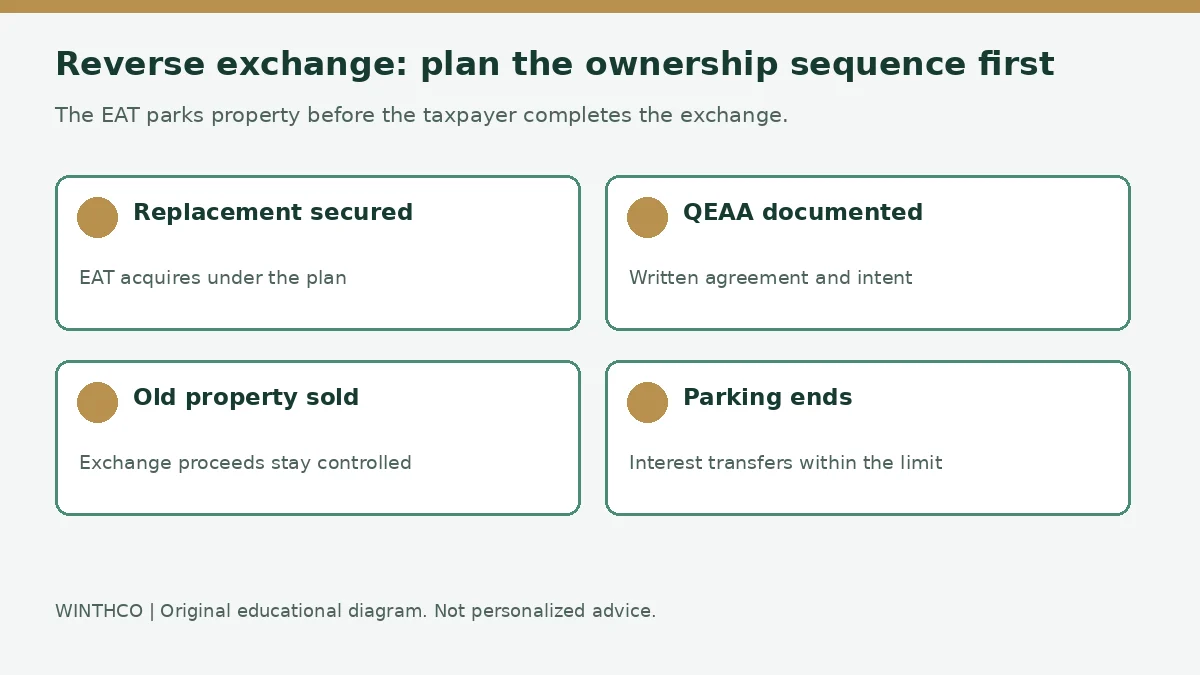
A conventional deferred exchange starts with the transfer of relinquished property and ends with the acquisition of replacement property. A reverse exchange changes the order because the desired replacement property is acquired first. The taxpayer does not simply buy both properties and label the later sale an exchange. Ownership must be structured before the replacement acquisition.
Revenue Procedure 2000-37 describes a qualified exchange accommodation arrangement, or QEAA. Under its safe harbor, an exchange accommodation titleholder, commonly called an EAT, holds qualified indicia of ownership in the parked property. The IRS treats the EAT as beneficial owner for federal income tax purposes when the stated requirements are met.
Share your timeline and investment range. A Winthco team member will follow up with you.
The reverse structure addresses acquisition order, not every other Section 1031 requirement. The relinquished and replacement interests still must be qualifying real property held for business or investment use, and the transaction must otherwise qualify. Winthco's 1031 exchange rules resource provides broader context, but the taxpayer's CPA and attorney must analyze the actual facts.
IRS Revenue Ruling 2004-86 concludes that beneficial interests in the specific Delaware statutory trust described in the ruling are treated as direct interests in the trust's real property for federal tax purposes. That analysis can support use of a properly structured DST interest as replacement property, but it does not approve every trust or transaction.
A reverse exchange raises an additional question: can the EAT acquire and park the proposed DST interest under a QEAA, and can that interest later be transferred as planned? The Delaware statutory trust 1031 guide explains the general replacement-property concept, but the sponsor, securities professional, EAT, qualified intermediary and tax counsel must confirm that the subscription, ownership records and transfer restrictions support the proposed sequence.
Many DST offerings are private placements. The temporary holder may need to satisfy purchaser, accreditation, subscription, anti-money-laundering and transfer requirements. The offering documents may restrict assignments or transfers, and a sponsor may decline an EAT structure. Do not fund a subscription in the taxpayer's name first and expect the reverse-exchange documents to change the acquisition afterward.
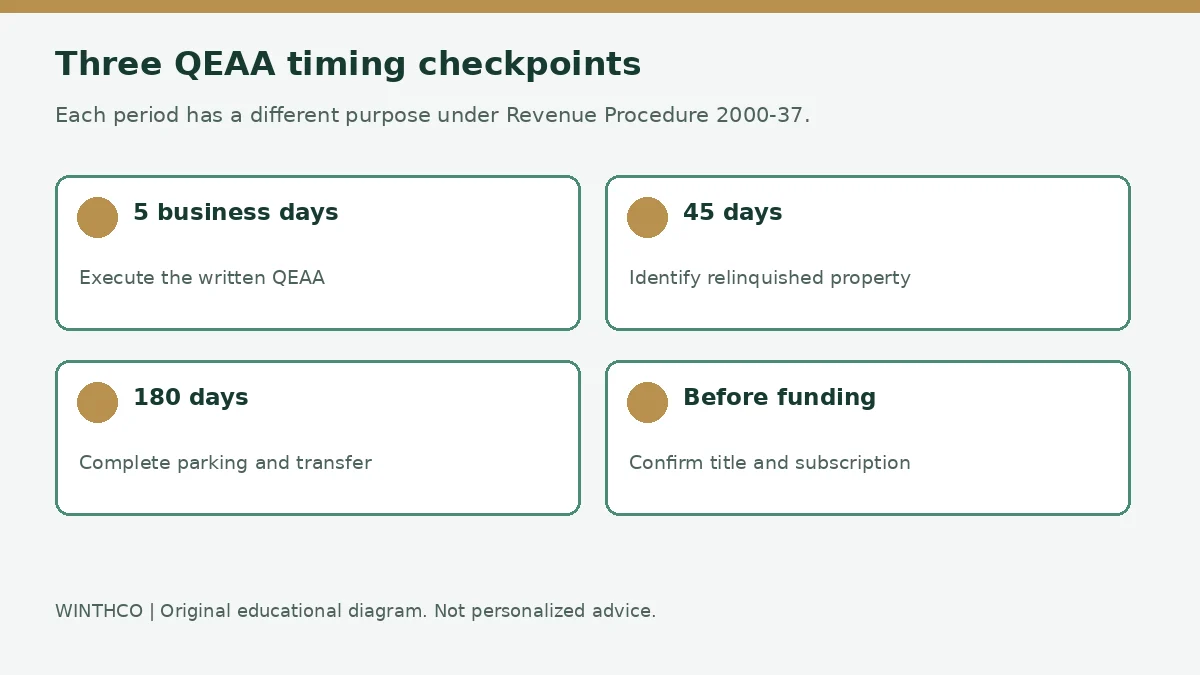
The EAT must hold qualified indicia of ownership in the parked property, and the taxpayer must have a bona fide intent that the property serve as replacement or relinquished property in a Section 1031 exchange. A written QEAA must be executed no later than five business days after the EAT acquires qualified indicia of ownership.
If replacement property is parked, the taxpayer must identify the property to be relinquished no later than 45 days after the EAT acquires the parked property. The identification rules follow the principles of Treasury Regulation 1.1031(k)-1. The identification should be signed, unambiguous and delivered through the procedure established by the exchange team.
The combined period during which the parked property and any identified relinquished property are held in the QEAA cannot exceed 180 days. Revenue Procedure 2004-51 also says the safe harbor does not apply to replacement property the taxpayer owned during the 180-day period ending when qualified indicia of ownership is transferred to the EAT. These periods are outside limits, not targets.
Discuss your DST questions with Winthco →
Start before signing or funding the replacement acquisition. Confirm the taxpayer that owns the relinquished property, the entity expected to receive the replacement interest, the proposed EAT, the qualified intermediary and each closing or subscription party. A mismatch in taxpayer identity, title or sequence can create problems that later paperwork may not repair.
Determine who will supply cash or financing while the property is parked. Reverse exchanges can require the taxpayer to advance funds, guarantee debt or arrange a loan to the EAT. Revenue Procedure 2000-37 permits certain agreements without automatically disqualifying the QEAA, but it does not decide every income, interest, debt, state-law or securities issue.
For a proposed DST, obtain written confirmation of how the EAT would appear in subscription and ownership records, how accreditation would be handled, whether the interest can be transferred to the taxpayer, and what approvals are required. Compare those documents with the QEAA and exchange agreement. The tax structure and the securities closing must describe the same transaction.
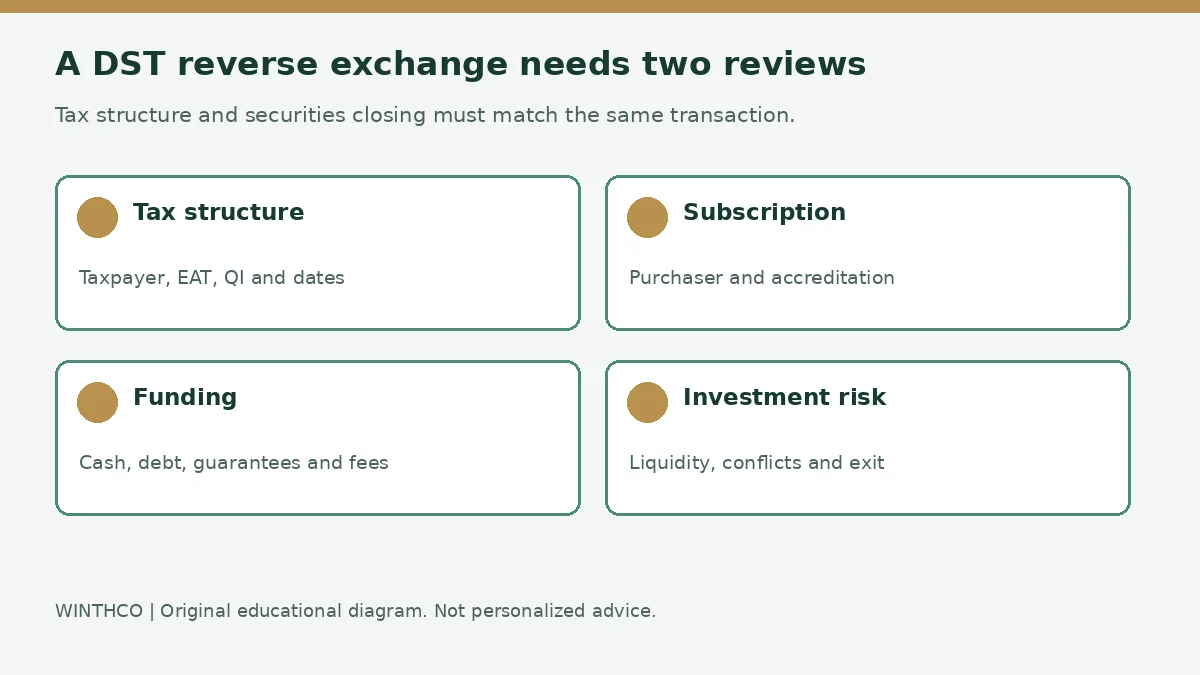
A reverse exchange does not extend the federal safe-harbor limits or cure a prior direct acquisition. It also does not reserve a DST offering, override subscription restrictions or require the sponsor to accept an EAT. If the structure is discussed only after the taxpayer has acquired the interest, Revenue Procedure 2004-51 may prevent reliance on the safe harbor.
A normal deferred exchange may be simpler when the relinquished property will close first and a suitable DST interest can be acquired during the exchange period. Review how to buy a DST alongside the offering documents, but do not assume speed establishes tax qualification or suitability. The team should compare direct property, one or more DSTs, a partial exchange and a taxable sale.
The reverse structure can also fail commercially even when the documents are sound. The relinquished property may not sell in time, the parked acquisition may need financing, a DST sponsor may not permit the intended transfer, or the taxpayer may need cash that becomes committed to an illiquid interest. Model the failed-sale and delayed-sale cases before proceeding.
WATCH & LEARN
Accruit's Paul Holloway gives a general overview of reverse 1031 exchanges. This third-party video is educational, not a Winthco endorsement; Revenue Procedures 2000-37 and 2004-51, transaction documents and the investor's advisers control. Original resource · Watch on YouTube ↗
Educational context only. The discussion does not establish the suitability, returns or tax treatment of an investment.
Ask for the EAT and qualified-intermediary fee schedules, legal and tax-review costs, entity and filing expenses, lender fees, interest, guarantees, title or transfer charges and any sponsor-related compensation. Some amounts can arise even if the relinquished property does not sell. Determine who bears each cost and whether it affects exchange funds or outside cash.
The SEC warns that private placements can provide limited disclosure, impose transfer restrictions, be highly illiquid and involve total loss. A DST can add property, tenant, financing, sponsor, valuation and market risks. Distributions can change or stop, and the exit can occur earlier or later than expected. A valid QEAA does not make the investment suitable.
FINRA explains that concentration can arise from correlated asset classes, regions, security types and illiquid investments. Evaluate the proposed DST with every other real-estate holding and private investment. Several properties or DST interests may still depend on the same sponsor, tenant, market, debt profile or economic driver. Keep separate liquid resources for taxes and foreseeable needs.
Consider a hypothetical owner who finds a replacement opportunity before a warehouse sale is ready to close. Before the acquisition, the owner asks tax counsel, a CPA, the QI and an EAT to review ownership, funding and the planned exchange. The DST sponsor is asked whether an EAT subscription and later transfer are permitted. This example is educational and is not a client result or recommendation.
The EAT acquires the approved interest and the parties execute the QEAA within five business days. The owner identifies the warehouse as relinquished property within 45 days using the documented procedure. The warehouse sale closes later, exchange proceeds are handled under the exchange agreement, and the parked interest is transferred within the overall 180-day safe-harbor period.
If the sponsor refuses the temporary ownership structure or the warehouse sale cannot be completed on schedule, the team does not describe the plan as successful. Counsel and the CPA determine the consequences from the actual documents and transfers. A prospect contact form begins a conversation with Winthco; it does not appoint an EAT or QI, create tax or legal advice, reserve a DST or establish suitability.
| Decision | Evidence to request | What to avoid assuming |
|---|---|---|
| Acquisition order | Executed QEAA, EAT title and closing records | A direct purchase can be relabeled later |
| DST eligibility | Trust, subscription, ownership and transfer documents | Revenue Ruling 2004-86 approves every DST |
| Timing | Five-business-day, 45-day and 180-day calendar | A reverse exchange provides extra time |
| Funding | Cash, loan, guarantee, fee and release terms | The EAT supplies financing automatically |
| Investment fit | Offering risks, liquidity, fees and household exposure | Exchange qualification establishes suitability |
Not by label alone. A reverse exchange requires advance structuring, commonly through an EAT and QEAA. Revenue Procedure 2004-51 limits the safe harbor when the taxpayer already owned the replacement property.
The exchange team must determine what property will be parked and who will hold qualified indicia of ownership. For a DST interest, the offering and subscription documents must also permit the proposed holder and transfer.
Revenue Procedure 2000-37 requires the taxpayer and EAT to enter a written QEAA no later than five business days after the EAT acquires qualified indicia of ownership in the parked property.
When replacement property is parked, the taxpayer must identify the relinquished property within 45 days after the EAT acquires qualified indicia of ownership. The exchange team should document the exact deadline and permitted recipient.
The Revenue Procedure 2000-37 safe harbor limits the combined QEAA holding period to 180 days. A transaction outside the safe harbor requires separate legal and tax analysis and should not be assumed to qualify.
No. Exchange mechanics do not remove property, tenant, financing, sponsor, fee, valuation, liquidity, concentration or loss risks. Review the current offering documents and household liquidity before investing.
Sources checked October 11, 2026. This article explains general concepts; your facts and the applicable documents control.
Winthco DST services · Winthco evaluation overview · Editorial standards
1031 exchange planning
Plan the identification and completion periods for a deferred 1031 exchange, including the earlier tax-return deadline.
Read guide →1031 exchange planning
Understand the three-property, 200 percent and 95 percent identification rules before naming DST replacement property.
Read guide →DST eligibility and risk
Learn the DST accredited investor income, net worth, credential and entity tests before planning a 1031 exchange.
Read guide →Explore Winthco’s main DST article collection
Share your timeline and investment range. A Winthco team member will follow up with you.