1031 exchange planning
1031 exchange deadlines: the 45-day and 180-day rules
Plan the identification and completion periods for a deferred 1031 exchange, including the earlier tax-return deadline.
Read guide →
Home / Learning center / Local Guides
Local Guides
Winthco Wealth Management · Updated November 18, 2026
A South Pasadena DST advisor can help evaluate passive replacement real estate, but an older rental's sale deserves attention first. Check property history with your broker and the city, involve tax counsel and a qualified intermediary before closing, and compare DST control, expenses and liquidity with the retirement responsibilities you want to reduce.
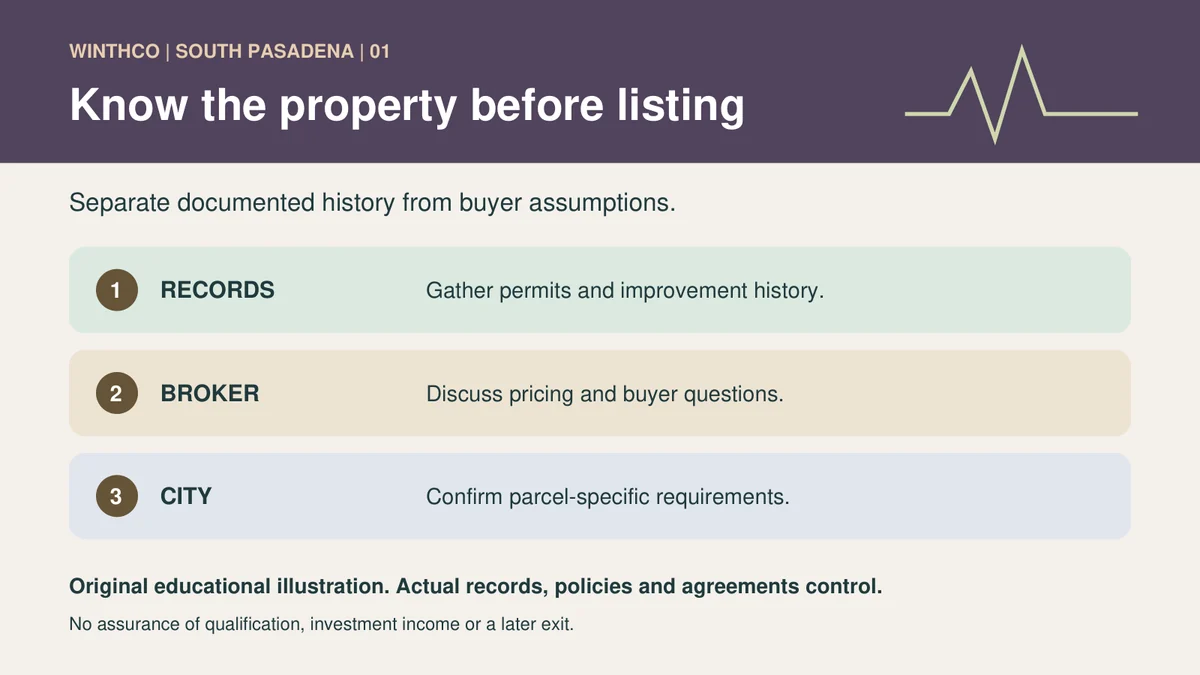
An older property's history can be an asset to a buyer and a source of unanswered questions. South Pasadena's official House Research page points owners to its historic-resource inventory, building permit records and the Los Angeles County Assessor portal. Use those resources to organize what is documented about the property before marketing it. A photograph of an attractive addition does not establish its approved use, and an assessor description is not a substitute for a planning determination.
Interview a licensed realtor or commercial broker about experience with comparable rental properties, valuation evidence, tenant communication, compensation and buyer contingencies. Ask how unresolved permit or historic-status questions will be handled in the sale process. Keep the scope practical: gather existing records, identify discrepancies and assign follow-up to the appropriate professional. Neither this guide nor a DST advisor can determine the city's requirements for a particular building.
Share your timeline and investment range. A Winthco team member will follow up with you.
Start with the address and assessor identification number, leases, improvement records and any existing city correspondence. The city's Planning Division publishes zoning and historic-resource materials, while its House Research guidance explains how to request building permit records. Ask city staff about the property itself rather than inferring approval from a neighboring parcel. South Pasadena is a separate city from Pasadena, so use the correct municipality's resources and forms.
The city announced its new online permitting system on August 11, 2026. Its current Planning Resources page directs applications to the South Pasadena OpenGov portal. If your sale involves proposed repair or alteration work, confirm the current submission process and applicable approvals before promising a buyer that work can be completed by closing. These local records help the sale team understand the asset; they do not determine federal exchange eligibility or whether a replacement investment is suitable.
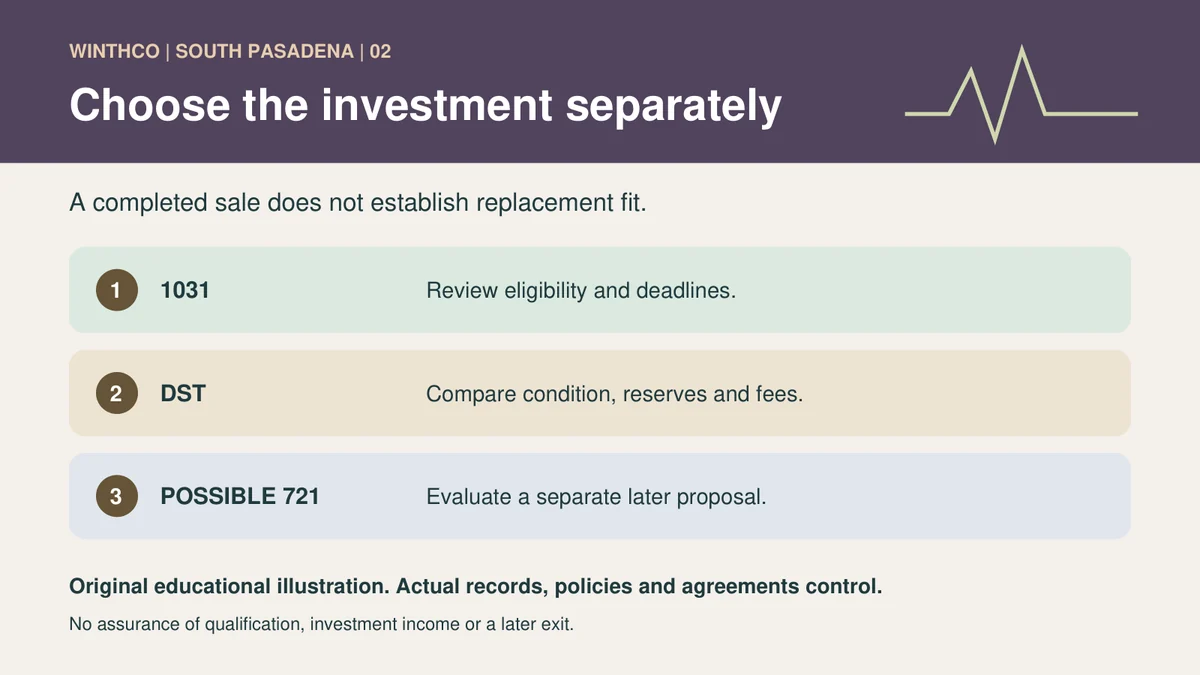
A realtor's sale strategy, a CPA's tax analysis and an investment advisor's recommendation serve different purposes. Your attorney should address title, ownership, agreements and legal obligations. A qualified intermediary coordinates the deferred-exchange structure and documents. Arrange that team before the transfer, not after the sale proceeds reach your account. A request for a South Pasadena DST CPA does not make a financial advisor a CPA; verify credentials and responsibilities individually.
Section 1031 can defer eligible gain on qualifying investment or business real property, but it does not erase tax. The ordinary identification period is 45 days after transfer. Replacement receipt must occur by the earlier of 180 days or the federal return due date, including extensions. Your QI should confirm actual dates and written identification. Cash or other non-like-kind consideration may create recognized gain. Use the exchange deadline guide with your advisers rather than treating a delayed purchase as an automatic extension.
Discuss your DST questions with Winthco →
A qualifying Delaware statutory trust interest can provide exposure to real estate without personally arranging every repair or tenant renewal. Winthco's DST replacement-property explanation describes the basic structure. IRS Revenue Ruling 2004-86 analyzes a specific trust arrangement that can qualify; it is not approval of every offering. The taxpayer's facts and the actual documents still need review. Tax eligibility and investment quality are separate questions.
For an owner accustomed to deciding whether to repair an aging roof or preserve an original feature, the change in authority may be substantial. A DST investor generally cannot direct the property's daily management or independently choose when the underlying asset is sold. Ask who makes those decisions, what investors can approve and what happens when the business plan encounters a problem. Less direct work should be weighed against less control.
Hypothetical: a South Pasadena owner wants to stop coordinating maintenance on a long-held rental. During buyer review, questions arise about an earlier alteration. The owner resolves that issue with the broker, city and counsel while separately evaluating a possible DST allocation. The lesson is not that a DST fixes a difficult sale. It is that sale readiness, exchange mechanics and investment fit each need their own evidence. No actual client, available offering or projected return is represented.
Do not replace a familiar building with an unfamiliar summary sheet. Read the private placement memorandum and supporting property information. Winthco's DST document evaluation guide offers a starting point for questions about the investment. Compare the acquisition price, physical condition, tenant obligations, lease expirations and funded reserves. Ask what inspections support the budget and which assumptions are estimates rather than binding agreements.
An older-rental seller may be particularly sensitive to unexpected maintenance. That concern does not disappear because someone else manages the replacement. Ask who pays for major work, whether reserves are restricted and how cash flow could change if spending exceeds the plan. A newer-looking property can still have tenant, financing or operating problems. Our DST reserve and repair discussion explains why the availability and purpose of reserves matter.
Review every layer of cost: acquisition and selling charges, ongoing management expenses, financing costs and disposition or later-transaction fees. Ask who receives each payment, including related parties. Compare the amount invested with the amount actually exposed to property economics after costs. A distribution headline alone cannot tell you whether two investments have similar economics. Request a clear explanation of compensation and conflicts before committing.
WATCH & LEARN
Tina Colson-Jones of Equity Advantage 1031 Exchange explains the QI's role. Third-party education, not a Winthco affiliation or an individual tax determination. Original resource · Watch on YouTube ↗
Educational context only. The discussion does not establish the suitability, returns or tax treatment of an investment.
Replacing a local property with real estate in another market changes the exposure rather than eliminating it. Examine tenant concentration, local demand, lease rollover, insurance and taxes. Multiple DST interests may still share the same sponsor, region, tenant industry or lender. Look through the number of investments to the factors that could affect them together. Diversification does not assure a profit or protect against all loss.
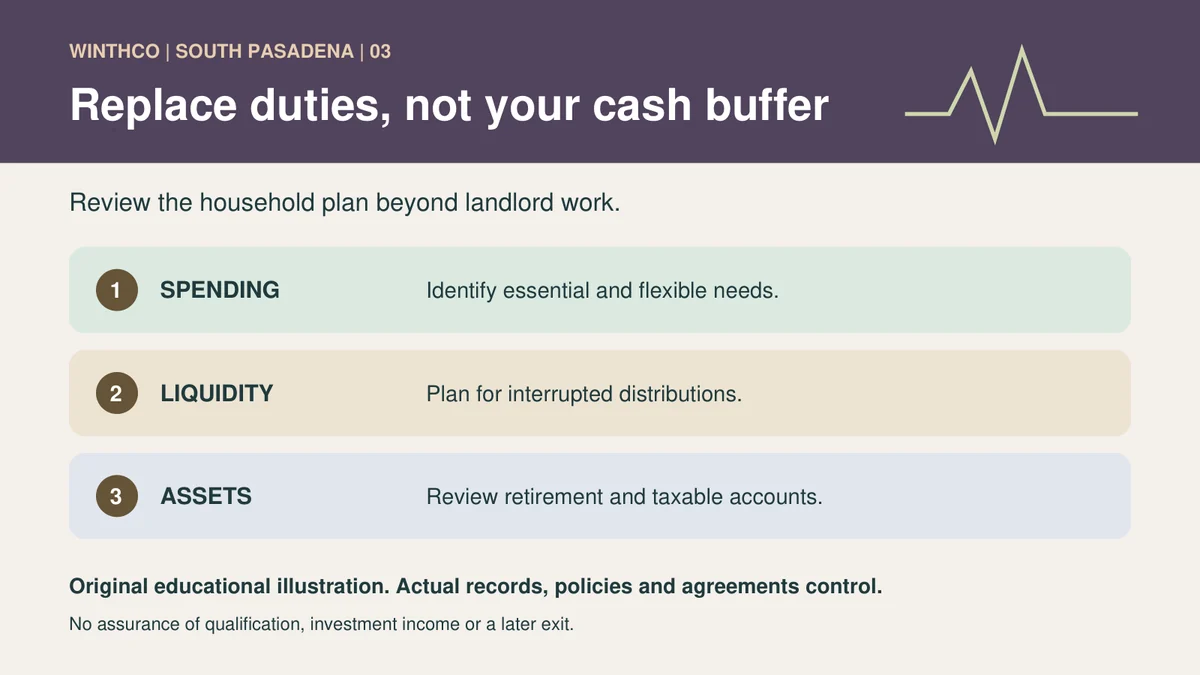
Read debt terms separately from the operating forecast. Identify maturity, interest-rate exposure, lender restrictions and assumptions about refinancing or sale. Ask what happens if revenue falls while expenses rise. Distributions can decline or stop, and principal can be lost. Model the household effect of interrupted payments and a longer holding period before deciding how much illiquid exposure is manageable.
DST private placements generally are limited to accredited investors and offered through a private placement memorandum. The SEC cautions that private placements can be difficult to resell and provide limited public information. FINRA's guidance discusses the recommending broker-dealer's investigation obligations. Ask what evidence supports the recommendation and which questions remain unresolved. Accreditation and a completed subscription do not establish that the investment is appropriate for your situation.
A later Section 721 contribution to a partnership is a separate possibility, not an automatic completion of a 1031 exchange. Ordinary REIT shares and partnership units are not direct Section 1031 replacement real estate. If an offering discusses a potential UPREIT transaction, ask your tax and legal advisers to distinguish the initial DST purchase from that later proposal. Do not assume the proposal will be offered, approved or completed.
A 721 UPREIT advisor should explain what could change in valuation, costs, governance and liquidity. Review who decides whether to proceed, how conflicts are addressed and what alternatives investors retain. A future redemption program is not cash available today. Evaluate whether the original DST still fits if no later transaction occurs, and do not assign a tax-free result to a redemption without an individual tax analysis.
If California property is exchanged for out-of-state property and California-source realized gain or loss remains unrecognized, the Franchise Tax Board requires Form FTB 3840. It generally continues for subsequent years until the deferred California amount is recognized. Ask your CPA about the locations underlying a proposed DST, basis allocation and record retention. A move out of California does not by itself resolve those reporting duties.
Then separate investment capital from money needed for living expenses, emergencies and anticipated family costs. Review taxable assets, 401(k)s, IRAs, retirement income and concentration with a financial advisor. Retirement accounts are not exchange proceeds. Compare costs, services and access rules before any rollover or account transfer, and coordinate beneficiaries and estate documents with counsel. The sale should support a workable financial plan, not merely end landlord duties.
Use either prospect contact form on this page or the dedicated contact page to describe your general sale window and planning goals. Avoid account numbers, tax returns and tenant details in the initial inquiry. Winthco's wealth-management services can be discussed alongside the property decision without assuming an advisory engagement or transfer is right for everyone. The map is South Pasadena city-area context only, not a claimed Winthco office or a parcel determination.
City-area context only, not a parcel boundary or Winthco office.
| Decision | Evidence to request | What to avoid assuming |
|---|---|---|
| Sale preparation | Property records and broker analysis | A photo proves approved use |
| 1031 structure | QI dates and CPA accounting | Tax deferral means tax elimination |
| DST purchase | Condition, reserves, fees and control | Passive ownership removes risk |
| Retirement plan | Accessible assets and spending needs | A future exit funds current bills |
No. Use South Pasadena's own planning resources for a property within that city. Confirm the parcel and applicable requirements with city staff.
No. The map shows city-area context only. It is not an office marker or property-boundary determination.
Historic status alone does not decide federal qualification. Your CPA and attorney must review ownership, use and the transaction's facts.
No. It may reduce your direct management responsibilities, but property costs can still affect the investment. Review condition, cost allocation and reserves.
No. It is a separate potential transaction with its own approvals, terms and tax considerations. Evaluate the DST without relying on that outcome.
Sources checked November 18, 2026. This article explains general concepts; your facts and the applicable documents control.
Winthco DST services · Winthco evaluation overview · Editorial standards
1031 exchange planning
Plan the identification and completion periods for a deferred 1031 exchange, including the earlier tax-return deadline.
Read guide →1031 exchange planning
Learn how multiple DSTs affect identification, closings, allocation and concentration risk in a 1031 exchange.
Read guide →DST due diligence
Before exchanging a rental into a DST, review repair budgets, restricted reserves and funding limits. Know which questions to ask before committing.
Read guide →Explore Winthco’s main DST article collection
Share your timeline and investment range. A Winthco team member will follow up with you.