Property sale planning
Before Listing a Rental: DST and 1031 Planning
Prepare a rental sale with broker questions, 1031 timing, DST and separate 721 review, and retirement planning before committing proceeds.
Read guide →
Home / Learning center / Employee stock and wealth planning
Employee stock and wealth planning
Winthco Wealth Management · Updated November 7, 2026

Can SpaceX employees cash out their shares? Yes, if they hold issued, transferable shares and are permitted to trade. SpaceX Class A common stock trades on Nasdaq as SPCX, but the listing did not free every employee share for sale. Check your award or share documents, lockup status and trading clearance before placing an order. Then review the tax lots and decide how much stock you can afford to keep.
If a SpaceX position is now worth $1 million or more, “Can I sell?” is only the first question. The next is how much you can turn into usable cash without taking on a surprise tax bill or leaving too much of your financial future tied to one company. Winthco Wealth Management helps employees and former employees turn that decision into a plan for their stock, the sale proceeds and the rest of their portfolio.
SpaceX announced that its Class A shares began trading on June 12, 2026. Its final IPO prospectus, filed with the SEC, sets out different release schedules. Here are the milestones most relevant when you read your account statement:
Share a general timeline and value range. Please leave account details and confidential company information out of your message.
| Prospectus milestone | What to check before you act |
|---|---|
| Earlier releases in August, September and October 2026 | Some shares subject to the standard 180-day lockup had phased release provisions. Check which lots your stock administrator actually shows as released. |
| Third-quarter earnings milestone | The prospectus allows up to an additional 28% of shares in the standard lockup group to be transferred beginning on the second full Nasdaq trading day after the qualifying results release. SpaceX reported Q3 results on October 20, 2026. Do not apply the percentage to your entire account balance. |
| December 8, 2026 | This is the 180th day identified in the prospectus. The standard lockup terms generally run through the close of trading that day, subject to earlier releases. Ask for your first eligible trade date rather than assuming you can sell at the opening bell. |
| Extended lockup | Certain holders have a separate schedule extending into 2027. Confirm the agreement that applies to you. |
These are offering terms, not personal trading clearance. A lot may be vested and still be unsettled, restricted from transfer or subject to a company trading blackout. Conversely, you may already have some eligible shares while other lots remain locked. Confirm any preclearance requirements and do not trade while aware of material nonpublic information. A broker’s willingness to accept an order does not resolve those obligations.
WATCH & LEARN
Bloomberg Television’s May 26, 2026 report covers the early IPO news. Check the final prospectus and your administrator for current restrictions. Original resource · Watch on YouTube ↗
Educational context only. The discussion does not establish the suitability, returns or tax treatment of an investment.
Employees often use “redeem” to mean cash out. For eligible Class A stock, the usual route is a brokerage sale to a market buyer. A company tender offer or repurchase, if one is available to you, is a separate transaction with its own terms. A public listing does not create an on-demand right to sell shares back to SpaceX.
Have shares unlocking soon? Ask Winthco for a SpaceX stock planning conversation. Start with an approximate value range, whether any shares are currently sellable and your biggest decision. Keep account numbers and confidential company information out of the contact form.
Start by separating compensation income from investment gain. Depending on the award, an RSU settlement or a nonqualified option exercise can produce taxable compensation. Incentive stock options have different rules, including potential alternative minimum tax at exercise and holding-period requirements that can affect the treatment of a later sale. A tax event can occur before the shares are available to sell. See IRS Publication 525 for employee stock and option rules.
When you sell shares, your capital gain or loss generally depends on the sale proceeds and your adjusted basis. For shares acquired through compensation, the basis can include an amount already treated as taxable pay. The figure on a brokerage statement may need to be reconciled with W-2 and stock-plan records. Starting with a zero basis just because the award cost you nothing can overstate the gain if compensation was already recognized.
For federal purposes, holding a capital asset for more than one year generally makes the gain long-term. That does not settle the answer for an incentive stock option or determine your final tax bill. Have your tax professional model federal tax, any applicable net investment income tax, and state taxes. California does not offer a lower state rate for capital gains, so a favorable federal rate does not translate into a matching California benefit.
You don’t need to choose between keeping every share and selling everything the moment a window opens. We start with the amount of company stock your household can afford to keep. Then we build a sale and reinvestment plan around eligible lots, expected future grants, near-term spending and your tax professional’s estimates.
Set a concentration target. Consider the portion of your investable assets tied to SpaceX, including exposure in other accounts. If you work there, your salary and future awards may also depend on the same company. A simple test: if the stock dropped sharply before your next eligible window, which financial goals would need to change? FINRA’s stock award guide explains why employer stock should be reviewed in the context of the whole portfolio.
Budget realized gains across eligible windows. Compare selling enough to meet a risk or cash target now with spreading permitted sales over more than one tax year. Review specific lots, including the trade-off between basis and holding period. A phased sale may give you more control over when gains are realized. It also leaves you exposed for longer, and future prices, trading windows and tax rules can change. Sometimes a larger immediate sale is the better fit despite the tax cost.
Reinvest with a plan for future gains. Where appropriate, part of the proceeds can go into a diversified taxable portfolio with ongoing tax-loss harvesting. That means selectively realizing losses on holdings that have declined and using eligible losses to offset capital gains under the tax rules. A separately managed portfolio that holds individual securities, sometimes called direct indexing when it seeks to track an index, is one possible implementation to evaluate. Compare it with simpler alternatives based on fees, diversification, trading costs and the potential to differ from the benchmark.
Harvesting opportunities depend on market conditions and the portfolio. They can diminish over time, and selling a holding at a loss can reduce the basis of the investment exposure you rebuild, potentially shifting tax into a later year rather than eliminating it. Review transactions across relevant household accounts for wash-sale issues. IRS Publication 550 explains that a loss can be disallowed if substantially identical securities are acquired within 30 days before or after the sale. Loss harvesting does not undo compensation income already recognized on an award.
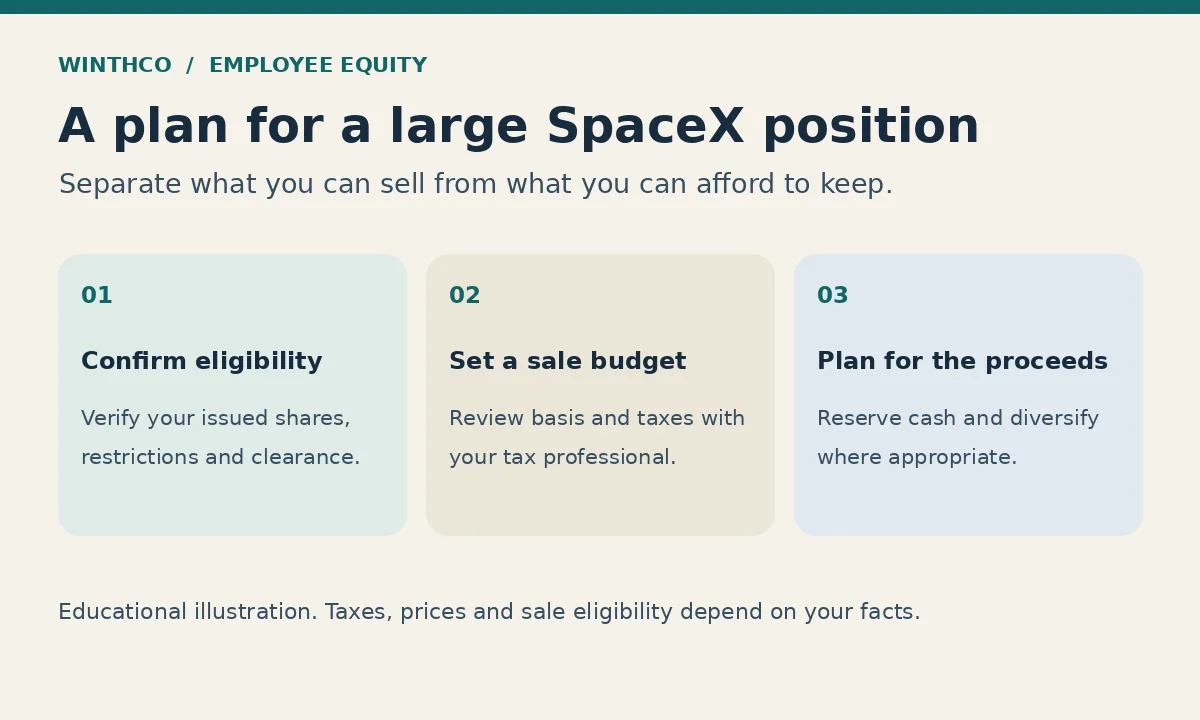
Suppose an employee has $2 million in investable assets, including $1.4 million in SpaceX stock. The employee decides to sell $350,000 of eligible shares. The specific lots sold have a verified adjusted basis of $100,000. For simplicity, assume the gain and available losses can be netted as illustrated, with no fees or other transactions.
| Item | Illustrative amount |
|---|---|
| Proceeds from selling eligible shares | $350,000 |
| Adjusted basis of those lots | $100,000 |
| Realized gain before offsets | $250,000 |
| Eligible realized capital losses from other holdings | $40,000 |
| Net capital gain in this simplified example | $210,000 |
The $40,000 reduces the gain used in the example, not the tax bill dollar for dollar. With no eligible losses, the example’s gain would still be $250,000. The employee also still holds about $1.05 million of SpaceX stock at the original prices. That remaining exposure is why a tax strategy needs a risk target. The amounts are hypothetical and do not represent a client, forecast or expected tax outcome. See IRS Topic 409 for capital gain and loss rules.

Winthco can help organize the decision before a sale is possible. Bring your award agreements, stock plan statements, vesting and settlement history, available basis records, and an estimate of your upcoming cash needs. Your stock administrator and, where needed, securities counsel determine what can be transferred or sold. Your tax professional confirms the reporting and estimates. We help connect those answers to the investment decisions: which position to keep, how much cash to set aside, and how to manage the investable proceeds.
For a large position, ask whether eligible shares can be held at a custodian the advisor can work with, how any restricted holdings will be tracked, what assets would be managed, and which fees would apply. If the stock has to stay in the employer plan, the plan can still account for that exposure while managing other eligible assets. The goal is to connect your SpaceX equity with your cash needs and retirement plan.
WATCH & LEARN
SpaceX’s April 27, 2026 video provides company background. SpaceX does not endorse Winthco’s advisory services. Original resource · Watch on YouTube ↗
Educational context only. The discussion does not establish the suitability, returns or tax treatment of an investment.
Can I transfer locked SpaceX shares to my financial advisor?
It depends on the share terms and receiving custodian. Confirm with the plan administrator before initiating a transfer. If transfer is not permitted, an advisor can still help plan around the shares and manage eligible assets or proceeds under an advisory agreement.
Do I have to sell as soon as the lockup expires?
The lockup’s expiration removes that restriction for eligible lots; it does not by itself require a sale. Award deadlines and other obligations are separate. Compare cash needs and the risk of keeping the shares before setting a sale schedule.
Can tax-loss harvesting eliminate my SpaceX capital gains tax?
No outcome is guaranteed. Eligible realized losses may offset some or all realized gains depending on the amounts and applicable tax rules. The strategy does not guarantee losses will be available, erase wage income or fix excessive concentration.
Can I work with Winthco if I’ve already sold some shares?
Yes. A conversation can cover how much to reserve for taxes, what to do with cash, how to invest proceeds, and how remaining company stock affects your portfolio and retirement plans.
If your SpaceX shares are a major part of your net worth, schedule a conversation with Winthco Wealth Management or call 805-583-2720. We can start with three questions: What is available to sell, what would a sale mean for your taxes, and how much SpaceX exposure do you want to keep after the trade?
Winthco Wealth Management is not affiliated with or endorsed by SpaceX. This article is educational and does not recommend buying, holding or selling SPCX. Investment and tax outcomes vary. Confirm your restrictions with your stock administrator and review your circumstances with your tax and legal professionals.
Property sale planning
Prepare a rental sale with broker questions, 1031 timing, DST and separate 721 review, and retirement planning before committing proceeds.
Read guide →DST due diligence
Review DST downside scenarios, cash-flow assumptions and exit risks before investing. Learn what a stress test can reveal and what it cannot promise.
Read guide →Share a general timeline and value range. Please leave account details and confidential company information out of your message.