DST investment due diligence
DST Private Placement Memorandum: What to Review
Selling a rental property? Learn how to review a DST private placement memorandum, compare fees and risks, and assess separate 721 UPREIT terms.
Read guide →
Home / Learning center / DST due diligence
DST due diligence
Winthco Wealth Management · Updated October 31, 2026
DST downside scenarios examine how weaker property results, higher costs or a delayed exit could affect cash flow and invested capital. Compare the assumptions, timing and available resources rather than a single projected distribution. A stress test is a decision aid, not a forecast, a guarantee or proof that an investment is suitable.
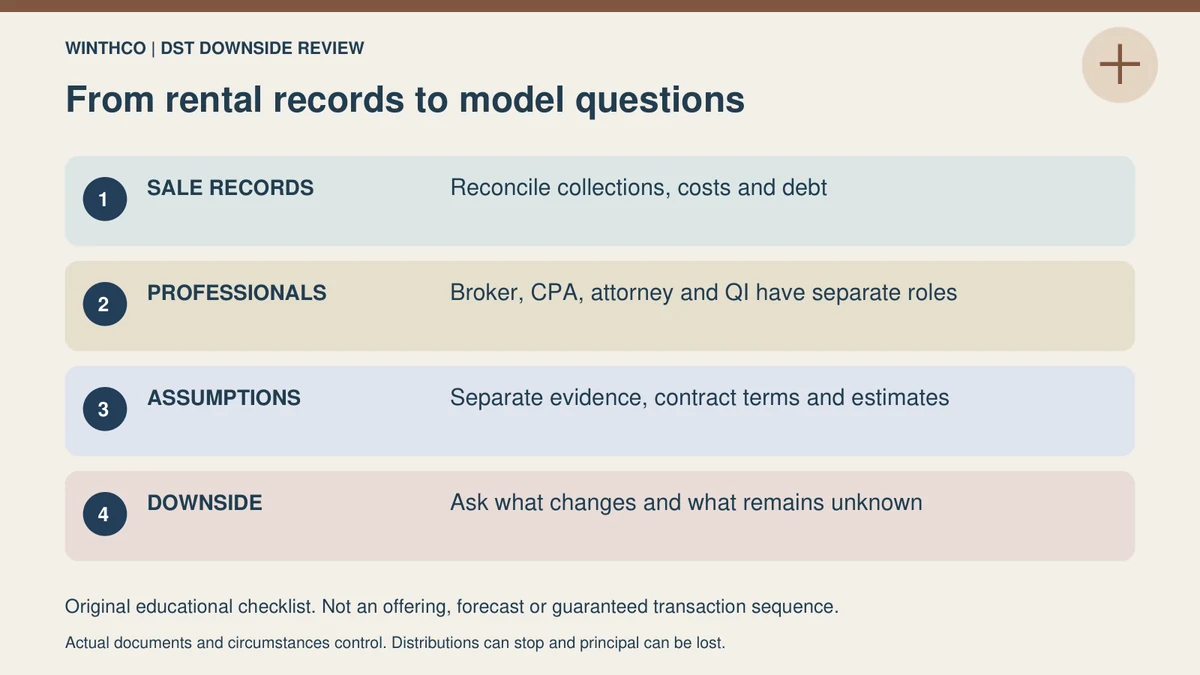
An owner considering a rental sale may want fewer management duties, different property exposure or money for retirement. Interview an appropriately licensed realtor or commercial broker about relevant property experience, valuation evidence, marketing, fees and closing coordination. Assemble leases, collection records, expenses, repairs and debt information. The sale file provides a useful discipline for the replacement review: separate documented results from assumptions about what might happen next.
If considering a deferred exchange, involve the CPA, attorney and qualified intermediary before closing or receiving proceeds. Replacement property generally must be identified within 45 days after transfer of the relinquished property and received by the earlier of 180 days or the applicable tax-return due date, including extensions. Potential deferral is not tax elimination. A short exchange calendar should not replace investment analysis; review the DST investment-selection framework while alternatives remain available. The Santa Monica sale-to-retirement planning guide applies the records-first approach to a rental-property transition without treating modeled distributions as spendable reserves. The El Segundo seller decision checklist keeps local sale-file questions separate from investment assumptions and household liquidity, so resolving one task does not imply the others are complete. The Los Angeles seller decision checklist keeps local sale-file questions separate from investment assumptions and household liquidity, so resolving one task does not imply the others are complete. See exit valuation sensitivity for hypothetical higher-cap-rate and lower-equity examples.
Share your timeline and investment range. A Winthco team member will follow up with you.
A base case is a set of assumptions used to describe an expected path. It is not a contractual promise. A downside scenario changes selected assumptions to examine consequences under less favorable conditions. A sensitivity analysis often changes one input at a time, while a combined scenario can examine several adverse developments together. Ask the preparer to define the terms actually used in the presentation.
FINRA Regulatory Notice 10-22 describes reasonable-investigation practices for broker-dealers recommending private placements, including examining forecast assumptions, requesting financial models and documenting stress-test analysis. That guidance is not approval of a particular DST. An investor's questions do not replace the recommending firm's obligations, and this article does not claim that any specific model or diligence process has been completed.
Request the model's date, version, preparer and source documents. Identify which information is historical, contractually established or estimated. Ask whether the displayed projections match the current offering documents and material updates. The DST offering-document checklist can help organize those records. If important inputs or calculation methods cannot be explained, a polished output chart does not resolve the uncertainty.
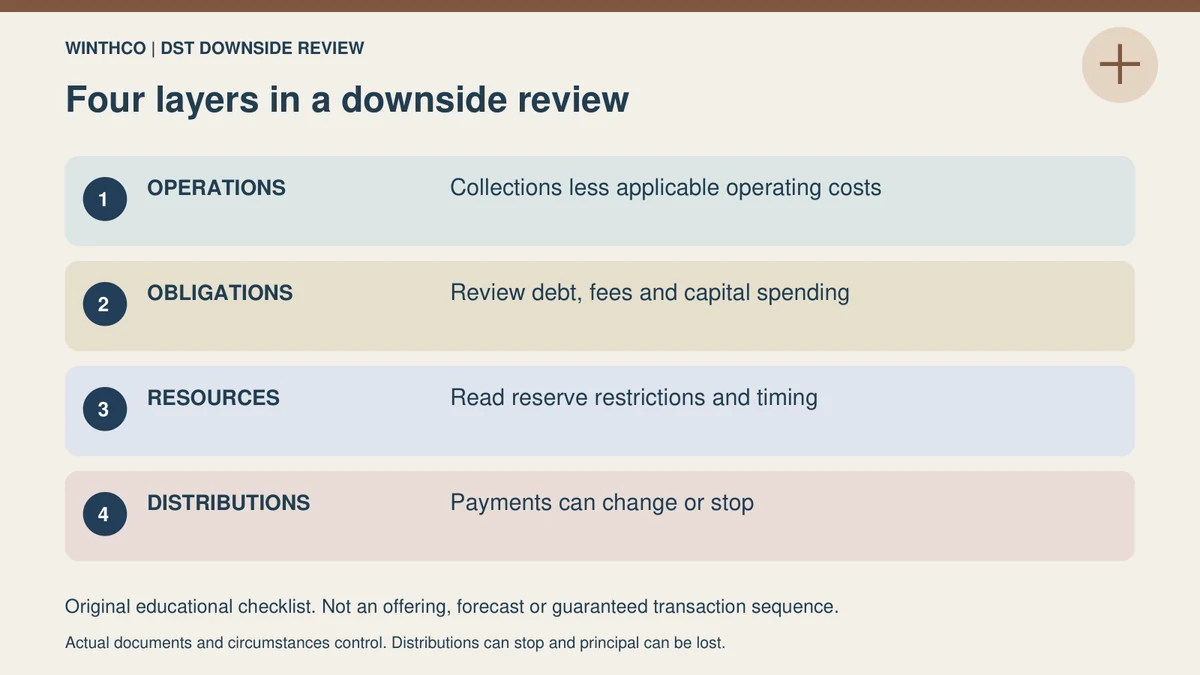
Begin with revenue actually collected, not simply occupied space or scheduled rent. Examine vacancy, concessions, tenant credit, lease expirations and expense reimbursements where applicable. Ask what supports renewal rents, renewal probabilities and leasing downtime. A scenario that assumes both uninterrupted occupancy and immediate rent growth may hide the very transition risk the household wants to understand.
Review expense assumptions independently. Insurance, taxes, utilities, maintenance, management and capital needs may respond differently to changing conditions. Ask which costs are fixed, which can vary and which arise only when a tenant leaves or a repair becomes necessary. Do not apply one uniform cost increase and assume every important property risk has been represented.
Then combine related pressures. A weaker leasing market might produce lower collections, longer vacancy and additional re-leasing spending at the same time. The tenant rollover review explains that timing problem. Ask the preparer to show the cash-flow effect of the combined case and explain why the chosen inputs are relevant to the property. This is an analytical framework, not a prediction that a particular adverse event will occur.
Discuss your DST questions with Winthco →
Ask for a bridge from property revenue to cash available after operating expenses, capital spending, debt obligations, applicable fees and reserve requirements. Confirm whether the displayed figure is net operating income, cash after financing or a projected investor distribution. Those labels need not represent the same amount. A change in property income may affect each stage differently.
Review when expenses are paid as well as their total. A reserve can look adequate over an entire projected holding period while a near-term repair or leasing event creates a timing gap. Ask which reserves are restricted, which uses are permitted and what the governing documents allow if the modeled resources prove insufficient. Do not assume an unlimited ability to borrow, obtain new contributions or restructure a DST.
For a leveraged property, read the actual loan terms. Examine payment obligations, fixed or floating interest provisions, maturity dates, covenants and any relevant refinancing assumptions. Ask how the scenario treats a lender restriction or unavailable refinancing, rather than simply increasing an interest-rate input. The leveraged DST considerations provide context, but leverage and document-specific obligations require their own review.
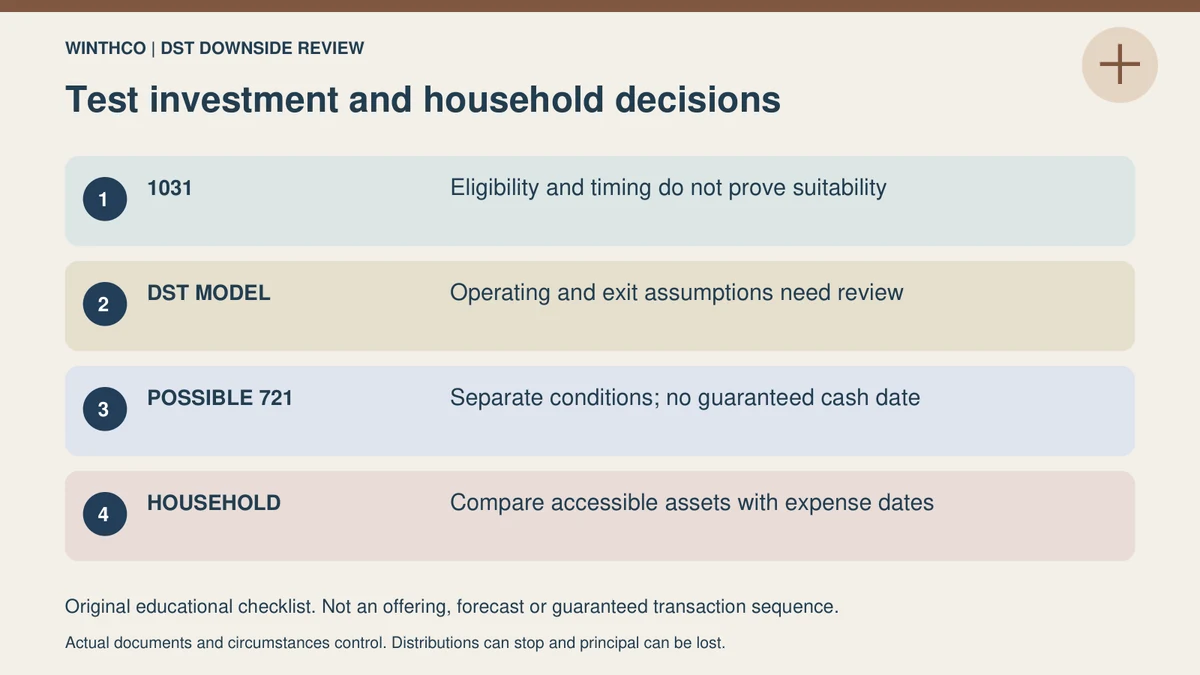
A projected property sale can be highly influential in a model even when the discussion emphasizes current distributions. Ask how the sale value is estimated, which income measure supports it and what transaction costs, debt payoff and other obligations are deducted. Separate gross property value from cash potentially available to investors. Neither a valuation assumption nor an appraisal creates a willing buyer at the modeled price.
Review a later exit, weaker operating income and a less favorable valuation assumption separately and together. Ask what continuing expenses or financing issues arise if the property is not sold on the proposed schedule. A longer hold changes when money might become available even if the final modeled dollar amount appears similar. Do not describe a target holding period as an investor redemption right.
If a model uses a capitalization rate, have the preparer explain its relationship to the selected income measure and its limitations. Holding other factors constant, a higher capitalization rate produces a lower indicated value under the income-divided-by-rate calculation. Actual pricing depends on more than that arithmetic. The DST appraisal and price discussion helps separate a valuation method from a transaction outcome.
WATCH & LEARN
Equity Advantage 1031 Exchange discusses the time and energy demands of direct ownership and DSTs as one possible alternative. This third-party video supplies general context, not stress-test results, an endorsement or a promise of investment performance, tax treatment or liquidity. Original resource · Watch on YouTube ↗
Educational context only. The discussion does not establish the suitability, returns or tax treatment of an investment.
Consider a hypothetical seller reviewing a DST while planning a major household expense several years ahead. This is not an actual client, offering or outcome. The initial presentation assumes stable collections and a sale before the expense. A separate scenario assumes slower leasing, added repairs and a delayed sale. No return figures or probabilities are assigned here.
The useful question is whether the household could meet its obligation if distributions declined and invested capital remained inaccessible. The review also asks which operating or financing decisions investors cannot control. A disappointing scenario does not automatically establish that a DST is unsuitable, and a favorable scenario does not establish that it is appropriate. The analysis should reveal dependencies and unanswered questions before the proposed commitment becomes binding.
Section 721 generally addresses property contributed to a partnership for partnership interests, subject to exceptions and transaction facts. It is a separate framework from Section 1031. Ordinary REIT shares and operating-partnership units generally are not direct Section 1031 replacement real property. IRS Revenue Ruling 2004-86 addressed a specified DST arrangement, not an automatic sequence ending in a REIT investment.
If materials describe a possible later contribution, test the initial DST without assuming it will occur. Ask who controls the decision, which approvals remain, how property value and debt would be measured and which costs apply. A later transaction may change the form of ownership without immediately providing accessible cash.
Have the CPA and attorney review any actual proposal, unit rights, redemption conditions and tax consequences separately. A minimum holding period or FIFO description does not guarantee a contribution, liquidity or tax-free basis withdrawals. The household's downside plan should work without relying on an unconfirmed conversion date or an assumed redemption value.
A DST may reduce direct management duties while exposing investors to limited control, illiquidity, sponsor, tenant, property, leverage, fee, valuation, concentration and tax-law risks. Distributions can change or stop, and principal can be lost. Private DST offerings are generally directed to accredited investors through offering documents; eligibility does not establish suitability or make a projected scenario reliable.
The SEC warns that private placements can involve limited disclosure, highly illiquid securities and total loss. A model cannot represent every event, assign dependable probabilities to all outcomes or guarantee the availability of a remedy. Ask which risks remain outside the calculations. FINRA's concentration guidance also supports reviewing correlated exposures across the household, rather than assuming several DST names provide independent protection.
Connect the findings with accessible savings, existing financial assets, 401(k)s, IRAs, retirement-income needs and beneficiary or estate coordination. Winthco's wealth-management conversation can include the tax and legal professionals without assuming an account transfer, rollover or advisory engagement is appropriate. Compare choices, costs and services separately. Use the prospect form for the planning question, not confidential financial models or account records; request an approved secure process for later documents.
| Decision | Evidence to request | What to avoid assuming |
|---|---|---|
| Operating case | Collections, costs, downtime and repairs | Occupancy alone establishes future cash |
| Cash bridge | Debt, fees, capital needs and reserves | NOI equals investor distributions |
| Exit case | Value, sale costs, financing and timing | A modeled value is a buyer's bid |
| Household case | Accessible resources and expense dates | A stress test guarantees liquidity |
No. It shows calculated consequences under selected assumptions, not the probability of those assumptions occurring. Outcomes may be worse than the cases modeled.
Not necessarily. One may vary a single input while the other changes several related inputs. Ask how each presentation is constructed.
No. Definitions, fees, reserves, debt and timing may differ. Compare the underlying inputs and cash-flow bridges first.
Yes. The household may need money before it becomes available, and continuing costs or financing issues can change results. Timing is part of the risk.
No. Model limits, unrepresented risks and personal circumstances remain important. Accreditation and exchange eligibility also do not establish suitability.
Review that possibility separately and test the initial investment without depending on it. The event may not occur, and resulting unit rights can remain restrictive.
Sources checked October 31, 2026. This article explains general concepts; your facts and the applicable documents control.
Winthco DST services · Winthco evaluation overview · Editorial standards
DST investment due diligence
Selling a rental property? Learn how to review a DST private placement memorandum, compare fees and risks, and assess separate 721 UPREIT terms.
Read guide →DST due diligence
Learn how to read a DST property's debt service coverage ratio, test its assumptions and connect leverage risk with 1031 and retirement planning.
Read guide →DST due diligence
Learn how DST lease expirations, renewal assumptions, downtime and re-leasing costs can affect cash flow. Prepare a document-based review.
Read guide →Explore Winthco’s main DST article collection
Share your timeline and investment range. A Winthco team member will follow up with you.