Property sale planning
Before Listing a Rental: DST and 1031 Planning
Prepare a rental sale with broker questions, 1031 timing, DST and separate 721 review, and retirement planning before committing proceeds.
Read guide →
Home / Learning center / California advisor guides
California advisor guides
Winthco Wealth Management · Updated November 1, 2026
A Santa Monica owner evaluating a DST advisor should reconcile the rental property's operating and rent-control records before selling, while coordinating tax, legal and exchange advice before closing. Compare reduced management with DST fees, limited control and illiquidity. Review any possible 721 contribution separately and protect money needed for near-term household expenses.
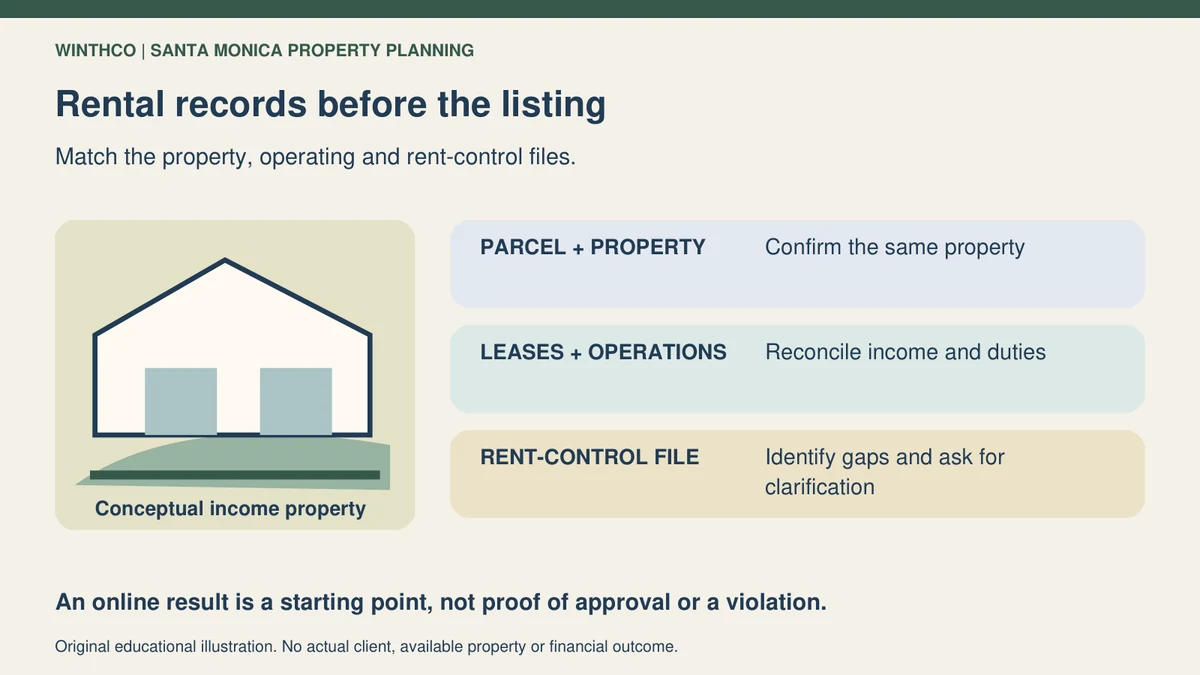
Start by explaining what the sale should change. Are you seeking fewer maintenance calls, a different real-estate allocation, retirement spending or funds for a known expense? Interview appropriately licensed realtors or commercial brokers about relevant rental-property experience, comparable-sale evidence, marketing, compensation and occupied-property diligence. Ask which conclusions require an attorney, city staff or a tax professional rather than accepting a broad promise about what a buyer could do.
Assemble leases, amendments, actual collections, deposits, operating costs, repair history, insurance and debt payoff information. Give the broker a consistent operating file and have counsel review material tenancy questions. If a deferred exchange is contemplated, engage the CPA, attorney and qualified intermediary before closing or receiving proceeds. The 1031 exchange benefits and limits belong in that early conversation, alongside the option of paying tax and retaining accessible capital.
Share your timeline and investment range. A Winthco team member will follow up with you.
Santa Monica's Property and Survey Information page links to SaMoMAP property information, Los Angeles County Assessor resources and the city's GIS catalog. Use those starting points to match the address and parcel to the records being discussed. A map or assessor entry is not a conclusion about permitted construction, lawful rental use or the terms of a particular tenancy. Ask the responsible officials and qualified professionals to interpret discrepancies.
The Rent Control Board's public-access portal offers address or parcel searches and describes document availability from 2005 onward, with older documents handled through Rent Control at City Hall. Reconcile available records with the owner's leases and correspondence; an empty online result is not proof that no earlier issue exists. The Board's Spring 2026 newsletter also identifies ownership and tenancy changes as registration events. Have the agency or counsel confirm the actual obligations and timing for the transaction. This guide does not determine coverage, allowable rent or eviction rights. The map below shows Santa Monica's city area, not a Winthco office or parcel boundary.
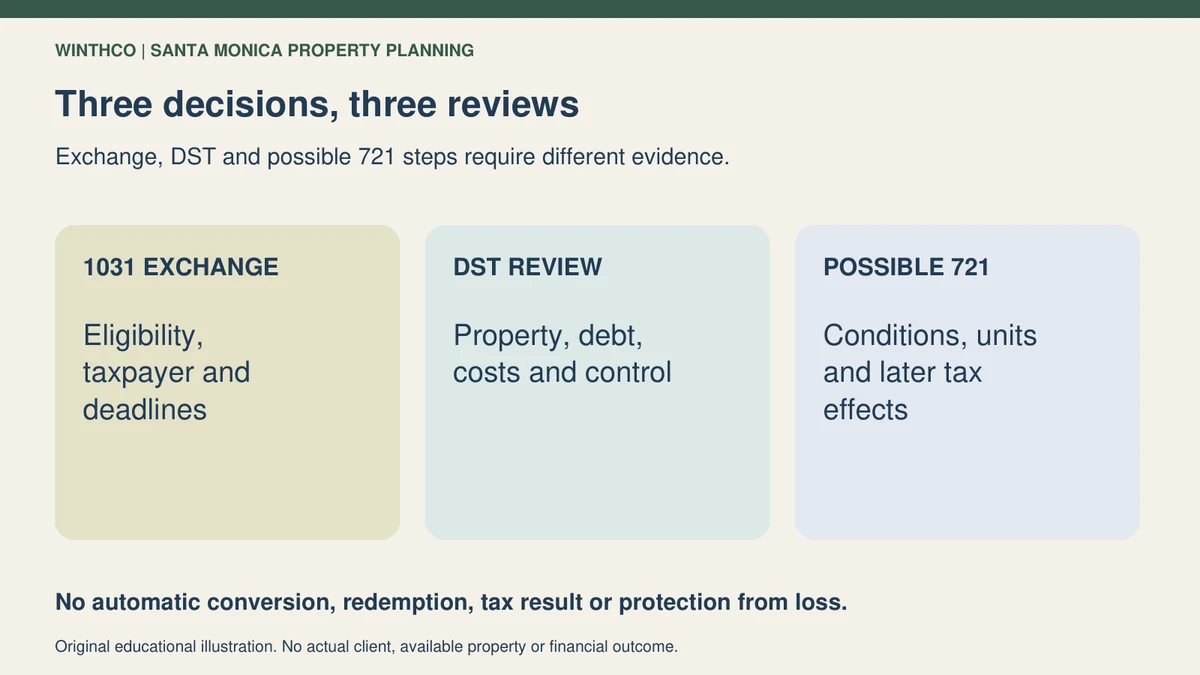
Section 1031 can defer eligible gain when qualifying business or investment real property is exchanged under the applicable rules. Deferral is not tax elimination, and a property's marketing description does not establish eligibility. The CPA should review ownership, the taxpayer, use history, adjusted basis, depreciation and liabilities. Cash or other non-like-kind property received can create recognized gain; ask how a partial exchange differs from full deferral.
In an ordinary deferred exchange, replacement property generally must be identified within 45 days after transfer of the relinquished property and received by the earlier of 180 days or the applicable tax-return due date, including extensions. Assign responsibility for the actual calendar and proceeds restrictions with the QI and tax preparer. A replacement opportunity's availability does not extend a deadline. Keep the qualified-intermediary engagement separate from the listing and securities-service agreements so everyone understands their responsibility.
Discuss your DST questions with Winthco →
A Delaware statutory trust may hold identified real estate while investors own beneficial interests. IRS Revenue Ruling 2004-86 addressed a specified trust arrangement whose interests were treated as real-property interests for federal tax purposes when the other exchange requirements were met. It is not blanket approval of every DST-labeled product. Have the tax and legal professionals review the actual offered interest rather than relying on its name.
A DST can reduce the investor's direct role in leasing, tenant calls and repair coordination. The trade-off includes limited control over operations, financing, reserves and sale timing. Ask who has authority under the governing documents and what information investors receive. A proposed holding period is not an individual redemption right or assurance that money becomes available on the household's preferred date.
Read the private placement memorandum, trust agreement, subscription documents and amendments. Private DST offerings are generally directed to accredited investors, but eligibility does not establish suitability. The Santa Monica sale value does not determine how much of a household's wealth should become illiquid. Review the DST document checklist with the relevant professionals and identify unanswered questions before signing.
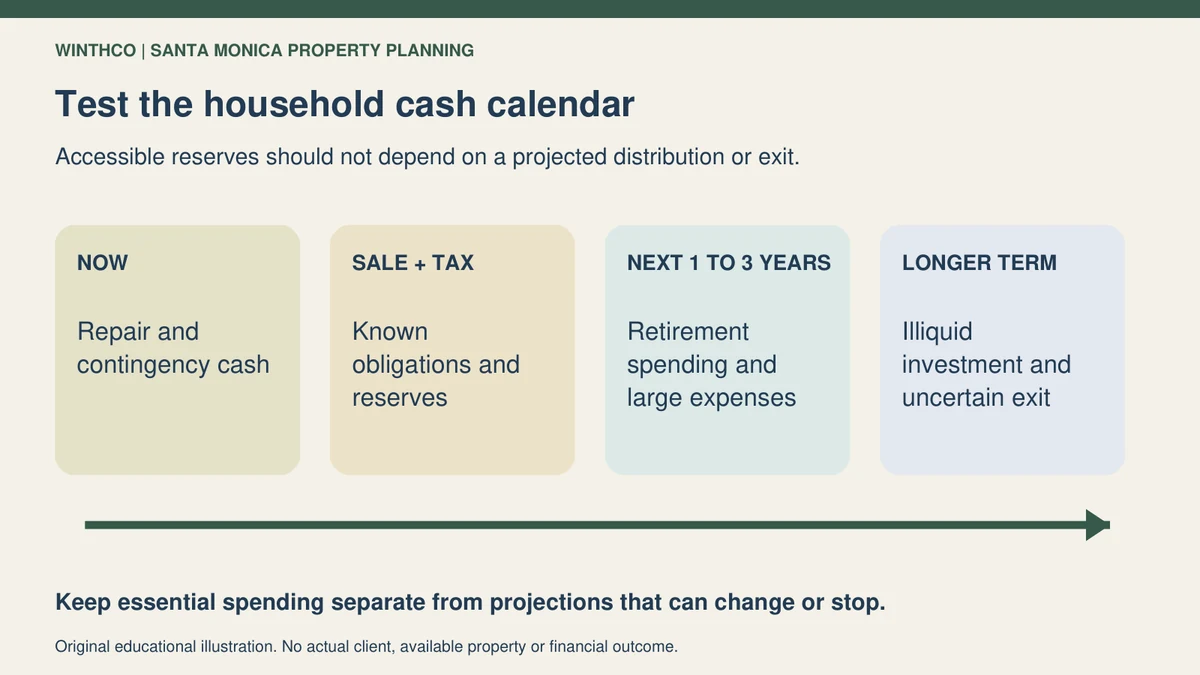
Compare actual net economics rather than gross rental income with a projected distribution percentage. Reconcile vacancy, concessions, collection losses, management, taxes, insurance, maintenance, debt service and capital spending. Distinguish a buyer's proposed future operations from documented current results. Apply the same discipline when reviewing a replacement: what is supported, what is conditional and what is simply assumed?
For a DST, ask how projected distributions relate to operations, reserves and any other funding sources. Review acquisition, organization, financing, property-management, asset-management and disposition costs, including affiliate compensation. A stated distribution is not total return. Payments can change or stop, and the eventual property value can be lower than expected. The DST downside-scenario review helps organize questions without claiming to predict performance.
Consider tenant losses, rising costs, reserve shortfalls, repairs, loan maturity and a delayed property sale. Several DST names may still share sponsors, tenants, lenders, property sectors or regions. FINRA's concentration guidance supports reviewing correlated exposures across the whole household. Do not treat an advisor's help organizing documents as proof that a specific offering has passed every required diligence or suitability review.
WATCH & LEARN
Winthco Wealth Management introduces general DST educational resources. This is not Santa Monica rent-control guidance, an offering recommendation or a promise of income, liquidity or tax treatment. Original resource · Watch on YouTube ↗
Educational context only. The discussion does not establish the suitability, returns or tax treatment of an investment.
Section 721 generally addresses property contributed to a partnership in exchange for partnership interests, subject to exceptions and transaction-specific facts. An UPREIT commonly holds real estate through an operating partnership associated with a REIT. That framework is distinct from Section 1031: ordinary REIT shares and operating-partnership units generally are not direct 1031 replacement real property.
Some DST materials describe a potential later operating-partnership contribution. Evaluate the initial DST without assuming that event will occur. Ask who controls timing, what conditions remain, how property value and debt would be measured and which costs apply. A plan for a future contribution is not a current right to obtain cash, choose a conversion date or eliminate exposure to property economics.
If an actual proposal arises, the CPA and attorney should review its separate documents, unit rights, liabilities, distribution provisions and redemption consequences. Restrictions and taxes can remain relevant afterward. A FIFO description does not guarantee tax-free withdrawals of basis. Keep the proposed transaction's conditions distinct from the household's spending calendar; a possible change in ownership form is not a substitute for an accessible reserve.
Consider a hypothetical owner who has held a Santa Monica rental for many years and wants less day-to-day management. The household also expects a significant expense within several years. This is not an actual client, property or investment outcome. Before listing, the broker and attorney reconcile the operating file, while authorized records requests identify what needs clarification with city staff.
The CPA and QI compare a taxable sale, partial exchange and full exchange before closing. The replacement discussion includes direct property and qualifying DST interests, but it does not assume a distribution target or later 721 event will fund the expense. The household separates documented obligations, accessible resources and uncertain investment dates. That exercise can reveal a mismatch before capital becomes difficult to retrieve.
The SEC cautions that private placements can offer limited disclosure, be highly illiquid and expose investors to total loss. DST risks include sponsor, property, tenant, leverage, valuation, fees, conflicts, concentration and tax-law changes. Distributions can decline or stop and principal can be lost. Neither accreditation nor possible exchange eligibility protects against these outcomes.
Winthco's wealth-management conversation can connect the property decision with existing financial assets, 401(k)s, IRAs, retirement-income needs, asset allocation and beneficiary or estate coordination. Verify the DST advisor's role and service scope rather than assuming one professional supplies legal, tax, brokerage and exchange-administration services. A reference to a DST CPA should prompt credential and engagement checks, not an inference that an investment advisor is also a CPA.
Compare relevant options, costs and services before any rollover, securities transfer or advisory engagement; a property sale does not automatically justify those steps. Retirement accounts are not themselves exchange proceeds. Keep sale and basis records for the tax preparer and assign responsibility for ongoing federal and state reporting. Use the prospect form for the planning question, not tenant details or confidential financial records, and request an approved secure process for later documents.
Geographic context, not a Winthco office or property-boundary determination.
| Decision | Evidence to request | What to avoid assuming |
|---|---|---|
| Sale preparation | Records, broker scope and legal questions | A portal result resolves every issue |
| 1031 review | Taxpayer, property, funds handling and dates | A replacement label proves eligibility |
| DST review | Documents, operations, costs and financing | Reduced management eliminates property risk |
| Possible 721 | Conditions, unit rights and later taxes | A planned event guarantees available cash |
This guide does not claim one. The main contact page lists Simi Valley; the map gives city-area context only.
The portal describes documents from 2005 onward and directs people to Rent Control at City Hall for older documents. Ask the agency how to obtain and interpret the relevant file.
No. Property information is a diligence starting point, not a property-specific legal conclusion. Consult the responsible officials and qualified counsel.
Do not assume so. Confirm the scope and credentials of the investment advisor, CPA, attorney, listing broker and QI separately.
Do not rely on it as guaranteed cash. Payments can change or stop and the investment can remain illiquid longer than expected.
No. It may not occur and resulting units can have transfer or redemption limits. Review actual agreements and tax consequences separately.
Sources checked November 1, 2026. This article explains general concepts; your facts and the applicable documents control.
Winthco DST services · Winthco evaluation overview · Editorial standards
Property sale planning
Prepare a rental sale with broker questions, 1031 timing, DST and separate 721 review, and retirement planning before committing proceeds.
Read guide →DST investment due diligence
Selling a rental property? Learn how to review a DST private placement memorandum, compare fees and risks, and assess separate 721 UPREIT terms.
Read guide →DST due diligence
Review DST downside scenarios, cash-flow assumptions and exit risks before investing. Learn what a stress test can reveal and what it cannot promise.
Read guide →Explore Winthco’s main DST article collection
Share your timeline and investment range. A Winthco team member will follow up with you.