1031 replacement property
DST vs 721 UPREIT after a property sale
Compare DST and 721 UPREIT paths, tax rules, ownership, liquidity, control and risks before a property sale or exchange.
Read guide →
Home / Learning center / Property sale planning
Property sale planning
Winthco Wealth Management · Updated October 13, 2026
Before listing an investment rental, coordinate the sale plan with a licensed real estate broker, CPA, attorney and qualified intermediary. Evaluate replacement-property choices and household liquidity before closing. A qualifying DST may reduce direct management, but potential 1031 deferral does not establish investment suitability or guarantee a later 721 transaction.
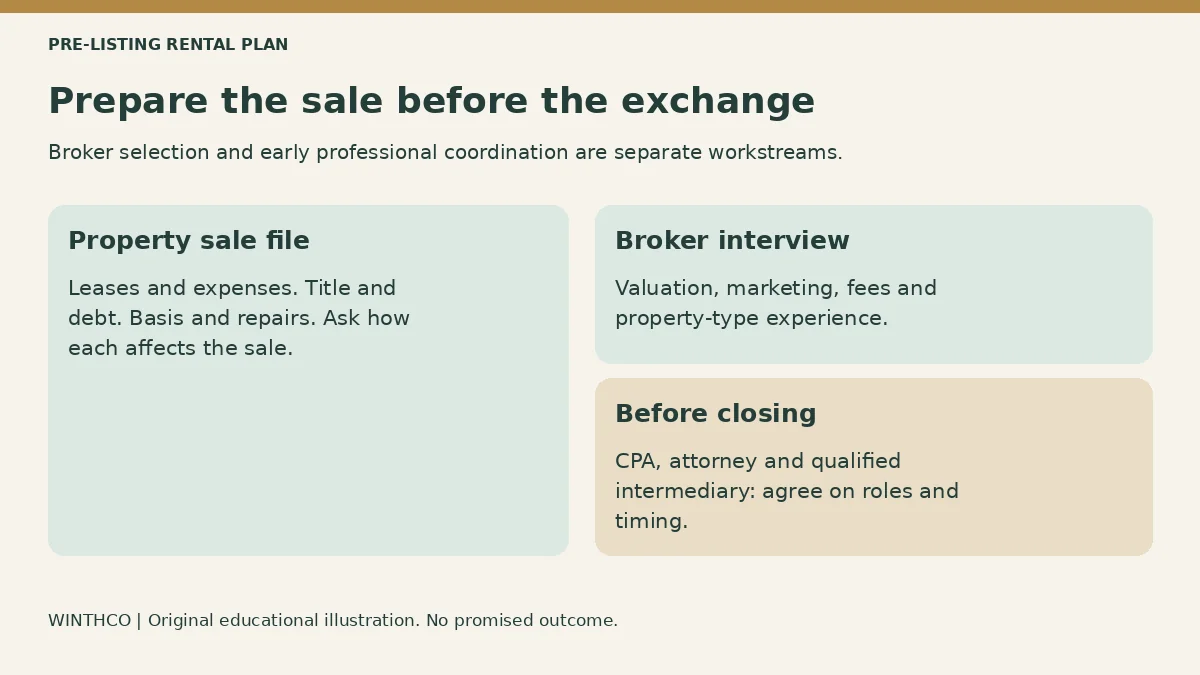
The first meeting should produce a sale strategy, not a promise that a particular exchange investment will be available. Ask a licensed realtor or commercial broker about comparable transactions, experience with your property type, likely buyers, marketing, proposed fees and realistic closing conditions. Verify licensing with the applicable state regulator. A residential rental, occupied apartment building and leased industrial property can require different preparation and buyer diligence.
Request a written explanation of the proposed valuation and what could change it. Bring leases, rent collections, operating expenses, repair history, title information and debt statements. Discuss tenant access, inspections, confidentiality and any missing permits. Winthco's DST advisor planning framework can help start the separate investment conversation. This guide does not identify a Winthco real estate brokerage or promise a broker referral.
Share your timeline and investment range. A Winthco team member will follow up with you.
Separate the reason for selling from the reason for exchanging. Reducing repair calls, raising liquid cash, changing geographic exposure and preparing for retirement are different objectives. Rank them before negotiating a contract. A tax-deferral objective can conflict with a need to spend proceeds soon, so compare continued ownership, outside management, a taxable sale, direct replacement real estate and DST interests using the same household assumptions.
Have the CPA review qualifying investment use, adjusted basis, depreciation, ownership and debt. Have the attorney review title, entity authority and contract terms. Engage a qualified intermediary before closing and before receiving sale proceeds if a deferred exchange is contemplated. These professionals have different responsibilities. Put their names and deliverables on one closing checklist instead of assuming the listing agent or investment professional can answer every question.
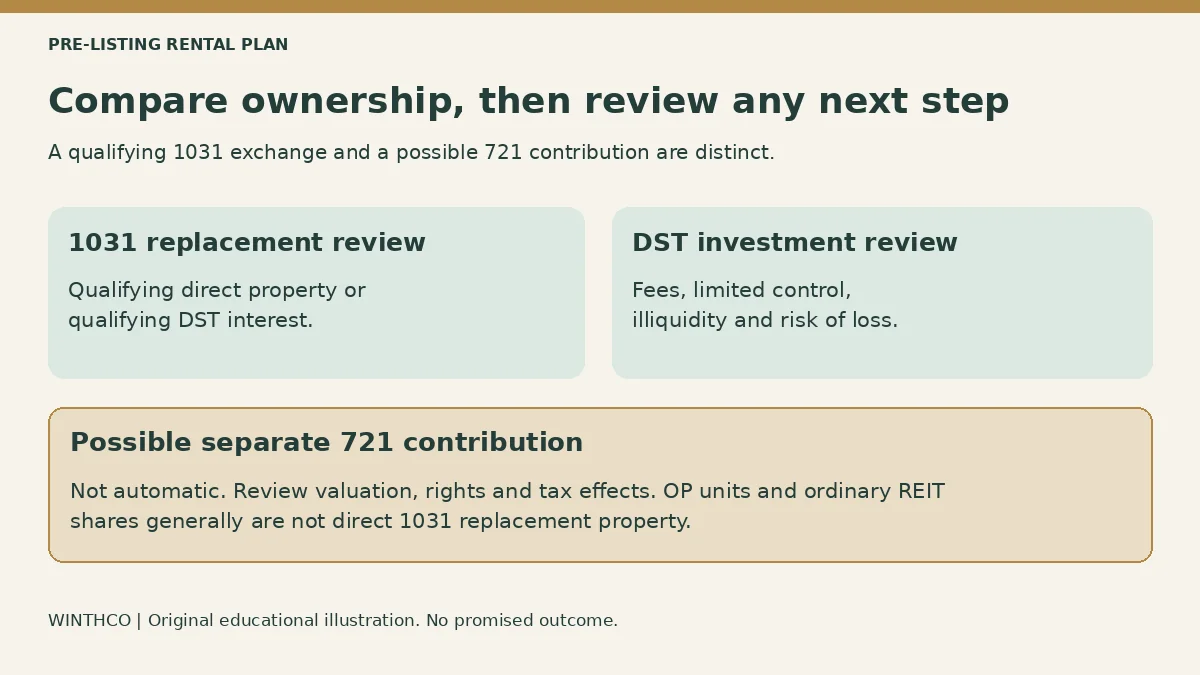
Section 1031 can defer eligible gain when qualifying real property held for business or investment is exchanged under the applicable rules. Deferral carries future tax consequences forward; it does not erase gain. The IRS Form 8824 instructions explain that cash or other non-like-kind property received can cause recognized gain. Debt relief, replacement liabilities and exchange expenses require a transaction-specific calculation.
The replacement identification generally must be delivered in signed writing within 45 days after the relinquished property transfers. Acquisition must finish by the earlier of 180 days after transfer or the applicable federal tax-return due date, including extensions. Both periods start from the transfer. Ask the intermediary and CPA to calculate the dates and confirm identification rules; do not rely on an estimated listing date or assume a late-year closing always gives the full 180 days.
Keep investment review ahead of that calendar. A DST allocation can require document delivery, accreditation checks and subscription acceptance. Identification does not reserve an allocation or establish that a proposed trust qualifies. Discuss alternatives before the sale closes, including what happens if the intended replacement becomes unavailable. The goal is to avoid making an irreversible investment decision merely because the clock is running.
Discuss your DST questions with Winthco →
Revenue Ruling 2004-86 treats interests in the specific trust described there as interests in real property for federal tax purposes. It provides a framework for reviewing qualifying arrangements, not blanket approval of every DST. Read the actual trust and offering documents with the responsible professionals. Many DST securities are private placements generally offered to accredited investors, and the private placement memorandum governs the offering information.
The practical attraction may be a shift away from directly handling tenants, repairs and property operations. That shift also means giving up meaningful decision-making authority. Identify who controls leasing, budgets, financing, a sale and distributions. Ask what the investor can approve, what requires no investor consent, and whether transfer restrictions could prevent an exit when household needs change.
Evaluate the property as if tax deferral were unavailable. Review tenant dependence, lease expirations, condition reports, capital needs, reserves and market assumptions. Examine loan terms, maturity, interest-rate exposure and lender remedies. An attractive building photograph or a professionally prepared forecast does not answer whether the purchase price, financing and operating assumptions make sense.
Request the complete fee and compensation schedule, including acquisition, selling, financing, management and disposition costs. Ask which entities receive payments and whether affiliates stand on both sides of a transaction. Compare net investment exposure after costs, not only the stated subscription amount. A lower visible fee may coexist with other charges elsewhere in the structure.
Run a household stress case in which DST distributions decline or stop and the interest cannot be sold when expected. Then test vacancy, delayed lease renewal, rising insurance costs, major repairs and a weaker exit market. A sponsor's resources and experience deserve review, but neither eliminates property, debt or sponsor risk. Loss of principal, including total loss, is possible.
Look across holdings for shared sponsors, tenants, lenders, regions and property sectors. Owning several interests does not necessarily reduce correlated exposure. FINRA's concentration guidance is particularly relevant when a household already owns rentals or other illiquid assets. Keep emergency spending and foreseeable commitments outside assumptions about a DST redemption or scheduled property sale.
WATCH & LEARN
Accruit introduces DST interests as possible 1031 replacement property. This third-party educational video does not represent Winthco advice or endorse an offering; IRS guidance and the actual documents control. Original resource · Watch on YouTube ↗
Educational context only. The discussion does not establish the suitability, returns or tax treatment of an investment.
Some programs contemplate a later contribution of property to an operating partnership in exchange for partnership units. That is a separate Section 721 analysis with its own documents, conditions and consequences. IRS Publication 541 explains the general nonrecognition rule for property contributions as well as exceptions and liability-related issues. It is not a promise that any proposed contribution will receive a particular tax result.
Ask whether a later transaction is optional, mandatory under specified provisions or merely contemplated. Who determines valuation? Which fees apply? What lockups, redemption limits and tax-protection terms exist? What happens if the contribution is delayed or never offered? Winthco's separate 721 UPREIT planning considerations provide background for questions, while the signed agreements and independent advice determine actual rights.
Do not substitute operating-partnership units or ordinary REIT shares for qualifying 1031 replacement real property. Those interests generally do not qualify as direct replacement property. A later redemption or conversion can create tax consequences and should be reviewed before relying on liquidity. There is no general guarantee that choosing a particular redemption order lets an investor withdraw basis tax-free.
Consider an owner preparing to sell a leased duplex within six months. The owner wants fewer maintenance obligations but also needs funds for a home repair and has an old employer retirement plan. The broker prepares valuation and marketing recommendations, the CPA reconstructs basis, and the attorney checks title. The intermediary is engaged before any exchange closing, not after proceeds arrive.
The investment review compares direct property, a DST allocation and a taxable sale. The household models lower distributions and an extended hold. Cash needed soon is identified explicitly, with the CPA analyzing the consequences of retaining it. A possible later 721 contribution is evaluated separately rather than used to justify a cash need on a fixed date. This is an educational scenario, not a client experience or a recommended transaction.
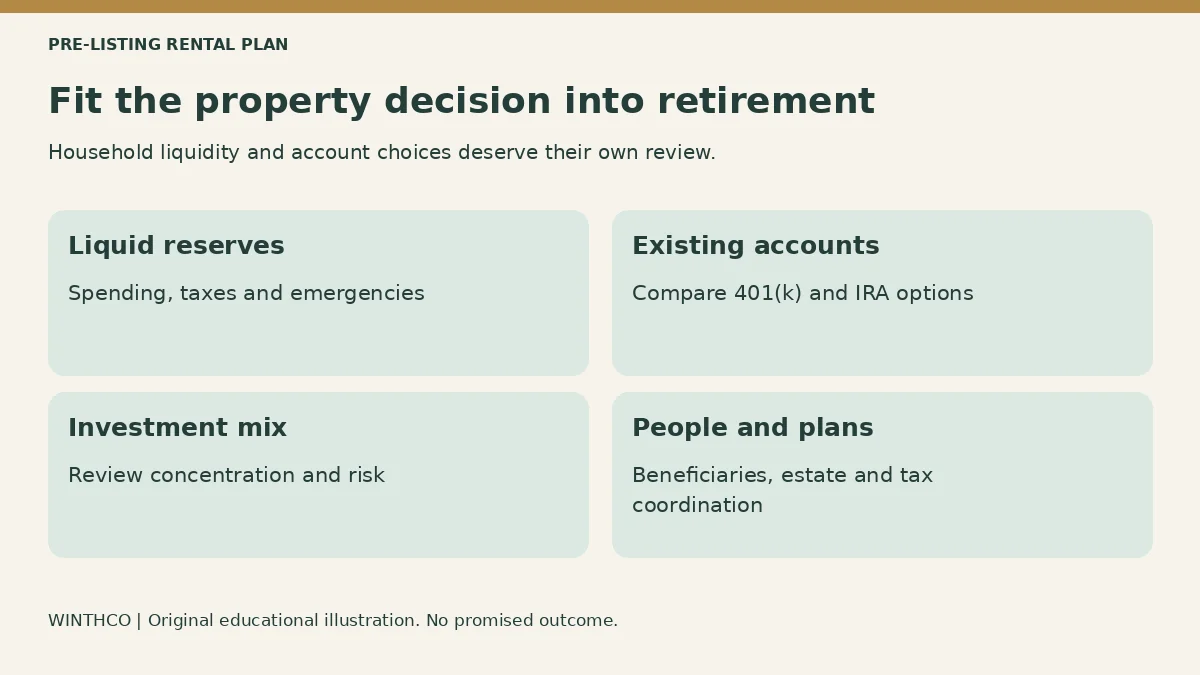
Inventory existing financial assets, retirement accounts, anticipated spending, liabilities and beneficiary arrangements before deciding how much capital can remain illiquid. Winthco describes wealth management, retirement planning and 401(k) rollover services on its main website. A planning conversation can examine these issues together without assuming every account should move or an advisory engagement is appropriate.
An IRA or 401(k) decision is separate from a property exchange. Compare keeping an eligible employer plan, moving to another eligible plan when available, and an IRA using actual fees, investments, services and account protections. Consider withdrawal rules and tax consequences with the relevant professionals. Qualified retirement accounts are not simply a destination for personal 1031 exchange proceeds.
Coordinate retirement-income needs, asset allocation, liquidity, beneficiaries and estate documents with tax and legal advisers. Use Winthco's DST tax preparation questions to organize the tax discussion, without treating investment education as tax advice. The prospect forms on this page or the contact page begin that conversation. Do not enter tax returns or identity documents in a general inquiry. This resource uses AI-assisted drafting with Winthco organization attribution and source review dated October 13, 2026.
| Decision | Evidence to request | What to avoid assuming |
|---|---|---|
| Listing strategy | Comparable sales, marketing plan and written fees | A high suggested price proves a better outcome |
| Exchange readiness | QI agreement, tax analysis and deadline calendar | The process can be added after receipt of proceeds |
| DST selection | Offering documents and downside cases | An identified investment is reserved or suitable |
| Possible 721 contribution | Valuation, rights, tax review and exit limits | Partnership units are direct 1031 replacement property |
| Retirement coordination | Account options, fees and household cash needs | Every account should be transferred |
You can begin education and suitability review before listing, but availability and offering terms may change. Do not assume that an early discussion reserves an allocation.
A listing professional has a distinct role. Verify any additional role and conflicts, and engage a qualified intermediary, CPA and attorney as appropriate before closing.
No. Qualifying use, ownership, replacement property, timing and the exchange procedure all matter. Ask your tax and legal professionals to review the facts.
Do not assume so. DST interests can be highly illiquid and subject to transfer restrictions, with no assured secondary market or investor-controlled exit.
No. Availability, timing, control and tax consequences depend on separate documents and facts. Operating-partnership units generally are not direct 1031 replacement property.
No. Compare eligible account options, costs, investments and services independently of the property transaction. A rollover is not an automatic part of an exchange.
Sources checked October 13, 2026. This article explains general concepts; your facts and the applicable documents control.
Winthco DST services · Winthco evaluation overview · Editorial standards
1031 replacement property
Compare DST and 721 UPREIT paths, tax rules, ownership, liquidity, control and risks before a property sale or exchange.
Read guide →1031 exchange planning
Learn how retiring landlords can compare a DST 1031 exchange with direct real estate, including control, liquidity, debt, income and risk.
Read guide →1031 exchange planning
Learn what a qualified intermediary does in a DST 1031 exchange and how to review agreements, fund controls, deadlines and professional roles.
Read guide →Explore Winthco’s main DST article collection
Share your timeline and investment range. A Winthco team member will follow up with you.