DST due diligence
DST Appraisals: Value, Price and Investor Proceeds
Learn how to review DST appraisals, compare acquisition costs and separate property value from investor proceeds before a 1031 exchange.
Read guide →
Home / Learning center / Due Diligence
Due Diligence
Winthco Wealth Management · Updated November 18, 2026
A DST exit cap rate is an assumption used to estimate the property's value when it is sold. A higher rate generally produces a lower value for the same net operating income. It is not your distribution rate, a promised sale price or a commitment that the investment will end on schedule.
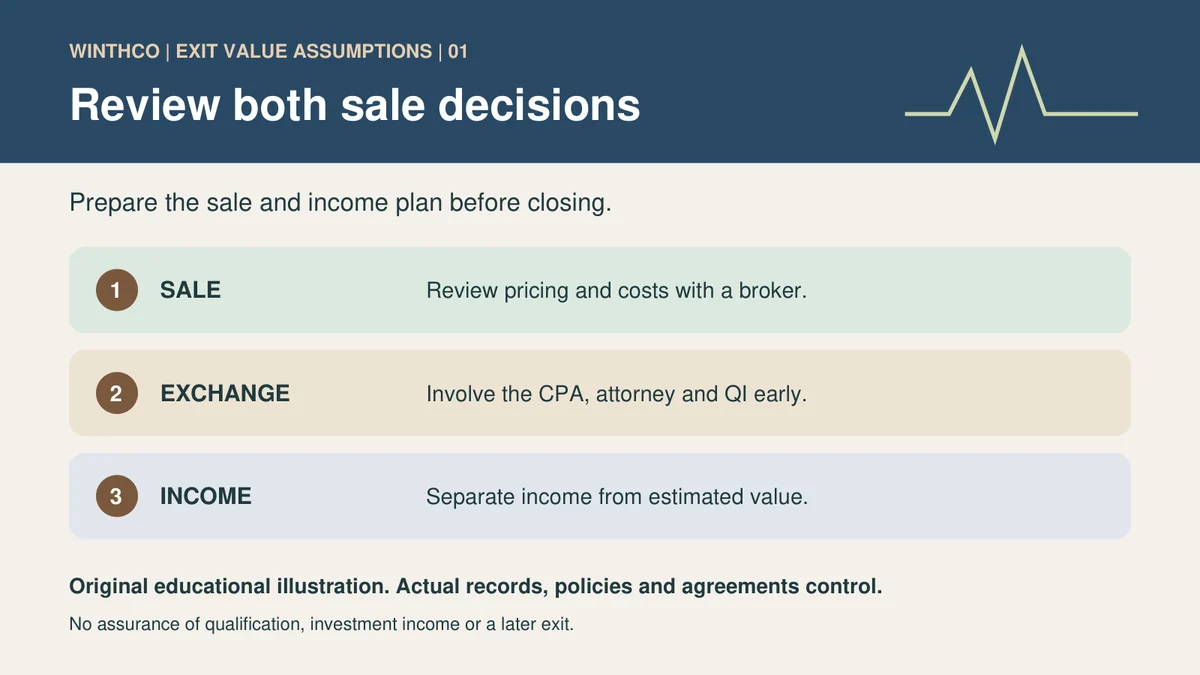
Before listing a rental, interview a licensed realtor or commercial broker about comparable sales, property-type experience, pricing, compensation and the likely buyer pool. Ask what operating records support the asking price. The same discipline belongs in a replacement-property review: an attractive future sale value needs evidence, not just a polished presentation. Your current property's sale price and a DST's future exit estimate are separate decisions.
Involve your CPA, attorney and qualified intermediary before closing or receiving proceeds if a deferred exchange is contemplated. Then evaluate the replacement on its own merits. Winthco's framework for evaluating a DST can help organize questions about documents, property economics and risk. A nearing exchange deadline does not make an optimistic exit assumption more credible, nor does it turn a proposed holding period into a contractual maturity.
Share your timeline and investment range. A Winthco team member will follow up with you.
The basic direct-capitalization relationship is estimated property value equals annual net operating income divided by the capitalization rate. Appendix 3 of the federal banking agencies' commercial-real-estate guidance explains this approach and the use of a terminal cap rate in estimating an eventual sale value. It also distinguishes capitalization from discounting future cash flows. This valuation framework is background, not an agency endorsement of a DST investment.
In a DST projection, ask which year's income enters the exit calculation. Is it the final holding year's income, the following year's forecast, or a stabilized estimate? Ask whether that number assumes occupied space, renewed leases or completed improvements that do not exist today. Two models using the same cap rate can produce different values because their income definitions and timing differ.
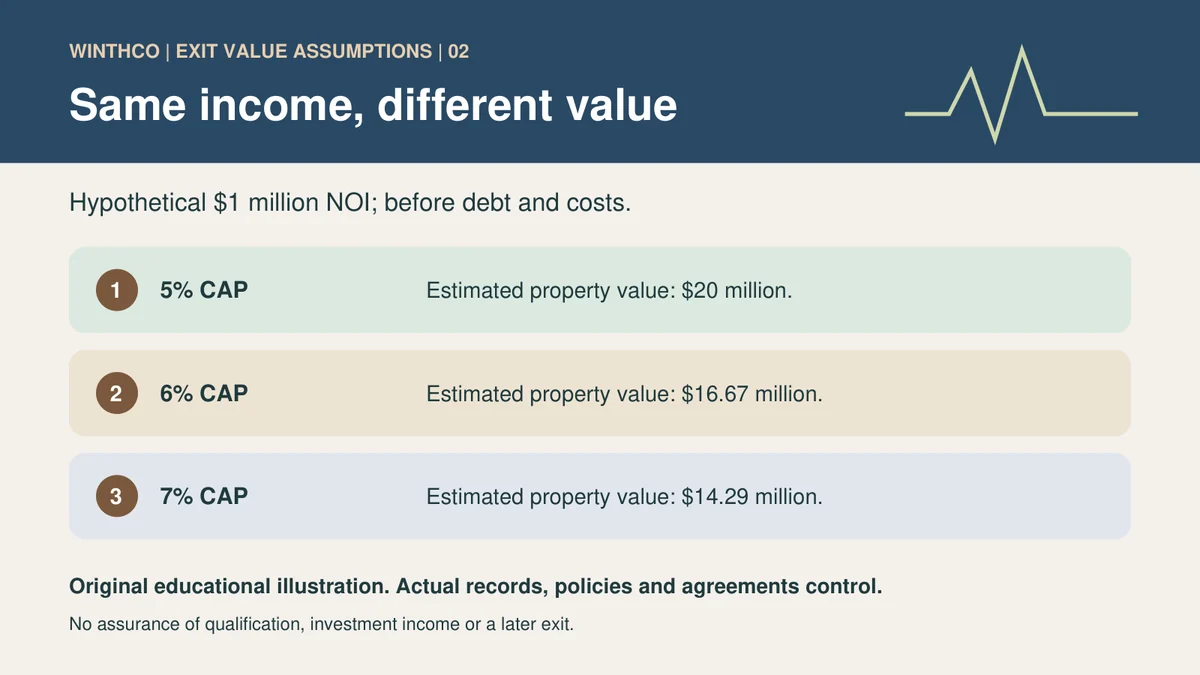
Consider a purely hypothetical property with annual net operating income of $1 million at sale. Dividing by a 5% cap rate gives an estimated gross property value of $20 million. At 6%, the estimate is about $16.67 million. At 7%, it is about $14.29 million. These figures are arithmetic illustrations, not current market rates, an available offering or a forecast of any investor's result.
The move from 5% to 6% is one percentage point, not a 1% relative increase. With income unchanged, the estimated value falls about 16.7%. The relationship is not linear: another one-point increase does not create the same dollar change. Ask for an actual sensitivity calculation instead of accepting a statement that the exit assumption is only slightly different.
Income growth can offset some valuation pressure without eliminating it. Suppose the same hypothetical income grows to $1.1 million but the exit cap rate is 6%. Estimated gross value becomes about $18.33 million, still below the $20 million illustration using $1 million and 5%. Higher rent alone does not establish a higher sale price, particularly if expenses also rise. Our rent growth and inflation discussion separates rent increases from cash available to investors.
Discuss your DST questions with Winthco →
No. A cap rate relates a property's operating income to its price or estimated value. An investor distribution rate compares cash distributed with an investment amount, subject to the definition used in the documents. Neither number, by itself, measures the investor's complete after-fee and after-tax return. A displayed percentage should always come with its numerator, denominator and measurement period.
Debt service, reserves, capital work and trust-level expenses can create substantial differences between property operating income and distributable cash. Request a reconciliation from property income to actual investor payments. Winthco's DST ownership and exchange overview provides structural context, while the specific private placement memorandum governs the investment's terms. Do not interpret a distribution history as proof of either future payments or an exit valuation.
Ask whether an illustrated return depends heavily on sale proceeds. If most of the model's apparent benefit occurs in the last year, the exit assumptions deserve particular attention. Request results with a later sale, a higher exit cap rate and weaker income. These are questions for document review, not instructions to accept a particular rate as conservative in every market.
Gross property value is not the amount available to equity investors. In another simplified illustration, a $20 million sale with $10 million of debt leaves $10 million before sale costs and other obligations. A $16.67 million sale with that same debt leaves approximately $6.67 million. The 16.7% decline in gross value becomes roughly a 33.3% decline in this residual equity amount.
That example holds debt constant and excludes fees, taxes, reserves and other liabilities. It does not model an actual DST capital structure. Obtain the projected loan balance at the proposed sale date rather than substituting the original borrowing amount. Review repayment charges and any other restrictions with the offering's advisers. Our loan maturity and balloon-payment guide explains why the financing timeline requires its own review.
Then identify disposition fees, brokerage commissions, closing costs and any compensation payable to related parties. Ask how remaining reserves and unpaid obligations are handled. Compare net proceeds with the full investor contribution, including amounts absorbed by acquisition and offering costs. A statement that the property sold above its purchase price is not enough to establish that every investor recovered all invested capital.
WATCH & LEARN
Accruit explains DST replacement-property ownership. Third-party structural background, not a cap-rate forecast, valuation opinion or Winthco affiliation. Income and tax qualification are not assured. Original resource · Watch on YouTube ↗
Educational context only. The discussion does not establish the suitability, returns or tax treatment of an investment.
Ask for the origin and date of the exit cap rate assumption, the proposed buyer profile and relevant comparable transactions. Ask the reviewer to explain differences in location, lease duration, tenant quality and property condition. A cap rate from a different asset type or a stale transaction should not be accepted without explanation. A professional valuation remains an estimate rather than a binding purchase offer.
FINRA Notice 23-09 discusses broker-dealer obligations to reasonably investigate private placements and address red flags. Ask the recommending professional what investigation supports the business plan and how contrary evidence was considered. Request a clear explanation of compensation and conflicts. A sponsor's spreadsheet is a starting point for questions, not a substitute for the recommending firm's analysis.
A useful comparison changes one assumption at a time before combining stresses. Hold income steady while increasing the cap rate; then hold the rate steady while reducing income. Finally examine both together and include a delayed sale. Keep all versions on the same basis for debt, costs and timing so that a favorable result is not caused by silently changing unrelated inputs.
DST investors generally have limited control over property operations and sale timing. Illiquidity, sponsor execution, tenant concentration, property condition, leverage and market changes can affect results. Distributions can decline or stop, and principal can be lost. A diversified set of interests may still share exposure to the same market forces. The SEC's private-placement bulletin warns about resale difficulty and limited disclosure.
DST offerings generally are limited to accredited investors and made through a private placement memorandum. IRS Revenue Ruling 2004-86 addresses a particular trust arrangement that can qualify for Section 1031 treatment; it does not approve every DST. Tax eligibility is distinct from valuation quality. A compliant exchange can still lead to a disappointing investment result.
For an ordinary deferred exchange, identification is generally required within 45 days after transfer. Receipt must occur by the earlier of 180 days or the federal return due date, including extensions. Section 1031 defers eligible gain rather than eliminating tax; cash or other non-like-kind consideration may cause recognized gain. Confirm the transaction's facts and dates with your CPA, attorney and QI.
No. A later Section 721 contribution to a partnership is a separate potential transaction, not an automatic outcome of buying a DST. Ask who determines the contribution value, how costs and conflicts are handled and what approvals are needed. An estimated property value does not establish what an investor will receive in a future transaction that has not been agreed upon.
Ordinary REIT shares and partnership units are not direct Section 1031 replacement real estate. A possible UPREIT transaction changes the questions rather than removing them: review valuation, governance, redemption restrictions and individual tax consequences with advisers. Do not base current spending plans on a future redemption or assume it will be tax-free. Evaluate the original DST even if no later transaction occurs.
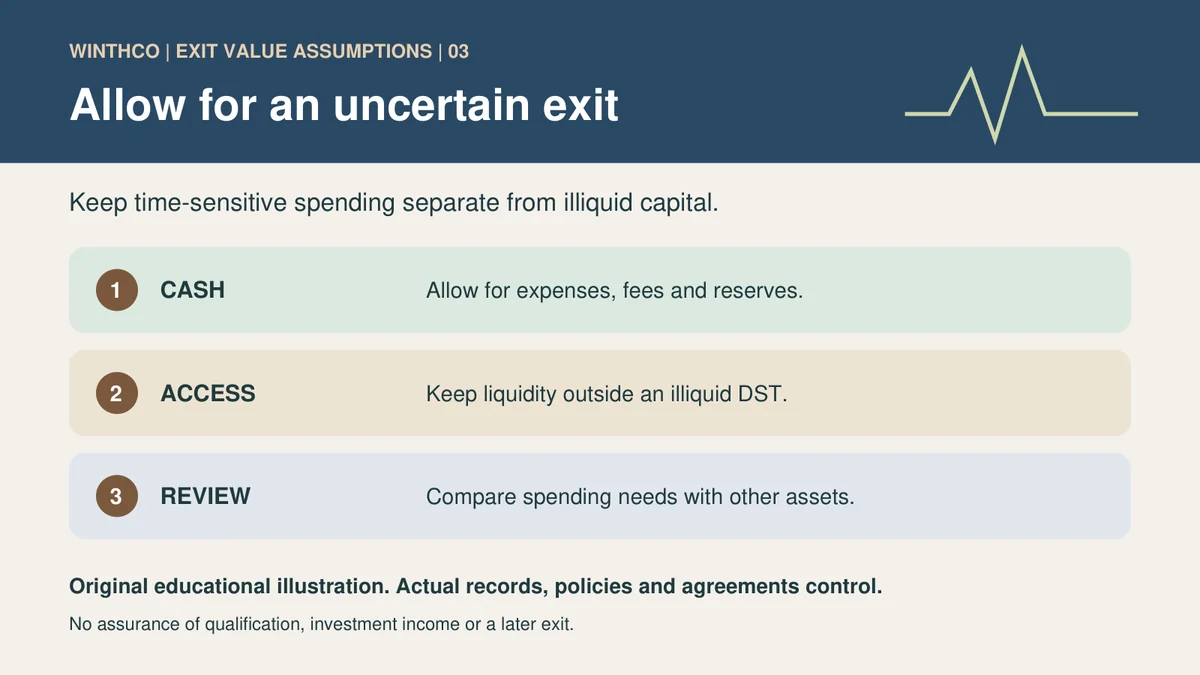
Separate money needed on a known date from capital that can remain illiquid. Review retirement income, taxable investments, 401(k)s, IRAs, emergency liquidity and estate coordination together. Retirement-account balances are not exchange proceeds. Before any rollover or transfer, compare options, costs and services rather than assuming consolidation is appropriate.
Use either prospect form on this page or the dedicated contact page to discuss general sale timing and planning priorities. Winthco's wealth-management services can be considered alongside tax and legal advice without presuming an engagement. The practical goal is a plan that remains workable if income falls, the exit value disappoints or the sale takes longer, not a spreadsheet that works only at one favorable cap rate.
| Decision | Evidence to request | What to avoid assuming |
|---|---|---|
| Exit valuation | Income year, definition and cap-rate support | A forecast is a buyer commitment |
| Investor proceeds | Debt balance, sale costs and obligations | Gross property value is investor cash |
| Retirement timing | Liquidity outside the DST | The proposed exit date is assured |
No. It is a property valuation input, not an investor return. Costs, debt, distributions and timing also affect results.
Not with the same income. Dividing the same income by a larger rate produces a lower estimated value.
It can offset some pressure if net operating income rises enough. Higher gross rent alone does not establish that outcome.
No. An appraisal is an opinion of value under its assumptions and effective date. It is not a future buyer's commitment.
Do not assume you have that right. Review the trust documents and keep needed liquidity outside an investment whose sale you cannot control.
Sources checked November 18, 2026. This article explains general concepts; your facts and the applicable documents control.
Winthco DST services · Winthco evaluation overview · Editorial standards
DST due diligence
Learn how to review DST appraisals, compare acquisition costs and separate property value from investor proceeds before a 1031 exchange.
Read guide →DST due diligence
Review DST downside scenarios, cash-flow assumptions and exit risks before investing. Learn what a stress test can reveal and what it cannot promise.
Read guide →DST Due Diligence
Learn how DST lease escalators, expenses and reserves affect purchasing power. Review the documents and discuss your retirement-income needs.
Read guide →Explore Winthco’s main DST article collection
Share your timeline and investment range. A Winthco team member will follow up with you.