Risks and due diligence
DST fees and expenses: what investors should compare
Learn how to review DST acquisition costs, ongoing expenses, financing charges and exit fees without relying on a single headline number.
Read guide →
Home / Learning center / DST due diligence
DST due diligence
Winthco Wealth Management · Updated October 17, 2026
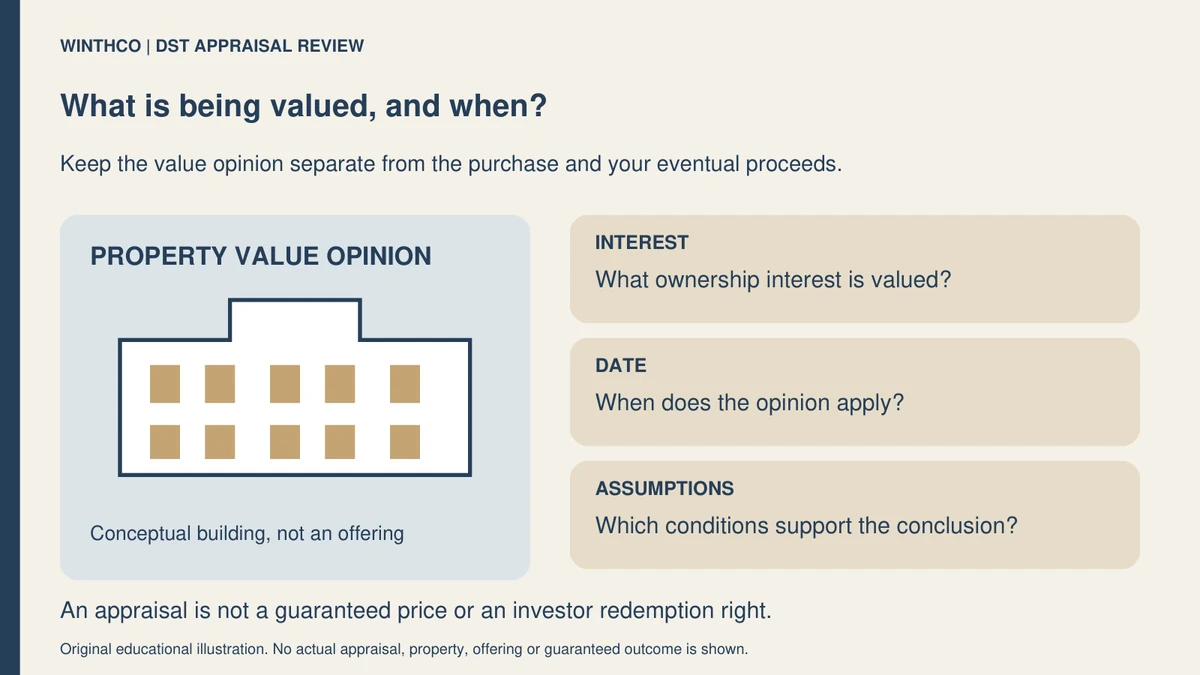
A DST property's appraised value is an opinion tied to a particular interest, date and set of assumptions. It is not necessarily the offering's total cost, a guaranteed future sale price or the cash an investor could receive. Review the appraisal alongside acquisition costs, debt, reserves, fees and the governing documents.
A property seller may hear several numbers before making a decision: a broker's suggested asking price, an estimated closing amount and an appraisal of a possible replacement property. Interview an appropriately licensed realtor or commercial broker about relevant experience, valuation evidence, marketing, fees and sale readiness. Gather leases, expense records, improvement history and current debt information before comparing those numbers.
If a deferred exchange is contemplated, involve the CPA, attorney and qualified intermediary before closing or receiving proceeds. Begin the replacement review early. Winthco's guide to evaluating DST offering documents identifies appraisal value among the information to examine. This article focuses on reading that number in context, not on producing an appraisal or recommending a particular offering.
Share your timeline and investment range. A Winthco team member will follow up with you.
The Office of the Comptroller of the Currency describes appraisals as professional judgments about real-property market value informed by market factors. That description is useful for an investor: the conclusion is an opinion supported by analysis, not a commitment from a buyer. Ask for the report or available supporting information rather than treating a number copied into a marketing summary as the complete evidence.
Identify the property interest being valued, effective date, intended use and key assumptions. Ask the professional reviewing the investment to explain whether the reported interest matches the ownership and lease structure described in the offering. Do not assume that a valuation of an entire property is also a price at which your restricted beneficial interest can be sold.
Ask who engaged the appraiser and which parties may rely on the report. Have a qualified appraisal professional explain material methods or limitations that are unclear. This is a practical request for evidence, not a claim that every investor is entitled to rely on a lender's report or that the same engagement rules apply to every transaction.
The interagency appraisal guidelines distinguish an as-is value from prospective values associated with expected completion or stabilization. An as-is opinion addresses the property's condition, use and zoning at its effective date. A prospective opinion concerns an expected future date and assumptions. Those labels should remain attached to the number whenever it is discussed.
If a summary mentions stabilized value, ask what occupancy, work, spending and elapsed time the analysis assumes. Which conditions are already present, and which still need to occur? Ask how the costs and risks of reaching that condition appear in the investment's budget. A prospective value should not quietly become a statement that the property has already achieved the projected result.
The agencies' appraisal FAQs also explain that the continued usefulness of an older valuation depends on facts such as property and market conditions, not a universal expiration period. In applying that idea, request an explanation of significant changes since the effective date. Examples to investigate include a major tenant departure, new repair findings or changed financing assumptions. A newly printed brochure does not update the underlying appraisal.
Discuss your DST questions with Winthco →
Request a sources-and-uses schedule that shows how investor equity and any borrowing are allocated. Separate the amount paid for the real estate from reserves, offering expenses, financing costs and other disclosed uses. Identify acquisition-related compensation and payments involving affiliates. Ask the sponsor to reconcile the schedule with the property purchase information and the appraisal rather than comparing only the largest numbers.
A difference is a question to understand, not an automatic finding that the offering is attractive or inappropriate. Some dollars may fund cash reserves or transaction expenses rather than additional appraised real estate. Ask what each category represents and how it affects the investor's economic position. Avoid calling every difference a fee, and avoid treating every subscribed dollar as independently appraised property value.
Winthco's DST selection considerations place fees, property type, financing and household goals in the broader review. Keep your comparison consistent across offerings: label property value, acquisition price, equity, debt and total capitalization separately. If a figure is missing, mark it as unresolved rather than using zero or assuming a competing proposal uses the same definition.
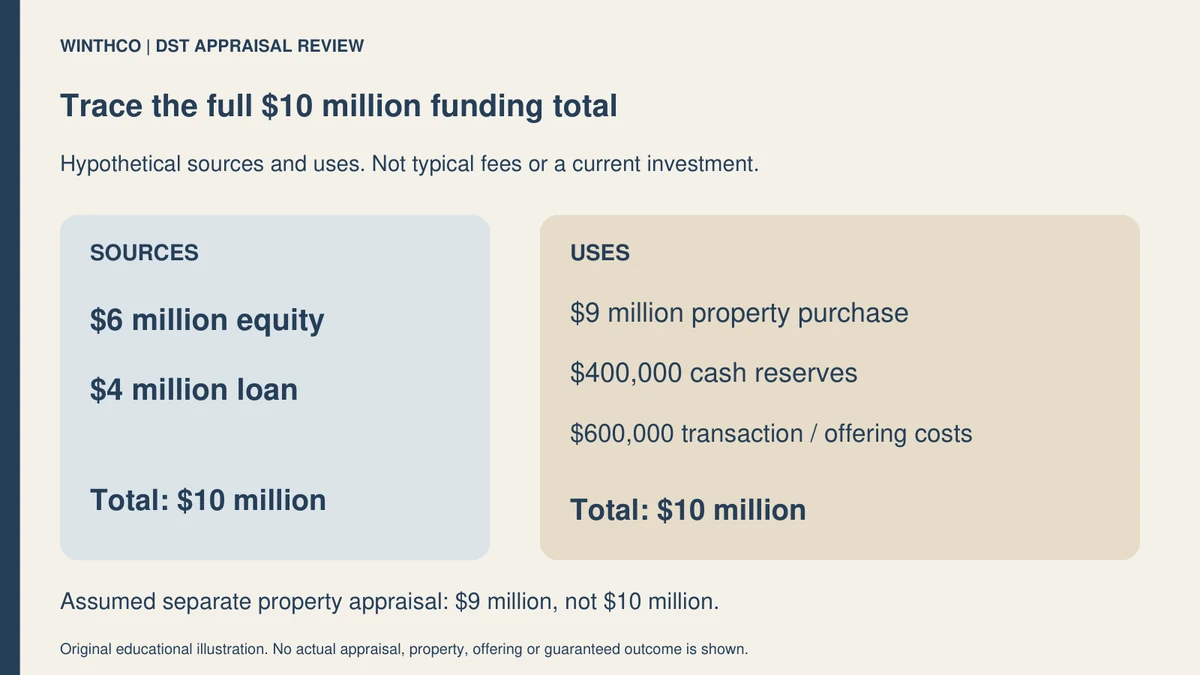
Suppose a fictional acquisition uses $6 million of investor equity and a $4 million loan. The $10 million total funds a $9 million property purchase, $400,000 of cash reserves and $600,000 of combined transaction and offering costs. Assume a separate appraisal concludes $9 million for the stated property interest and date. These invented figures illustrate categories only, not normal fees, a current offering or a fair-price conclusion.
The appraisal in this example does not turn the $10 million funding total into $10 million of real-estate value. Nor does the $1 million difference represent only compensation: the example separately identifies reserve cash. Ask the sponsor to provide the equivalent reconciliation using actual documents, with every recipient and purpose identified. Request explanations for changes between the initial and final schedules.
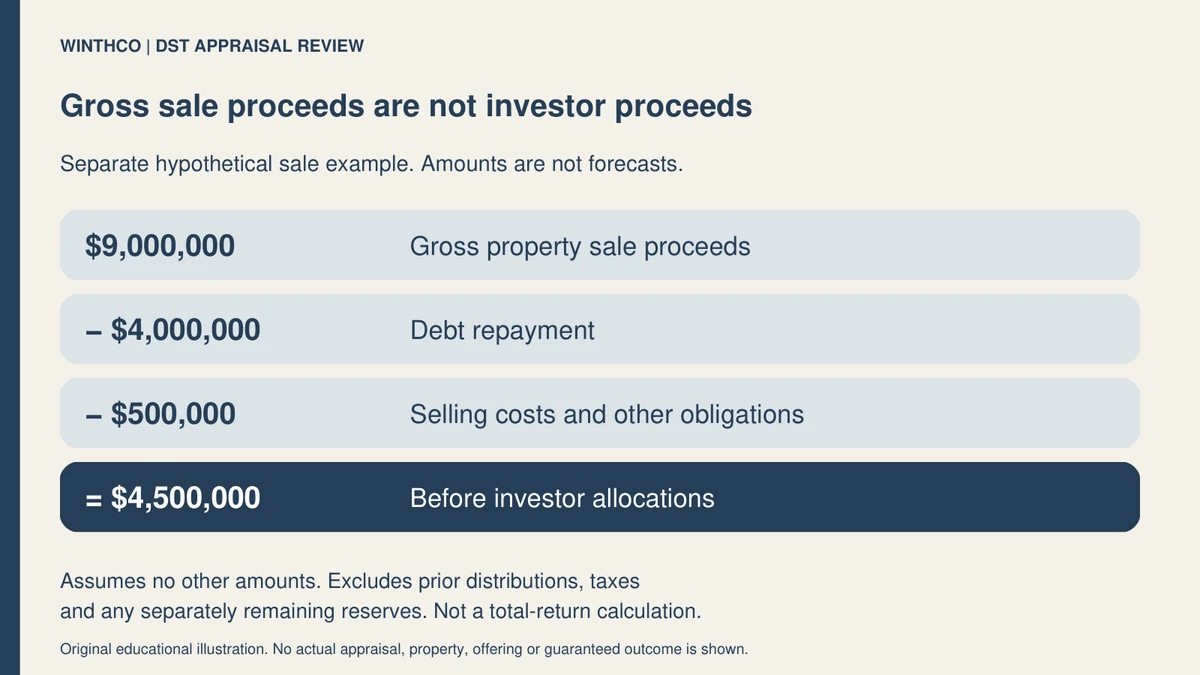
Now consider a separate, simplified future-sale scenario: $9 million of gross proceeds minus $4 million of debt and $500,000 of selling costs and other obligations leaves $4.5 million before investor allocations. Assume no other amounts in this arithmetic. It is not a total-return calculation, and it does not include prior distributions, taxes or any separately remaining reserves. Actual proceeds depend on the transaction and documents.
WATCH & LEARN
Winthco Wealth Management introduces general DST and property-sale planning. This background video is not an appraisal, a valuation of an offering or a guarantee of investor proceeds. Review the actual reports and documents with qualified professionals. Original resource · Watch on YouTube ↗
Educational context only. The discussion does not establish the suitability, returns or tax treatment of an investment.
A property appraisal does not create an investor redemption right. Read transfer restrictions, required approvals and any costs or limitations affecting a sale of your interest. Ask whether a quoted value is a property-level estimate, an account-reporting figure or an actual offer from a buyer. Those descriptions should not be treated as interchangeable merely because they appear in dollar amounts.
The SEC cautions that private placements can involve limited disclosure, restricted resale and the possibility of total loss. A favorable property appraisal does not remove those securities-level concerns. Review sponsor conflicts, debt, tenant performance, expenses and the ability to sustain reduced distributions. An investor can face an unfavorable outcome even when a property once appraised near its acquisition price.
Use Winthco's DST purchase-process overview to organize the conversations before subscribing, not to rush past unresolved valuation questions. Ask for a downside discussion involving lower sale proceeds and a delayed exit. Review what happens to debt repayment, expenses and the amount left for investors. Treat the response as a scenario with stated assumptions, not a prediction.
No. IRS Revenue Ruling 2004-86 analyzes a specified trust arrangement and its treatment under Section 1031. Tax and legal professionals must assess the actual structure and transaction. An appraisal does not by itself establish that a particular interest qualifies as replacement real property, that the exchange is correctly executed or that all eligible gain will be deferred.
IRS Form 8824 instructions generally require identification within 45 days after transfer and receipt by the earlier of 180 days or the applicable tax-return due date, including extensions. Section 1031 can defer eligible gain when requirements are met; it does not eliminate tax. Have the CPA and QI review cash, liabilities, possible boot and alternatives separately from the property's investment value.
A possible later Section 721 contribution to an UPREIT operating partnership requires a separate valuation and terms review and may never happen. IRS Publication 541 explains the general partnership-contribution framework and exceptions. Ask how contribution value and any unit allocation would be determined. OP units and ordinary REIT shares generally are not direct 1031 replacement property, and FIFO treatment does not guarantee tax-free basis withdrawals.
Private DST offerings are generally limited to accredited investors and offered through a private placement memorandum. Consider illiquidity, limited control, sponsor and property risk, debt, fees, concentration, changing tax law and loss of principal. Distributions may change or stop. A third-party appraisal is one input, not a substitute for the complete investment review.
FINRA's concentration guidance supports examining related exposures and the difficulty of accessing illiquid holdings. Bring the proposed commitment into a broader Winthco financial-advising and wealth-management conversation covering other property, financial assets, 401(k)s, IRAs, retirement-income needs and accessible cash. Ask whether essential household spending would remain manageable if the investment sold later or for less than expected.
Coordinate tax estimates, beneficiary choices and estate documents with the appropriate professionals. Retirement accounts are not Section 1031 proceeds, and a property sale does not automatically justify an account rollover, transfer or advisory engagement. Compare relevant options, costs and services separately. Use the prospect form to discuss your sale timeline and unanswered appraisal questions; request a verified secure channel before sharing confidential reports.
| Decision | Evidence to request | What to avoid assuming |
|---|---|---|
| Appraised property value | Interest valued, effective date and assumptions | A guaranteed sale or investor-redemption price |
| Acquisition funding | Equity, debt and a complete sources-and-uses schedule | Every dollar buys appraised real estate |
| Prospective value | Future condition, timing and supporting assumptions | The projected condition already exists |
| Investor proceeds | Debt, costs, other amounts and allocation provisions | Gross property value equals cash payable to you |
No. It is a value opinion under stated conditions, not a buyer's promise. An eventual transaction may occur on different terms.
Not necessarily. Identify the interest covered by the report and review your own transfer rights. A property-level conclusion does not establish an available secondary-market buyer.
Total acquisition funding can include reserves and expenses in addition to real estate. Request a complete reconciliation and evaluate the actual terms rather than assuming the difference is either harmless or improper.
It concerns the property's value at an expected stabilized condition and date. Review the assumptions, required work and costs rather than treating the projection as today's achieved result.
There is no useful universal shortcut for the investor's review. Ask how material property and market changes since the effective date affect the conclusion.
No. Tax qualification and exchange execution require separate professional analysis. A property value estimate cannot replace that review.
Sources checked October 17, 2026. This article explains general concepts; your facts and the applicable documents control.
Winthco DST services · Winthco evaluation overview · Editorial standards
Risks and due diligence
Learn how to review DST acquisition costs, ongoing expenses, financing charges and exit fees without relying on a single headline number.
Read guide →DST investment due diligence
Selling a rental property? Learn how to review a DST private placement memorandum, compare fees and risks, and assess separate 721 UPREIT terms.
Read guide →DST due diligence
Review DST loan maturity, balloon payments and exit assumptions before exchanging a rental. Prepare questions about debt and household liquidity.
Read guide →Explore Winthco’s main DST article collection
Share your timeline and investment range. A Winthco team member will follow up with you.