DST ownership and exits
DST holding period and exit timing
Understand DST holding periods, sponsor sale timing, early-exit limits and the tax decisions that may follow a trust's disposition.
Read guide →
Home / Learning center / DST due diligence
DST due diligence
Winthco Wealth Management · Updated October 16, 2026
DST loan maturity risk is the possibility that a property cannot repay its remaining debt when due on acceptable terms. Before buying a leveraged DST interest, compare the contractual maturity date, expected loan balance, sale assumptions and permitted alternatives. Regular interest payments do not necessarily reduce principal or resolve the final repayment obligation.
A landlord planning a sale may focus on the mortgage being paid off at closing. Start by asking a licensed realtor or commercial broker about valuation, marketing, fees and a realistic sale process. Gather the payoff information for your current property. Then ask a different question about any proposed DST: what debt would the replacement property carry, and when would it come due?
Coordinate with the CPA, attorney and qualified intermediary before closing or receiving proceeds if a deferred exchange is contemplated. Use Winthco's DST document-evaluation questions to organize the investment review early. Debt allocation for exchange purposes and the ability of a property to repay its loan are separate issues. A transaction can address a tax-planning objective while introducing a maturity risk that still needs careful evaluation.
Share your timeline and investment range. A Winthco team member will follow up with you.
The loan term tells you when repayment is due. The amortization schedule describes how principal is scheduled to decline through payments. An interest-only period describes payments that do not include scheduled principal reduction. These features can coexist in one loan, so a payment amount or interest rate alone cannot explain the remaining debt at maturity.
The OCC's Commercial Real Estate Lending handbook describes a balloon payment as the remaining principal due at the end of a loan that has not fully amortized. Its guidance also notes the repayment risk associated with interest-only terms and long amortization periods. Although written for bank supervision rather than DST suitability, that distinction helps investors ask why manageable periodic payments may leave a substantial final obligation.
Request the actual loan schedule and a dated estimate of principal due at maturity. Ask whether the interest rate is fixed or variable, when any interest-only period ends and which assumptions affect the projection. Do not infer that a fixed rate fixes the property's eventual sale price. Have the investment professional explain the numbers and counsel interpret material loan provisions.
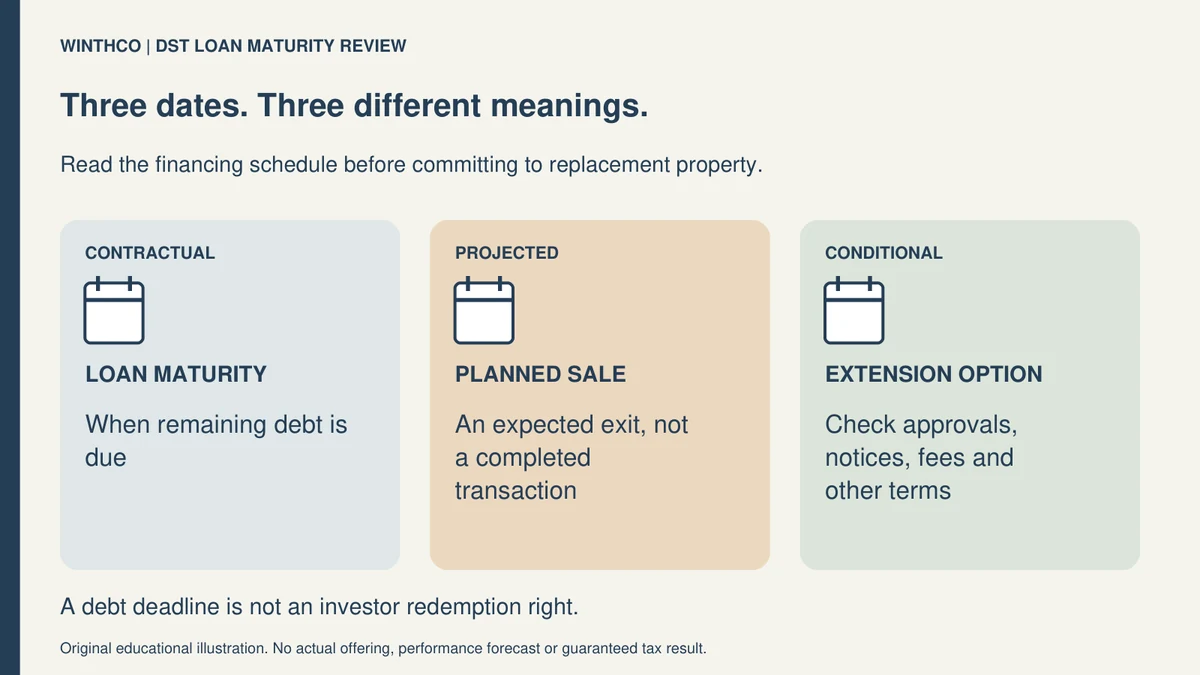
Put the contractual maturity date beside the sponsor's contemplated sale window, material lease expirations and any conditional extension deadlines. Label each date by its source. A loan document may establish an obligation, while an offering projection describes an expectation. Combining them on one sheet makes a timing mismatch visible without pretending that all events are equally certain.
If an extension is described, ask who can exercise it, what conditions apply, whether approval is required and what notice or payment is due. Request the relevant provisions rather than relying on a sales summary. An available option subject to conditions is different from an extension already granted. Do not count an unexercised extension as additional assured holding time.
Winthco's DST holding-time overview provides context for the ownership discussion, but the sponsor's planned holding period is not a personal redemption date. Ask when marketing would need to begin to support the proposed exit, what could delay closing and how the documents address the remaining loan if a sale does not occur as expected. The response should identify contingencies, not just repeat the target year.
Discuss your DST questions with Winthco →
IRS Revenue Ruling 2004-86 analyzes a particular trust arrangement with limited trustee powers, including restrictions on renegotiating acquisition debt. It also explains that additional powers, including refinancing, can change the entity's federal tax classification under the facts described. Do not treat every entity labeled a DST as having identical documents or unrestricted refinancing authority.
Ask tax counsel and the attorney to explain the actual trust agreement, loan terms and any contemplated change in structure. If a manager mentions a conversion, workout or another entity, request a plain-English explanation of who would own what afterward and which tax consequences require analysis. A potential alternative is not the same as an approved, executable plan that preserves every original objective.
This issue does not mean that a maturity problem has only one possible outcome. It means the response must be supported by the applicable documents and professional analysis. Ask which decisions rest with the lender, trustee, sponsor or other parties. Do not assume investors can direct a refinancing, supply additional capital or select a sale date merely because they own beneficial interests.
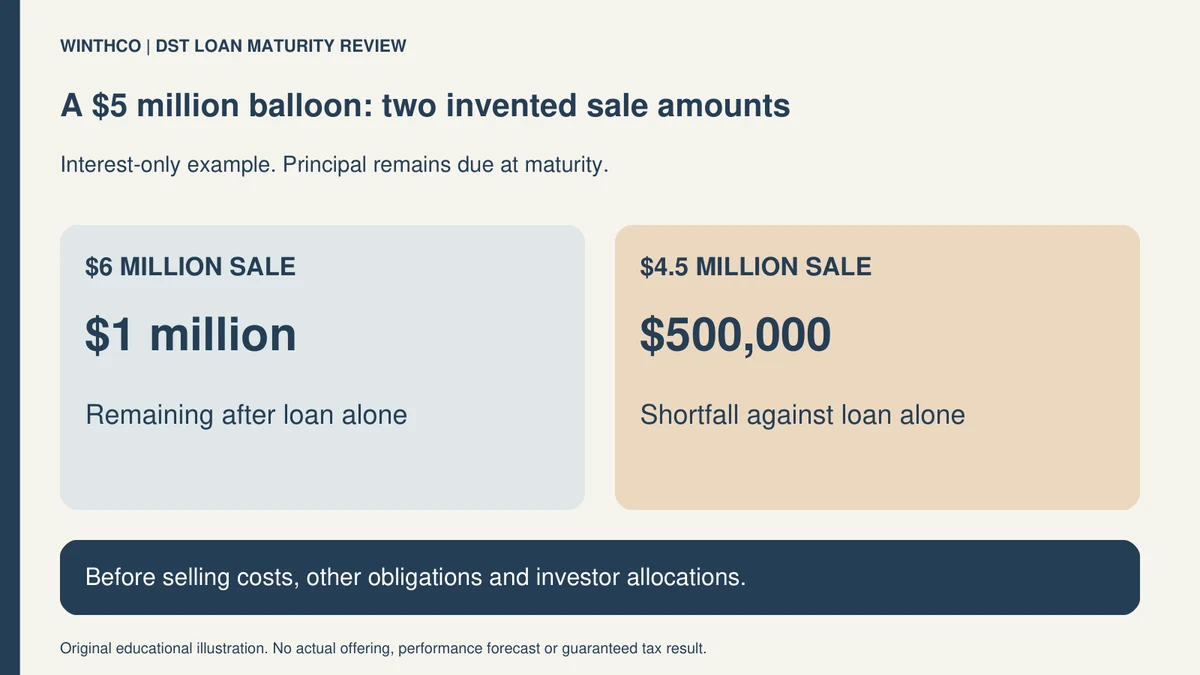
Consider a hypothetical property with a $5 million interest-only loan whose full principal remains due at maturity. If an illustrative sale produces $6 million before selling costs and other obligations, $1 million remains after the loan alone. If the illustrative sale amount is $4.5 million, there is a $500,000 shortfall against the loan alone. These invented figures are arithmetic, not an offering or forecast.
Neither result is an investor distribution calculation. Selling costs, reserves, other liabilities, ownership allocations and the governing documents still matter. Ask the sponsor for a reconciliation from gross property proceeds to potential investor proceeds, with each deduction identified. An appraisal or projected sale value is not cash received, and a sponsor's favorable scenario should not be treated as the only possible outcome.
Request a separate scenario combining a delayed sale with weaker operations. What obligations remain, and which permitted responses are available? Ask how a material lease expiration before maturity changes the assumptions. Have the professionals explain relevant lender remedies and potential loss exposure. A nonrecourse description does not protect the equity investment from declining property value or loss of principal.
WATCH & LEARN
Accruit explains DSTs as replacement property in a 1031 exchange. This third-party introduction is general structural background, not a loan-maturity assessment or a promise of diversification, distributions or tax treatment. Accruit is the creator, not a Winthco representative. Original resource · Watch on YouTube ↗
Educational context only. The discussion does not establish the suitability, returns or tax treatment of an investment.
An investment without acquisition debt avoids that particular loan's maturity obligation, but it still faces property expenses, market conditions, tenant risk and illiquidity. Use Winthco's debt-free DST background when comparing structures, not as a conclusion that one is appropriate for every seller. Compare a qualifying exchange, a taxable sale and continued ownership where relevant; do not select leverage solely because it appears in a tax worksheet.
A proposed later Section 721 contribution to an UPREIT operating partnership requires its own evaluation. IRS Publication 541 explains the general partnership-contribution framework and exceptions. Tax and legal professionals should analyze the actual terms, liabilities and related transfers. A planned contribution may not occur and should not be treated as a guaranteed way to retire or assume the DST property's debt.
OP units and ordinary REIT shares generally are not direct Section 1031 replacement real property. If an UPREIT transaction is proposed, review the partnership's financing, fees, control and redemption conditions separately. Later dispositions or redemptions can have tax consequences. FIFO treatment does not guarantee tax-free withdrawals of basis, and a broader portfolio does not remove every debt or liquidity risk.
A maturity review is one part of investment due diligence. Private DST offerings are generally limited to accredited investors and offered through a private placement memorandum. The SEC cautions that private placements may involve limited disclosures, resale restrictions and loss of the entire investment. Examine sponsor conflicts, fees, property condition, tenant exposure and tax-law changes alongside the financing documents.
Distributions may change or stop, and a projected exit may be delayed or produce a loss. FINRA warns that concentration can include holdings sharing related exposures or limited liquidity. Ask whether several DST interests depend on sales during the same period, as well as whether they share markets or tenants. That is a practical portfolio question, not a prediction that a particular maturity year will be unfavorable.
Keep exchange execution separate. IRS Form 8824 instructions generally require identification within 45 days after transfer and receipt by the earlier of 180 days or the applicable return due date, including extensions. Eligible gain may be deferred when requirements are met, not eliminated. Have the CPA and QI evaluate cash, liabilities, possible boot and alternatives without letting a deadline substitute for satisfactory investment review.
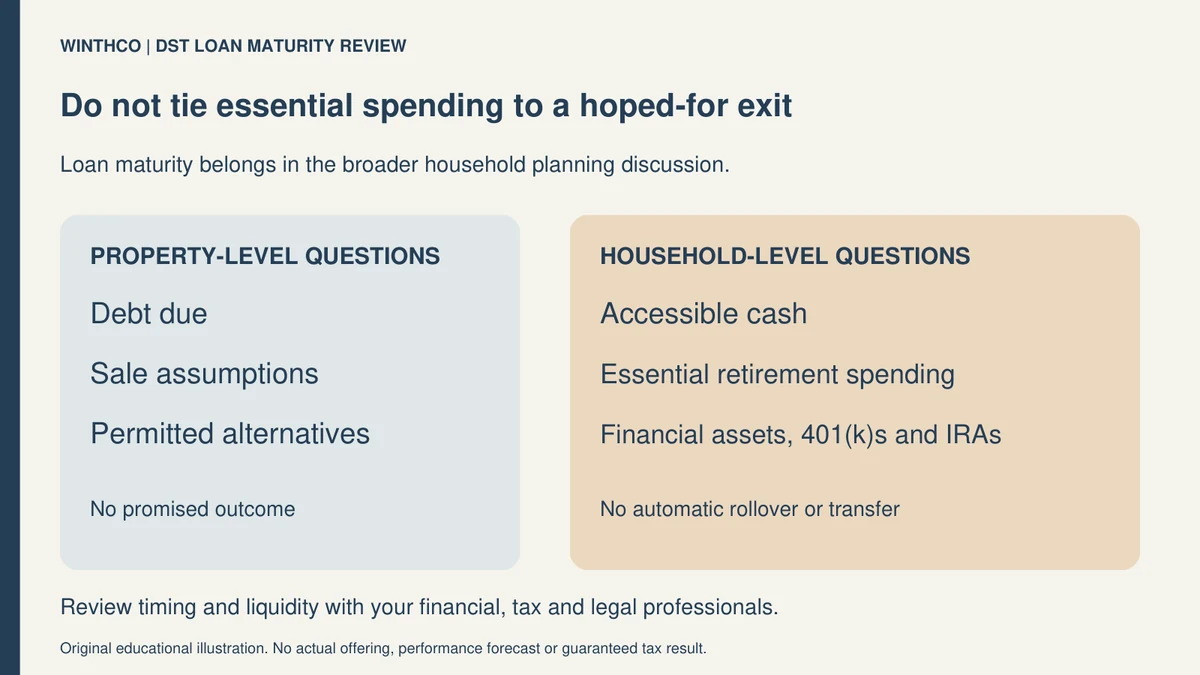
Bring the property decision into a broader discussion with Winthco's financial-advising and wealth-management team. Review existing financial assets, remaining rentals, 401(k)s, IRAs, cash reserves and essential retirement spending. Ask how the household would respond if the investment paid less or returned capital later than projected. Do not match an essential personal expense to an uncommitted property sale as though it were a scheduled bank withdrawal.
Coordinate beneficiary and estate questions with counsel and tax estimates with the CPA. Retirement accounts are not Section 1031 exchange proceeds, and selling a rental does not automatically justify a rollover, transfer or advisory engagement. Compare relevant options, costs and services independently. Use the prospect contact form to discuss the sale timeline and loan-review questions; request a verified secure channel before providing confidential statements or transaction documents.
| Decision | Evidence to request | What to avoid assuming |
|---|---|---|
| Loan maturity | Contractual date and principal due | A planned sale automatically repays the loan |
| Amortization | Actual principal-reduction schedule | Every monthly payment reduces principal |
| Extension | Conditions, notices, fees and approval requirements | An option is an extension already granted |
| Investor exit | Sale assumptions, costs and governing documents | Property maturity creates a personal redemption right |
It is the remaining principal due at the end of a loan that has not fully amortized. Review the actual schedule rather than inferring the balance from the periodic payment.
No. Fixing the rate does not establish the property sale value or provide the cash needed for final repayment. Property performance and the loan documents still matter.
No. A property financing obligation is different from an investor withdrawal right. Review the trust documents and transfer restrictions.
Do not assume so. Revenue Ruling 2004-86 concerns a specified arrangement with limited powers; have tax and legal professionals explain the actual structure and any proposed change.
No. Personal liability under loan documents and the risk to invested equity are different questions. Ask counsel to explain the actual provisions and exceptions.
No future contribution should be treated as assured. Evaluate the current investment and any proposed partnership transaction separately, including debt, liquidity and tax consequences.
Sources checked October 16, 2026. This article explains general concepts; your facts and the applicable documents control.
Winthco DST services · Winthco evaluation overview · Editorial standards
DST ownership and exits
Understand DST holding periods, sponsor sale timing, early-exit limits and the tax decisions that may follow a trust's disposition.
Read guide →1031 replacement property
Compare debt-free and leveraged DST structures, exchange debt analysis, loan risks, liquidity and due diligence before a 1031 exchange.
Read guide →DST due diligence
Before exchanging a rental into a DST, review repair budgets, restricted reserves and funding limits. Know which questions to ask before committing.
Read guide →Explore Winthco’s main DST article collection
Share your timeline and investment range. A Winthco team member will follow up with you.