Alternatives and comparisons
DST Distributions vs. Rental Cash Flow
Compare DST distributions with rental cash flow, fees, tax reporting and retirement spending before selling an investment property.
Read guide →
Home / Learning center / DST Due Diligence
DST Due Diligence
Winthco Wealth Management · Updated November 17, 2026
DST rent increases do not necessarily keep pace with inflation or increase investor distributions. The result depends on the actual lease formula, timing, expenses, reserves and financing. Before using a Delaware statutory trust for retirement income, distinguish contractual rent changes from projected market growth and test what the cash could buy after prices rise.
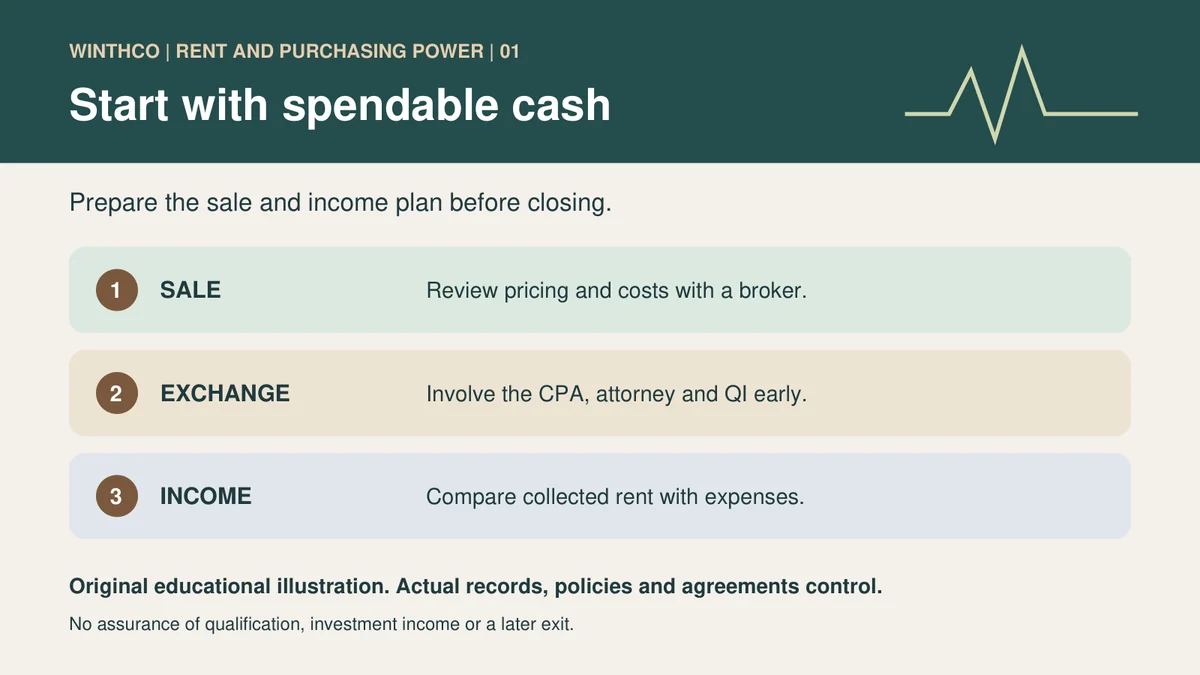
Before listing an investment property, consider what you want the sale to accomplish. Reducing management duties and maintaining spending power are different goals. Interview an appropriately licensed realtor or commercial broker about valuation, likely buyers, marketing, compensation and sale readiness. Ask for a net-proceeds estimate and realistic closing contingencies. Compare the property's current rent roll with its actual expenses, rather than treating gross rent as the income you are replacing.
Involve your CPA, attorney and qualified intermediary before closing if you are considering a deferred 1031 exchange. Qualifying exchanges can defer eligible gain, not eliminate tax. Ordinary deadlines require identification within 45 days and receipt by the earlier of 180 days or the federal return due date, including extensions. Cash or other non-like-kind consideration can create recognized gain. A deadline should not turn a claim about inflation protection into an accepted investment assumption.
Share your timeline and investment range. A Winthco team member will follow up with you.
An offering might describe scheduled rent increases, exposure to growing market rents or preservation of purchasing power. Those are three separate propositions. A lease clause specifies what a tenant owes; a market forecast estimates what space might command; purchasing power describes what your money can buy. The SEC identifies inflation as a risk because rising prices can reduce the value of income in real terms. None of these concepts establishes that your distribution will rise each year.
Winthco's overview of DST replacement interests explains the ownership structure. In a qualifying DST, an investor can exchange direct landlord responsibilities for a beneficial interest in real estate, but generally gives up control over day-to-day decisions. Ask which document supports an inflation-related statement and where it appears in the lease or private placement memorandum. A presentation graph is not a contractual promise.
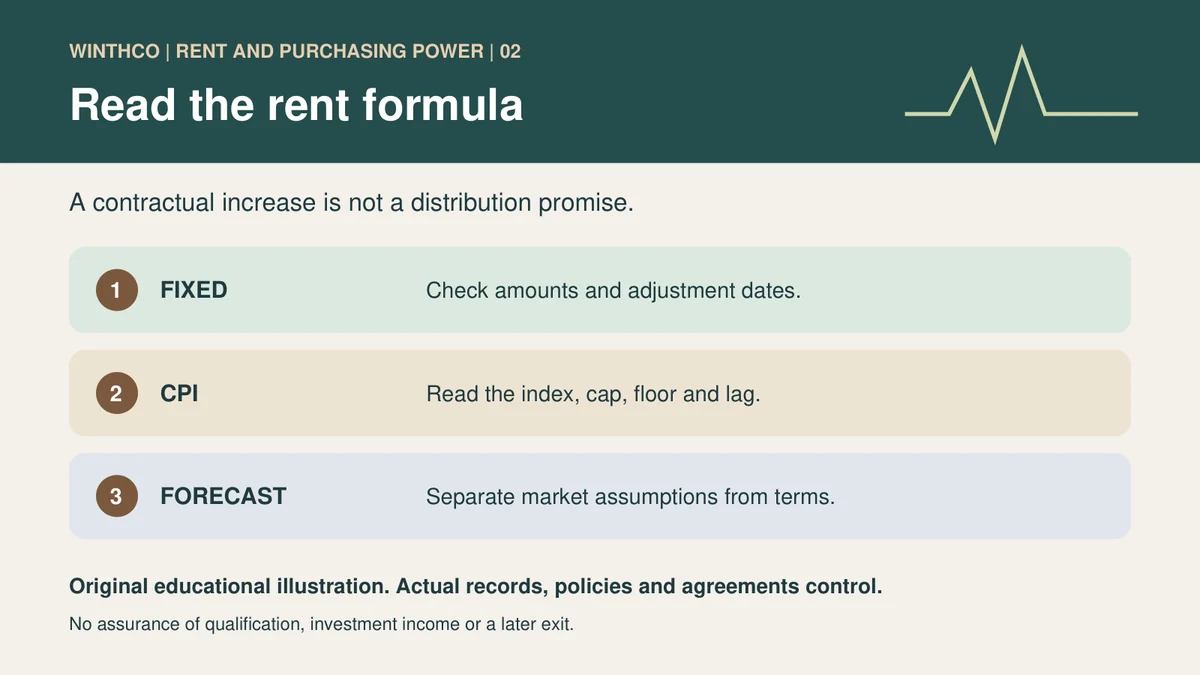
A fixed escalator sets an increase according to the lease's stated schedule. It might apply annually or only at specified intervals. A CPI-linked formula instead references a defined consumer-price index. Read the precise index, base period, comparison dates and calculation method, plus any cap, floor or delay. Do not assume a phrase such as 'inflation-linked' means the tenant pays every change in prices immediately or without a limit.
Revenue Ruling 2004-86 describes a particular net lease in which rent can adjust through a fixed rate or objective index such as CPI, with neither party controlling the rate or index. The ruling addresses specific facts and trust restrictions, not a blanket approval of every DST or lease design. Have counsel review the actual structure. It does not establish that any rent formula will match your household's rising expenses.
Create a simple schedule from the signed lease: current rent, next adjustment date, formula, limitations and renewal provisions. Separate increases already required by contract from increases assumed after a future lease expiration. If the investment thesis depends on replacing a tenant at a higher rent, ask about vacancy, leasing costs and the evidence for that assumption. Our lease-expiration and tenant-rollover discussion addresses the separate risks of re-leasing space.
Discuss your DST questions with Winthco →
Start by identifying the payer. A property can have tenants paying rent to a master tenant that separately owes rent to the DST. Growth in rents collected from occupants is not automatically identical to growth in the rent owed under the master lease. Trace the actual agreements and any permitted additional payments. The master-lease risk guide explains why the master tenant's finances and obligations matter alongside the underlying property's occupancy.
Next, identify responsibility for taxes, insurance, repairs, utilities and major replacements. A net lease can shift specified costs to the tenant, but the exact allocation and exceptions still matter. Shifting a cost does not make it disappear economically: an obligated tenant must be able to pay it. Ask how rising costs could affect tenant performance, credit support and the trust's position if payment is interrupted. Review reserve funding and restrictions separately.
Hypothetical arithmetic, not an offering or forecast: assume annual rent of $100,000 and owner-paid operating expenses of $40,000. If rent rises 2% while those expenses rise 5%, the next amounts are $102,000 and $42,000. The $60,000 difference is unchanged. This simplified example excludes debt, fees, reserves, capital work and taxes. It shows why a rent increase alone cannot establish growth in cash available to an investor.
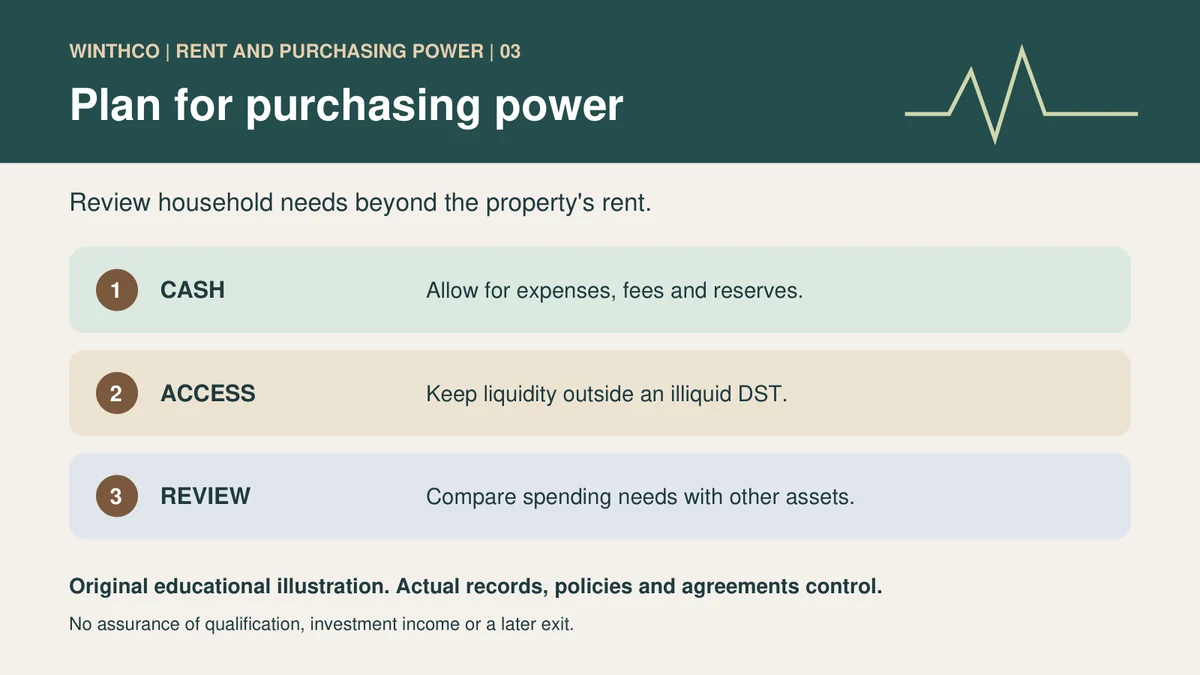
Property revenue must be considered alongside the applicable expenses, debt service, fees and reserves. Ask for a reconciliation from collected revenue to cash available for distribution and identify each deduction. Determine whether the advertised amount depends on operating results, reserve releases or other sources. A payment supported by a reserve is not evidence that the property earned more rent. Our rental cash flow and DST distributions comparison provides additional questions about the source of cash.
Use Winthco's guide to evaluating DST documents to organize the review. Obtain the private placement memorandum, lease summaries, material agreements and assumptions supporting projections. Ask the recommending professional what investigation supports the proposed investment, including the reasonableness of rent and expense assumptions. FINRA Notice 23-09 discusses broker-dealer obligations in private placements. Neither that guidance nor a professional's review guarantees the investment's results.
Consider financing separately. If an offering has floating-rate exposure, ask how rate changes, any cap and its expiration affect cash. If debt is fixed, examine maturity and what must happen when it comes due. Lower expenses in one category do not eliminate another risk. Acquisition, ongoing and disposition fees also affect the economics. Compare compensation and affiliate payments rather than assuming a scheduled rental increase reaches investors dollar for dollar.
WATCH & LEARN
Accruit explains DSTs as passive replacement property in a 1031 exchange. Third-party structural background, not an inflation forecast or a Winthco affiliation. Rent growth, distributions and tax qualification are not assured. Original resource · Watch on YouTube ↗
Educational context only. The discussion does not establish the suitability, returns or tax treatment of an investment.
A contractual obligation is only useful if the obligated party performs. Tenant default, vacancies, repairs, weak local demand and sponsor decisions can impair results. A long lease may provide a specified rent schedule while limiting the opportunity to reset rent if market prices rise faster. Conversely, an assumption of frequent resets can involve turnover and leasing costs. Review the actual balance instead of treating either lease style as universally superior.
DST private placements generally are limited to accredited investors and offered through a private placement memorandum. They can be illiquid, have limited public information and expose investors to loss of principal. Distributions can decline or stop. Concentration by tenant, sponsor, region or property type can persist even across multiple DSTs. A projected sale value is not a liquid reserve, and a longer holding period can extend exposure to changing costs and purchasing power.
No. A later Section 721 contribution to a partnership is a separate potential transaction, not an automatic stage of a 1031 exchange. It may never be offered or completed. Ordinary REIT shares and partnership units are not direct Section 1031 replacement real estate. Review consent rights, valuation, expenses, conflicts and individual tax consequences with your advisers before relying on a proposed contribution.
A future operating partnership interest can introduce different holdings and redemption conditions, but it does not promise inflation-adjusted distributions or ready cash. Do not make a current purchase affordable only by assuming a later conversion or redemption. Ask what your plan would look like if the DST remained in place longer, income fell and the anticipated subsequent transaction did not occur.
Begin with household spending, not a target distribution percentage. Separate essential expenses, flexible spending and foreseeable larger costs. Compare those needs with accessible cash and other income sources, and model a period without DST distributions. A CPI-linked lease, even when present, need not track your personal mix of housing, healthcare and family expenses. Keep the inflation assumption used for planning distinct from a prediction about any particular investment.
Review taxable investments, 401(k)s, IRAs, asset allocation and liquidity with your financial adviser. Retirement accounts are not 1031 exchange proceeds. Compare costs, services and access rules before any rollover or transfer, and coordinate beneficiary and estate questions with counsel. Winthco's wealth-management discussion can connect the property decision to these broader needs without assuming every account should move.
Use either prospect form on this article or the dedicated contact page to describe your general sale timeline and income-planning question. Do not include account numbers, tax returns or tenant records in an initial inquiry. The useful question is not simply whether rents can rise. It is whether the documented structure, downside risks and liquidity limits fit the way your household needs to use its money.
| Decision | Evidence to request | What to avoid assuming |
|---|---|---|
| Fixed escalator | Amount, timing and exceptions | It matches future inflation |
| CPI-linked formula | Index, dates, cap and floor | It tracks personal expenses exactly |
| Projected market rent | Evidence, vacancy and leasing costs | Forecast growth is contracted |
| Investor distribution | Fees, debt, reserves and cash source | Rent growth equals payout growth |
No. The actual lease may contain fixed increases, an index-based formula or other provisions. Read the governing documents rather than inferring protection from the property type.
No. Payment timing, caps, expenses, reserves and other obligations can affect cash available. The tenant also must perform its obligations.
No. A forecast is an assumption about future conditions. A signed lease establishes contractual obligations subject to its terms and the parties' performance.
Yes. Costs, debt service, fees or reserve requirements may offset higher collections. Review the full cash reconciliation rather than only the rent line.
There is no such assurance. A potential Section 721 transaction is separate, may not occur and carries its own investment, liquidity and tax considerations.
Sources checked November 17, 2026. This article explains general concepts; your facts and the applicable documents control.
Winthco DST services · Winthco evaluation overview · Editorial standards
Alternatives and comparisons
Compare DST distributions with rental cash flow, fees, tax reporting and retirement spending before selling an investment property.
Read guide →DST investment due diligence
Review who owes rent in a DST master lease, what supports payment, and how lease risks fit a property sale, 1031 exchange and retirement plan.
Read guide →DST due diligence
Learn how DST lease expirations, renewal assumptions, downtime and re-leasing costs can affect cash flow. Prepare a document-based review.
Read guide →Explore Winthco’s main DST article collection
Share your timeline and investment range. A Winthco team member will follow up with you.