DST investment due diligence
DST Master Lease Risks: A Property Seller's Guide
Review who owes rent in a DST master lease, what supports payment, and how lease risks fit a property sale, 1031 exchange and retirement plan.
Read guide →
Home / Learning center / DST due diligence
DST due diligence
Winthco Wealth Management · Updated October 30, 2026
DST lease-expiration risk is the possibility that tenants leave, renew on less favorable terms or require additional spending when leases end. Review the expiration schedule, contractual options, renewal assumptions, downtime and re-leasing costs together. Current occupancy alone does not show how future cash flow or investor distributions could change.
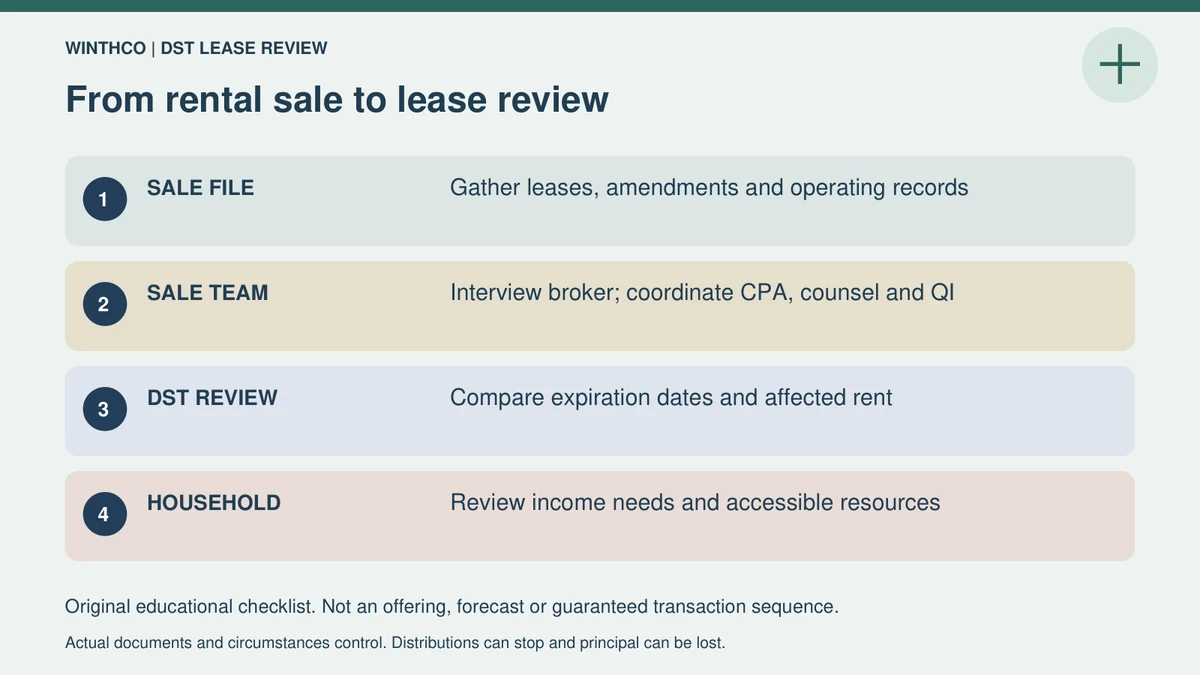
Start with the investment property you plan to sell. Interview an appropriately licensed realtor or commercial broker about property-type experience, valuation evidence, marketing strategy, fees and closing coordination. Bring leases, amendments, operating statements and improvement records. The quality of that sale file also reveals an important replacement-property question: are you reducing management work while accepting a different set of leasing risks?
If a deferred exchange is contemplated, involve the CPA, attorney and qualified intermediary before closing or receiving proceeds. The IRS generally requires identification within 45 days after transfer of the relinquished property and receipt by the earlier of 180 days or the applicable tax-return due date, including extensions. Potential gain deferral is not tax elimination. A DST real-estate overview provides context, but an exchange deadline does not make an untested renewal forecast reliable. The Culver City rent and lease records guide shows how sellers can distinguish lease terms and collections before testing a replacement property’s assumptions. The Glendale occupied sale and lease review applies a lease calendar to both the sale and the replacement-property decision.
Share your timeline and investment range. A Winthco team member will follow up with you.
Request a current rent roll and lease-expiration schedule through the authorized diligence process. For each relevant period, compare the share of space expiring with the share of contractual rent affected. Those measures answer different questions: a small area occupied by a high-rent tenant can matter disproportionately. Confirm the measurement date, definitions and treatment of vacant space before comparing summaries.
Read the underlying lease provisions rather than relying solely on the displayed expiration year. Ask about extension options, notice deadlines, early termination rights and any conditions attached to them. An available option is not the same as a completed renewal. Ask counsel which party controls each right and what evidence supports the assumption that the tenant will exercise it.
The OCC's Commercial Real Estate Lending handbook discusses reviewing current rent rolls, leases and significant upcoming expirations, including tenant turnover's potential effect on debt-service coverage. This is bank-supervision guidance, not an approval of a DST or a required investor scoring system. It supplies a useful analytical discipline: identify the contractual event, then examine the cash-flow consequences.
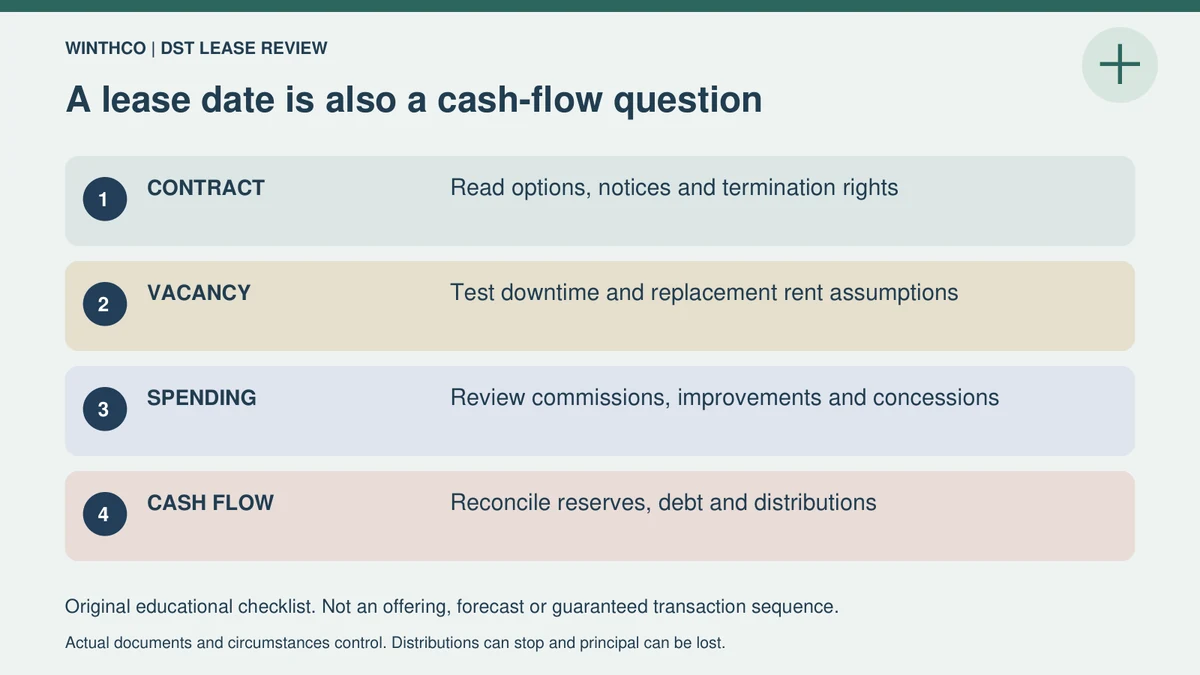
Ask which leases are signed renewals, which are active negotiations and which are simply modeled renewals. Separate a tenant's informal expression of interest from executed documents. Request the source and date of assumptions about renewal probability, replacement rent, concessions and the time needed to find a new occupant. A forecast should be recognizable as a forecast, not presented as already contracted revenue.
Compare the assumptions with property-specific leasing experience and appropriately comparable market evidence. Ask whether the evidence concerns the same property type, location, space condition and tenant needs. Broad market occupancy cannot establish demand for a specialized suite. Likewise, a tenant's recognizable name does not prove the financial capacity of the actual lease obligor or eliminate its contractual termination rights.
A weighted-average remaining lease term can be helpful, but it compresses a schedule into one number. Ask whether several important expirations cluster in the same year despite a comfortable-looking average. The DST sponsor review questions help identify who assembled the forecast, which outside evidence was used and how material discrepancies are investigated.
Discuss your DST questions with Winthco →
A lease expiration can create costs before a replacement tenant starts paying. Review assumed vacancy downtime, leasing commissions, tenant improvements, repairs, rent-free periods and other concessions. Ask when the cash is expected to leave the property and when rent is expected to resume. Some re-leasing costs may sit outside the operating-expense measure used in a headline net operating income figure.
The OCC handbook specifically notes that re-leasing costs matter to cash-flow analysis even when they are not included in the operating expenses used to calculate net operating income. Ask for a reconciliation from reported operating income to cash available after these costs, debt obligations, reserves and other applicable charges. Do not equate a favorable occupancy percentage with cash available for distribution.
Review reserves for their permitted uses, restrictions and funding assumptions. Money allocated to one purpose may not be available for another. Ask what happens if downtime lasts longer, construction costs increase or several renewals require spending together. The DST reserve review complements this analysis without treating a reserve balance as a guarantee that every leasing shortfall can be funded.
Identify the trustee, property manager, sponsor and any master tenant, then map their actual contractual responsibilities. A property manager's leasing activity is not automatically the same as the trustee entering a new lease. Ask who negotiates with occupants, which approvals are required, who pays each cost and how information reaches beneficial owners. Review affiliate relationships and compensation for potential conflicts.
IRS Revenue Ruling 2004-86 analyzed a specified arrangement with limited trustee powers. Its facts generally prohibited renegotiating the lease with the named lessee or entering leases with other tenants, with an exception for that lessee's bankruptcy or insolvency. Do not convert that specific structure into a universal statement that every operating party can freely renegotiate every lease.
Counsel should explain the governing documents, tax opinion and any contingency provisions that could change the structure. The master-lease responsibility guide separates the master tenant's obligations from underlying occupant collections. A master lease does not make underlying vacancies irrelevant or promise that its obligor can keep paying through stress.
WATCH & LEARN
Equity Advantage 1031 Exchange discusses the time and energy demands of direct ownership and DSTs as one possible alternative. This third-party video supplies general management context, not lease-renewal advice, an endorsement or a promise of income or liquidity. Original resource · Watch on YouTube ↗
Educational context only. The discussion does not establish the suitability, returns or tax treatment of an investment.
Consider two hypothetical properties with the same current occupancy. One has a large share of rent expiring near the loan's maturity; the other has more staggered expirations. This is an illustration, not an actual offering or client outcome. Neither is automatically superior: tenant credit, renewal rights, property condition, rent levels, debt terms and available reserves could change the comparison.
Ask the reviewing team to show a supported base case and a downside case with slower leasing, weaker rent and higher re-leasing costs. Compare the timing of spending, debt-service coverage and potential distribution reductions. Then identify which assumptions would need to be wrong for the plan to become stressed. No universal expiration percentage establishes suitability, and a model cannot predict which tenants will remain.
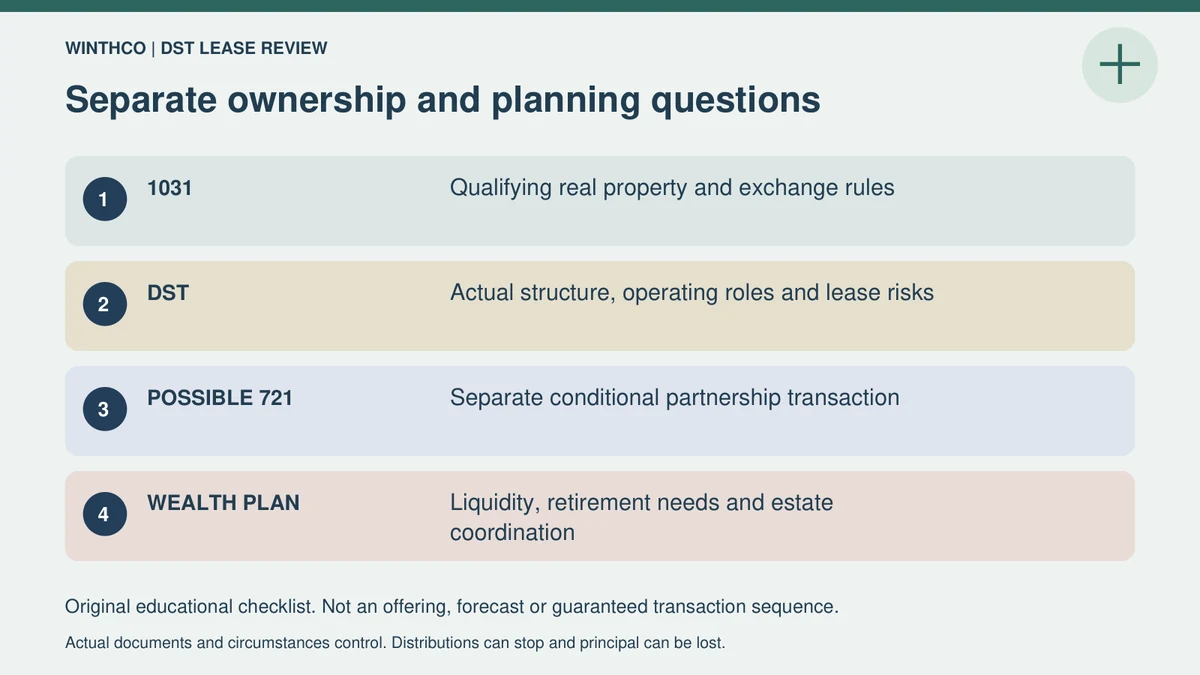
A possible later contribution to an operating partnership is a separate proposal, not a renewal strategy. Section 721 generally addresses property contributed for partnership interests, subject to exceptions and transaction facts. An UPREIT's operating partnership may hold real estate, but ordinary REIT shares and operating-partnership units generally are not direct Section 1031 replacement real property.
If materials describe a potential future contribution, ask who controls timing, how leasing conditions affect value and what approvals or other conditions remain. The event may never occur. Unit transfer and redemption restrictions, debt effects, fees and tax consequences require separate review. A proposed 721 path does not promise liquidity, eliminate property exposure or guarantee tax-free basis withdrawals. Analyze today's lease obligations without assuming a later transaction will solve them.
DST ownership may reduce direct management duties, but investors surrender substantial control and can face prolonged illiquidity. Tenant, property, sponsor, leverage, fee, conflict, concentration and tax-law risks remain. Distributions can change or stop, and principal can be lost. DST private placements are generally offered to accredited investors through offering documents; eligibility does not establish suitability or protection from loss.
FINRA cautions that correlated holdings and illiquid investments can concentrate risk. Review lease expirations across the household's real-estate exposure, not just within one DST. Multiple holdings may depend on similar tenants, markets or refinancing conditions. Compare the DST holding-period considerations with accessible savings, expected expenses and the consequences of a delayed property sale.
Connect the property decision with existing financial assets, 401(k)s, IRAs, retirement-income needs, asset allocation and beneficiary or estate coordination. Winthco's wealth-management discussion can include tax-professional coordination without assuming an account transfer, rollover or advisory engagement is appropriate. Compare relevant choices, costs and services separately. Use the prospect form for the planning question, not confidential leases or account records; request an approved secure process for later documents.
| Decision | Evidence to request | What to avoid assuming |
|---|---|---|
| Expiration schedule | Rent and space affected by period | Current occupancy answers the future question |
| Renewal evidence | Executed terms versus modeled assumptions | An option means a tenant will stay |
| Cash-flow bridge | Downtime, spending, reserves and debt | Headline NOI equals distributable cash |
| Operating authority | Actual contracts and governing documents | Every DST party has the same powers |
Not necessarily. Occupancy describes a current condition, while the expiration schedule identifies future contractual events. Rent exposure and renewal terms require separate review.
No. Ask who controls the option, what conditions apply and whether it has been exercised. Have counsel interpret the actual lease.
Review both. A relatively small space can account for a larger share of rental revenue, and summaries may use different definitions.
No. Ask how the particular presentation treats tenant improvements, commissions and other costs. Review a cash-flow reconciliation rather than relying on one label.
Do not assume that authority. The IRS ruling addressed a specified limited-power arrangement, and actual governing documents and operating roles need legal review.
No. The event may not occur and resulting units can remain restricted. Tax, valuation and liquidity consequences require separate analysis.
Sources checked October 30, 2026. This article explains general concepts; your facts and the applicable documents control.
Winthco DST services · Winthco evaluation overview · Editorial standards
DST investment due diligence
Review who owes rent in a DST master lease, what supports payment, and how lease risks fit a property sale, 1031 exchange and retirement plan.
Read guide →DST due diligence
Selling a rental? Review DST tenant concentration, rent collections and lease expirations before choosing replacement property. Prepare your questions.
Read guide →DST due diligence
Before exchanging a rental into a DST, review repair budgets, restricted reserves and funding limits. Know which questions to ask before committing.
Read guide →Explore Winthco’s main DST article collection
Share your timeline and investment range. A Winthco team member will follow up with you.