Property sale planning
Before Listing a Rental: DST and 1031 Planning
Prepare a rental sale with broker questions, 1031 timing, DST and separate 721 review, and retirement planning before committing proceeds.
Read guide →
Home / Learning center / Local DST guides
Local DST guides
Winthco Wealth Management · Updated November 6, 2026
Before selling a Culver City rental and considering a Delaware statutory trust, reconcile the city’s rental registration with your leases and actual rent records. Coordinate your exchange team before closing, then review the replacement investment on its own merits. Reducing management work does not eliminate property risk or assure liquidity.
Interview an appropriately licensed broker who has sold comparable rental properties. Ask which sales support the valuation, what the marketing and fees cover, and how long buyer diligence may take. Ask to see how the broker separates current income from projected increases or vacancy assumptions. Identify the work you want to stop doing, such as handling repairs or tenant calls, and whether you also need liquid proceeds. Those are separate goals, and a higher headline price does not answer both.
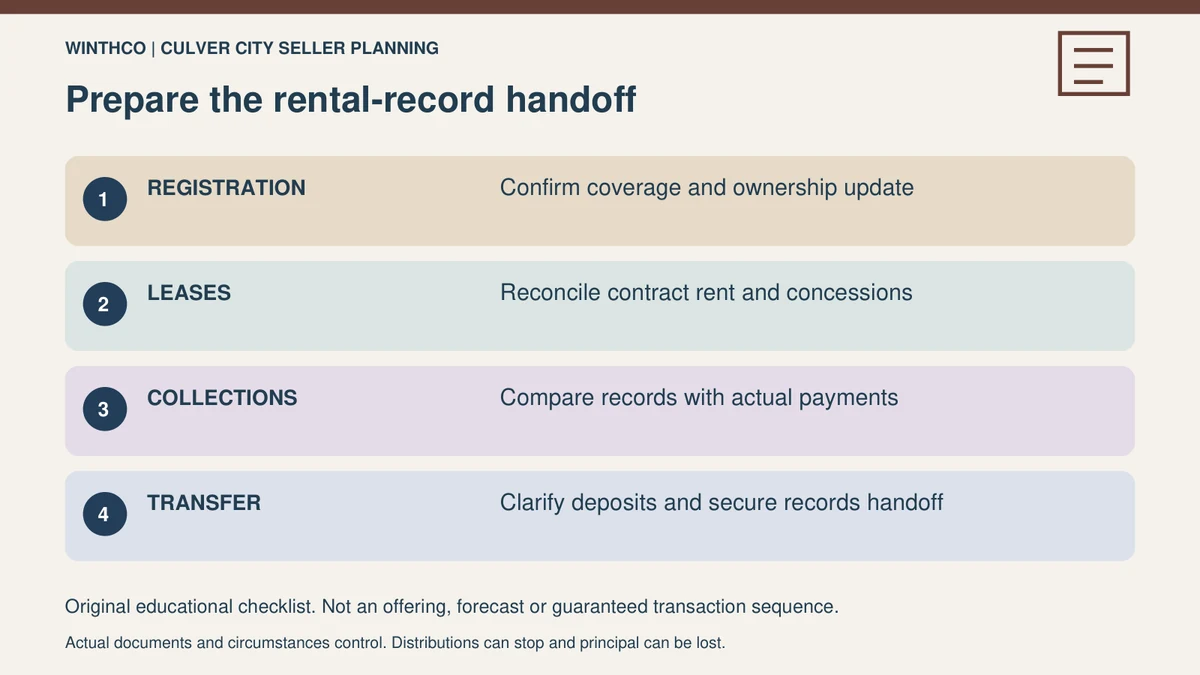
Culver City’s published Rule 2021-RC03 says rental-unit registration certificates are updated on an ownership change, as well as for certain tenancy and housing-service changes. Confirm jurisdiction, unit coverage, the current process and responsibilities with the city and your attorney. Compare the registration with leases, rent notices and collected amounts. Ask counsel and escrow how to document deposits, open maintenance issues and any tenant notices. Use a secure handoff for tenant records rather than putting personal information into public marketing material.
Share your timeline and investment range. A Winthco team member will follow up with you.
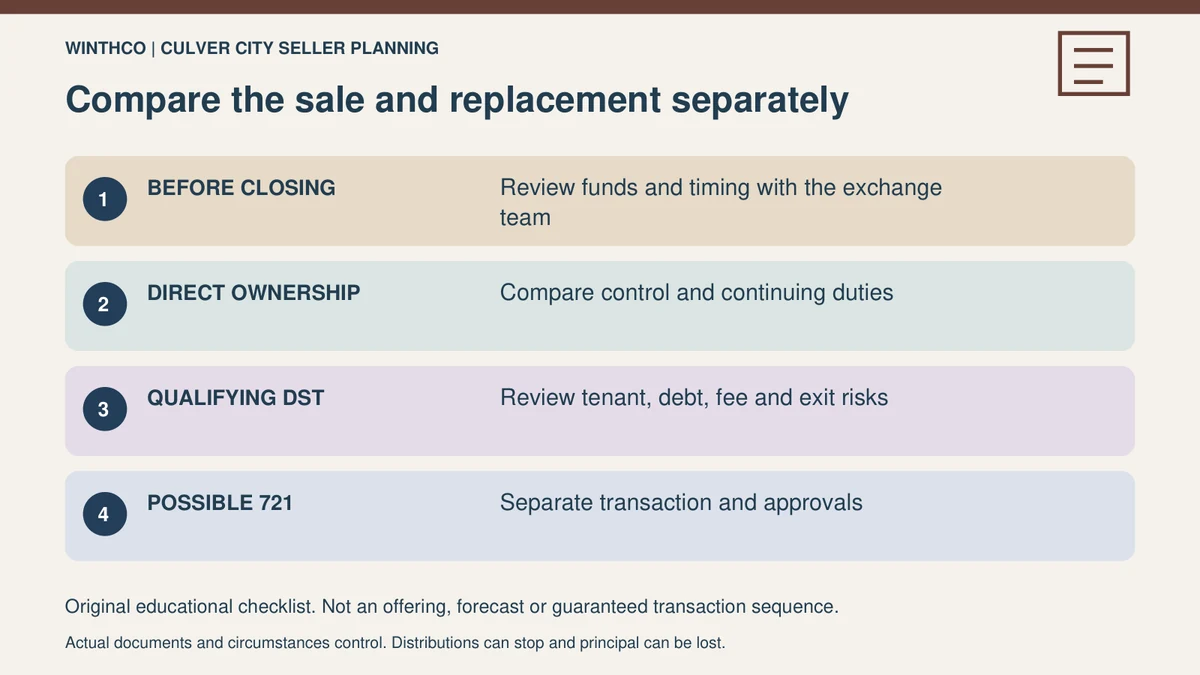
Build a simple unit-by-unit worksheet: contract rent, collected rent, concessions, deposits and unresolved differences. Compare these with the seller’s operating statements and available registration records. An advertised market rent is not proof of what the buyer can collect from a current tenant. Have counsel review applicable restrictions and the accuracy of any rent or vacancy statements in the sale materials. Ask the broker to show how a buyer might value the property using documented collections rather than a rent assumption no one has verified.
Discuss your DST questions with Winthco →
If a deferred exchange is under consideration, involve your CPA, attorney and qualified intermediary before closing or taking control of proceeds. Have them review the taxpayer, the sale agreement, the estimated closing statement and the handling of funds. Section 1031 can defer eligible gain when qualifying real property held for investment or business is exchanged. Generally, identification is due within 45 days and receipt by the earlier of 180 days after transfer or the applicable federal return due date, including extensions. Cash or other non-like-kind consideration can trigger recognized gain. Review Winthco’s 1031 exchange rules overview for background and rely on your advisers for your actual deadlines.
A qualifying interest can provide exposure to replacement real estate without leaving you responsible for daily property operations. Revenue Ruling 2004-86 analyzes a particular trust with limited powers. It does not establish that every DST qualifies. Ask tax counsel to review the actual structure and ask the financial adviser to evaluate suitability separately. You may no longer manage leases yourself, but the property still has tenants, expenses and obligations. Read Winthco’s DST offering memorandum evaluation guide before reviewing the current offering, trust and loan documents.
WATCH & LEARN
Equity Advantage 1031 Exchange discusses the time and effort of direct property ownership. This third-party video provides general context, not Culver City rental guidance or advice about a specific investment. Original resource · Watch on YouTube ↗
Educational context only. The discussion does not establish the suitability, returns or tax treatment of an investment.
Use the same distinction between current performance and forecast assumptions. Ask for existing leases or a meaningful summary, recent collections, lease expirations and occupancy assumptions. If an operator or master tenant is involved, ask who owes which payments and what happens if that party cannot perform. Check the timing of expected repairs, insurance renewals, property taxes and any debt maturity. Compare those obligations with reserves and financing terms. A property in another market can have different rules, but its projections still require evidence.
Suppose an owner of a small occupied rental finds that one lease has a concession not reflected in the sale summary. The owner asks the broker to revise the income worksheet and asks counsel and the city what should be reconciled before transfer. The owner is considering either a directly owned replacement with a hired manager or a qualifying DST. Direct ownership may preserve more decision-making authority, but the owner still bears landlord obligations. The DST may reduce daily work but generally offers less control and a harder exit. Neither option should be selected merely to meet a deadline.
Separate placement and acquisition costs from ongoing management, property and financing expenses. Ask who is paid, whether any recipient is affiliated and how fees affect the amount invested. Model a period when income is lower, an expense arrives early or refinancing is more expensive than projected. Ask what would happen to reserves and distributions. DST interests are generally private placements marketed to accredited investors and can have limited disclosure and transfer restrictions. Distributions can fall or stop, and you can lose principal. A longer holding period and exposure to the same sponsor, lender or tenant across positions can magnify the impact.
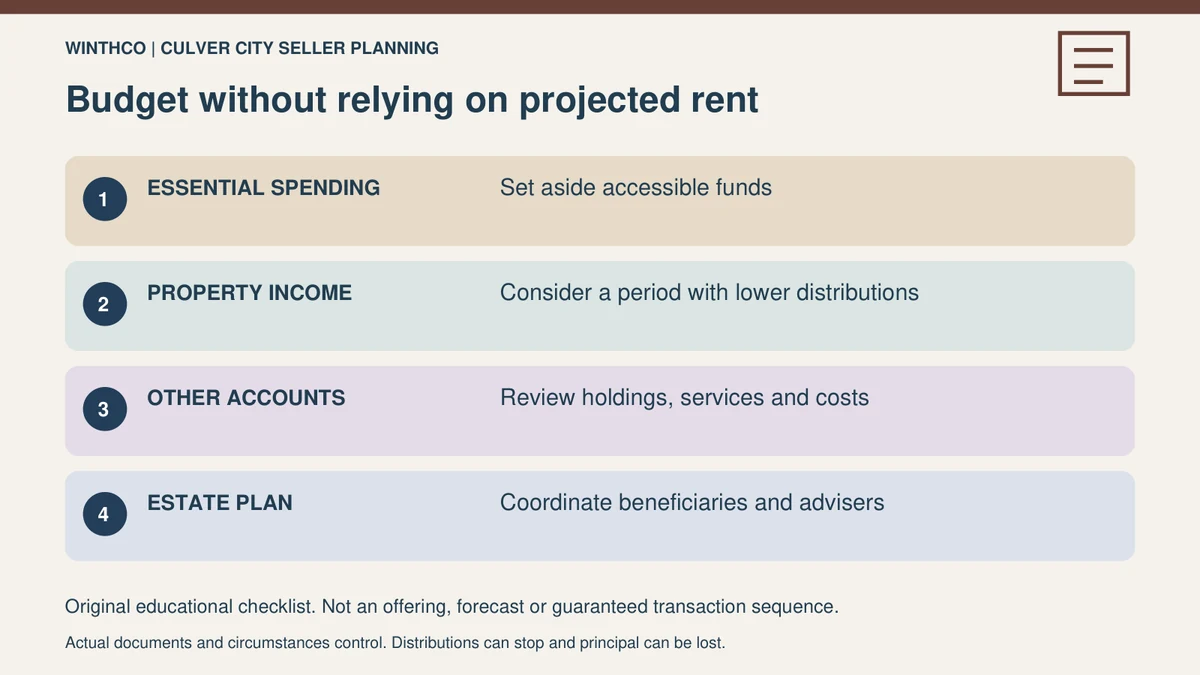
Do not let an uncertain rent figure migrate from a broker’s worksheet into your retirement budget. Label the number as an assumption and ask who can verify it. For the property being sold, that might mean checking payment ledgers and the operative lease; for a DST, it might mean requesting a dated operating summary and an explanation of any adjustments. Then compare a case using documented receipts with a lower-income case. A gap between the two is a reason to ask more questions, not proof that either forecast will occur.
Treat a potential later contribution to an operating partnership as a separate transaction with separate review. Section 721 generally addresses property contributed in exchange for a partnership interest, subject to exceptions and the facts. A DST purchase does not assure such a contribution, an exit or a particular tax outcome. Ordinary REIT shares and operating partnership units are not direct replacement real property for Section 1031. Ask counsel and a prospective 721 adviser who can approve a transaction, what costs and liabilities matter, and what transfer or redemption restrictions would apply. Do not rely on a possible future redemption for near-term spending.
Ask a CPA familiar with real estate to review adjusted basis, debt relief, depreciation-related gain, cash retained and filing requirements. The CPA’s work is distinct from the attorney’s legal review, the intermediary’s exchange coordination and the investment adviser’s assessment. California’s Franchise Tax Board explains that an exchange of California property for out-of-state property with deferred California-source gain or loss generally requires FTB 3840 for the exchange year and subsequent years until recognition. Ask how the actual replacement and ownership structure affect reporting, rather than assuming that buying outside California ends state obligations.
Estimate accessible money needed for taxes, large purchases and essential living expenses before choosing how much to tie up in another property. Compare a taxable sale, direct replacement and a qualifying DST with your advisers. Review taxable holdings, IRAs, 401(k)s, beneficiaries and estate arrangements separately from exchange proceeds. If considering a rollover or transfer, compare costs, services and available choices without assuming a move is appropriate. Use the prospect forms here or the dedicated contact page to discuss your sale, retirement liquidity and broader financial planning with Winthco Wealth Management.
Write down which assumptions are documented and which still need confirmation. For the sale, identify who will resolve a rent discrepancy and manage the record handoff. For the exchange, confirm who will track deadlines and funding. For the DST, ask what would change your decision if the costs, tenant exposure or debt differed from the original presentation. The rental seller planning guide provides a separate checklist for work before listing. Revisit your plan if the property sale changes, rather than transferring the old assumptions to a new closing date.
Geographic context, not a Winthco office or a determination of parcel jurisdiction.
| Decision | Evidence to request | What to avoid assuming |
|---|---|---|
| Rental record handoff | Registration, leases, rent and deposits | An ownership change settles all tenant questions. |
| Deferred exchange | Taxpayer, deadlines and written instructions | Closing first leaves the same choices. |
| DST diligence | Fees, debt, tenants, reserves and control | Delegating work removes investment risk. |
| Retirement liquidity | Accessible funds and expenses | A later 721 event provides cash on demand. |
Culver City’s published guideline calls for a certificate update upon an ownership change. Confirm current procedure and who handles the filing with the city and counsel.
No. Compare leases, notices and collections, and ask counsel about applicable rent and tenant protections.
A qualifying DST interest may be replacement real property when exchange requirements are met. Consult your CPA, attorney and intermediary before closing.
No. It can reduce direct management, but it can add illiquidity and limit control. Loss of principal is possible.
No. It provides Culver City geographic context. The verified office for this campaign is in Simi Valley.
Sources checked November 6, 2026. This article explains general concepts; your facts and the applicable documents control.
Winthco DST services · Winthco evaluation overview · Editorial standards
Property sale planning
Prepare a rental sale with broker questions, 1031 timing, DST and separate 721 review, and retirement planning before committing proceeds.
Read guide →DST investment due diligence
Selling a rental property? Learn how to review a DST private placement memorandum, compare fees and risks, and assess separate 721 UPREIT terms.
Read guide →DST due diligence
Learn how DST lease expirations, renewal assumptions, downtime and re-leasing costs can affect cash flow. Prepare a document-based review.
Read guide →Explore Winthco’s main DST article collection
Share your timeline and investment range. A Winthco team member will follow up with you.