1031 exchange planning
Multiple DSTs in one 1031 exchange
Learn how multiple DSTs affect identification, closings, allocation and concentration risk in a 1031 exchange.
Read guide →
Home / Learning center / DST due diligence
DST due diligence
Winthco Wealth Management · Updated October 15, 2026
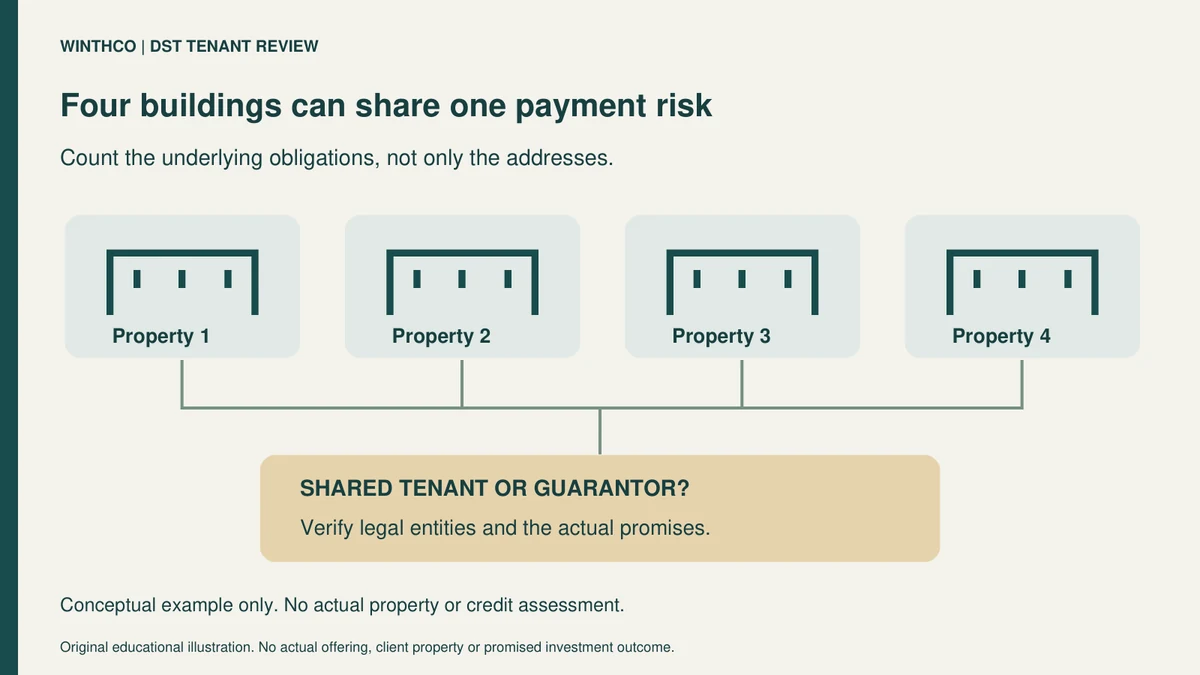
DST tenant concentration risk is the possibility that too much rental income depends on the same tenant, related businesses or shared economic conditions. Before exchanging a property into a DST, examine who owes the rent, what is actually collected and when leases expire. More buildings do not necessarily mean independent income sources.
A property sale can change your workload without changing every investment risk. When interviewing a licensed realtor or commercial broker, discuss valuation, marketing, fees and the lease records needed for the sale. Also write down why you want to sell. Reducing tenant calls, reducing dependence on one employer and freeing accessible cash are different goals, and one replacement may not accomplish all three.
If a deferred exchange is contemplated, coordinate with the CPA, attorney and qualified intermediary before closing or receiving proceeds. Section 1031 can defer eligible gain when its requirements are met; it does not establish investment suitability. Use Winthco's DST property and document review framework to organize questions before the identification period creates pressure. Ask which risks you are leaving behind and which you would acquire.
Share your timeline and investment range. A Winthco team member will follow up with you.
A building count answers a geographic question, not a credit question. Several properties could be leased to subsidiaries of one company. Conversely, one property could contain unrelated businesses with different payment sources. Request the actual legal tenant names, ownership relationships and available guaranty information. A recognizable store sign is not proof that the publicly known parent company has promised to pay the lease.
Build a simple schedule using a consistent measure, such as each tenant's share of annual contractual base rent. Label the date and definition. Do not mix square footage, scheduled rent, collected rent and estimated property value as if they measure the same thing. Then ask for a second view grouped by related entities or shared guarantors. The comparison can reveal dependence that the number of leases conceals.
FINRA explains that apparently different holdings can share industry or geographic exposure. Applying that principle to DST review means looking beyond the trust's name. Ask whether proposed interests overlap with your remaining rentals, existing DSTs, business income or employer. The following questions are a practical review framework, not a regulatory concentration limit or a claim that any particular percentage is acceptable.
Request a dated rent roll and an explanation of its fields. For each material tenant, ask about space occupied, contractual rent, payment status, concessions and expiration dates. Compare the schedule with the operating statements and the offering's assumptions. If a summary says fully leased, clarify whether space is occupied, paying and free of temporary concessions. Those are separate questions.
For residential properties, avoid transferring commercial-lease assumptions without checking the actual arrangement. Winthco's multifamily DST overview can introduce that property category, but a large unit count alone does not establish stable collections. The OCC's commercial real estate lending handbook distinguishes reported occupancy from actual collections. Although written for bank examination, that distinction is useful when asking a sponsor to explain apartment operating results.
If a master tenant sits between the trust and occupants, identify both levels. Ask who owes rent to the trust, how that obligation is funded and what happens when occupants pay less. An affiliated master tenant is not automatically a financially independent backstop. Review the documents and financial information with the investment professional; do not substitute an organizational chart or brand name for the actual obligations.
Discuss your DST questions with Winthco →
Ask for lease expirations by year, with the associated rent exposure. Compare the schedule with debt maturity and the sponsor's contemplated sale period. A weighted-average remaining lease term can hide a large near-term expiration. Request the underlying dates and explain any assumptions about extensions. A tenant option is not the same as an exercised renewal.
Ask counsel which termination, assignment, guaranty and co-tenancy provisions are material. The OCC handbook notes that certain retail co-tenancy clauses can reduce rent or permit termination when an anchor stops operating. That is a reason to read the actual contracts, not to assume every retail property has such a clause. Separate the tenant's obligation from any guarantor's scope, term and financial capacity.
IRS Revenue Ruling 2004-86 addresses a specific trust arrangement with limits on trustee powers, including lease changes subject to stated exceptions. It is not a blanket permission for every DST to operate like an unrestricted landlord. Ask how the particular documents address a tenant failure, what actions are permitted and whether a structural change could affect ownership or tax treatment. Have tax and legal professionals evaluate the response.
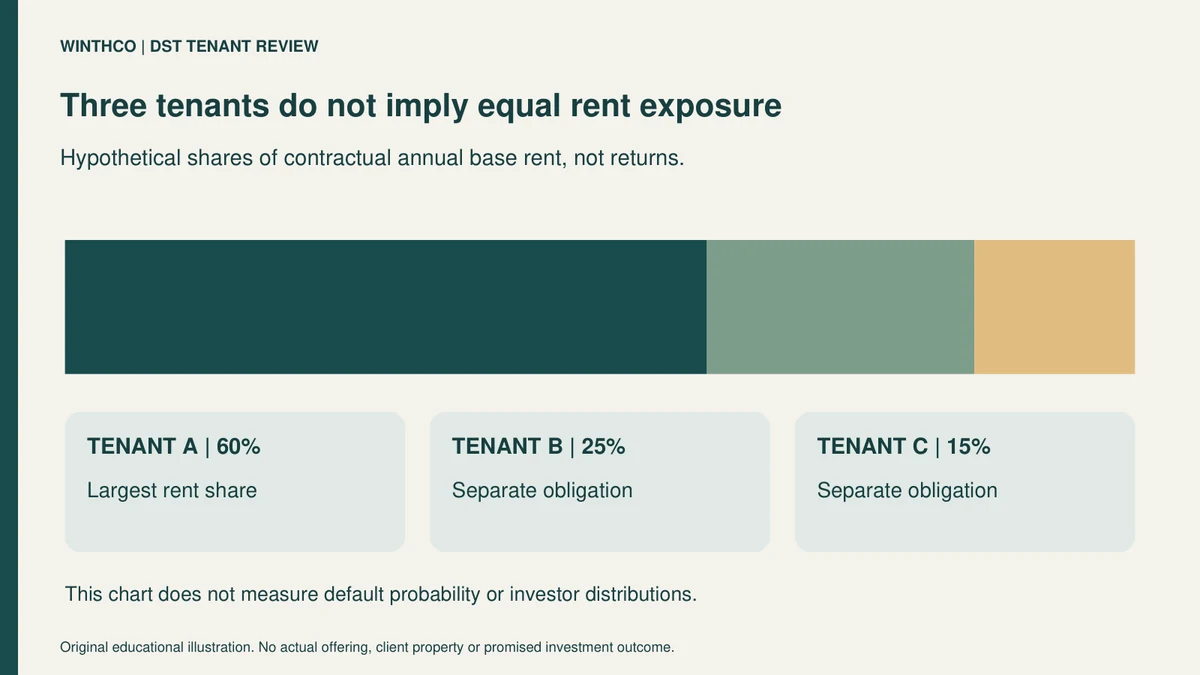
Consider a hypothetical property whose three unrelated tenants account for 60%, 25% and 15% of contractual base rent. The largest tenant represents most of that rent despite being only one of three tenants. These percentages describe an invented concentration example, not an offering, return projection or recommended allocation. They also do not tell you whether the largest tenant will pay.
Ask the sponsor to explain a scenario in which that tenant stops paying. What rent would be interrupted? Which expenses would remain? What would replacement leasing require, and which reserves are available under the documents? Request support for the assumptions rather than choosing a favorable downtime estimate. A rent shortfall does not translate one-for-one into an investor distribution change because other cash flows, costs and obligations intervene.
Compare at least two problems separately: a payment interruption before expiration and a nonrenewal at the scheduled end. Ask how each could affect property operations, debt obligations and exit choices. Then ask your advisor what evidence would cause the investment to be rejected or resized. There is no universal tenant-share threshold that makes every DST appropriate for every household.
WATCH & LEARN
Accruit introduces DSTs as replacement property in a 1031 exchange. This is general structural background, not a tenant-credit assessment or a promise of diversification, distributions or tax treatment. Accruit is the third-party creator, not a Winthco representative. Original resource · Watch on YouTube ↗
Educational context only. The discussion does not establish the suitability, returns or tax treatment of an investment.
Several DSTs may hold different buildings while sharing a tenant, sponsor, property type or local economy. Request a combined exposure schedule before treating separate subscription documents as diversification. Also consider the administrative burden and total fees of multiple interests. The goal is a comprehensible portfolio, not the largest possible number of positions. Diversification cannot ensure a profit or prevent loss.
A contemplated Section 721 contribution to an UPREIT operating partnership requires a separate evaluation. It is not an automatic extension of a qualifying 1031 exchange, and OP units or ordinary REIT shares generally are not direct 1031 replacement real property. IRS Publication 541 explains the partnership-contribution framework and exceptions. The CPA and attorney must assess the proposed transaction, including liabilities and related transfers.
A broader operating-partnership portfolio may change exposure, but review its actual tenants, leverage, fees and redemption terms. Do not rely on an uncertain future contribution to cure a concentration problem in the current DST. Ask whether the investment remains appropriate if the contribution never occurs. Later redemption or conversion may have tax consequences; FIFO treatment does not guarantee tax-free withdrawals of basis.
Tenant review is only one part of due diligence. Private DST offerings are generally limited to accredited investors and made through a private placement memorandum. The SEC warns that private placements can involve limited disclosures, restricted resale and loss of the entire investment. Review sponsor conflicts, fees, property condition, debt, limited control, tax changes and exit provisions as well as the leases.
Distributions can change or stop, and principal can be lost. Winthco's DST holding-period questions provide background for the liquidity discussion, but a contemplated property sale date is not a right to redeem your interest. Ask how accessible funds outside the investment would cover spending if payments fall or the holding period becomes longer than expected.
Exchange timing must remain a separate workstream. IRS Form 8824 instructions generally require identification within 45 days after transfer and receipt by the earlier of 180 days or the applicable return due date, including extensions. Tax deferral does not justify ignoring unresolved investment questions. Discuss alternatives, possible taxable cash retained and the consequences of an incomplete exchange with the qualified intermediary and tax professional.
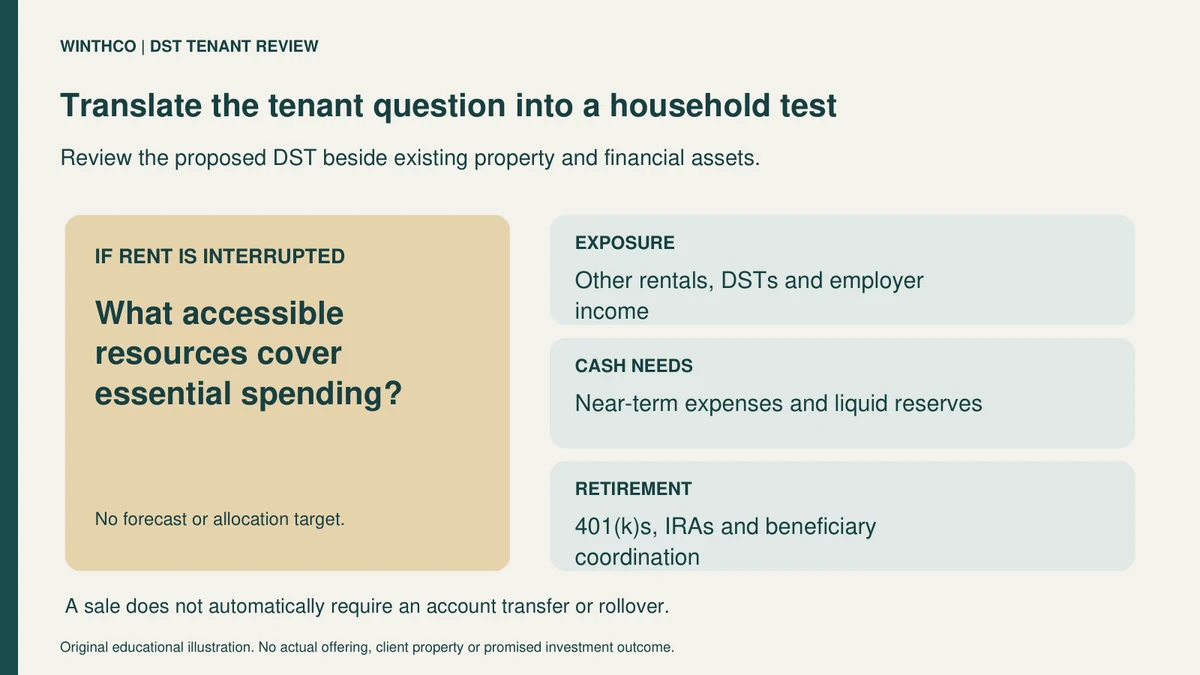
Before committing, put the proposed real estate exposure beside your existing financial assets, 401(k)s, IRAs, cash reserves and retirement-income needs. Ask Winthco's financial-advising and wealth-management team to help distinguish essential spending from expenses that can wait. A hypothetical distribution reduction should be tested against the household plan rather than compared only with the rental property's last year of income.
Include beneficiary and estate coordination with counsel and tax estimates with the CPA. Retirement accounts are not Section 1031 proceeds, and a property sale does not automatically justify a rollover or transfer. Compare relevant account options, costs and services independently. Use the prospect contact form to arrange a discussion of your sale timeline and review questions; request a verified secure channel before sharing statements or confidential documents.
| Decision | Evidence to request | What to avoid assuming |
|---|---|---|
| Tenant dependence | Legal tenants, related entities, guaranty scope and rent shares | Several addresses mean independent payment sources |
| Current operations | Dated rent roll, collections, concessions and operating statements | Fully leased means every scheduled dollar is collected |
| Lease rollover | Expiration schedule, exercised options and material clauses | An average term eliminates near-term exposure |
| Portfolio fit | Combined tenant/market exposure and accessible reserves | More DST interests automatically diversify the household |
Tenant count alone cannot determine suitability. Review the actual payment obligation, property, lease, debt and household exposure. A strong tenant name does not remove liquidity or loss risk.
No. Lease terms and the ability to pay are different considerations. Property costs, debt and the investment documents also affect cash available for distributions.
Leased status describes contractual occupancy under a stated definition. Collected rent reflects payments received; concessions and delinquency can create a difference. Ask for dates and consistent definitions.
There is no universal percentage suitable for every investor and structure. Use a defined measure and review the financial consequences with your investment professional.
Review the actual trust and lease documents with legal and tax professionals. The specified arrangement in Revenue Ruling 2004-86 limits trustee powers and contains particular exceptions; do not assume unlimited operational flexibility.
Not necessarily, and the transaction may never occur. Evaluate both the current DST and any proposed partnership portfolio, including fees, liquidity and later tax consequences.
Sources checked October 15, 2026. This article explains general concepts; your facts and the applicable documents control.
Winthco DST services · Winthco evaluation overview · Editorial standards
1031 exchange planning
Learn how multiple DSTs affect identification, closings, allocation and concentration risk in a 1031 exchange.
Read guide →DST investment due diligence
Selling a rental property? Learn how to review a DST private placement memorandum, compare fees and risks, and assess separate 721 UPREIT terms.
Read guide →DST investment due diligence
Review who owes rent in a DST master lease, what supports payment, and how lease risks fit a property sale, 1031 exchange and retirement plan.
Read guide →Explore Winthco’s main DST article collection
Share your timeline and investment range. A Winthco team member will follow up with you.