1031 replacement property
Debt-free vs leveraged DST for a 1031 exchange
Compare debt-free and leveraged DST structures, exchange debt analysis, loan risks, liquidity and due diligence before a 1031 exchange.
Read guide →
Home / Learning center / DST due diligence
DST due diligence
Winthco Wealth Management · Updated October 22, 2026
A DST debt service coverage ratio, or DSCR, compares a property's net operating income with its annual debt-service requirement. It can help evaluate payment capacity, but only after you verify the income, expense and loan assumptions behind the calculation. A projected ratio is not a promise of distributions, liquidity or principal protection.
Start with the property being sold, not an offering metric. Ask an appropriately licensed residential or commercial real estate professional to support the expected value, marketing period, buyer profile, likely transaction costs and sale conditions. Assemble leases, operating statements, debt terms, insurance, taxes, repairs and capital-work records. Those facts help the CPA estimate the tax alternatives and help the household compare keeping, managing, partially selling or fully selling the property.
If a deferred exchange may be used, involve the CPA, attorney and qualified intermediary before closing or receiving proceeds. For a typical deferred exchange, replacement property generally must be identified within 45 days after the relinquished property is transferred. Completion is due by the earlier of 180 days or the applicable tax-return due date, including extensions. Put the dates and responsibilities in writing. A looming deadline should not substitute for reading the offered DST's loan documents and private placement memorandum. The combined DST downside review examines operating pressures, financing constraints and delayed exits together, beyond a single coverage ratio. Review cash-trap provisions to understand how defined financing tests may affect access to property cash.
Share your timeline and investment range. A Winthco team member will follow up with you.
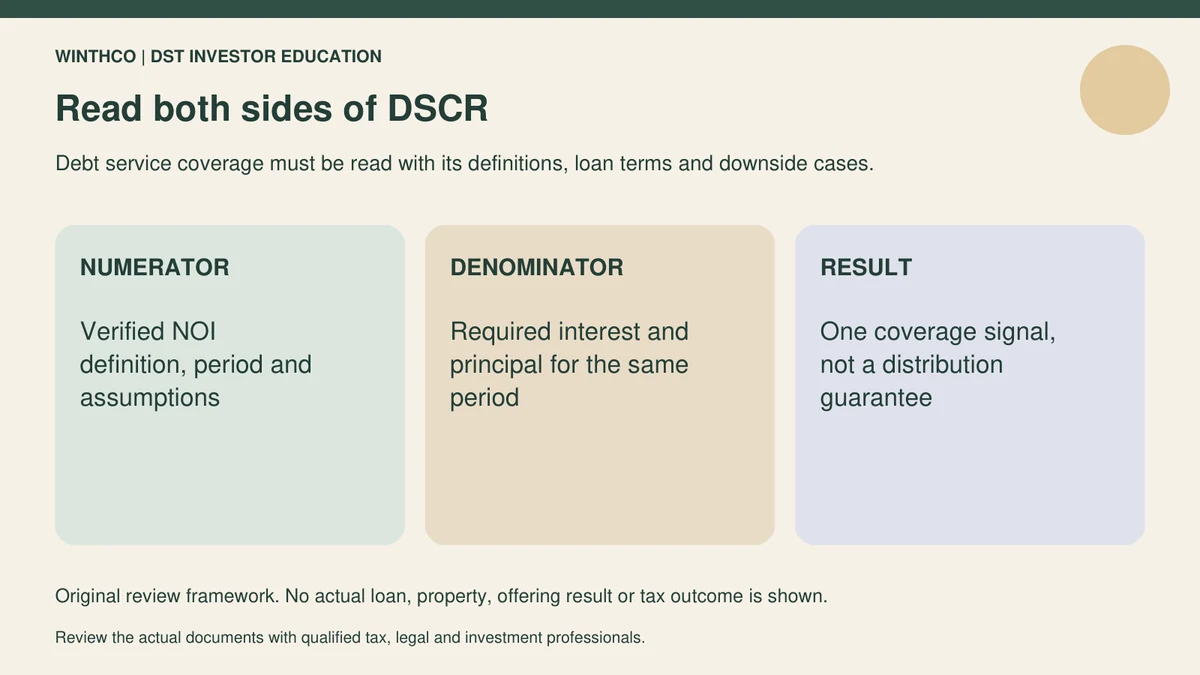
The Office of the Comptroller of the Currency defines DSCR as net operating income divided by annual debt-service requirements. Net operating income generally reflects property revenue after the expenses included in the applicable calculation but before mortgage payments. Debt service usually includes required interest and principal for the measurement period. A result above 1.0 means the stated numerator exceeds the stated debt service, but that observation alone does not establish an adequate cushion or a suitable investment.
The OCC guidance is written for bank supervision, not for deciding whether a DST is appropriate for a particular investor. It explains why an appropriate DSCR depends on features such as amortization and cash-flow volatility. Do not import a universal minimum from another property, lender or marketing page. Ask which calculation the lender uses, which calculation the sponsor presents and whether the offering shows a different stabilized or projected measure.
The 1031 exchange with mortgage overview can help organize questions about relinquished-property debt and replacement-property value. Exchange debt analysis and property loan performance are different reviews. Satisfying a tax-planning objective does not prove that the new property's cash flow can carry its financing through changing conditions.
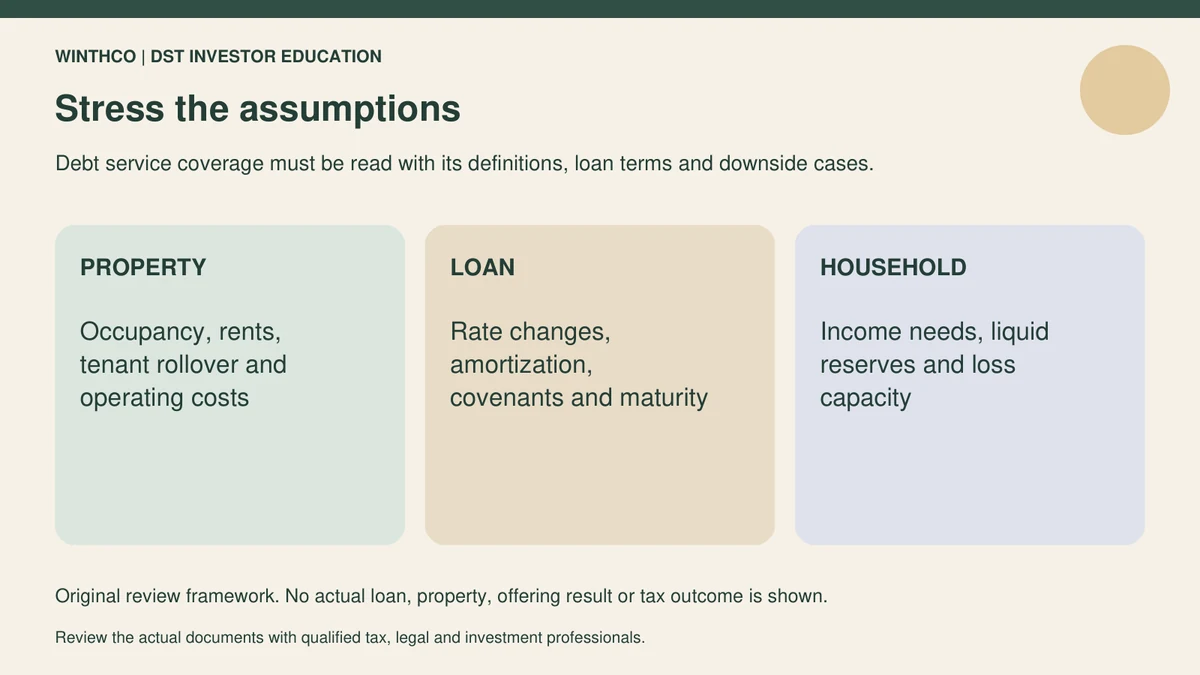
Request a bridge from gross potential rent to effective revenue and then to the exact net operating income used in the ratio. Check vacancy, concessions, credit loss, tenant reimbursements, management fees, property taxes, insurance, utilities, repairs and replacement reserves. Ask whether the figure is historical, trailing, annualized, budgeted or stabilized. Cash-basis statements can omit incurred expenses, and a projection can assume occupancy or rents that have not been achieved.
On the denominator side, identify the loan balance, interest rate, amortization, payment frequency, interest-only period, maturity and any variable-rate protection. Compare current payments with payments after an interest-only period ends or a rate cap expires. A calculation based on current debt service can look stronger than an as-if-amortizing or stressed calculation. The OCC also notes that covenant definitions can differ from underwriting and risk-rating calculations. Label every ratio by period, source and definition.
Use the leveraged DST explanation as background for asking how property debt is allocated and described. Then return to the actual promissory note, loan agreement, offering memorandum and sponsor model. A webpage cannot establish the rights of a particular lender, borrower, trust or investor.
Discuss your DST questions with Winthco →
Replace one optimistic assumption at a time and recalculate. Test lower occupancy, a major lease expiration, slower rent growth, higher insurance, taxes or repairs, and debt service after any interest-only or fixed-rate period. Examine combinations as well, because a tenant departure can reduce income while leasing costs and capital needs rise. The objective is not to predict one future ratio. It is to locate the assumptions that leave the least room for error.
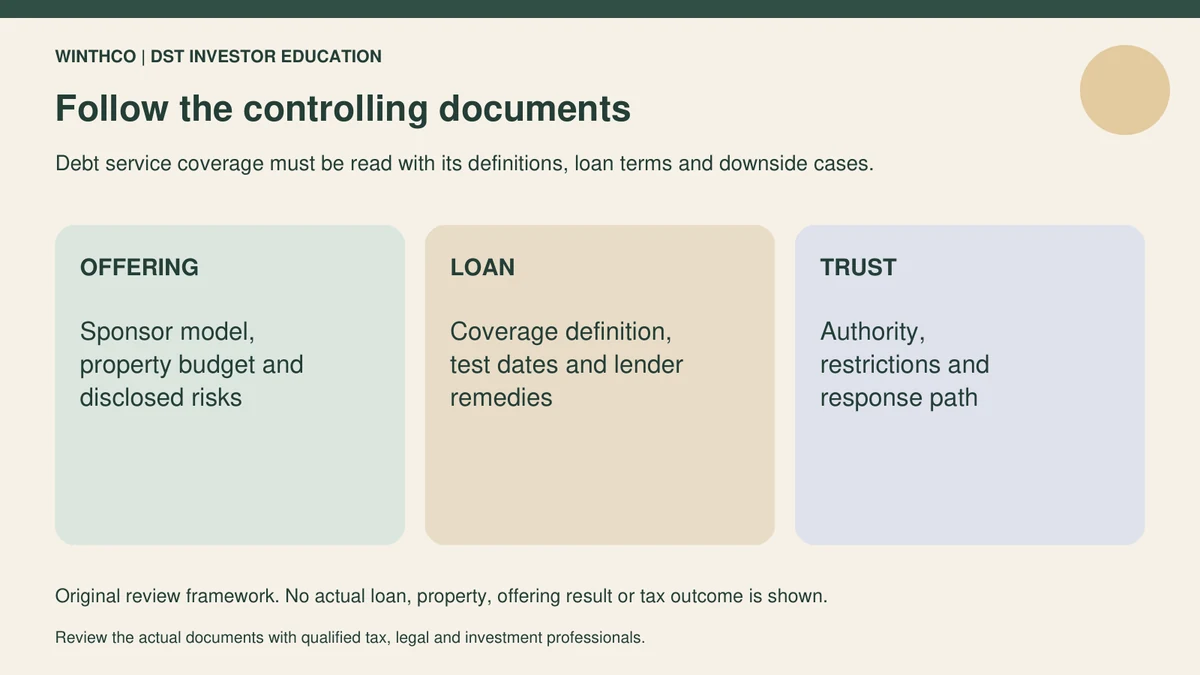
Ask what the loan documents require if a covenant is missed. Possible provisions can include cash sweeps, blocked distributions, additional reserves, lender consent rights, default remedies or acceleration. Do not infer those rights from a generic DSCR definition. Have counsel explain the actual provisions and whether the sponsor, master tenant, guarantor or another party has obligations that may affect the response.
Also compare DSCR with loan-to-value, debt yield, maturity and the remaining principal balance. A property may make scheduled payments today yet face a difficult sale or refinance later. Conversely, an apparently conservative ratio does not remove tenant, valuation, environmental, casualty or sponsor risk. Metrics answer different questions and can share the same optimistic inputs.
Debt service is paid at the property or borrower level before cash can move through the structure according to the governing documents. Investor distributions can also be affected by reserves, fees, capital work, leasing costs, master-lease terms and other obligations. A ratio that exceeds 1.0 does not promise that a stated distribution will be paid, maintained or increased. Review the sources of any projected payment and whether it depends on reserves or financing rather than current property operations.
Compare actual and projected operating results on the same basis. Ask for tenant-level explanations of material variances, reserve balances, covenant status and changes in loan terms. The DST failure and downside review is useful only as a prompt for evidence: identify what would happen in the offered property, who has authority to act and how losses or delays could reach investors. Avoid relying on a sponsor's history or size as a substitute for property-specific diligence.
WATCH & LEARN
Equity Advantage discusses DSTs as one possible response to the time and energy demands of direct property ownership. This third-party video is general education, not a DSCR analysis, tax opinion or endorsement of any offering. Original resource · Watch on YouTube ↗
Educational context only. The discussion does not establish the suitability, returns or tax treatment of an investment.
IRS Revenue Ruling 2004-86 addressed a specified trust arrangement and concluded, under its facts, that beneficial interests were interests in real property for federal tax purposes. The ruling discussed limited trustee powers, including restrictions involving debt, leases, new investments and significant property modifications. It does not approve every entity called a DST or guarantee that an offered interest will qualify for a particular exchange.
Ask how the actual trust agreement, loan documents, master lease and management contracts interact if income falls or a covenant is threatened. Do not assume that a DST can freely refinance, accept new investor capital or renegotiate every lease. Also do not assume that no response exists. Counsel should trace the permitted steps, contingencies and consequences under the documents. The answer may affect cash, sale timing and the risk of loss.
A debt-free DST removes scheduled property-level mortgage payments and foreclosure risk tied to that loan, but it does not remove property, tenant, sponsor, fee, valuation, control, liquidity or tax risks. A leveraged DST may support a particular exchange structure yet magnify losses to equity when property performance weakens. Compare the complete economics rather than treating leverage as automatically good or bad.
Section 721 generally concerns property contributed to a partnership for partnership interests, subject to exceptions and transaction-specific facts. An UPREIT commonly holds real estate through an operating partnership associated with a REIT. This is a separate framework from Section 1031. Ordinary REIT shares and operating-partnership units generally are not direct 1031 replacement real property.
Some materials describe a possible later contribution of DST property to an operating partnership. Do not use that possibility to dismiss current debt or DSCR risk. Ask who controls the event, which conditions remain, how debt and value would be measured, what unit rights would apply and what happens if the contribution never occurs. Debt allocations, distributions and later redemptions can have tax consequences. A holding period or FIFO description does not guarantee conversion, cash or tax-free basis withdrawals. The CPA and attorney should review any real proposal separately.
DST interests are commonly private-placement securities with limited liquidity and disclosure compared with public investments. Investors face property, tenant, sponsor, debt, conflict, fee, concentration and tax-law risks. Distributions can change or stop, sale timing and price are uncertain, and principal can be lost. Accreditation or exchange eligibility does not establish suitability.
List the household's expected income needs, emergency reserves, taxes, health costs and major purchases. Then compare those dates with an investment that may not offer a ready secondary market or personal withdrawal right. Include financial assets, cash, 401(k)s and IRAs in the concentration and liquidity review, but do not assume a property sale should trigger a retirement-account rollover, securities transfer or advisory relationship. Compare choices, costs and services separately.
Finally, coordinate beneficiary and estate planning. Ask how an illiquid beneficial interest would be valued, administered and transferred, and whether beneficiaries would have cash for expenses without a forced sale. Keep accessible resources outside the offering when appropriate to the plan. Use the prospect form to share the sale stage and planning question, then request a secure channel before sending confidential records.
| Decision | Evidence to request | What to avoid assuming |
|---|---|---|
| Historical DSCR | Recorded income, expenses and debt service | Past performance fixes future results |
| Projected DSCR | Lease, occupancy, expense and rate assumptions | A forecast is a promise |
| Covenant DSCR | Loan-defined numerator, denominator and test date | Every document uses the same formula |
| Household review | Liquidity, income needs and loss capacity | Property coverage equals personal cash availability |
The OCC describes DSCR as net operating income divided by annual debt-service requirements. Confirm how each term is defined in the actual loan and offering documents.
No. Property type, cash-flow volatility, amortization, lender requirements and calculation definitions vary. A ratio alone cannot establish suitability or safety.
No. It only indicates that the stated numerator exceeds the stated debt service. Reserves, fees, capital needs, covenants and other obligations can affect distributions.
It can reduce current required debt service, but principal may not decline and later payments or maturity risk may be greater. Compare current and as-if-amortizing calculations.
Do not assume so. Review the loan and trust documents and have counsel explain the trustee's permitted authority and the lender's rights.
No. It removes property-level mortgage debt risk but not tenant, sponsor, fee, valuation, control, liquidity, tax or loss-of-principal risk.
Do not rely on that outcome. A later contribution is separate, conditional and document-specific, and it can have debt, liquidity and tax consequences.
Sources checked October 22, 2026. This article explains general concepts; your facts and the applicable documents control.
Winthco DST services · Winthco evaluation overview · Editorial standards
1031 replacement property
Compare debt-free and leveraged DST structures, exchange debt analysis, loan risks, liquidity and due diligence before a 1031 exchange.
Read guide →Alternatives and comparisons
Compare DST distributions with rental cash flow, fees, tax reporting and retirement spending before selling an investment property.
Read guide →DST due diligence
Review DST loan maturity, balloon payments and exit assumptions before exchanging a rental. Prepare questions about debt and household liquidity.
Read guide →Explore Winthco’s main DST article collection
Share your timeline and investment range. A Winthco team member will follow up with you.