DST due diligence
DST Reserves and Capital Repairs: What to Review
Before exchanging a rental into a DST, review repair budgets, restricted reserves and funding limits. Know which questions to ask before committing.
Read guide →
Home / Learning center / Due Diligence
Due Diligence
Winthco Wealth Management · Updated November 19, 2026
A DST cash trap is a financing provision that can restrict the release of property cash when specified conditions occur. Tenants may still pay rent while investor distributions decline or stop. Before investing, review the actual loan documents, trigger calculations, permitted uses of restricted cash and conditions for releasing it.
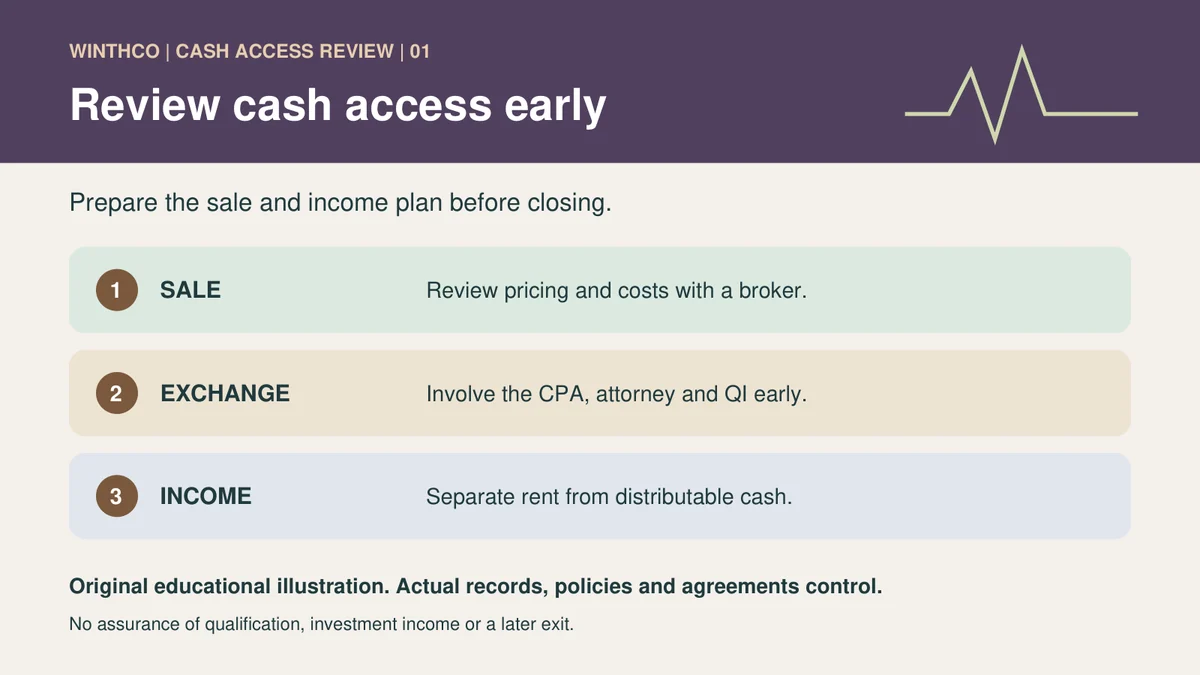
A landlord considering a DST often wants fewer maintenance calls and less involvement in daily operations. That goal should be considered alongside the owner's need for accessible income. Interview the selling broker about pricing, compensation and closing coordination, but ask a securities professional separately how the proposed replacement handles property cash. The sale team's estimate of net proceeds does not answer whether a DST can distribute rent after closing.
Start the investment discussion before the sale creates deadline pressure. Winthco's questions for evaluating a DST can help frame the review. Request the offering memorandum and financing disclosures early enough to discuss unfamiliar terms with counsel. A projected payment schedule is not a substitute for knowing what could interrupt it. Ask for an explanation that connects each important restriction to the relevant document rather than relying on a verbal description of typical financing.
Share your timeline and investment range. A Winthco team member will follow up with you.
Rent enters a property-level financial system that also pays operating expenses, debt obligations and other required amounts. Investors need to distinguish the building's economic performance from cash that can actually be released. A property may report positive operating income while a loan provision restricts the transfer of remaining cash. This is a reason to read the financing documents alongside the distribution illustration, not merely compare advertised percentages.
A historical SEC-filed debt disclosure linked below illustrates this distinction: specified coverage conditions redirected excess cash to a reserve account instead of releasing it to the borrower. That filing is an example of a contractual mechanism, not a current DST offering, a universal threshold or a recommendation. Each DST's own documents control. Do not import another borrower's calculation, testing period or release standard into an unrelated investment.
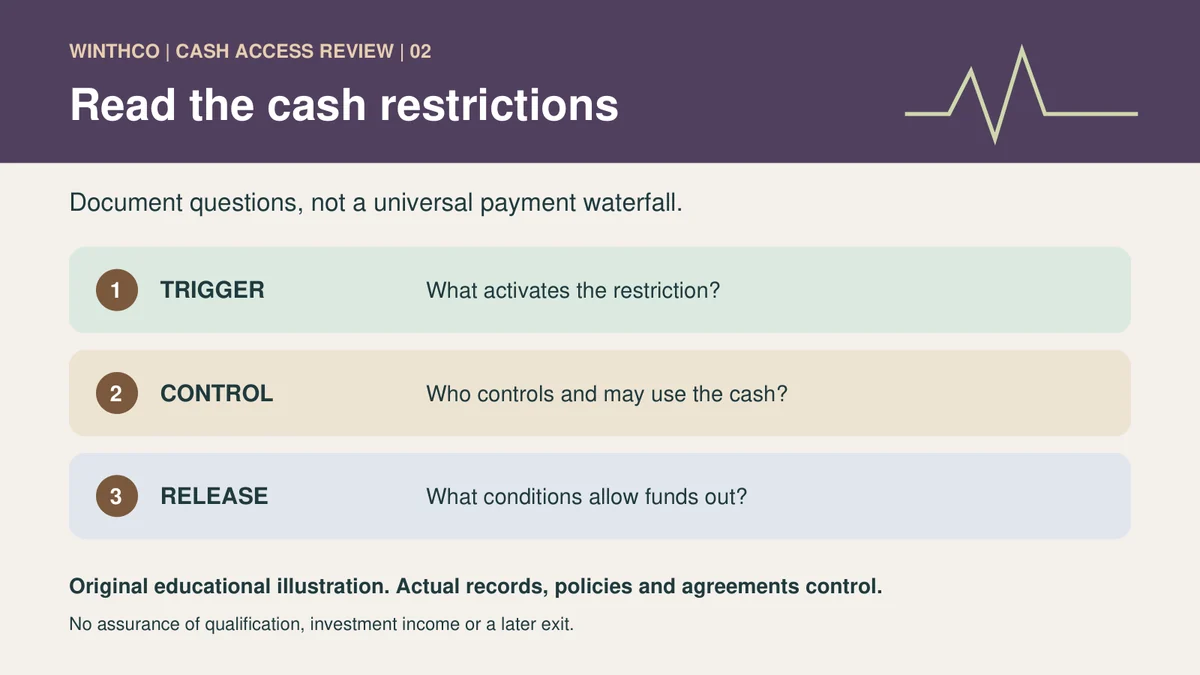
Begin with the definitions. Does the agreement refer to a cash management period, cash trap, lockbox, cash sweep or distribution restriction? Ask counsel to explain what each term means in that agreement. Similar labels do not establish identical rights. Identify the party that controls the account, the amounts that must be deposited, and the payments that may still be made while a restriction is active.
Next, request the complete trigger calculation rather than a single ratio from a presentation. If a coverage test is involved, ask what income and expenses enter the calculation, whether it uses historical or projected results, and how often it is tested. Our debt-service coverage explanation provides background on the ratio, but a generic calculation cannot replace the lender's defined test. A different expense treatment or measurement period can change the result.
Finally, ask whether additional conditions apply. Request a written explanation of any tenant, reporting, reserve or other provision that can restrict payments. These are document-review questions, not a claim that every loan contains every type of trigger. Record who will monitor compliance and what information investors will receive. If the relevant provision cannot be explained clearly, treat that uncertainty as an unresolved diligence issue.
Discuss your DST questions with Winthco →
Not necessarily. A restriction on releasing cash and an event of default can be different contractual conditions with different consequences. Ask for both definitions and a description of their relationship. Do not infer that scheduled debt payments have stopped merely because investor distributions stop. Equally, continued payment of interest does not prove that all covenants are satisfied or that the investment is financially healthy.
Distinguish money held in a restricted account from money applied to reduce debt. The economic effects and future availability can differ. Ask whether the documents permit retained funds to be used for property expenses, reserve requirements, principal repayment or another purpose. The answer should come from the governing agreements. Avoid treating an account balance reported as restricted cash as money that investors can demand immediately.
Read our distribution and cash-flow comparison when comparing the proposed DST with the rental property you are selling. A direct owner may be accustomed to transferring money from a property account after paying bills. A passive investor should not assume that the same discretion survives the change in ownership structure. Reduced operational responsibility also means giving up important decisions.
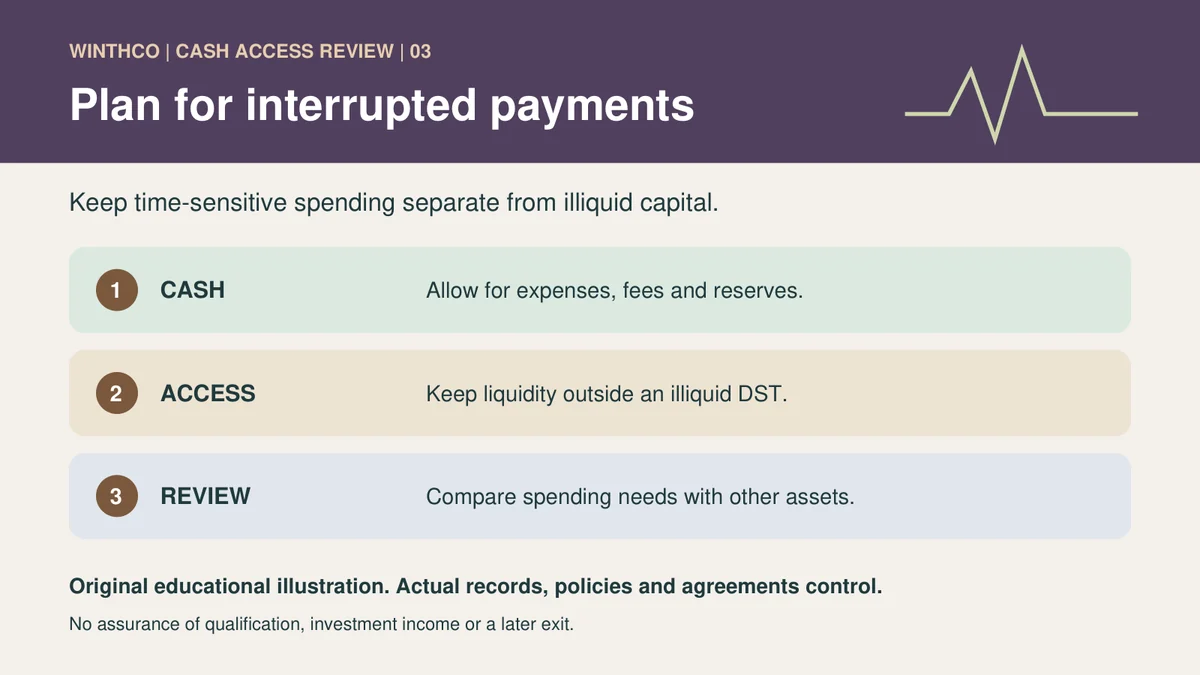
Hypothetical: an owner sells a rental and considers an investment whose illustrated distributions would help fund household spending. During diligence, the owner learns that a contractual test could limit payments even while the property collects rent. The owner asks the adviser to model a period with no distributions and identifies which expenses would instead be funded from accessible assets. This is an invented planning example, not a prediction or client experience.
The useful result is not a guessed date when distributions will resume. It is a clearer view of the household's dependence on that cash flow. Separate essential expenses from flexible spending, and identify other reliable resources and obligations. An emergency fund intended for personal needs should not be counted twice as both household liquidity and money available to address investment problems.
Compare proposed investments on the same basis. Ask each provider for the relevant restrictions, reporting arrangements and release requirements. A distribution illustration with a higher percentage may still be less appropriate for a household that cannot absorb interruptions. The review should include the overall investment, not simply choose the loan with the fewest apparent restrictions.
WATCH & LEARN
Accruit explains DST replacement-property ownership. Third-party background, not advice about a particular loan, distribution assurance or a Winthco affiliation. Original resource · Watch on YouTube ↗
Educational context only. The discussion does not establish the suitability, returns or tax treatment of an investment.
Ask for the actual release conditions and who determines whether they have been met. Would improved performance alone suffice, or are repeated tests, delivery of information, lender confirmation or other steps required? Do not assume a better month automatically restores distributions. Request an explanation of how any retained balance would be treated after a restriction ends and whether release remains subject to other obligations.
Also ask how the sponsor will communicate an active restriction. Which investor report would show the trigger, account balance, permitted expenditures and remaining conditions? How would an investor distinguish a contractual restriction from a discretionary decision to increase reserves? Our DST reserve planning guide covers a related issue, but ordinary reserves and lender-controlled funds should not be treated as interchangeable without supporting documentation.
IRS Revenue Ruling 2004-86 analyzes a specific trust arrangement with limited trustee powers, including restrictions on additional contributions and renegotiating debt. It does not approve every DST or supply a universal cure for financing problems. Ask counsel how the particular trust structure affects available responses. Do not assume the trustee can simply refinance, collect more investor capital or revise the business plan like an unrestricted operating partnership.
Understanding a restriction does not remove property, tenant, sponsor, leverage or concentration risk. Distributions can change or stop, property values can fall and principal can be lost. Read acquisition, financing, management and disposition fees alongside the loan terms. Ask how related-party compensation and other conflicts affect recommendations or decisions about cash. Winthco's DST ownership overview is a starting point, not approval of a particular offering.
DST private placements generally are available only to accredited investors and are offered through a private placement memorandum. The SEC cautions that private placements can involve illiquidity, limited disclosure and total loss. FINRA's guidance addresses reasonable investigation by recommending broker-dealers. Ask what investigation supports the recommendation and what information remains unavailable. Investor eligibility is not evidence that the investment meets your spending needs.
Do not rely on selling the interest quickly to bridge an interruption. Review transfer restrictions and the uncertain holding period. A possible later Section 721 UPREIT contribution is a separate potential transaction, not an automatic escape from current financing terms. Ordinary REIT shares and partnership units are not direct Section 1031 replacement real estate. Evaluate the initial investment without assuming a future contribution, redemption or tax-free withdrawal will occur.
Involve your CPA, attorney and qualified intermediary before closing or receiving sale proceeds. Section 1031 may defer eligible gain on qualifying investment or business real property, but deferral is not tax elimination. The ordinary identification period is 45 days after transfer; receipt must occur by the earlier of 180 days or the federal return due date, including extensions. Cash or other non-like-kind consideration can cause recognized gain.
Keep those deadlines separate from the investment decision. A tight identification period does not make unclear loan terms acceptable. Ask the team what alternatives and tax consequences would apply if you decline an investment. Review accessible savings, taxable investments, 401(k)s, IRAs and retirement spending with a financial advisor; retirement-account balances are not exchange proceeds. Compare costs and services before considering any rollover or transfer.
Use either prospect form on this page or the dedicated contact page to discuss general sale timing and income priorities with Winthco. Avoid account numbers and sensitive tax documents in an initial inquiry. Bring the cash-restriction questions to the investment review, and let qualified tax and legal professionals address your circumstances. The goal is an informed decision about both the property investment and the household plan, not simply completion of an exchange.
| Decision | Evidence to request | What to avoid assuming |
|---|---|---|
| Operating income | Property performance reports | All income is available to investors |
| Cash restriction | Loan and cash-management provisions | Every restriction is a payment default |
| Release conditions | Defined tests and approval requirements | One improved month restores payments |
| Household liquidity | Spending and accessible-asset review | A future exit will cover current bills |
Yes, property expenses and contractual restrictions can limit available cash. Review the particular offering and financing documents.
No. The agreement may define separate conditions and consequences. Ask counsel to explain both.
No. Definitions and calculations are agreement-specific. Another property's ratio is not a substitute for the actual terms.
Do not treat restricted balances as accessible household funds. Release depends on the documents and circumstances.
Do not assume that outcome. A later contribution is a separate possible transaction, not an assured remedy.
Sources checked November 19, 2026. This article explains general concepts; your facts and the applicable documents control.
Winthco DST services · Winthco evaluation overview · Editorial standards
DST due diligence
Before exchanging a rental into a DST, review repair budgets, restricted reserves and funding limits. Know which questions to ask before committing.
Read guide →DST due diligence
Review DST loan maturity, balloon payments and exit assumptions before exchanging a rental. Prepare questions about debt and household liquidity.
Read guide →DST due diligence
Learn how to read a DST property's debt service coverage ratio, test its assumptions and connect leverage risk with 1031 and retirement planning.
Read guide →Explore Winthco’s main DST article collection
Share your timeline and investment range. A Winthco team member will follow up with you.